Oilfield fleet operations occur in environments where cellular connectivity is not merely unreliable but systematically absent — drilling sites located 60-100 kilometers beyond the nearest cell tower, completion operations in remote basin locations where terrain blocks signal propagation, pipeline patrol routes traversing hundreds of kilometers through areas with zero telecommunications infrastructure, and wellsite service calls requiring vehicle positioning at locations deliberately isolated from populated corridors. Fleet management platforms dependent on continuous internet connectivity fail operationally in these environments — drivers cannot complete FMCSA-required DVIR inspections without cellular signal, maintenance issues discovered at remote locations cannot be documented until vehicles return to coverage zones hours or days later, incident reports requiring immediate capture sit unrecorded during the critical window when details are fresh, and GPS tracking stops functioning exactly where operational visibility matters most for safety monitoring and dispatch coordination. FleetRabbit's offline-first architecture was purpose-built to eliminate these operational gaps through a sync-on-return model that enables full platform functionality without any connectivity requirement — drivers complete DVIR inspections with photo attachments and digital signatures while standing at wellsites beyond cellular range, maintenance technicians log service activities and parts consumption during field repairs at remote equipment locations, safety managers document incidents with timestamped photos and GPS coordinates captured at the moment events occur regardless of signal availability, and all data stores locally on mobile devices with automatic synchronization to the cloud database the instant connectivity is restored when vehicles return to coverage zones. This technical architecture examination details how FleetRabbit's offline mode operates across five critical operational workflows that oilfield fleets execute daily in dead zones — pre-trip and post-trip DVIR completion with full inspection checklist functionality and defect photo documentation, maintenance activity logging including parts used and labor hours consumed during remote service calls, safety incident reporting with timestamped evidence capture and witness statement recording, GPS position tracking that continues recording vehicle location via satellite connectivity when cellular networks are unavailable, and fleet dispatch coordination that enables communication through delayed message queues syncing when connectivity windows open. Book a demo to see FleetRabbit's offline mode demonstrated in actual remote oilfield conditions.
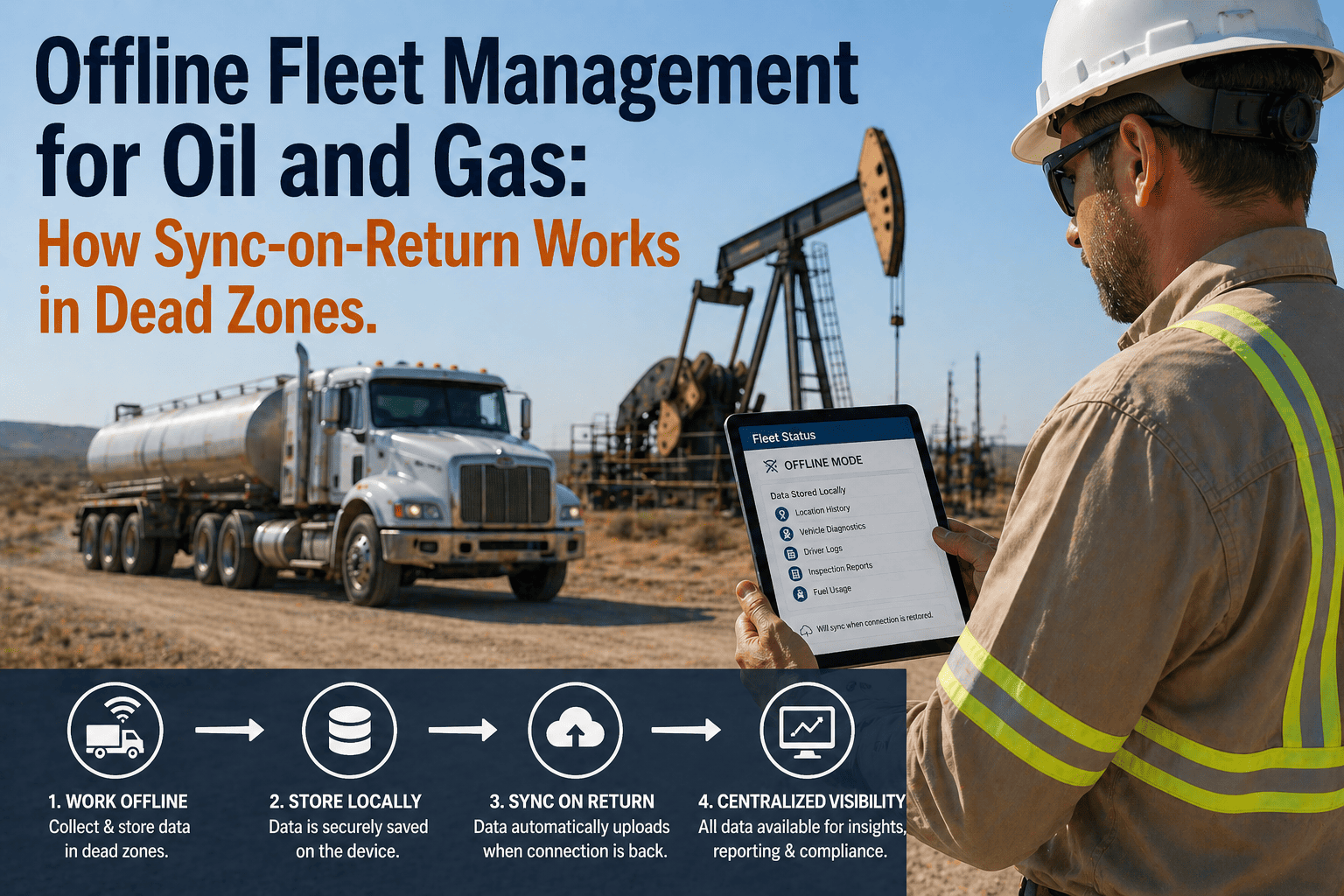
Offline Fleet Management for Oil and Gas: How Sync-on-Return Works in Dead Zones
FleetRabbit's offline mode enables drivers to complete DVIR inspections, log maintenance activities, capture incident photos, and record operational data with zero cellular signal. Everything syncs automatically the moment connectivity returns — no manual intervention required.
Why Traditional Fleet Platforms Fail in Remote Oilfield Environments
Oilfield operations span geographic regions deliberately selected for subsurface geology favorable to hydrocarbon accumulation rather than proximity to telecommunications infrastructure. Drilling sites emerge in remote basin locations 60-100 kilometers beyond the nearest cellular tower, completion operations position equipment at wellheads accessible only through private lease roads crossing terrain that blocks signal propagation, pipeline patrol routes traverse hundreds of kilometers through uninhabited corridors where telecommunications carriers have no economic justification for tower construction, and wellsite service calls require technicians to work at isolated production facilities where connectivity has never existed and likely never will.
Fleet management platforms architected with the assumption of continuous internet connectivity create systematic operational failures in these environments. Drivers arriving at remote wellsites for pre-trip DVIR inspections discover mobile apps displaying "No Connection" errors preventing inspection checklist access, maintenance technicians completing emergency repairs at isolated compressor stations cannot log service activities until returning to coverage zones hours later where memory of specific parts used and labor time consumed has degraded, safety managers responding to incidents at remote locations cannot capture timestamped photo evidence during the critical window when scene details are fresh and witnesses are present, and dispatch coordinators lose GPS visibility of fleet vehicle positions exactly where operational monitoring matters most for safety oversight and emergency response coordination.
The operational consequence manifests as compliance gaps where DVIR inspections required by FMCSA regulations cannot be completed at remote locations, maintenance documentation delays where service activities performed today are not logged until tomorrow or later when memory gaps introduce errors, safety incident reporting failures where critical evidence windows close before documentation can begin, and fleet visibility blackouts where dispatch loses contact with vehicles for hours or days creating unnecessary safety concern and operational coordination challenges.
FleetRabbit's offline-first architecture eliminates operational gaps at remote locations where connectivity is absent. Drivers complete all required workflows without any signal dependency. Start a free trial to test offline DVIR and maintenance logging functionality →
How FleetRabbit Maintains Full Functionality in Dead Zones
FleetRabbit enables complete operational capability without connectivity across five workflows that oilfield fleets execute daily at remote locations beyond cellular range.
Offline DVIR: Complete Inspections Without Connectivity
FMCSA regulations require drivers to complete pre-trip and post-trip DVIR inspections regardless of vehicle location or connectivity availability. FleetRabbit's offline DVIR mode enables full inspection checklist completion, defect photo capture with GPS coordinates and timestamps, digital signature recording, and supervisor notification queue management — all without any cellular or WiFi connection. The mobile app stores completed inspections locally on the driver's device with automatic upload to the compliance database the instant connectivity is restored.
Offline Maintenance Logging: Document Service at Remote Locations
Maintenance technicians performing emergency repairs or preventive service at remote wellsites, compressor stations, and equipment yards need to document service activities, record parts consumed, log labor hours, and capture before/after photos while work is being performed — not hours or days later when memory of specific details has degraded. FleetRabbit's offline maintenance mode enables complete service documentation without connectivity, with all data syncing automatically when the technician's device returns to a coverage zone.
Offline Incident Reporting: Capture Evidence Without Delay
Safety incidents occurring at remote oilfield locations require immediate evidence capture during the critical window when scene details are fresh, witnesses are present, and physical evidence has not been disturbed. Connectivity-dependent reporting systems force delays where incidents at remote wellsites cannot be documented until hours or days later when vehicles return to coverage zones — by which time witness memory has degraded, scene conditions have changed, and critical evidence windows have closed. FleetRabbit's offline incident reporting enables immediate capture with automatic sync when connectivity returns.
Satellite GPS Tracking: Maintain Visibility in Dead Zones
Fleet dispatch coordinators and safety managers require continuous vehicle position visibility for operational coordination and emergency response capability — especially when vehicles operate at remote locations where incident risk is elevated and response resources are limited. Cellular-only GPS tracking systems create visibility blackouts exactly where monitoring matters most. FleetRabbit's dual-mode GPS tracking automatically switches to satellite connectivity when cellular signal is unavailable, maintaining continuous position monitoring 80+ kilometers beyond cell tower range.
Delayed Message Queues: Communication Through Connectivity Windows
Fleet operations require bidirectional communication between drivers and dispatch even when vehicles operate in dead zones for extended periods. FleetRabbit's delayed message queue architecture enables dispatchers to send instructions, maintenance alerts, route changes, and safety notifications to drivers operating without connectivity — with messages automatically delivered the instant vehicles enter coverage windows. Similarly, drivers can compose messages and requests while offline with automatic transmission when connectivity is restored.
Full Platform Functionality Without Connectivity Requirement
FleetRabbit's offline-first design enables drivers to complete DVIR inspections, log maintenance activities, report safety incidents, and communicate with dispatch while operating in dead zones — with automatic synchronization the instant connectivity returns.
How FleetRabbit's Automatic Synchronization Works
Data Capture and Local Storage
When drivers operate FleetRabbit mobile app in areas without cellular connectivity, all data entry — DVIR inspections, maintenance logs, incident reports, photos, voice notes — is captured normally through the standard user interface with zero functional limitation. The application stores all data locally on the mobile device in an encrypted SQLite database, with photos and attachments stored in device file system directories. Data integrity verification checksums are calculated and stored with each record to detect any corruption during offline storage period.
Automatic Signal Monitoring
FleetRabbit mobile app continuously monitors device connectivity status through background processes that check for cellular or WiFi network availability every 60 seconds. When connectivity is detected, the app performs validation testing by attempting connection to FleetRabbit cloud API endpoints. If successful connection is established and sustained for 10+ seconds, the automatic synchronization process is triggered without requiring any driver interaction or manual upload initiation.
Automatic Upload and Verification
Once connectivity is confirmed, FleetRabbit initiates batch upload of all locally-stored data to cloud database servers. Upload occurs in priority sequence with DVIR inspections and safety incidents transmitted first, followed by maintenance logs, then photos and attachments. Each record upload is verified through server acknowledgment confirming successful database insertion. If upload is interrupted by connectivity loss, the process automatically resumes from the last successfully-uploaded record when connection is re-established. After all data is uploaded and verified, local copies are marked as synced but retained on device for offline reference.
Database Integration and Notification
Once uploaded data reaches FleetRabbit cloud infrastructure, server-side processing validates data integrity, integrates records into the central fleet management database with appropriate timestamps preserving offline capture times, triggers any automated workflows such as supervisor notifications for DVIR defects or predictive maintenance alerts, and updates web dashboard displays for dispatch coordinators monitoring fleet operations. The entire process from connectivity detection to dashboard update typically completes within 2-3 minutes of vehicle entering coverage zone.
How Offline Capability Delivers Value to Oilfield Fleet Operations
Compliance Gap Elimination
FMCSA requires DVIR inspections regardless of vehicle location or connectivity availability. FleetRabbit's offline DVIR ensures 100 percent inspection completion even when drivers operate exclusively in dead zones, eliminating regulatory violations from inability to complete required documentation at remote wellsites.
Documentation Accuracy Improvement
Enabling immediate data capture during activity performance rather than delayed entry hours or days later dramatically improves documentation accuracy. Maintenance logs completed in real-time during service work contain correct parts consumption and precise labor hours vs estimates from degraded memory.
Safety Evidence Preservation
Incident investigations depend on evidence captured during the immediate post-event window when scene integrity is maintained and witness memory is fresh. Offline incident reporting enables documentation at the moment incidents occur rather than after critical evidence windows have closed.
Driver Productivity Protection
Connectivity-dependent systems force drivers to delay required workflows until returning to coverage zones, consuming productive time on administrative tasks that should have been completed during natural workflow breaks at remote locations. Offline capability enables drivers to complete documentation during downtime at wellsites rather than at end of shift.
FleetRabbit's offline architecture enables oilfield fleets to maintain full operational capability regardless of cellular infrastructure availability. Test offline DVIR and maintenance logging functionality at your remote locations. Book a demo to see sync-on-return demonstrated in actual dead zone conditions →
Common Questions About Offline Fleet Management
Deploy Fleet Management That Works in Dead Zones
FleetRabbit's offline-first architecture enables drivers to complete DVIR inspections with photo attachments and digital signatures, log maintenance activities with parts consumption and labor hours, capture safety incident evidence with timestamped GPS coordinates, and communicate with dispatch through delayed message queues — all without any cellular connectivity requirement. Data synchronizes automatically the instant connectivity returns with zero manual intervention.
Maintain Full Fleet Management Capability at Remote Wellsites Beyond Cellular Range
FleetRabbit's offline mode eliminates operational gaps at remote drilling sites, completion operations, pipeline patrol routes, and wellsite service locations where cellular connectivity is systematically absent. Drivers complete FMCSA-required DVIR inspections with full checklist functionality and defect photo documentation, maintenance technicians log service activities with parts consumption and labor hour tracking during field repairs, safety managers capture incident evidence with timestamped photos and GPS coordinates at the moment events occur, and dispatch coordinators maintain GPS visibility through satellite tracking fallback — all workflows function identically whether connectivity is available or absent, with automatic synchronization uploading locally-stored data to cloud databases the instant vehicles return to coverage zones without requiring any manual upload initiation or driver intervention.