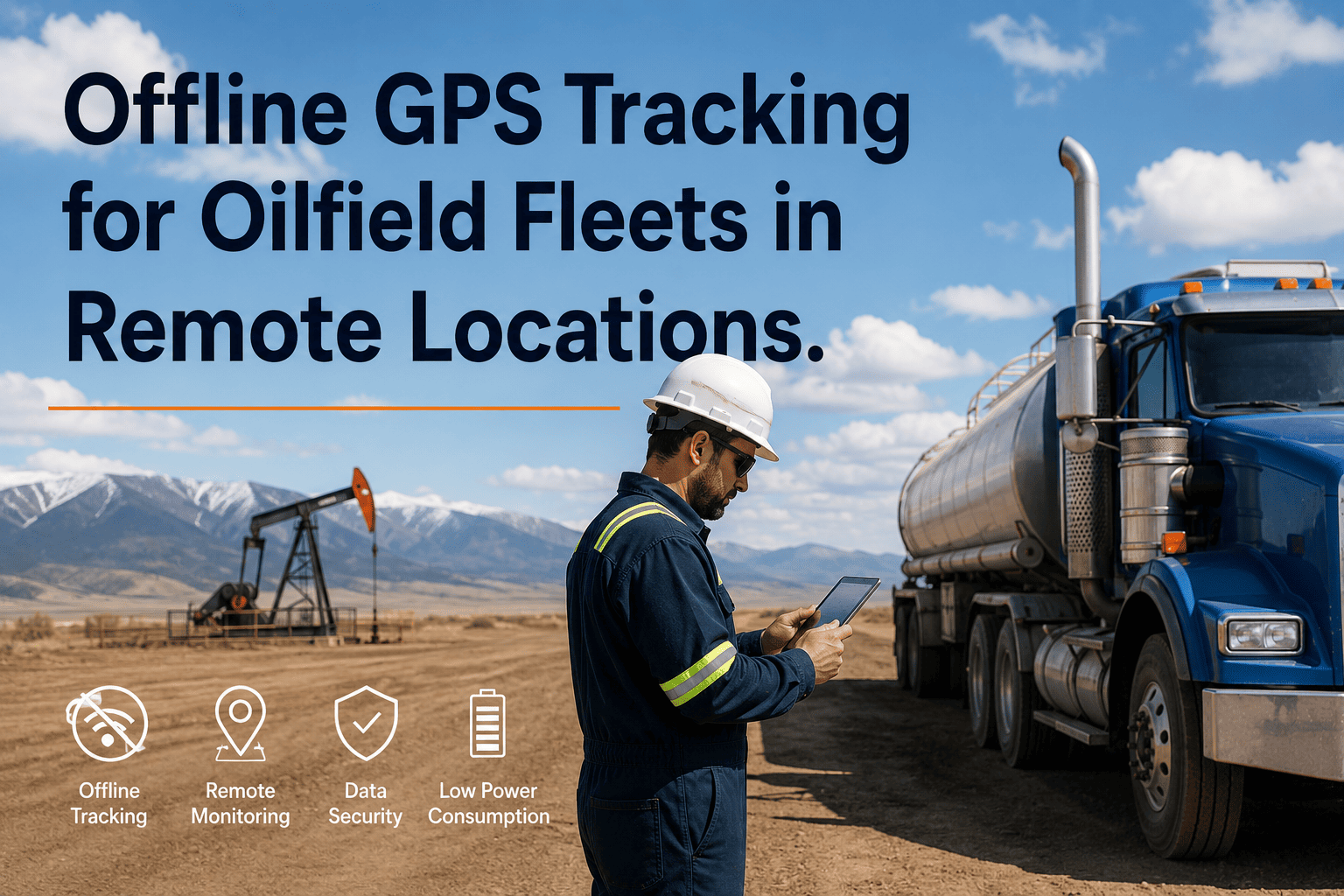
Offline GPS tracking for oilfield fleets is not a feature enhancement — it is an operational necessity that determines whether remote wellsite assets remain visible, manageable, and compliant when cellular networks end. The Permian Basin, Bakken formation, and other major North American oilfields contain thousands of square miles where cellular signal strength drops below usable thresholds, creating blind spots where traditional telematics platforms cease transmitting location, engine diagnostics, driver behaviour, and compliance data precisely when fleet managers need visibility most. A water hauler operating 45 miles from the nearest cell tower is not "offline" in operational reality — it is actively moving product, consuming fuel, accumulating engine hours, and exposing the organisation to safety, compliance, and liability risk — yet conventional GPS tracking systems report nothing until the vehicle returns to coverage, creating 6-12 hour data gaps that prevent real-time dispatch optimisation, delay maintenance intervention, and compromise regulatory documentation. FleetRabbit's offline GPS tracking architecture is purpose-built for oilfield remote operations — capturing and storing 36+ vehicle data streams locally on ruggedised hardware when connectivity is unavailable, automatically transmitting buffered data via cellular or satellite fallback when signal is restored, and maintaining continuous fleet visibility from headquarters to the most isolated wellpad without manual intervention or data reconciliation. This is not intermittent tracking with occasional sync — it is continuous performance monitoring that operates identically whether the vehicle is on an urban highway or a lease road 80 miles from the nearest tower, ensuring fleet managers and executives retain decision-grade intelligence regardless of location. Book a demo to see FleetRabbit's offline GPS tracking platform operating on a live remote oilfield fleet.
Offline GPS Tracking for Oilfield Fleets in Remote Locations
Maintain complete fleet visibility across remote oilfield operations where cellular coverage ends. FleetRabbit's offline GPS tracking captures location, diagnostics, and compliance data locally when signal is unavailable, then transmits buffered data automatically when connectivity is restored — ensuring zero data gaps from wellpad to headquarters.
Why Conventional GPS Tracking Fails in Oilfield Remote Operations
Oilfield fleets operate across geographic regions where cellular infrastructure was not designed for industrial telemetry — creating systematic visibility gaps that compromise operational control, safety oversight, and compliance documentation. Understanding these limitations is the first step toward implementing a tracking solution that performs reliably across your entire operational footprint.
Cellular Coverage Gaps
Major oil-producing basins contain extensive areas with no cellular signal or intermittent coverage below 2G thresholds. Conventional telematics devices cease transmitting when signal drops, creating data blackouts lasting hours or days until vehicles return to coverage zones.
Data Loss During Offline Periods
When conventional devices lose connectivity, sensor readings, GPS positions, and diagnostic events are typically discarded rather than stored locally. This creates permanent data gaps that prevent accurate route reconstruction, maintenance analysis, and compliance verification.
Delayed Alert Transmission
Critical safety events, maintenance alerts, and compliance violations occurring during offline periods are not transmitted until connectivity is restored — potentially delaying emergency response, maintenance intervention, or regulatory reporting by many hours.
Manual Data Reconciliation Burden
Fleet managers using conventional systems must manually reconcile offline periods, estimate missing data, and reconstruct vehicle activity from partial records — consuming administrative time and introducing errors into operational reporting and compliance documentation.
Satellite Integration Complexity
Adding satellite connectivity to conventional telematics typically requires proprietary hardware, complex configuration, and separate subscription management — creating integration challenges and cost structures that many operators find prohibitive for fleet-wide deployment.
Regulatory Documentation Risk
DOT, OSHA, and EPA regulations require complete, tamper-evident records of vehicle operation, maintenance, and driver activity. Data gaps from offline periods create documentation vulnerabilities that regulators may cite as inadequate recordkeeping during audits.
Continuous Data Capture. Automatic Sync. Zero Manual Intervention. Satellite Optional.
FleetRabbit's offline GPS tracking maintains complete fleet visibility across remote oilfield operations by capturing all vehicle data locally when cellular signal is unavailable, storing it in tamper-evident local memory, and automatically transmitting buffered data when connectivity is restored — with optional Iridium satellite fallback for critical alert transmission at the most isolated locations.
FleetRabbit's Four-Stage Offline Data Management Pipeline
FleetRabbit converts the challenge of remote connectivity into a seamless operational capability through an automated data management pipeline that operates continuously across every vehicle — capturing, storing, prioritising, and transmitting fleet intelligence regardless of network availability.
Continuous Local Data Acquisition
All vehicle sensors, GPS receivers, and diagnostic interfaces feed data to FleetRabbit's onboard processing unit at configured intervals — regardless of cellular signal status. Location coordinates, engine parameters, driver events, and compliance indicators are captured continuously and written to local non-volatile memory with cryptographic timestamping.
Tamper-Evident Local Buffering
Captured data is stored in encrypted local memory with 72-hour capacity at standard sampling rates. Each record includes cryptographic hash verification ensuring data integrity and tamper-evidence for regulatory compliance. Buffer management automatically prioritises critical alerts and compresses routine data to maximise storage efficiency.
Intelligent Alert Classification
When connectivity is unavailable, FleetRabbit classifies buffered events by operational criticality. Safety-critical alerts (crash detection, severe mechanical fault, driver distress) are flagged for immediate transmission via satellite fallback if configured. Routine operational data is queued for standard cellular sync when signal is restored.
Automatic Sync on Reconnect
When cellular signal is detected, FleetRabbit automatically initiates data transmission without driver or manager intervention. Buffered data is transmitted in priority order with integrity verification, then local storage is cleared for continued offline operation. Average sync time for 24 hours of buffered data: under 90 seconds on 4G connection.
What Offline GPS Tracking Delivers at Each Organisational Level
Common Questions About Offline GPS Tracking for Oilfield Fleets
Deploy Continuous Fleet Visibility Across Your Entire Remote Oilfield Operation — Starting This Week
FleetRabbit maintains complete GPS tracking, diagnostic monitoring, and compliance documentation across remote oilfield locations where cellular coverage ends — deployed in 5-7 working days at $3/vehicle/month. At that investment level, a single prevented remote breakdown or avoided compliance penalty pays for the platform for over a decade.