Oilfield operators lose millions annually to equipment failures that could have been predicted through proactive oil analysis. When lubricants degrade, contaminants accumulate, or wear metals rise, your equipment's oil broadcasts early warning signals long before mechanical breakdown occurs. FleetRabbit's automated oil analysis platform transforms routine fluid sampling into predictive intelligence — detecting bearing wear, gear degradation, and contamination issues weeks in advance. Book a demo to see predictive oil analysis in action.
Predictive Intelligence
Oil Analysis Programs: The Complete Framework for Oilfield Equipment Reliability
OIL ANALYSIS · PREDICTIVE MAINTENANCE · FLEET RELIABILITY
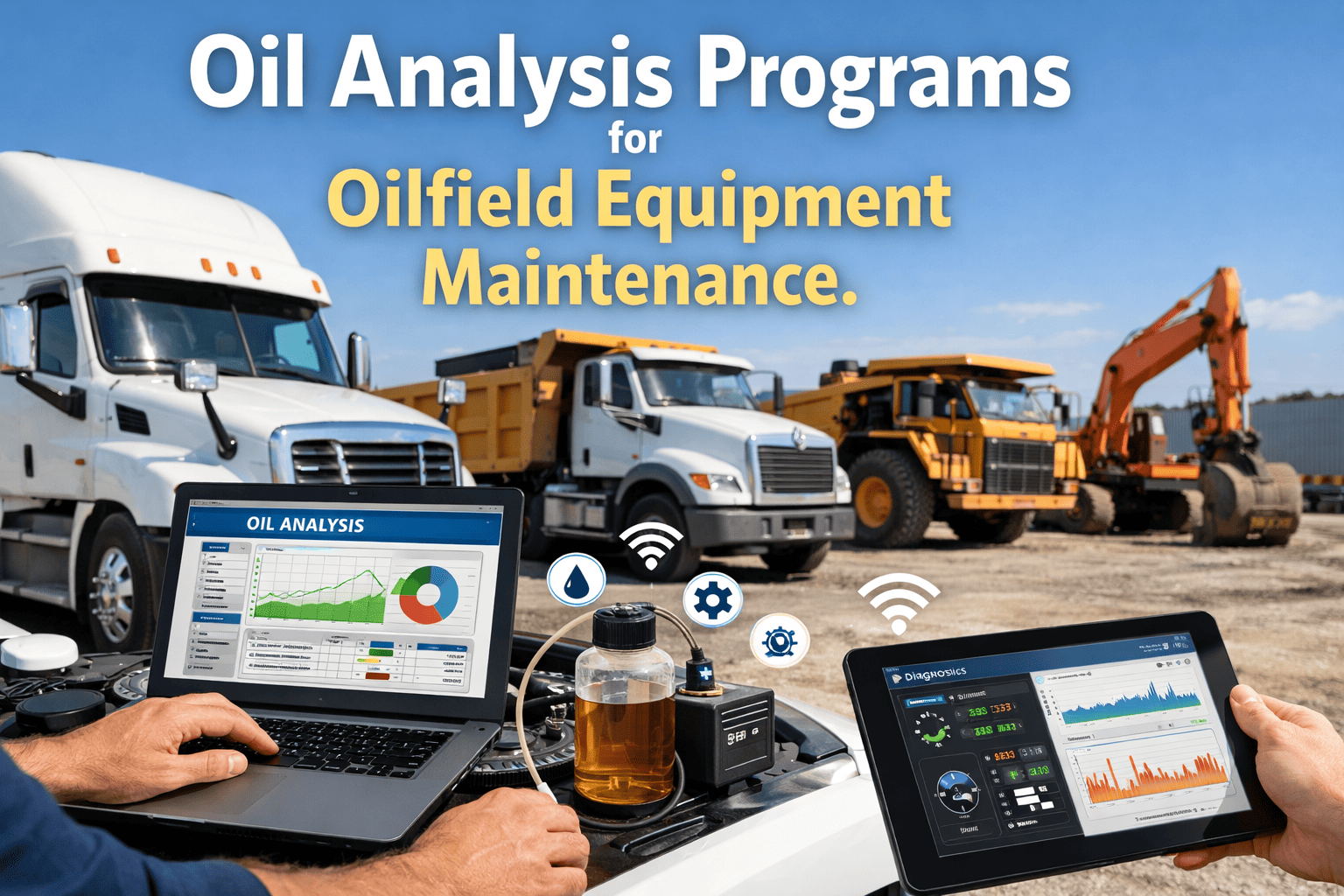
Oil Analysis Programs for Oilfield Equipment Maintenance
FleetRabbit converts routine oil sampling into actionable maintenance intelligence — identifying wear metals, contamination, and lubricant degradation before they impact equipment performance, so your upstream operations maintain maximum uptime and efficiency.
Early Detection
4–10 weeks advance warning before mechanical failure through intelligent oil trending
Cost Prevention
Prevent catastrophic failures · Reduce lubricant costs by 35%+ through condition-based changes
Fleet Visibility
Single dashboard view across all monitored equipment with real-time Oil Health Index scores
Rapid Insights
Actionable intelligence delivered within 24–48 hours of sample collection
Executive Overview
Oil analysis is the most comprehensive diagnostic tool for internal component health in oilfield equipment. Unlike vibration or thermal monitoring, oil reveals chemical, physical, and mechanical degradation simultaneously — identifying exactly which component is wearing, what type of wear is occurring, and how contamination is accelerating failure. FleetRabbit's platform integrates automated sampling workflows, advanced laboratory testing, and AI-driven trend analysis — giving fleet managers and maintenance directors the intelligence to schedule interventions during planned downtime, not emergency shutdowns.
Oil as a Real-Time Equipment Health Sensor
Every drop of lubricating oil circulating through your equipment carries a detailed history of internal conditions. As components operate, microscopic wear particles, oxidation byproducts, and external contaminants enter the oil stream — creating a continuous diagnostic signal that reflects equipment health in real time.
FleetRabbit's platform captures this signal through structured sampling protocols and transforms it into predictive maintenance intelligence. Traditional oil analysis relies on periodic lab reports that arrive days after sampling — often too late to prevent accelerated wear. Our connected sampling workflow, combined with rapid-turnaround testing and automated trend analysis, delivers actionable insights within 24–48 hours of sample collection.
See how real-time oil monitoring works →
01
Multi-Parameter Diagnostic Coverage
Oil analysis simultaneously monitors wear metals (iron, copper, chromium), contamination (silicon, sodium, water), and lubricant condition (viscosity, TBN, oxidation). This multi-dimensional view identifies not just that wear is occurring, but what type of wear, which component is affected, and whether external factors are accelerating degradation.
02
Component-Specific Wear Signatures
Different wear mechanisms produce distinct particle signatures: sliding wear generates platelet-shaped particles, rolling contact fatigue creates spherical particles, and abrasive wear produces jagged fragments. FleetRabbit's analytical engine classifies particle morphology to pinpoint failure modes — enabling targeted corrective actions rather than generic maintenance.
03
Contamination Source Tracking
Elevated silicon indicates dust ingress through seals; sodium suggests coolant leakage; water content reveals condensation or seal failure. FleetRabbit's contamination intelligence module correlates elemental data with equipment configuration to identify root causes — helping maintenance teams address systemic issues, not just symptoms.
04
Lubricant Life Optimization
Rather than changing oil on fixed intervals, FleetRabbit's condition-based approach monitors additive depletion, oxidation, and contamination to determine optimal change points. This extends lubricant service life by 30–60% while ensuring protection never falls below critical thresholds — reducing costs without compromising reliability.
Advanced Oil Testing Framework
QR-coded sample bottles linked to equipment records via mobile app. Technician scans bottle, selects sampling point, records operating conditions, and submits sample. System tracks chain-of-custody, sample age, and testing status — eliminating manual data entry errors and ensuring traceability for compliance audits.
Samples processed through ICP-OES for elemental analysis, FTIR for lubricant chemistry, particle counting for contamination severity, and analytical ferrography for wear particle morphology. Testing protocols customized per equipment type and criticality — ensuring relevant data without unnecessary cost.
Machine learning models trained on 1.8 million oil analysis records identify abnormal trends before limits are exceeded. System flags accelerating wear rates, emerging contamination patterns, and lubricant degradation trajectories — providing early warnings that enable proactive intervention.
Alerts classified by severity and recommended action: Monitor (trend watch), Investigate (root cause analysis), Plan (schedule maintenance), or Act (immediate intervention). Each alert includes plain-language diagnosis, supporting data, and recommended next steps — enabling rapid decision-making without specialist expertise.
Approved actions trigger work orders in connected CMMS systems with fault details, required parts, and repair procedures. Post-repair oil samples validate intervention effectiveness and update equipment health models — creating a continuous learning loop that improves prediction accuracy across the fleet.
Transform Your Oil Sampling Into Predictive Intelligence
FleetRabbit's oil analysis platform delivers laboratory-grade insights with field-ready workflows — detecting wear, contamination, and lubricant degradation weeks before failure.
Failure Mode Intelligence via Oil Data
Gearboxes & Reducers
Speed/torque conversion across drilling and production equipment
Gear Tooth Wear
Bearing Fatigue
Water Ingress
Additive Depletion
Iron and chromium elevation signals gear or bearing wear; copper indicates bronze component degradation. FleetRabbit correlates wear metal ratios with equipment geometry to isolate failing components — enabling targeted repairs before cascade damage occurs.
Reciprocating Compressors
Gas compression for wellhead, pipeline, and injection applications
Ring/Liner Wear
Valve Degradation
Fuel Dilution
Soot Loading
Elevated aluminum and silicon indicate ring/liner wear; iron spikes suggest valve train issues. FleetRabbit's combustion byproduct analysis detects fuel dilution and soot accumulation — critical for maintaining compressor efficiency and preventing catastrophic seizure.
Hydraulic Systems
Power transmission for BOPs, drawworks, and auxiliary equipment
Particle Contamination
Water Emulsification
Seal Degradation
Viscosity Shift
Particle counting identifies ISO cleanliness code trends; water content monitoring prevents emulsification damage. FleetRabbit's contamination intelligence flags seal wear patterns and recommends filtration upgrades — extending component life and maintaining system responsiveness.
Oil Health Index (OHI) KPI System
Wear Metal Severity Score
0–30 Normal
31–60 Monitor
61–85 Critical
86–100 Severe
Composite index weighting iron, copper, chromium, aluminum, and lead concentrations against equipment-specific baselines. Enables fleet-wide prioritization without reviewing individual element reports.
Contamination Risk Index
Evaluates silicon (dust), sodium (coolant), water content, and particle count against ISO cleanliness targets. Index triggers filtration recommendations, seal inspection alerts, or environmental controls. Reduces abrasive wear and corrosion by maintaining contamination below damage thresholds.
Lubricant Condition Rating
Tracks viscosity, TAN/TBN, oxidation, and additive depletion to assess remaining useful life. Rating guides oil change decisions: Extend service (green), Monitor closely (yellow), Schedule change (orange), Replace immediately (red). Optimizes lubricant spend while ensuring protection.
Trend Velocity Indicator
Measures rate of change for critical parameters — identifying accelerating wear or contamination before absolute limits are exceeded. Early detection of trend acceleration enables intervention 2–4 weeks sooner than threshold-based monitoring alone.
Real-World Case: Gearbox Failure Prevented Through Oil Trending
Month 0
Baseline Established
FleetRabbit oil sampling protocol established for critical gearbox. Baseline results: iron 12 ppm, copper 3 ppm, viscosity 220 cSt @ 40°C, particle count ISO 18/16/13. All parameters within OEM guidelines. Equipment classified as "Healthy."
Month 3
Early Signal Detected
Iron rises to 28 ppm (133% increase); trend velocity analysis flags accelerating wear rate. System classifies: "Early gear tooth wear, Input stage, Confidence 82%." Yellow alert issued with recommendation for monthly sampling.
Month 5
Fault Confirmed
Analytical ferrography identifies platelet-shaped iron particles characteristic of sliding wear. Iron reaches 52 ppm; copper rises to 9 ppm. System calculates remaining useful life: "~420 operating hours to critical threshold." Orange alert triggers maintenance planning.
Month 6
Planned Intervention
Targeted repair executed during scheduled maintenance window. Total intervention: $11,500 vs. estimated $275,000 for catastrophic failure. FleetRabbit's 8-week detection window enabled cost-effective planning.
FleetRabbit Platform: Oil Analysis Features Built for Oilfield Operations
Connected Sampling Workflow
Mobile app guides technicians through proper sampling procedures with QR-code tracking, photo documentation, and real-time submission. Eliminates chain-of-custody errors and ensures sample integrity from field to lab.
Multi-Method Laboratory Testing
ICP-OES, FTIR, particle counting, and analytical ferrography performed at ISO 17025 accredited labs. Testing protocols customized per equipment type to deliver relevant insights without unnecessary cost.
AI Trend Intelligence Engine
Machine learning models detect abnormal trends before limits are exceeded. Accelerating wear rates, emerging contamination patterns, and lubricant degradation trajectories trigger early warnings for proactive intervention.
Fleet-Wide Oil Health Dashboard
Single-pane view of all monitored equipment with OHI scores, alert status, and trend indicators. Sort by severity, location, or equipment type. Geographic map highlights assets requiring attention.
Start Your Predictive Oil Analysis Program
FleetRabbit makes advanced oil analysis accessible for oilfield operations of any size. Deploy connected sampling, receive AI-driven insights, and prevent failures before they impact production.
Return on Investment: Predictive Oil Analysis vs. Reactive Maintenance
Reactive Model
Failure cost per event
$160K – $290K
Emergency procurement
$25K – $55K
Production loss
$45K – $110K/day
Unplanned outages/year
15 – 22 events
FleetRabbit Model
Planned intervention
$7K – $14K
Annual program investment
$75K – $125K
Production continuity
Maintained
Unplanned outages
0 from monitored equipment
Typical Payback: First Prevented Failure
For a 28-rig fleet averaging 3 major failures/year: program investment $110K, prevented failure value $720K+ — net ROI 555% in Year 1.
"
FleetRabbit's oil analysis program flagged elevated iron in a critical gearbox three months before we would have detected it through routine inspection. We scheduled replacement during a planned turnaround, avoiding a $250K emergency repair and three days of lost production. The platform has paid for itself multiple times over.
— Reliability Engineer, Independent Upstream Operator · Permian Basin Operations
Frequently Asked Questions
How often should we sample oil from critical equipment?
Quarterly for baseline monitoring; monthly for elevated trends or harsh conditions. Frequency dynamically adjusts based on equipment criticality and trend velocity.
Can oil analysis work at remote offshore or desert locations?
Yes. Connected sampling workflow functions offline; data syncs when connectivity restored. Critical alerts transmit via satellite for locations without cellular coverage.
How does FleetRabbit reduce false alarms from normal wear?
Equipment-specific baselines and trend velocity analysis distinguish normal from abnormal wear. Alerts require multi-parameter confirmation, reducing nuisance alerts by over 85%.
What is the typical deployment timeline for a 28-rig fleet?
Standard deployment: 8–12 weeks. Weeks 1–3: survey and design. Weeks 4–7: phased rollout. Weeks 8–10: baseline collection. Weeks 11–12: training and go-live.
Can oil analysis be combined with vibration monitoring?
Yes — combination significantly improves diagnostic confidence. When oil shows elevated wear metals AND vibration detects bearing defects, both signals confirm the same failure mode.
How does FleetRabbit ensure sample integrity during transport?
QR-coded bottles with tamper-evident seals, temperature-stable containers, and chain-of-custody tracking ensure integrity. Compromised samples trigger automatic recollection at no cost.
Detect Equipment Wear 10 Weeks Before Failure
FleetRabbit's oil analysis platform transforms routine sampling into predictive intelligence — identifying wear, contamination, and lubricant degradation across your entire fleet from a single dashboard. Prevent catastrophic failures, optimize lubricant spend, and maintain production continuity with confidence.
Connected Sampling
AI Trend Intelligence
Oil Health Index KPIs
Fleet Dashboard
CMMS Integration
April 21, 2026
By David
All Posts