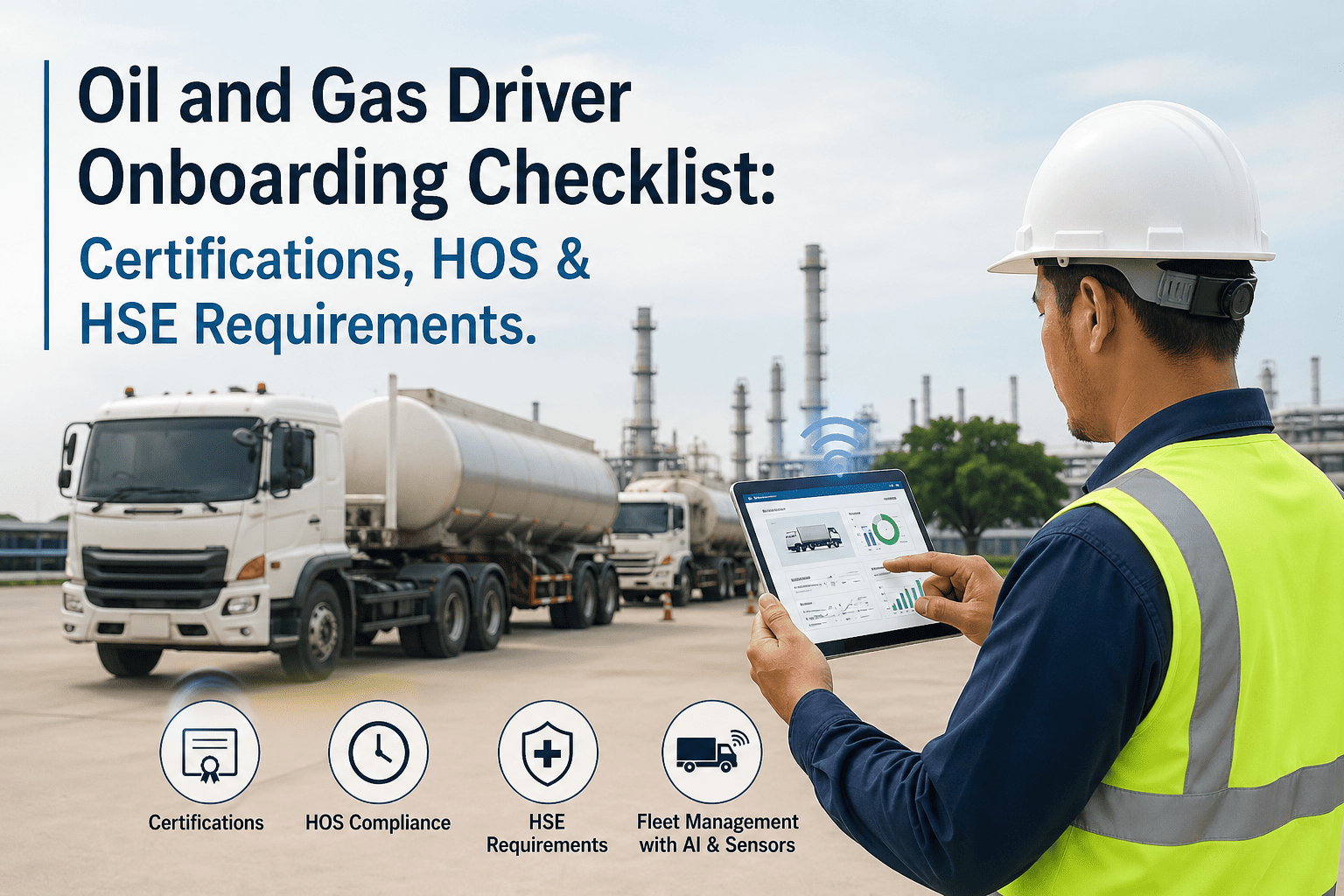
New driver onboarding in oil and gas operations is where fleet safety programs succeed or fail before the first dispatch. In 2026, regulatory requirements span DOT medical certifications, HAZMAT endorsements, H₂S training, site-specific access credentials, and Hours of Service compliance — all requiring validation before assignment to high-risk oilfield routes. Yet 68% of fleet managers report discovering certification gaps only after wellsite gate refusals or during incident investigations, not during structured pre-boarding workflows. This comprehensive driver onboarding checklist delivers a systematic verification framework across seven critical credential domains, ensuring every new hire meets FMCSA Part 391, OSHA 1910.120, and operator-specific requirements before vehicle keys are issued. Each section includes FleetRabbit automation guidance showing how digital onboarding eliminates the documentation blind spots that expose fleets to regulatory enforcement and operational delays. See automated driver onboarding in action
Complete Oil & Gas Driver Onboarding Checklist
From initial screening to first dispatch — validate every certification, qualification, and safety requirement with zero gaps
Why Traditional Driver Onboarding Fails in Oilfield Operations
Paper-Based Chaos
Certification documents scattered across email, shared drives, and physical filing cabinets — impossible to validate completeness before first assignment
No Expiry Tracking
Medical certificates, HAZMAT training, and site credentials expire mid-employment with zero automated alerts — discovered only at gate or during audit
Qualification Mismatches
Drivers dispatched to H₂S zones without current certification, HAZMAT loads without endorsements, or client sites without operator-approved credentials
Incomplete DQFs
Driver Qualification Files missing required employment history, MVR reviews, or previous employer verifications — audit findings waiting to happen
FleetRabbit transforms driver onboarding from fragmented paper workflows into structured digital verification — with credential-to-task mapping that prevents dispatch mismatches before they occur. See digital onboarding →
Basic Driver Qualifications & Background Verification
FMCSA Part 391.11 establishes minimum driver qualification standards including age, language proficiency, safe driving history, and physical capability. These foundational requirements must be validated and documented before proceeding to specialized certifications. FleetRabbit captures all verification evidence digitally with timestamps and document version control.
FleetRabbit Automation Solution
Driver qualification module stores employment applications, MVR documents, background checks, and drug screening results in unified digital driver files. System tracks annual MVR renewal requirements and Clearinghouse query schedules with automated alerts. Previous employer verification workflow sends requests, tracks responses, and flags incomplete records before onboarding completion. All documents timestamped with upload date, source verification, and digital signatures meeting ESIGN compliance standards.
FleetRabbit eliminates the manual tracking spreadsheets that cause driver qualification gaps. Digital workflows enforce completion checkpoints — no dispatch assignment possible until all critical verifications are documented. See credential automation →
Medical Certification & Physical Examination Requirements
DOT medical certification under FMCSA Part 391.41 requires examination by certified medical examiners listed on the National Registry. Oilfield drivers frequently require additional fitness assessments for confined space entry, respirator use, and extreme temperature exposure per OSHA and operator-specific requirements. Medical certificate expiration is the single most common compliance gap in oilfield fleets.
FleetRabbit Automation Solution
Medical certification module tracks DOT physical expiration with automated 90/60/30-day alerts to drivers and fleet managers. System blocks dispatch assignments when medical certificates lapse — preventing non-compliant vehicle operation. Respiratory fit test dates, vision/hearing exam results, and operator-specific medical requirements stored with independent expiry tracking. Dashboard displays medical compliance status across entire driver pool with real-time expiration forecasting.
Commercial Driver Licensing & HAZMAT Endorsements
CDL classification and endorsements must match vehicle types and cargo transported. Oilfield operations frequently require Class A licenses for tractor-trailer combinations, tanker endorsements for liquid transport, and HAZMAT endorsements for crude oil, produced water, and well stimulation chemicals. Endorsement-to-task mapping prevents the assignment of under-qualified drivers to specialized loads.
FleetRabbit Automation Solution
License tracking module validates CDL class and endorsements against vehicle asset types during dispatch assignment. System prevents HAZMAT load assignment to drivers without current H endorsement or tanker loads to drivers lacking N endorsement. TSA threat assessment expiration tracked independently with renewal alerts. Multi-jurisdiction license privileges mapped to operating regions with automatic compliance validation before cross-border dispatch.
How FleetRabbit Prevents Driver-to-Load Mismatches
Credential-to-Task Mapping
System validates driver certifications against load requirements in real-time — blocking dispatch of H₂S loads to drivers without current gas safety training or HAZMAT assignments to drivers with lapsed endorsements
Multi-Dimensional Expiry Tracking
Track medical certificates, CDL renewals, training expirations, and site credentials independently with jurisdiction-specific alert schedules — preventing the single-expiry blindspot that causes compliance failures
Automated Dispatch Blocking
Non-compliant driver profiles automatically removed from dispatch assignment pools when certifications lapse — eliminating manual qualification verification before every job assignment
Safety Training & OSHA Compliance Certifications
Oilfield driver safety training extends far beyond standard defensive driving courses. OSHA 1910.120 HAZWOPER, H₂S awareness, confined space entry, lockout/tagout, and company-specific safety orientations are mandatory before wellsite access. Training completion must be documented with certificates, attendance records, and competency assessments — all subject to client operator audit.
FleetRabbit Automation Solution
Training certification module stores all safety course certificates with independent expiry dates and jurisdiction-specific renewal cycles. HAZMAT training tracked on 3-year intervals per DOT requirements while H₂S certifications monitored annually per operator standards. Automated 90/60/30-day renewal alerts prevent training lapses. Dashboard shows training compliance status across driver pool with drill-down to individual certificate details. Digital signature capture for safety orientation acknowledgments creates tamper-evident training records.
Operator Site Access & Client-Specific Credentials
Wellsite access requirements imposed by operators like ADNOC, Aramco, Shell, or BP often exceed regulatory minimums — requiring proprietary safety training, site-specific inductions, biometric badges, and security clearances. Credential gaps discovered at wellsite gates create costly turnaround delays and client relationship damage. Pre-validation prevents both.
FleetRabbit Automation Solution
Site access credential module tracks operator-specific badges, security clearances, and training certifications with client-to-driver mapping. System validates site access requirements against dispatch assignments — preventing wellsite routing without verified credentials. Multi-operator environments supported with parallel credential tracking across ADNOC, Aramco, Shell, and custom client frameworks. Badge expiration alerts trigger 60/30/7 days before access lapses, preventing gate refusals.
Operational Readiness & Technology Proficiency
Technical proficiency with ELD devices, DVIR mobile apps, GPS tracking systems, and two-way communication platforms is not optional in modern oilfield operations. Drivers must demonstrate competency with digital workflows before unsupervised dispatch. This section validates technology readiness alongside traditional operational skills.
FleetRabbit Automation Solution
Mobile app onboarding workflow guides new drivers through ELD setup, DVIR practice submissions, and photo documentation procedures with step-by-step video tutorials. System tracks training completion with timestamped acknowledgments. Practice DVIR submissions validate driver proficiency before production dispatch assignments. Technology readiness dashboard shows per-driver competency status across all digital platforms — flagging training gaps before first solo assignment.
Driver Qualification File Assembly & Audit Readiness
FMCSA Part 391.51 requires motor carriers to maintain comprehensive Driver Qualification Files containing all verification documents, certifications, and employment records. Incomplete DQFs are the most common FMCSA audit finding — often resulting from fragmented document storage across email, shared drives, and paper files. FleetRabbit consolidates all DQF components in unified digital driver profiles.
FleetRabbit Automation Solution
Driver Qualification File module consolidates all required documents in unified digital profiles with version control and audit trail tracking. System flags incomplete DQFs before dispatch eligibility — preventing non-compliant driver assignments. One-click DQF export generates regulator-formatted audit packs satisfying FMCSA Part 391 requirements. Document upload timestamps, source verification, and digital signatures create tamper-evident records. Multi-year document retention with litigation hold capabilities protects historical driver records.
Multi-Region Compliance Coverage
FleetRabbit supports driver onboarding requirements across global oil and gas operating regions with jurisdiction-specific certification tracking and regulatory export formats.
North America
FMCSA Part 391, DOT PHMSA HAZMAT, ELD Mandate, OSHA 1910.120, Drug & Alcohol Clearinghouse, Canadian NSC standards
Middle East / GCC
ADNOC HSE requirements, Saudi Aramco SHEM, UAE labor law, Civil Defence permits, operator-specific safety credentials
United Kingdom / EU
DVSA operator licensing, Driver CPC, ADR dangerous goods, Working Time Directive, LOLER/PUWER compliance
Asia-Pacific
Indian MV Act 1988, DGMS directives, OISD standards, ONGC contractor requirements, Australia fatigue management
Every certification domain in this checklist deploys as a structured digital workflow in FleetRabbit — configured to your operating jurisdictions, client operator requirements, and fleet hierarchy. Stop onboarding drivers manually. Start onboarding them systematically. Start free trial →
Frequently Asked Questions
How does FleetRabbit prevent drivers from being assigned to jobs they're not qualified for?
FleetRabbit validates driver certifications against load requirements during dispatch assignment. If a HAZMAT load requires H endorsement and H₂S training, the system automatically filters the driver pool to show only qualified candidates. Attempting to assign an unqualified driver triggers a blocking alert with specific credential gaps listed. This credential-to-task mapping prevents qualification mismatches at the planning stage.
Can FleetRabbit track certifications that expire on different schedules for the same driver?
Yes. Each driver profile supports unlimited credential types with independent expiration dates and renewal schedules. A driver may have DOT medical expiring in 2 years, HAZMAT training in 3 years, H₂S certification annually, and site access badges quarterly — all tracked simultaneously with jurisdiction-specific alert timelines. The system manages multi-dimensional expiry tracking without manual calendar management.
How quickly can I generate a complete Driver Qualification File for a regulatory audit?
Fleet managers report generating complete DQF exports in under 5 minutes via FleetRabbit dashboard. Select the driver, define audit date range, click export — the system compiles employment application, MVR, medical certificate, CDL copy, training records, and all Part 391 required documents into a regulator-formatted PDF package. The same process on paper-based systems typically requires 2–4 hours of manual file assembly per driver.
What happens when a driver's critical certification expires while they're actively employed?
FleetRabbit sends automated renewal alerts at 90/60/30 days before expiration to both drivers and fleet managers. If certification lapses without renewal, the driver profile automatically transitions to non-compliant status — removing them from dispatch assignment pools. Attempting to assign a non-compliant driver triggers blocking alerts. This prevents expired-credential operations without requiring manual qualification checks before every job.
Does FleetRabbit support onboarding workflows for multiple client operators with different requirements?
Yes. FleetRabbit supports multi-operator environments with parallel credential tracking. A single driver can have ADNOC credentials, Aramco safety training, and Shell contractor registration tracked simultaneously — each with independent expiration dates and operator-specific documentation requirements. System validates site-specific credentials against dispatch location before assignment approval.
How long does FleetRabbit deployment take for a mid-sized oilfield fleet?
Typical deployment for 50–150 vehicle fleets completes in 5–7 working days including: driver profile creation, certification configuration, document upload, training module setup, and mobile app onboarding. Large multi-site deployments of 200+ vehicles with complex multi-jurisdiction requirements typically complete in 2–3 weeks with dedicated implementation support.
Transform This Driver Onboarding Checklist Into Automated Compliance Workflows
Every verification point in this checklist becomes a structured digital workflow in FleetRabbit — configured to your operating jurisdictions, client operator requirements, and fleet safety standards. Automated expiry tracking, credential-to-task mapping, and dispatch blocking eliminate the manual oversight that creates compliance gaps.