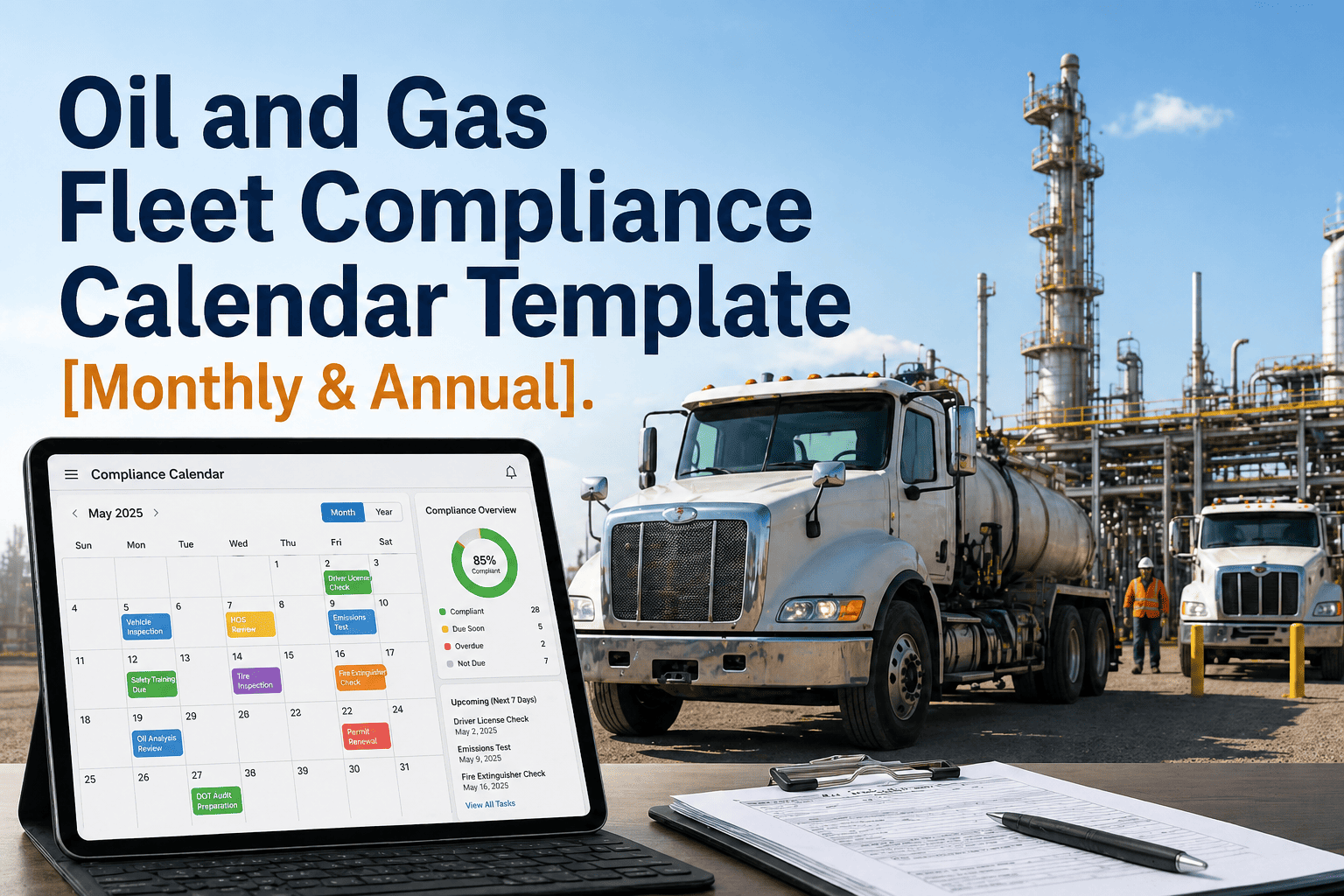
Oil and gas fleet compliance management operates on an unforgiving calendar — annual DOT inspections, quarterly ELD audits, monthly DVIR record reviews, CDL endorsement renewals, H₂S certification expirations, HAZMAT training cycles, permit renewals, and operator HSE filing deadlines that don't wait for operational peaks or budget cycles. Missing a single deadline doesn't just create paperwork — it creates regulatory exposure, insurance complications, contractor disqualification risk, and in serious cases, fleet-wide operational shutdowns pending compliance remediation. This free Oil and Gas Fleet Compliance Calendar Template gives fleet managers, HSE coordinators, and operations executives a structured annual framework that tracks every recurring compliance obligation across DOT FMCSA, OSHA, PHMSA, and operator HSE requirements — organised by frequency, regulatory body, and responsible party. FleetRabbit automates this entire compliance calendar digitally, sending automated alerts before every deadline, blocking non-compliant operations, and giving management real-time visibility on compliance status across every asset and driver. Book a demo to see how FleetRabbit replaces compliance spreadsheets entirely.
FREE TEMPLATE · DOT · OSHA · PHMSA · ADNOC
Oil & Gas Fleet
Compliance Calendar
Monthly and annual compliance deadline tracker for upstream and midstream fleet operations. Covers inspections, certification renewals, permit expirations, and regulatory filing deadlines — so nothing slips through the gaps.
Daily tasks
Monthly deadlines
Quarterly audits
Annual filings
M
T
W
T
F
S
S
1
2DVIR
3
4
5ELD
6
7
8
9
10H₂S
11
12
13DOT
14
15
16
17
18CDL
19
20
21
22PM
23
24
25HAZ
26
27
28OSHA
29
30
31
Safety certs
Inspections
HAZMAT
Regulatory
47+
Annual compliance deadlines tracked
4
Regulatory frameworks covered
12
Monthly monitoring categories
$0
Cost — free for all operators
THE COMPLIANCE GAP
Why Oilfield Fleets Miss Compliance Deadlines — And What It Costs
The average oil and gas fleet operator manages 63 individual recurring compliance deadlines annually across vehicles, drivers, certifications, and regulatory filings. Tracking these across spreadsheets, email reminders, and paper tickler files produces an inevitable failure rate — not from negligence, but from the sheer volume of overlapping obligation cycles that no manual system reliably handles at scale.
01
Spreadsheet Version Control Breaks Down
When multiple coordinators update the same compliance tracking spreadsheet, version conflicts, overwritten entries, and inconsistent formats produce a document no one trusts — and that no regulator would accept as evidence of a functioning compliance management system.
02
Certification Expiry Is Discovered After the Fact
Without automated alerts, H₂S Alive certificates, HAZMAT endorsements, and operator site access credentials are discovered to have lapsed when a driver is already at the gate — creating operational delays, compliance violations, and driver welfare issues in H₂S-present zones.
03
Annual DOT Inspection Deadlines Drift
Annual inspection certificates are tied to individual vehicle inspection dates — not a fleet-wide calendar date. Without per-vehicle tracking, anniversary dates drift out of awareness, and vehicles operated with lapsed annual inspections create both DOT OOS exposure and insurance coverage gaps.
04
Multi-Region Filing Deadlines Are Missed
Operators with fleets spanning North America and GCC face simultaneous FMCSA, ADNOC, DVSA, and DGMS filing cycles with different frequencies, formats, and submission windows. A single calendar cannot track all of these — and most don't try, creating regulatory gaps in non-primary operating regions.
Missed Deadline Cost Exposure
DOT OOS Violation
$16,000+
per vehicle per violation
PHMSA HAZMAT Fine
$84,425
max per violation per day
OSHA Serious Violation
$15,625
per citation
ADNOC Non-Compliance
Contract Loss
disqualification from future awards
Lapsed Annual Inspection
Fleet Shutdown
until all vehicles re-inspected
FleetRabbit eliminates manual calendar tracking entirely — automated alerts at 60, 30, and 7 days before every deadline.
Try it free →
Stop tracking compliance deadlines in spreadsheets. FleetRabbit monitors every certification, inspection, and filing date automatically — alerting the right people before deadlines are missed, and blocking non-compliant operations before they happen.
Start your free trial — deploy in 5 days →
ANNUAL COMPLIANCE CALENDAR
Complete 12-Month Oil & Gas Fleet Compliance Calendar
The following calendar organises every recurring compliance obligation by frequency and month. For per-vehicle obligations (annual inspections, registration renewals), deadlines are tied to each vehicle's specific anniversary date — the calendar flags the category; FleetRabbit tracks each individual vehicle date automatically.
Q1 · JANUARY — MARCH
January
ANNUAL
OSHA 300A Summary posting — post annual injury/illness summary in workplace from 1 Feb through 30 Apr
ANNUAL
Review and update fleet safety policy documents, emergency contact lists, and insurance certificates for new year
MONTHLY
DVIR record audit — review all December DVIRs for completeness and driver certification signatures
MONTHLY
HOS log audit — pull and review ELD records for the previous month for pattern violations
ONGOING
Check all driver CDL expiry dates — flag any expiring within 90 days for renewal initiation
February
REGULATORY
OSHA 300A Summary must be posted by 1 February — verify posting in all covered workplaces
QUARTERLY
Q4 drug and alcohol testing programme review — confirm random testing pool percentages met DOT requirements
MONTHLY
Review corrective actions from Q4 incidents — confirm closure of all assigned items
ONGOING
H₂S Alive certification audit — verify all active drivers in H₂S zones hold current certification
March
REGULATORY
OSHA 300A Summary posting ends 30 April — continue maintaining through end of April
QUARTERLY
Q1 fleet safety meeting — document attendance, agenda, and action items per OSHA safety committee requirements
MONTHLY
Preventive maintenance schedule review — confirm all vehicles are current on oilfield-adjusted PM intervals
ONGOING
HAZMAT endorsement audit — verify all designated HAZMAT drivers hold current H or X CDL endorsement
Q2 · APRIL — JUNE
April
REGULATORY
OSHA 300A Summary — final day of required posting is 30 April. Remove and retain in records for 5 years.
ANNUAL
Fleet insurance renewal review — confirm coverage limits, MCS-90 endorsements, and cargo coverage meet contractual minimums
QUARTERLY
DOT random drug/alcohol testing pool review — confirm Q1 random selections and test completion rates
MONTHLY
Annual inspection date audit — flag all vehicles whose DOT annual inspection expires within 90 days
May
ANNUAL
Mid-year FMCSA Safety Measurement System (SMS) review — check BASIC scores and initiate DataQs challenges for inaccurate roadside data
QUARTERLY
Q2 fleet safety audit — review incident frequency rates, near-miss reports, and corrective action status
MONTHLY
ELD device functionality check — confirm all ELD devices are FMCSA-registered and firmware is current
ONGOING
Operator site access credential review (ADNOC, Aramco) — verify all active contractors hold valid site passes
June
QUARTERLY
Q2 drug and alcohol testing — confirm random testing selections drawn and completed per DOT 49 CFR Part 382
MONTHLY
Mid-year PM review — compare actual maintenance performed against oilfield-adjusted intervals; update schedule for H2 activity forecast
ONGOING
HAZMAT training refresher audit — confirm all HAZMAT function-specific training is current (3-year cycle per 49 CFR 172.704)
MONTHLY
Driver qualification file audit — confirm DQ files contain current MVR, medical certificate, and CDL copy for all active drivers
Q3 · JULY — SEPTEMBER
July
ANNUAL
USDOT number biennial update — verify MCS-150 update is current. Deadline is the last day of the month of registration for the applicable year.
QUARTERLY
Q3 fleet safety meeting — document heat-related illness prevention measures for summer oilfield operations
MONTHLY
Tyre and brake inspection audit — summer heat accelerates tyre degradation on lease roads; confirm increased inspection frequency
ONGOING
Medical certificate audit — DOT medical certificates expire at 24 months (standard) or shorter. Pull all certificates expiring within 60 days.
August
QUARTERLY
Q3 drug and alcohol testing — confirm random selections drawn and tests completed per DOT programme requirements
MONTHLY
Cooling system and hydraulic fluid inspection — extended idle in summer heat accelerates coolant and hydraulic fluid degradation
ONGOING
Annual refresher training schedule — initiate scheduling for Q4 driver safety training to meet annual training programme obligations
MONTHLY
Contractor fleet compliance review — verify all third-party carrier insurance, DOT rating, and safety score remain within acceptance thresholds
September
ANNUAL
Year-end compliance planning — begin Q4 audit preparation; identify any regulatory changes effective 1 January that require procedure updates
QUARTERLY
Q3 incident review — compile incident frequency rate for 9-month period and benchmark against industry averages
MONTHLY
Annual inspection pre-audit — for vehicles with Q4 annual inspection anniversaries, initiate pre-inspection PM to minimise OOS findings
Q4 · OCTOBER — DECEMBER
October
ANNUAL
Annual fleet SOP review — all six SOP domains (dispatch, DVIR, HAZMAT, maintenance, emergency, contractors) reviewed and updated for regulatory changes
QUARTERLY
Q4 safety meeting — winter operations briefing: road conditions, cold-start procedures, H₂S behaviour in cold weather, visibility protocols
MONTHLY
Anti-freeze and cold-start equipment audit for fleets operating in northern basins (Bakken, WCSB, Siberia)
ONGOING
HAZMAT training 3-year cycle check — identify any drivers whose function-specific HAZMAT training will expire in the coming year
November
ANNUAL
Driver qualification file annual review — confirm all DQ files are complete, current, and retained per FMCSA 3-year retention requirement
QUARTERLY
Q4 drug and alcohol testing — confirm random testing selections drawn and completed before year-end
MONTHLY
Year-end corrective action review — confirm all 2024 corrective actions are closed or formally deferred with management sign-off
ONGOING
2025 compliance calendar preparation — pull all certificate expiry dates and program FleetRabbit alerts for the coming year
December
ANNUAL
OSHA 300 Log review — compile year-end totals, verify recordability determinations, prepare 300A Summary for 1 February posting
ANNUAL
Annual accident register audit — confirm all DOT-reportable accidents for the year are documented and register retained per 49 CFR 390.15
QUARTERLY
Full-year compliance scorecard — compile annual incident rates, compliance adherence percentages, and corrective action closure rates for executive reporting
MONTHLY
Final ELD record review for the year — ensure all driver logs are certified and archived per FMCSA 6-month retention requirement
FLEETRABBIT COMPLIANCE AUTOMATION
Replace This Calendar With Automated Deadline Tracking
FleetRabbit monitors every deadline in this calendar automatically — sending alerts at 60, 30, and 7 days before expiry. Dispatch is blocked when certifications lapse. Executives see real-time compliance status across the entire fleet.
RECURRING COMPLIANCE OBLIGATIONS
Daily, Weekly & Monthly Compliance Tasks Every Oilfield Fleet Must Track
Beyond the annual calendar, oilfield fleet compliance requires consistent daily and weekly task execution. The following obligations recur at sub-monthly frequencies and are easily missed when operations are busy — yet they generate the majority of DOT roadside inspection findings.
Pre-trip DVIR completion
Required before every departure under 49 CFR 396.11. Must be documented and retained 12 months.
ELD log certification
Drivers must certify daily HOS logs at end of each 24-hour period under 49 CFR 395.8.
Post-trip DVIR completion
Defect documentation at end of each shift — mechanic review and sign-off required within 24 hours.
Dispatch certification check
Verify driver CDL, HOS availability, and certification status before every load assignment.
Wellsite check-in confirmation
Confirm vehicle arrival and departure via GPS geofence or driver app check-in for lone-worker safety.
HOS violation review
Weekly ELD log review to identify HOS pattern violations before they accumulate into FMCSA BASIC score impacts.
Open defect status review
Confirm all DVIR-reported defects have been reviewed, resolved, or formally deferred with mechanic sign-off.
Certification expiry 7-day check
Pull weekly report of any driver certifications or vehicle documents expiring in the next 7 days — immediate action required.
GPS tracking data review
Review weekly fleet movement data for speeding events, unauthorised stops, and geofence violations.
Near-miss report review
Review any near-miss events reported during the week and initiate root cause analysis within 7 days of occurrence.
DVIR record completeness audit
Monthly audit confirms all DVIR records are complete, signed, and retained per 49 CFR 396.11 requirements.
90-day certification expiry pull
Monthly report of all certifications expiring within 90 days — H₂S, HAZMAT, CDL, medical certificates, site access.
PM schedule adherence review
Confirm all vehicles are within oilfield-adjusted PM intervals. Flag overdue units for immediate scheduling.
Incident frequency rate calculation
Calculate monthly IFR and compare against prior period — early trend detection before regulator or insurer review.
Corrective action closure review
Review all open corrective actions across incidents and inspections — confirm responsible parties are on track to due dates.
HOW FLEETRABBIT SOLVES THIS
How FleetRabbit Turns This Paper Calendar Into an Automated Compliance Engine
Every deadline in this calendar becomes a configured alert, a blocked dispatch rule, or a dashboard KPI inside FleetRabbit. Fleet managers stop manually tracking deadlines and start managing by exception — only seeing what needs their attention, rather than checking everything to find what's at risk.
01
Automated 60/30/7-Day Alerts
Every certification, inspection, and filing deadline in this calendar is configured as an automated alert sequence. Fleet managers receive notifications at 60 days (plan renewals), 30 days (initiate action), and 7 days (critical — escalates to HSE director) before every expiry. Nothing is missed because the system prompts every obligation before it becomes a violation.
02
Compliance-Gated Dispatch
When a certification expires, FleetRabbit doesn't just alert — it blocks. A driver whose H₂S Alive certificate has lapsed cannot be dispatched to an H₂S zone. A vehicle with an expired annual inspection cannot be assigned. Compliance deadlines enforced at the point of dispatch, not discovered during an audit.
03
Executive Compliance Dashboard
HSE directors and fleet executives see a real-time compliance health score across all assets and drivers — percentage of fleet in compliant status, upcoming deadline counts by category, and overdue items requiring immediate action. One dashboard replaces twelve spreadsheets.
04
Audit-Ready Export in Seconds
When a DOT inspector or ADNOC auditor requests compliance records, FleetRabbit generates a complete audit package — DVIR records, certification history, maintenance logs, incident reports, and corrective action documentation — in the required format, in seconds, without searching through filing systems.
05
Multi-Region Compliance Tracking
For operators with fleets in multiple jurisdictions — North America, GCC, UK/EU, India — FleetRabbit tracks region-specific compliance calendars simultaneously. FMCSA obligations for US assets, ADNOC requirements for UAE assets, DVSA for UK assets — one platform, complete multi-region visibility.
06
Contractor Compliance Visibility
Contractor fleet certification compliance — driver credentials, vehicle inspections, carrier insurance — appears in the same dashboard as owned fleet compliance. Operators set minimum compliance standards; contractors who fall below threshold receive automated notices and lose dispatch eligibility until resolved.
FleetRabbit's compliance calendar automation deploys across your entire fleet — owned and contractor vehicles — in 5–7 days. All features are included at $3/vehicle/month with zero add-on fees and locked pricing. Start your free trial with no credit card required →
DRIVER & VEHICLE CERTIFICATION TRACKER
Per-Driver and Per-Vehicle Certification Expiry Reference
Individual certificate cycles must be tracked per driver and per vehicle — not on a fleet-wide calendar date. The following reference table lists the standard renewal cycles for all major certifications required in oilfield fleet operations.
Driver Certifications
Certification
Renewal Cycle
Alert Lead Time
Commercial Driver's Licence (CDL)
4–8 years (state-specific)
90 days
DOT Medical Certificate
24 months (standard); 12 months if conditions apply
60 days
HAZMAT Endorsement (CDL)
Tied to CDL renewal cycle + TSA security threat assessment
60 days
H₂S Alive Certification
3 years
60 days
HAZMAT Function-Specific Training
3 years per 49 CFR 172.704
60 days
ADNOC / Aramco Site Access Credential
1–2 years (operator-specific)
30 days
First Aid / CPR Certification
2 years
30 days
Defensive Driving Course
Annual (most oilfield HSE programs)
30 days
Vehicle Certifications & Permits
Certification / Permit
Renewal Cycle
Alert Lead Time
Annual DOT Inspection (FMCSA)
12 months per vehicle from inspection date
60 days
Vehicle Registration
Annual (state-specific date)
60 days
IFTA Fuel Tax Filing
Quarterly (Jan, Apr, Jul, Oct)
30 days
Commercial Vehicle Insurance
Annual renewal
90 days
Oversize / Overweight Permit
Per-trip or annual — state-specific
15 days
HAZMAT Placard Certification
Per-vehicle, verified at each DVIR
Daily DVIR
ELD Device Registration (FMCSA)
Per device — verify on FMCSA registered ELD list annually
30 days
Pressure Vessel / Tank Certification
1–5 years depending on jurisdiction and vessel type
60 days
FREQUENTLY ASKED QUESTIONS
Oil & Gas Fleet Compliance Calendar: Key Questions
How often must oilfield fleet operators submit FMCSA MCS-150 updates?
FMCSA requires MCS-150 updates biennially (every two years), based on the USDOT number registration month. Filing is required even if no information has changed. Late filing or non-filing can result in USDOT number deactivation and operating authority suspension.
Can FleetRabbit track compliance for contractor vehicles, not just owned fleet?
Yes. FleetRabbit's contractor module extends compliance tracking to third-party drivers and vehicles. Operators set minimum compliance thresholds; contractors who fall below receive automated alerts and are removed from the eligible dispatch pool until resolved — giving operators full visibility without managing contractor HR directly.
How long must oil and gas fleet compliance records be retained?
Retention requirements vary by record type: DVIR records — 12 months; OSHA 300 logs — 5 years; DOT accident register — 3 years; driver qualification files — 3 years after driver departure; HAZMAT incident reports — 2 years; ELD records — 6 months. FleetRabbit retains all digital records for 5 years by default, covering the longest applicable retention requirement.
What is the DOT random drug testing percentage requirement for oilfield fleets?
FMCSA currently requires random alcohol testing at a minimum rate of 10% of the average number of driver positions, and controlled substance testing at 50% annually. These rates can be adjusted by FMCSA based on industry violation rates. FleetRabbit tracks testing pool membership and completion rates to confirm annual minimums are met before year-end.
Does this compliance calendar apply to GCC oilfield operations (UAE, Saudi Arabia)?
The calendar structure applies globally; specific deadline dates and regulatory references differ by jurisdiction. For GCC operations, ADNOC HSE Integrated Management System requirements, local traffic law certification cycles, and operator-specific contractor compliance schedules replace or supplement the FMCSA and OSHA entries. FleetRabbit supports region-specific compliance calendars for ADNOC, DVSA, DGMS, and FMCSA simultaneously.
How does FleetRabbit handle the vehicle-specific nature of annual inspection deadlines?
Each vehicle's annual inspection anniversary date is stored individually in FleetRabbit — not as a fleet-wide date. The platform tracks the specific expiry date per unit and triggers the 60/30/7-day alert sequence per vehicle. Fleet managers see a dashboard view showing all vehicles by inspection status: current, expiring soon, and expired — enabling proactive scheduling without manual calendar management.
FLEETRABBIT · OIL & GAS COMPLIANCE AUTOMATION
Replace Your Compliance Calendar With a System That Enforces Itself
FleetRabbit tracks every deadline in this calendar per driver and per vehicle — sending automated alerts at 60, 30, and 7 days before expiry, blocking non-compliant dispatch, and giving executives real-time compliance visibility across owned and contractor fleets. Deployed in 5–7 days at $3/vehicle/month with zero add-on fees.
April 27, 2026
By David
All Posts