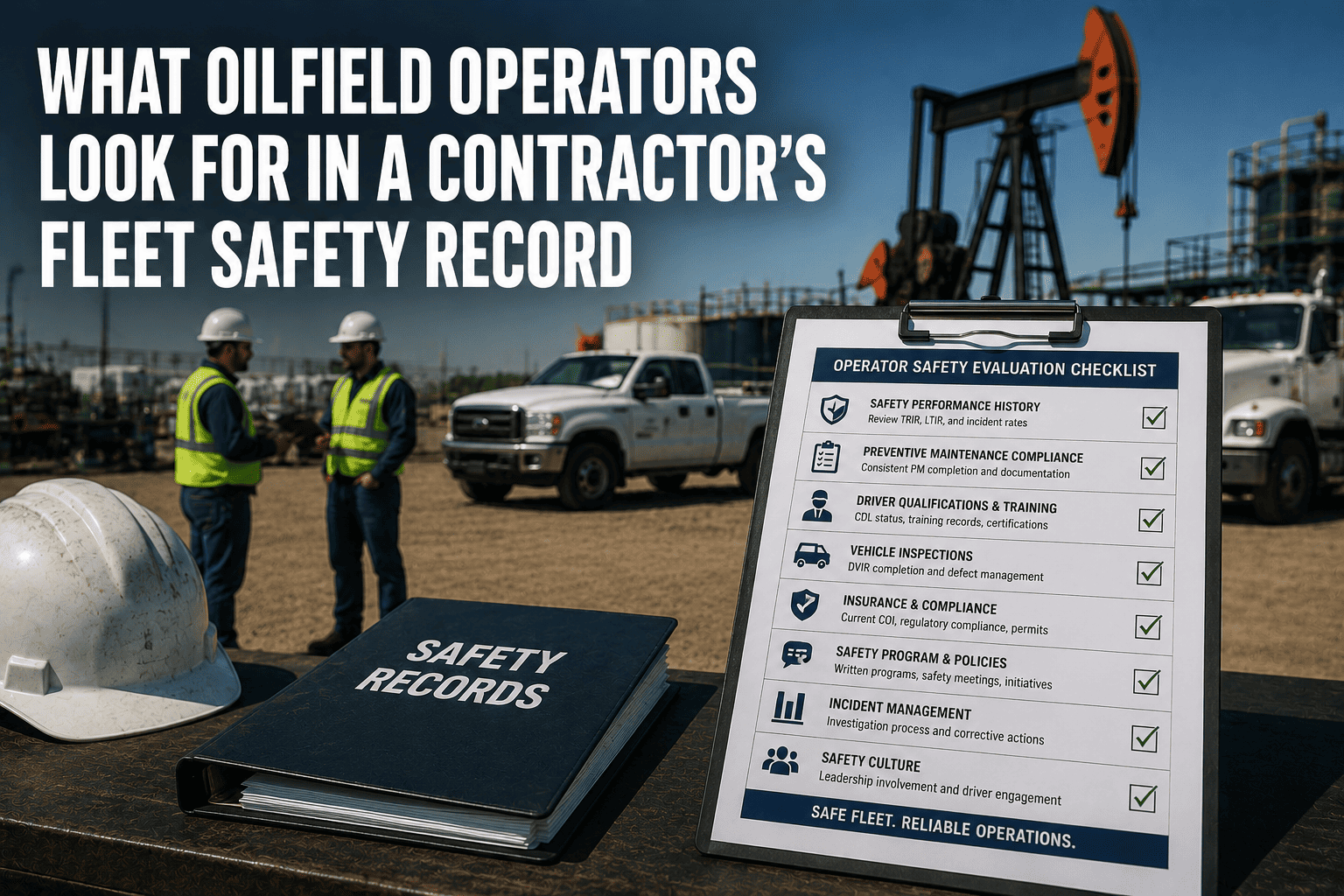
Oil and gas fleet managers face operational challenges that standard commercial fleet software cannot solve — from satellite connectivity gaps in remote basins to HAZMAT compliance failures that trigger $500,000 regulatory penalties. These challenges are not theoretical inconveniences; they are active threats to margin, uptime, and regulatory standing that cost operators $38–88 million annually per 500-vehicle fleet. Understanding these challenges is the first step toward eliminating them through purpose-built technology platforms like FleetRabbit.
This guide identifies the 10 most damaging fleet management challenges facing upstream, midstream, and downstream energy operators — and explains the specific FleetRabbit capabilities that solve each one without custom development or multi-year implementation timelines. Book a demo to see how FleetRabbit eliminates these challenges across your entire fleet.
Oil and Gas Fleet Management (And How FleetRabbit Solves Them)
From remote connectivity failures to HAZMAT compliance gaps, these 10 challenges cost energy operators $38–88M annually per 500-vehicle fleet. FleetRabbit eliminates each challenge through purpose-built capabilities that generic commercial platforms cannot deliver.
Why Oil and Gas Fleet Challenges Require Specialized Solutions
Generic commercial fleet platforms were designed for urban delivery, short-haul transport, and operations with consistent cellular coverage. They fail systematically in oilfield environments where vehicles operate 80 km from the nearest cellular tower, transport Class 3 flammables under ADR regulations, and accumulate engine hours at idle in temperature extremes. The challenges below represent operational realities that standard platforms cannot address — and that FleetRabbit was specifically engineered to solve.
Remote Connectivity Failures & Visibility Gaps
Cellular-only GPS tracking systems lose vehicles entirely when they enter remote basins — creating operational blind spots that average 47 minutes per incident and cost $180,000–$420,000 for search-and-rescue operations when emergencies occur in "dark" zones. Fleet managers cannot see vehicle locations, cannot contact drivers, and have no incident awareness if accidents, breakdowns, or medical emergencies occur beyond cellular range.
FleetRabbit's dual-mode cellular + satellite GPS provides continuous tracking with automatic fallback when vehicles move beyond cellular coverage. Two-way driver messaging, emergency SOS capability, and geofence alerts maintain full operational control regardless of infrastructure availability. Zero visibility gaps reported across Permian, Bakken, North Sea, and GCC remote basin deployments.
HSE Certification Compliance Failures
Manual spreadsheet tracking of driver and vehicle certifications (ADR, H₂S, ATEX, medical certificates, site access passes, LOLER inspections) cannot prevent compliance failures at scale. A driver arriving at a wellsite gate with lapsed H₂S certification costs the operation 4–8 hours minimum — and in strict enforcement jurisdictions, results in regulatory penalties from $5,000 to $250,000 per incident plus contract termination risk.
FleetRabbit tracks every certificate, qualification, and inspection date across every driver and vehicle with automated 60/30/7-day escalation alerts. The system blocks dispatch for non-compliant assignments before journey approval — preventing gate refusals and regulatory violations before they occur. Covers FMCSA, DVSA, ADNOC, DGMS, and client-specific HSE frameworks without custom development.
Unplanned Downtime From Reactive Maintenance
Mileage-based maintenance schedules fail systematically for oilfield vehicles that accumulate engine hours at idle, operate in temperature extremes (-40°F to 120°F), and experience accelerated wear from corrosive exposure and unpaved surfaces. Vehicles serviced "on schedule" still break down at remote wellsites 80 km from the nearest service depot — creating cascade delays across dependent operations and emergency repair costs 3–5× higher than planned maintenance.
FleetRabbit's predictive maintenance engine uses engine-hour accumulation, OBD-II fault code trending, and oilfield-specific condition triggers — not generic mileage intervals. Service schedules adjust for idle time, temperature extremes, and corrosive exposure patterns. Automatic work order generation routes maintenance requests to responsible technicians before failure occurs in remote locations.
HAZMAT Transport Compliance & Route Violations
HAZMAT transport without integrated routing controls results in tunnel violations, population-centre breaches, and restricted-zone entries that carry penalties from $10,000 to $500,000 per incident. Beyond regulatory fines, a single HAZMAT incident in a non-compliant zone can trigger operational shutdown, criminal prosecution of responsible officers, and insurance coverage denial. Generic platforms do not integrate HAZMAT routing restrictions or ADR consignment documentation into dispatch workflows.
FleetRabbit integrates HAZMAT-aware routing with tunnel, bridge, and population-centre restrictions per cargo classification. ADR and DOT consignment document management built directly into dispatch workflows. The platform prevents dispatch of uncertified drivers to HAZMAT loads and flags route violations before journeys begin — not after incidents occur.
Fuel Theft & Unauthorized Usage
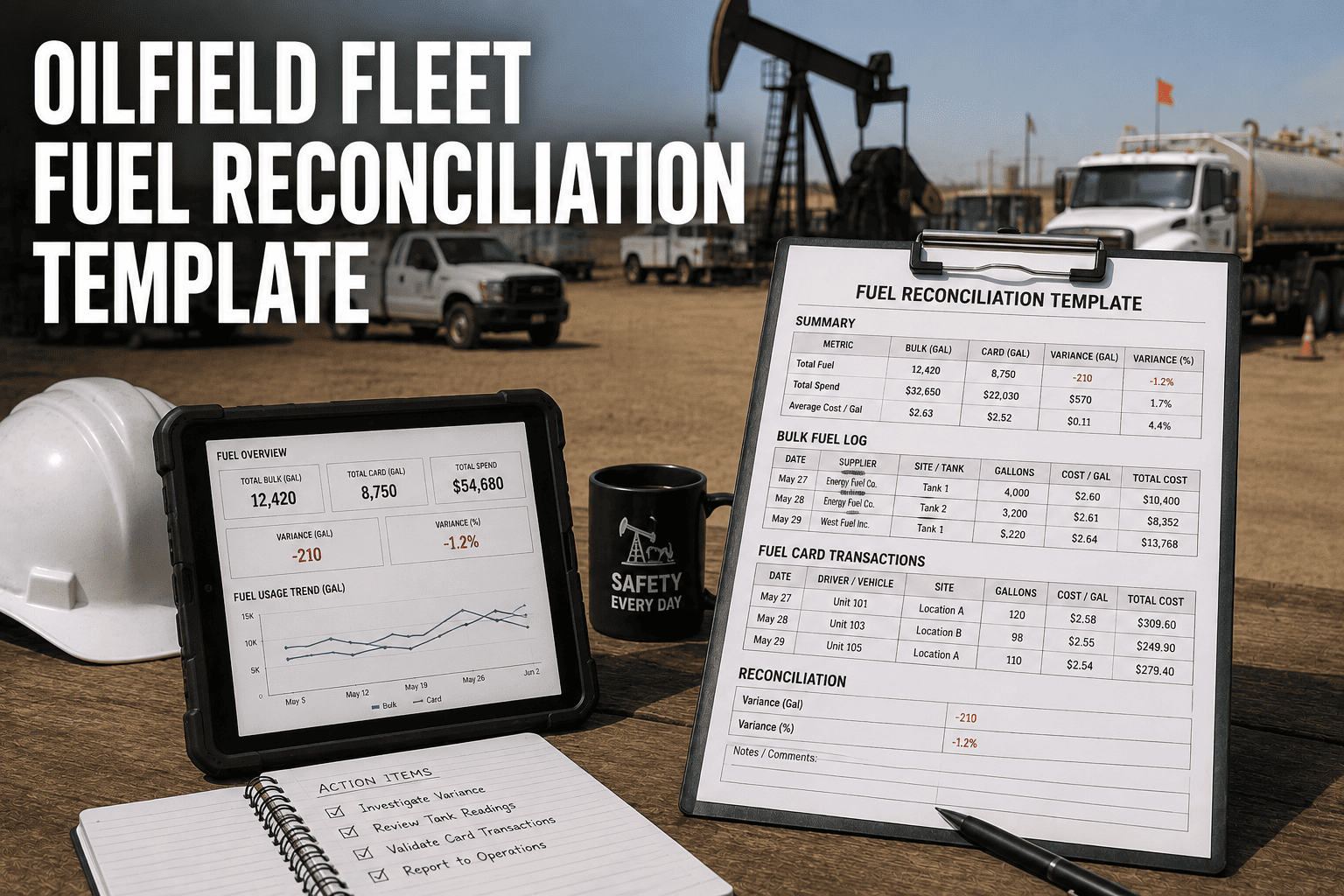
Fuel theft in remote oilfield operations occurs through siphoning, fraudulent fuel card transactions, and unauthorized vehicle use during off-hours. Without fuel monitoring integrated with GPS tracking, operators cannot distinguish legitimate consumption from theft — resulting in fuel losses averaging 8–15% of total fleet fuel expenditure. For a 500-vehicle fleet consuming 2 million gallons annually at $3.50/gallon, this represents $560,000–$1.05M in unrecovered losses.
FleetRabbit correlates fuel card transactions with GPS location data and engine hour accumulation to identify anomalies: fuel purchases when vehicles are off-duty, fill quantities exceeding tank capacity, purchases at locations outside assigned routes, and consumption rates inconsistent with engine runtime. Automated fraud alerts trigger investigation workflows before losses accumulate.
Driver Fatigue & Hours-of-Service Violations
Oilfield drivers working 14-hour shifts across multiple wellsites face fatigue-related incident risk 3× higher than standard commercial drivers. Manual logbooks cannot prevent hours-of-service violations in real-time — violations are only discovered during audits, resulting in $1,000–$16,000 fines per incident plus driver out-of-service orders. Fatigue-related accidents create liability exposure averaging $2.5M–$8M per serious incident.
FleetRabbit's electronic logging device (ELD) tracks driving hours, on-duty time, and rest periods automatically — alerting dispatchers and drivers when approaching hours-of-service limits per FMCSA, EU Drivers' Hours, or regional regulations. Driver behaviour monitoring identifies harsh braking, acceleration, and cornering patterns that correlate with fatigue. Proactive rest scheduling prevents violations before they occur.
Delayed Emergency Response in Remote Locations
Without real-time GPS and automated incident alerting, emergency response to remote field incidents averages 47 minutes from event to dispatch coordination. For medical emergencies, vehicle fires, or HAZMAT spills in locations 80+ km from professional emergency services, this delay is the difference between a managed incident and a catastrophic outcome. The liability and insurance cost of delayed response in a single serious incident can exceed $5M.
FleetRabbit's automated incident detection uses geofence breaches, harsh event triggers, and driver-activated SOS to route emergency alerts with precise GPS coordinates to designated responders. Two-way messaging enables immediate driver contact. Incident timeline documentation with timestamps and location history supports investigation and insurance claims. Average response coordination time reduced to 8 minutes — 83% faster than manual processes.
Incomplete or Inaccessible Compliance Records
Paper-based inspection records, manual logbooks, and spreadsheet certification tracking create compliance gaps that only become visible during regulatory audits or post-incident investigations. When auditors request driver qualification files, vehicle inspection histories, or HAZMAT consignment records, operators face 3+ days of manual retrieval across filing cabinets and office locations. Missing or incomplete records result in operational restrictions, license suspensions, and penalty assessments reaching $2M+ per major finding.
FleetRabbit's centralized cloud repository stores all inspection records, certifications, maintenance logs, and training documentation with timestamped integrity and role-based access control. One-click audit pack generation produces compliant records for any vehicle, driver, site, or time period in under 2 hours — formatted to satisfy FMCSA, DVSA, ADNOC, and DGMS audit requirements without manual assembly.
Executive Blind Spots & Delayed Risk Visibility
Operations directors and VPs receive safety and compliance reports that are 5–7 days out of date by the time field supervisors consolidate and submit them. This lag creates executive blind spots to emerging risk patterns, prevents proactive intervention, and results in board-level risk reporting that does not reflect current fleet health. When compliance issues or safety trends become visible to leadership, the opportunity for preventive action has already passed.
FleetRabbit's live executive dashboard provides real-time fleet-wide risk status, certification health, open defect counts, and maintenance cost trending across every site. Automated weekly and monthly digest reports deliver compliance status, incident trends, and cost variances directly to C-suite stakeholders. VPs and operations directors see current compliance status without waiting for field supervisors to consolidate data.
Offline Inspection Gaps in No-Connectivity Zones
Digital inspection platforms that require constant connectivity for record submission force drivers back to paper DVIRs in remote wellsite zones — defeating the entire purpose of digital workflows. When drivers revert to paper, inspection records do not reach maintenance teams until the next office visit (often 3–5 days), defects go unaddressed, and compliance gaps emerge that auditors will discover months later. The resulting paper-digital hybrid creates worse outcomes than fully paper systems.
FleetRabbit's mobile app operates fully offline. Drivers complete pre-trip and post-trip inspections, capture geo-tagged photos, and submit records with zero connectivity. All inspection data syncs automatically when signal returns, maintaining accurate timestamps from field completion time. Maintenance teams receive defect notifications within minutes of sync — not days later when the driver returns to the office.
Total Cost Impact of Unresolved Fleet Challenges
Solve All 10 Challenges in 5–7 Working Days
FleetRabbit deploys satellite GPS, offline DVIR, HSE compliance tracking, predictive maintenance, and executive dashboards on active oilfield fleets in 5–7 working days — including hardware delivery, configuration, training, and go-live. Enterprise platforms require 3–6 months for equivalent capability.
Frequently Asked Questions About Fleet Management Challenges
Ready to Solve Fleet Management Challenges That Cost $38–88M Annually?
FleetRabbit delivers satellite GPS, offline DVIR, HSE compliance automation, predictive maintenance, and live executive intelligence — deployed on your fleet in 5–7 days at $3/vehicle/month. Stop accepting challenges as operational realities.