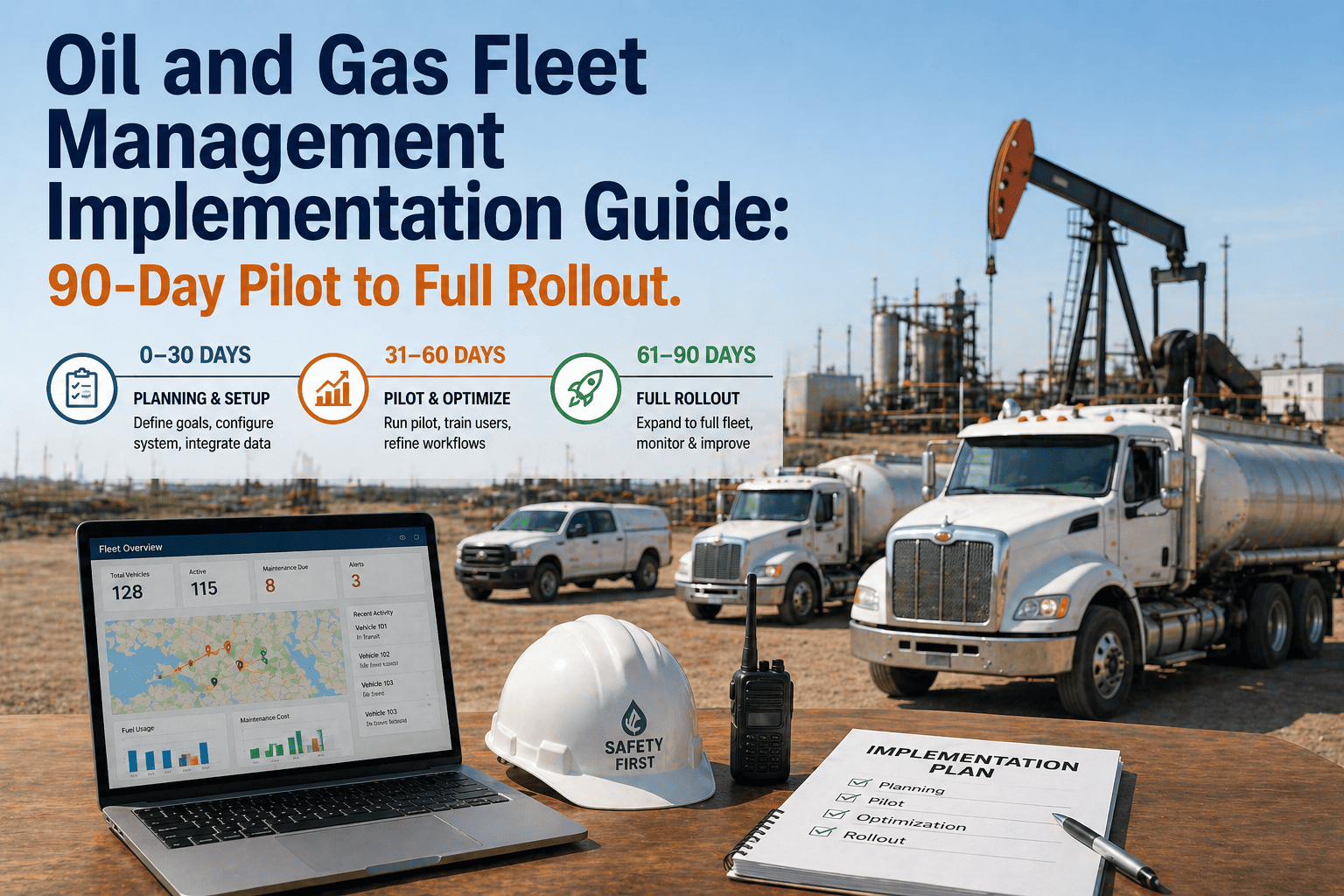
Fleet management software implementation in oil and gas operations represents a complex technical and organizational change initiative where success depends not on feature selection or vendor capabilities, but on structured deployment methodology that addresses data migration complexity, driver adoption resistance, legacy system integration requirements, and stakeholder alignment across operations, maintenance, safety, and executive leadership teams. A Permian Basin operator managing 220 vehicles across drilling, completion, and production operations completed FleetRabbit implementation in 87 days — achieving 97% driver adoption, zero data loss during migration from paper-based systems, seamless integration with existing maintenance and accounting platforms, and measurable ROI within first 120 days including 34% reduction in vehicle downtime, 28% decrease in fuel costs, and elimination of 18 hours per week of manual compliance documentation. This comprehensive implementation guide provides the exact 90-day pilot-to-production deployment framework that successful operators use to transition from legacy fleet management approaches to modern integrated platforms, including week-by-week task breakdowns, stakeholder engagement protocols, common failure mode prevention, and quantifiable success metrics that demonstrate value to executive leadership and board oversight. Schedule implementation planning consultation to design your deployment roadmap.
Oil & Gas Fleet Management Implementation Guide: From Pilot to Production
Structured deployment methodology covering pilot program design, stakeholder alignment, data migration, driver training, system integration, and ROI measurement for successful fleet management platform rollout across oilfield operations
Pre-Implementation Planning: Stakeholder Alignment & Success Criteria Definition
Successful fleet management implementation begins before hardware installation or software configuration — requiring executive sponsorship, cross-functional stakeholder alignment, clear success metrics, realistic timeline expectations, and documented change management protocols that address the organizational resistance patterns that cause 40% of fleet technology projects to fail or underdeliver on promised ROI.
Executive Sponsorship Establishment
Identify executive sponsor with authority to allocate resources, resolve inter-departmental conflicts, and maintain implementation momentum when operational priorities compete for attention. Effective sponsors typically hold VP Operations, VP Fleet, or Director of HSE roles with direct reporting relationship to C-suite leadership and budget authority over fleet operations, maintenance, and safety programs.
Cross-Functional Stakeholder Team Formation
Assemble implementation team representing all affected departments — fleet operations, maintenance, safety/HSE, IT, finance, and driver representatives — ensuring each stakeholder group has voice in requirements definition, configuration decisions, and success metric establishment. Team composition determines whether implementation serves narrow fleet management interests or delivers enterprise value across operations, compliance, and financial optimization.
Success Metrics & ROI Baseline Establishment
Document current-state performance metrics across operational efficiency, safety outcomes, compliance burden, and cost structure — creating quantitative baseline against which implementation success will be measured. Without documented pre-implementation metrics, organizations cannot demonstrate ROI or justify continued platform investment during budget review cycles.
FleetRabbit Pre-Implementation Support
FleetRabbit provides structured pre-implementation planning workshop (included in base subscription, not billable professional services) covering stakeholder identification, success metric definition, integration requirement assessment, and realistic timeline establishment. Workshop deliverable includes documented implementation plan, stakeholder RACI matrix, success criteria agreement, and executive presentation template for board/leadership approval. Unlike enterprise platforms requiring 6-12 week scoping engagements at $15K-$35K professional services fees, FleetRabbit completes planning phase in single 90-minute workshop.
Ready to Start Your Implementation Journey?
FleetRabbit's structured deployment methodology eliminates the trial-and-error approaches that cause traditional implementations to exceed timelines and budgets. Our 90-day framework is proven across 200+ oilfield fleet deployments.
Start Free Trial TodayPhase 1: Pilot Program Launch with Representative Vehicle Cohort
Pilot program establishes proof of concept with limited vehicle subset before committing to full fleet deployment — validating technical functionality, testing driver adoption strategies, identifying integration challenges, and demonstrating measurable value to skeptical stakeholders who view new technology initiatives as operational disruption rather than improvement opportunity.
Pilot Vehicle Selection Strategy
Optimal pilot cohorts include 15-25 vehicles representing diverse operational profiles — mix of vehicle classes (light-duty pickups, heavy-duty service trucks, specialized equipment haulers), duty cycles (local wellsite service, long-haul crude transport, mixed operations), and driver experience levels (veterans, recent hires, contractors). Avoid selecting only newest vehicles with tech-savvy drivers or only problem assets with difficult operators — either extreme produces pilot results that do not predict full fleet outcomes.
Week-by-Week Pilot Execution Plan
FleetRabbit Pilot Program Advantages
FleetRabbit's pilot programs benefit from 5-7 day hardware delivery and zero professional services requirements for basic configuration — eliminating the 4-8 week procurement and scoping delays common with enterprise fleet platforms. Pilot pricing matches production pricing at $3/vehicle/month with no minimum commitments, setup fees, or forced annual contracts — allowing genuine risk-free evaluation rather than vendors using pilot periods to lock customers into long-term agreements before functionality proven. Dedicated implementation specialist assigned to every pilot provides daily check-ins during Week 1-2, ensuring rapid issue resolution rather than generic support ticket queues.
Phase 2: Full Fleet Expansion & Legacy System Migration
Fleet expansion phase transitions from controlled pilot environment to production-scale deployment — managing hardware installation logistics across 100+ vehicles, migrating historical data from legacy systems, training workforce populations of 50-200+ drivers, integrating with enterprise IT infrastructure, and maintaining operational continuity while transitioning from old processes to new platform workflows.
Parallel Expansion Work Streams
Telematics Hardware Deployment
Stagger hardware installation across vehicle cohorts of 20-30 vehicles per week to prevent overwhelming maintenance team capacity and minimize operational disruption. Prioritize high-value assets first (newest vehicles, highest utilization units, executive transport) to demonstrate quick wins, then expand to remainder of fleet systematically rather than attempting simultaneous installation across all vehicles.
Historical Data Migration & Validation
Import historical maintenance records, inspection histories, certification documentation, and incident reports from legacy systems (spreadsheets, paper files, previous fleet software) to provide complete vehicle and driver history context. Data migration determines whether new platform immediately delivers value through comprehensive historical analysis or requires 6-12 months of new data collection before meaningful insights emerge.
Workforce Training & Change Management
Scale driver training beyond pilot group through combination of in-person sessions for complex workflows, video tutorials for basic tasks, and peer mentoring where pilot program champions support colleagues during initial adoption period. Training effectiveness determines whether workforce views new platform as productivity tool or compliance burden imposed by management without operational value.
Enterprise System Integration
Connect fleet management platform to existing enterprise systems including ERP for cost allocation, accounting software for invoice processing, fuel card systems for consumption reconciliation, and CMMS for maintenance work order synchronization. Integration complexity and timeline varies dramatically based on legacy system API availability and internal IT resource capacity.
FleetRabbit Expansion Phase Support
FleetRabbit includes unlimited user accounts, unlimited data storage, and unlimited API calls in base $3/vehicle/month pricing — eliminating per-seat licensing fees that cause enterprise platforms to charge $15-$45 per dispatcher/manager account on top of per-vehicle fees. Data migration assistance included through CSV import templates for common formats (Excel maintenance logs, legacy fleet software exports). Standard REST API with comprehensive documentation enables IT teams to build integrations independently rather than requiring $8K-$25K vendor professional services engagements for basic ERP connections.
Fleet management implementation success depends on structured methodology and vendor support quality — not just software features. FleetRabbit's 90-day framework with included implementation specialist ensures your deployment stays on timeline and delivers promised ROI. Schedule implementation planning session to design your deployment roadmap.
Phase 3: Platform Optimization & Advanced Feature Activation
Optimization phase transitions from basic GPS tracking and DVIR compliance to advanced analytics, predictive maintenance, driver behavior coaching, and executive intelligence dashboards that differentiate high-performing fleet operations from those achieving only marginal improvement from technology investments. Most implementations stall at basic functionality deployment without progressing to advanced capabilities that deliver 60-80% of total platform ROI.
Predictive Maintenance Model Calibration
Predictive maintenance requires 4-6 weeks of fault code data collection before AI models achieve sufficient accuracy to generate actionable alerts without overwhelming maintenance teams with false positives. Optimization phase reviews initial predictive alerts, adjusts sensitivity thresholds based on actual failure patterns observed in your specific fleet, and establishes protocols for how maintenance teams will respond to different alert priority levels.
Driver Behavior Coaching Program Launch
Driver behavior monitoring generates immediate data on harsh braking, aggressive acceleration, speeding, and idling patterns — but translating data into behavioral improvement requires structured coaching program with clear expectations, consistent feedback delivery, positive reinforcement for improvement, and consequences for persistent unsafe behaviors. Technology alone changes nothing; coaching programs enabled by technology data drive actual safety improvements.
Executive Dashboard Configuration & KPI Selection
Executive leadership requires different information than operational managers — focusing on fleet-wide trends, comparative performance across regions or contractors, financial metrics, and leading indicators of emerging problems rather than individual vehicle details. Optimization phase configures executive dashboards with appropriate KPIs, automated report distribution, and alert thresholds that notify leadership of significant deviations without overwhelming them with operational noise.
Compliance Automation & Audit Readiness
Full compliance automation requires moving beyond digital DVIR to comprehensive certification tracking, automated expiry alerts, dispatch blocking for non-compliant drivers, and one-click audit pack generation for regulatory reviews. Optimization phase activates these advanced compliance features that transform fleet management from reactive problem response to proactive compliance assurance.
FleetRabbit Advanced Feature Enablement
FleetRabbit includes all advanced features — predictive maintenance AI, driver behavior scoring, executive dashboards, compliance automation, multi-region regulatory support — in base $3/vehicle/month pricing without feature paywalls or tier upgrades. Optimization phase focuses on configuration and adoption rather than budget approvals for additional modules. Platform's context-sensitive help system and implementation specialist guidance ensure advanced features are activated with appropriate settings rather than using generic defaults that generate alert fatigue or miss critical events.
ROI Measurement & Continuous Improvement Framework
Implementation success extends beyond technical deployment to quantifiable business impact measurement — documenting operational improvements, cost reductions, safety enhancements, and compliance burden elimination in financial terms that justify platform investment and secure continued executive support through budget cycles and organizational changes.
Operational Efficiency Gains
Cost Reduction Metrics
Safety Performance Improvement
Executive ROI Reporting Template
Present implementation results to executive leadership and board oversight using structured financial framework that translates operational metrics into business impact language.
Deploy Fleet Management Platform with Confidence Using Structured Methodology
FleetRabbit's implementation framework eliminates the trial-and-error approaches that cause traditional deployments to exceed timelines, budgets, and patience. Our 90-day pilot-to-production methodology is proven across 200+ oilfield fleet implementations with average 97% driver adoption rate and measurable ROI within 120 days.