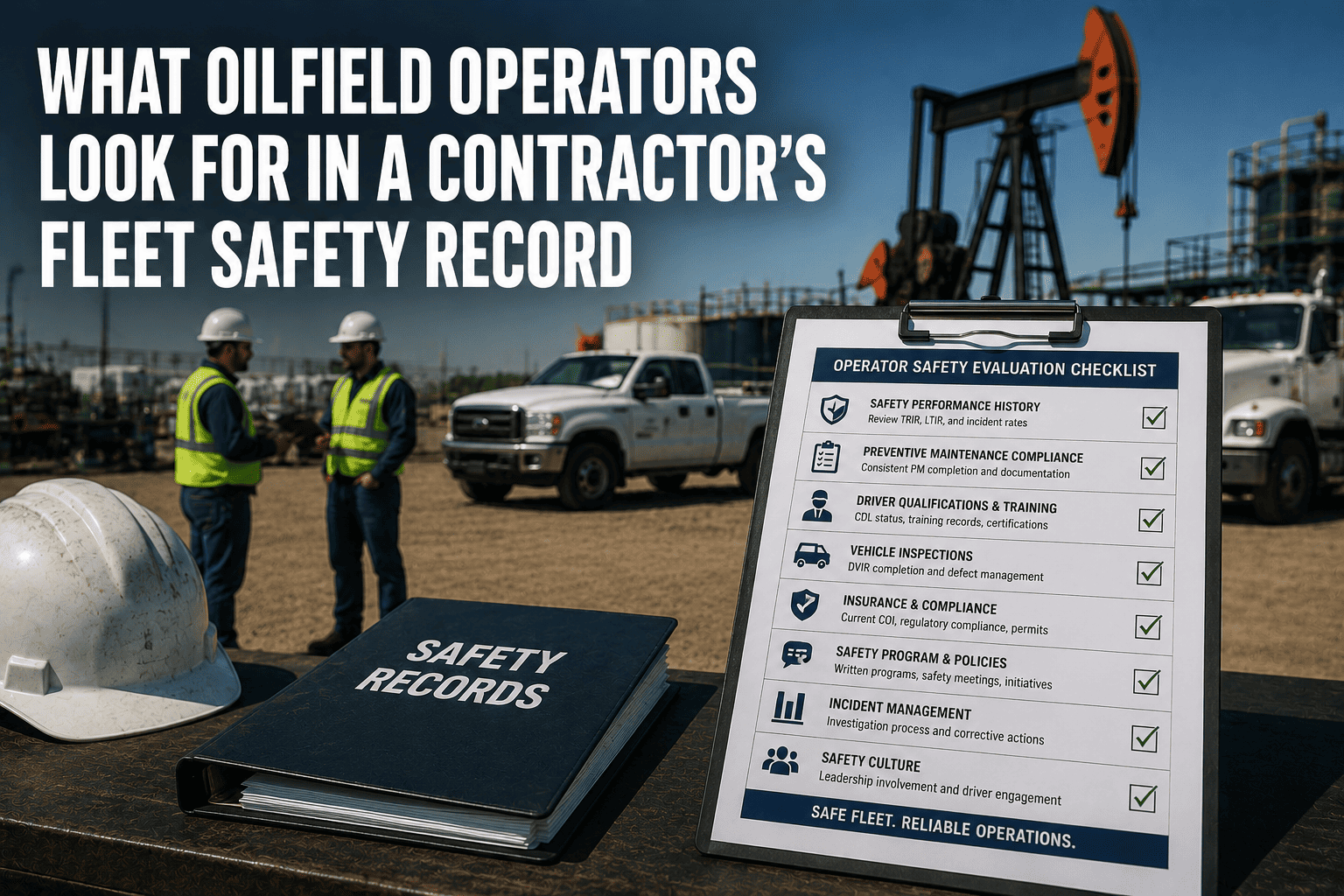
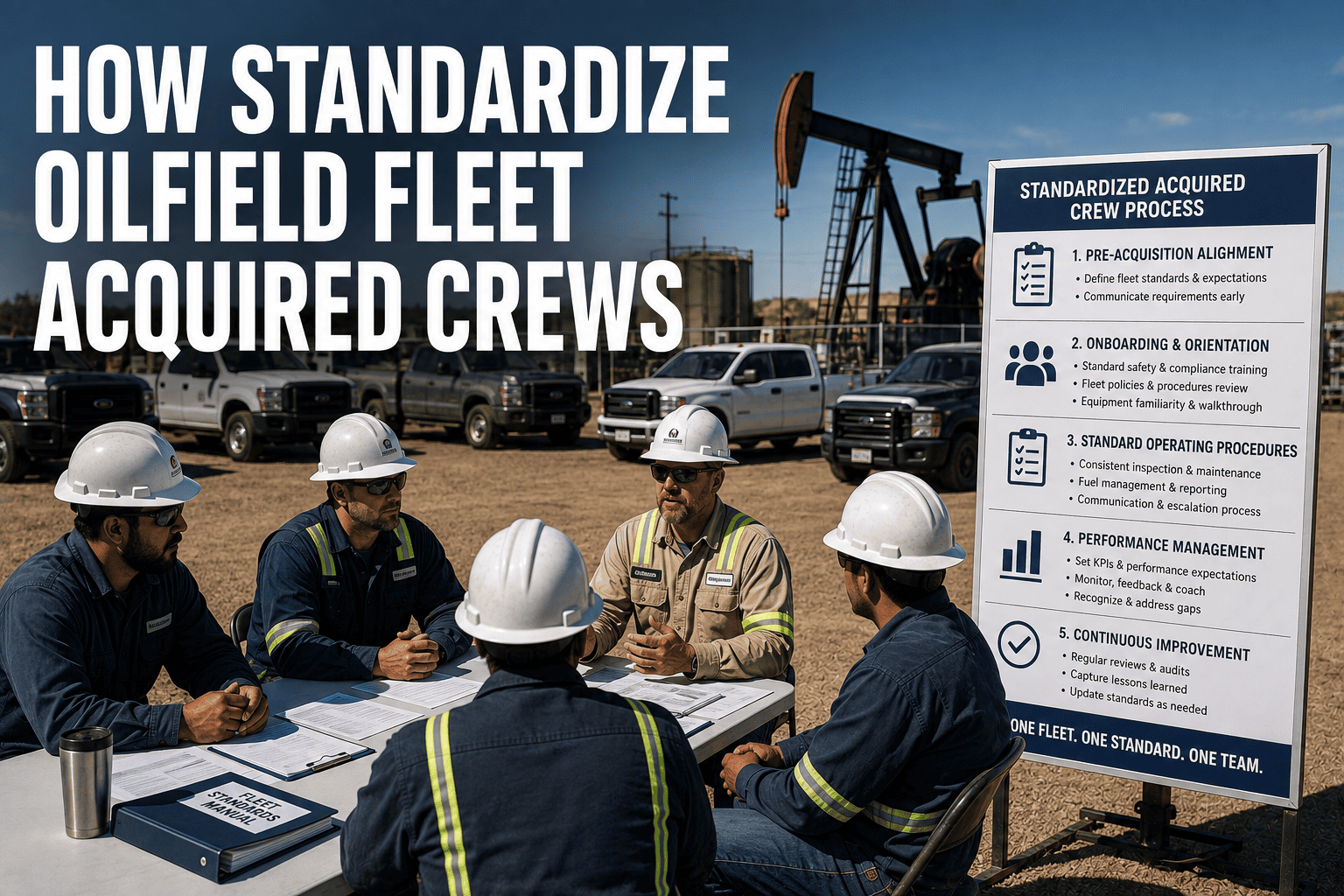
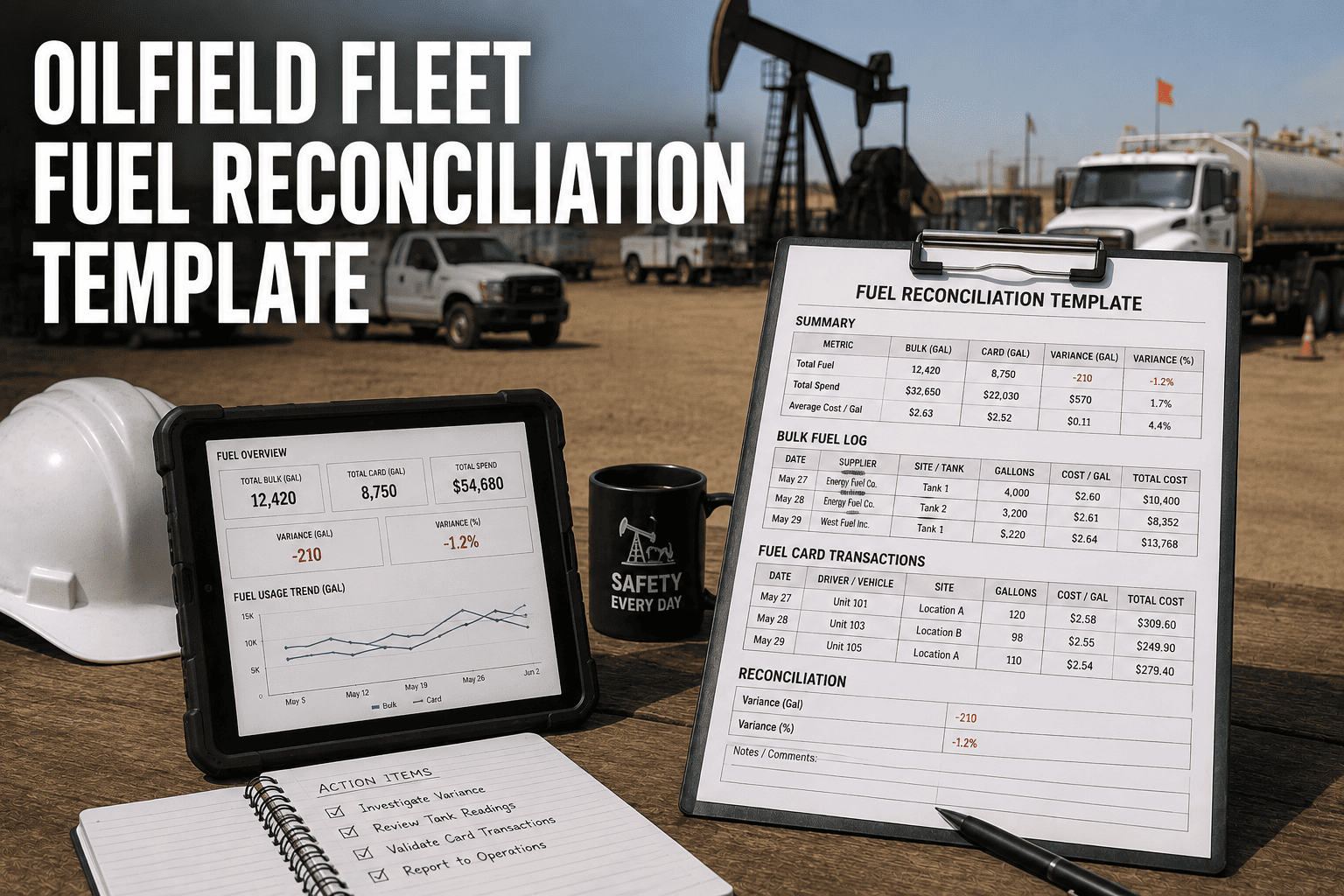
Every upstream and midstream oil and gas fleet operates at the intersection of regulatory compliance, operational safety, and commercial performance — a combination that demands written standard operating procedures (SOPs) that govern every repeatable workflow from morning driver dispatch to emergency HAZMAT response. Fleet managers who rely on verbal instructions, tribal knowledge, or outdated binders face compounding risk: regulatory violations when a driver self-certifies a defective vehicle, insurance exposure when a HAZMAT incident lacks documented response steps, contractor disqualification when an ADNOC or Aramco HSE audit finds no written procedures, and operational losses when a new fleet coordinator doesn't know the inspection protocol for a pressure pumper arriving from a third-party yard. This comprehensive Oil and Gas Fleet Manager SOP Template covers all six critical operating domains — driver dispatch, DVIR inspection, HAZMAT handling, maintenance scheduling, emergency response, and contractor management — pre-structured for DOT FMCSA, OSHA, PHMSA, and operator HSE compliance. FleetRabbit digitises and enforces every SOP in this template automatically, replacing manual procedure checklists with guided digital workflows, real-time compliance monitoring, and audit-ready documentation. See how FleetRabbit automates your fleet SOPs — book a demo.
THE BUSINESS CASE
Why Written SOPs Are Non-Negotiable for Oil & Gas Fleet Operations
Regulators, insurers, and major operators all evaluate fleet management quality through the lens of documented procedures. An undocumented fleet operation is not an operational choice — it is an unquantified liability waiting for its triggering event.
Regulatory Audit Survival
DOT FMCSA, OSHA, and PHMSA inspectors evaluate not just compliance records but the systems behind them. A written SOP demonstrating that every driver follows a pre-trip inspection procedure, every HAZMAT shipment uses a certification-verified driver, and every incident triggers a documented response — is direct evidence of a functioning safety management system. Its absence is a red flag that elevates audit intensity and penalty exposure across every finding.
Operator Contract Retention
ADNOC, Aramco, Shell, BP, and most IOCs require written HSE procedures as a minimum contractor pre-qualification standard. Missing documentation can disqualify a fleet from contract award regardless of operational track record.
Operational Continuity
Fleet coordinator turnover in oilfield operations averages 28% annually. Without written SOPs, institutional knowledge walks out the door — new coordinators improvise procedures, creating inconsistency that surfaces as compliance failures and operational gaps during peak activity periods.
Insurance Premium Leverage
Commercial fleet insurers apply risk loading factors based on documented safety management system maturity. Operators with written dispatch, inspection, and emergency response SOPs consistently demonstrate lower claim frequency — and negotiate lower base premiums as a result.
Litigation Defence
In post-incident litigation, the question is not just what happened — but whether the operator had a system to prevent it. Written SOPs, training records, and documented compliance are the primary evidence that transforms a negligence claim into a manageable insurance matter.
The dispatch SOP governs every driver-vehicle assignment from initial work order receipt to load departure — ensuring that no vehicle departs without verified driver qualifications, current vehicle inspection status, and complete load documentation. In oil and gas operations where drivers may be dispatching to remote wellsites 150 km from the nearest town, a dispatch failure is not a scheduling inconvenience — it is a safety and regulatory event.
Procedure Steps
01
Work Order Receipt & Classification
Receive work order from operations/logistics. Classify load type (standard, HAZMAT, oversize, restricted route). Determine applicable regulatory requirements based on classification. Flag HAZMAT loads for certification-verified driver pool only.
02
Driver Qualification Verification
Confirm driver CDL class and endorsements (HAZMAT/N/X as required). Verify HOS availability — minimum 10-hour rest period observed. Check driver certification currency: H₂S Alive, HAZMAT endorsement, operator site access credentials. Confirm driver is not in post-incident return-to-duty protocol.
03
Vehicle Assignment & Inspection Status Check
Assign vehicle appropriate for load type and route. Verify last DVIR completed with no open defects tagged Out-of-Service. Confirm current annual inspection validity. For HAZMAT vehicles: confirm placard certification and emergency equipment inventory are current.
04
Load Documentation Preparation
Issue Bill of Lading / shipping papers with all required fields completed. For HAZMAT: verify proper shipping name, UN number, hazard class, packing group, emergency contact. Confirm load is within vehicle weight and dimension limits for designated route. Issue wellsite access credentials and site-specific safety briefing if first visit.
05
Pre-Departure Confirmation & Departure Logging
Conduct verbal departure briefing: destination, route, estimated arrival, check-in intervals, emergency contact. Record departure time, driver name, vehicle unit, and load manifest in dispatch log. Set GPS tracking and geofence alerts for route monitoring. Confirm satellite connectivity active for remote wellsite routes.
06
En-Route Monitoring & Arrival Confirmation
Monitor GPS tracking at defined intervals (minimum every 2 hours for remote routes). Initiate check-in protocol if vehicle does not respond within 30 minutes of scheduled check-in. Confirm wellsite arrival via GPS geofence alert or driver app check-in. Record actual arrival time and any deviations from planned route.
FleetRabbit Automates This SOP
✓
Dispatch blocking prevents assignment of HAZMAT loads to drivers with lapsed endorsements or insufficient HOS — automatically, at point of dispatch
✓
H₂S Alive, site access credentials, and CDL endorsement expiry tracked per driver with 60/30/7-day alerts — no manual certification diary
✓
Vehicle assignment panel shows real-time DVIR status, annual inspection validity, and defect tags for every unit — dispatcher sees compliant vehicles at a glance
✓
Wellsite geofence alerts trigger automatically on arrival and departure — no manual check-in calls required for remote location confirmation
✓
Satellite GPS maintains continuous vehicle tracking beyond cellular coverage — dispatchers see remote fleet visibility with zero dead zones
✓
Check-in failure alerts escalate automatically to fleet manager if driver misses scheduled check-in — lone-worker safety enforced by platform
See Dispatch Automation Live →
DVIR completion is a mandatory DOT FMCSA requirement under 49 CFR 396.11 for CMVs in commercial operation. For oilfield fleets, the inspection requirement extends to the specific components that fail under oilfield duty cycles — not the abbreviated checklist designed for highway delivery trucks.
PRE-TRIP INSPECTION
Before every departure · Required by 49 CFR 396.11
Engine & Powertrain
Engine oil levelCoolant levelBelt conditionAir filter indicatorFuel level & leaksBattery terminals
Brakes & Wheels
Air pressure (90–120 PSI)Brake adjustmentTyre tread & pressureWheel torque indicatorsBrake lining visible wear
Lights & Electrical
HeadlightsReverse alarmHazard lightsMarker lightsELD function check
HAZMAT-Specific (if applicable)
Placard secured & correctEmergency kit presentFire extinguisher chargedSpill kit completeSDS onboard
EN-ROUTE CHECK
Every 3 hours or 250 km on remote routes
Tyre condition visualLoad securementEngine temp gaugeAir pressure gaugeUnusual noise / vibrationSatellite connectivity active
POST-TRIP INSPECTION
After every return to yard · Driver certification required
Defect Reporting
All defects noted by typeSeverity classificationPhoto documentationDriver certification signature
Mechanic Review
Defect reviewed within 4 hoursOOS determination madeRepair order createdReturn-to-service sign-off
Automate every SOP step. Deploy in 5–7 days.
FleetRabbit enforces dispatch blocking, DVIR compliance, HAZMAT certification checks, and maintenance scheduling — all at $3/vehicle/month with zero add-on fees.
Oilfield fleet HAZMAT operations — transporting crude oil, produced water, well stimulation chemicals, and drill cuttings — generate daily dangerous goods compliance obligations under DOT PHMSA 49 CFR Parts 171–180. A HAZMAT SOP is not optional documentation: it is the operational backbone that determines whether your team knows what to do before, during, and after a dangerous goods incident.
PRE-LOAD
Before Accepting a Dangerous Goods Load
Confirm driver holds current HAZMAT endorsement (CDL class A/B with H or X endorsement). Verify endorsement not within 30 days of expiry.
Obtain Material Safety Data Sheet (SDS/MSDS) for all materials being transported. Confirm SDS version is current and accessible offline on driver device.
Verify vehicle placard configuration matches cargo hazard class and UN number. Photograph placard placement and record in DVIR.
Complete shipping papers: proper shipping name, UN number, hazard class, packing group, quantity, emergency contact (CHEMTREC: 1-800-424-9300).
Confirm spill response kit is onboard and fully stocked: absorbent material, containment boom, personal protective equipment, and NRC notification guide.
Verify route does not transit HAZMAT-restricted tunnels or bridges. Obtain alternate routing approval if required.
EN-ROUTE
During Dangerous Goods Transport
Maintain shipping papers within driver reach at all times. Papers must be accessible to emergency responders within 30 seconds of cab exit.
No smoking within 25 feet of HAZMAT cargo. No idling near ignition sources at wellsites or tank farm locations.
Conduct visual cargo check at every en-route stop. Document any unusual odour, leakage, or pressure variation in trip log.
If route deviation required: notify dispatch immediately. Do not transit HAZMAT-restricted infrastructure regardless of GPS direction.
Activate satellite check-in if cellular connectivity lost. Do not proceed beyond last confirmed GPS point without check-in confirmation.
SPILL RESPONSE
If a Release Occurs
Immediate: Move to safe upwind position. Do not re-enter spill area without PPE. Call 911 if injury, fire, or release exceeding containment.
Within 15 minutes: Call dispatch and HSE coordinator. Provide GPS location, material released, estimated quantity, pathway (soil/water/air).
Within 1 hour: Assess NRC reportability. If qualifying release: call National Response Center at 1-800-424-8802. Record NRC confirmation number.
Containment: Deploy absorbent materials only if safe to do so without additional exposure. Photograph containment actions with geo-tagged device.
Documentation: Complete PHMSA incident report (DOT Form F 5800.1) within 30 days of qualifying release. Retain all records for minimum 2 years.
FleetRabbit HAZMAT Compliance: Dispatch blocking prevents HAZMAT load assignment to drivers with lapsed endorsements. Digital SDS library is accessible offline on driver mobile devices. Incident response workflow captures geo-tagged photos, spill details, and NRC notification log directly in the platform — no paper forms, no transcription.
See HAZMAT workflows →
Oilfield vehicles operate under extreme duty cycles — extended idle on wellsite locations, high-vibration gravel roads, desert heat, and continuous hydraulic system stress — that standard highway maintenance intervals fail to account for. A maintenance SOP built on generic OEM schedules produces premature failures; one built around actual oilfield operating conditions extends asset life and reduces unplanned downtime.
Maintenance Item
Standard Highway Interval
Oilfield SOP Interval
Rationale
Engine Oil & Filter
25,000 km
12,000 km or 400 engine hours
Extended wellsite idle accelerates oil degradation without proportional km accumulation
Air Filter Replacement
Per indicator only
Inspect every 5,000 km; replace every 15,000 km minimum
Dust loading on lease roads and wellsite locations is 10–40× highway levels
Brake Inspection
Annual or 50,000 km
Every 20,000 km or 6 months
Gravel road grade braking and loaded wellsite stops accelerate lining wear significantly
Tyre Rotation & Inspection
Every 40,000 km
Every 15,000 km — visual at every DVIR
Rock puncture and sidewall damage on lease roads requires continuous monitoring, not periodic checks
Hydraulic System (vacuum/pressure trucks)
Not applicable
Fluid & seal check every 250 operating hours
High-cycle hydraulic operations in wellsite environments produce accelerated seal wear and contamination
Cooling System Flush
Every 160,000 km
Every 60,000 km or 2 years
Extended idle at wellsites causes coolant additive depletion at rates not reflected in highway-based intervals
Annual DOT Inspection
Once per year (required)
Once per year + mid-year comprehensive inspection
Oilfield wear rates justify semi-annual comprehensive inspection to avoid OOS findings during operating season
Try Predictive Maintenance Free →
Emergency response in oilfield fleet operations spans three distinct scenario types — vehicle accidents on remote lease roads, H₂S exposure events at production facilities, and lone-worker non-response situations — each requiring a different initial response sequence. This SOP defines escalation protocols, notification timelines, and documentation requirements for all three.
T+0Driver: ensure own safety, call 911 if injury or HAZMAT release, move to safe location
T+15minDriver: call dispatch via satellite if no cellular. Report GPS location, injury status, vehicle status, load type
T+30minFleet Manager: assess DOT reportability. Brief HSE Director and legal counsel if qualifying accident
T+8hrPost-accident alcohol test must be completed if testing trigger met (per 49 CFR 382.303)
T+32hrPost-accident controlled substance test must be completed
T+24hrPreserve ELD data, dashcam footage, GPS track log, and all vehicle records
T+0Don SCBA if available. Evacuate upwind of H₂S source. Alert others via radio/SOS. Do not attempt rescue without breathing apparatus
T+5minActivate personal H₂S monitor alarm via FleetRabbit SOS. GPS location transmitted automatically to dispatch and HSE
T+15minFleet Manager: confirm evacuation, coordinate emergency services, notify site safety officer
T+1hrMedical evaluation of all potentially exposed personnel. OSHA recordability determination initiated
T+24hrIncident report completed. OSHA 300/301 determination made. Return-to-site protocol activated only after air quality clearance
T+0Check-in interval missed. FleetRabbit dispatches automated alert to fleet manager with last known GPS position
T+10minFleet Manager: attempt contact via all channels (cell, satellite phone, radio relay). Check GPS — is vehicle moving or stationary?
T+20minNo contact confirmed: activate nearest responder protocol. Dispatch second vehicle or notify site safety. Alert HSE Director
T+30minIf remote location with no nearby resources: contact RCMP/State Police with GPS coordinates and vehicle description
T+60minFull emergency search protocol active. All non-response incidents are documented regardless of outcome for SOP review
Oilfield operators bear HSE responsibility for contractor vehicles operating on their leases, pads, and facilities — regardless of whether those vehicles are owned by the operator. An operator whose contractor has a HAZMAT incident or OSHA recordable injury on-site faces the same regulatory scrutiny as if the vehicle were part of their own fleet. Contractor fleet management SOPs are therefore an operator liability management tool, not a courtesy service.
1
Contractor Pre-Qualification
Obtain current USDOT number and operating authority (MC number) for all carrier contractors
Verify DOT safety rating — Satisfactory or Conditional only. No Unsatisfactory-rated carriers accepted
Confirm insurance certificates: commercial auto minimum limits, MCS-90 endorsement, cargo coverage
Review FMCSA BASIC scores for each carrier — flag any score exceeding 65% in SMS system
Obtain written confirmation of HAZMAT certification for all HAZMAT-classified transport assignments
Confirm drug and alcohol testing programme in place per DOT 49 CFR Part 40
2
Driver-Level Onboarding
Verify CDL class, endorsements, and state validity for each contractor driver assigned to operator work
Confirm H₂S Alive certification for all drivers accessing H₂S-present production zones
Confirm site-specific safety orientation completed (operator wellsite induction)
Issue operator access credentials and wellsite gate code as applicable — timed to assignment, not open-ended
Register driver in FleetRabbit contractor portal — certification expiry dates tracked with automated alerts
3
Active Assignment Monitoring
Contractor vehicles appear in FleetRabbit unified fleet map alongside owned assets — single visibility pane for dispatch and HSE teams
GPS tracking active for all contractor vehicles on operator sites — geofence alerts for unauthorised area entry
DVIR completion tracked per trip — incomplete DVIRs generate dispatch hold notification
Certification expiry alerts escalate to fleet manager 30 days before any driver or vehicle certification lapses
4
Disqualification Triggers
DOT safety rating downgrade to Unsatisfactory — immediate removal from approved vendor list pending review
Unresolved OOS vehicle operated on operator assignment — suspension pending safety audit
Failure to complete post-accident drug/alcohol test within required window — immediate suspension
Lapsed HAZMAT endorsement on HAZMAT-assigned driver — load reassignment and written notice
Two or more DVIR violations within 30-day period — performance notice and corrective action plan required
FREQUENTLY ASKED QUESTIONS
Oil & Gas Fleet SOP: Fleet Manager Questions Answered
Are written SOPs legally required for oilfield fleet operations?
DOT FMCSA does not mandate written SOPs by name, but requires operators to maintain systematic compliance programs — which regulators assess through documentation. OSHA requires written programs for specific elements (hazard communication, PPE). Major oilfield operators and IOCs require written procedures as a contractor pre-qualification standard, making SOPs a commercial necessity regardless of regulatory baseline.
How often should oilfield fleet SOPs be reviewed and updated?
Annual review is the minimum standard. Trigger reviews are also required after any significant incident, regulatory change, equipment or route change, or when FMCSA/OSHA inspection findings identify procedural gaps. FleetRabbit's digital SOP workflows can be updated centrally and pushed to all drivers immediately — eliminating the version-control problem of paper SOPs in multi-site operations.
Do these SOPs cover contractor drivers or only employed drivers?
SOP 06 specifically governs contractor fleet management. For SOPs 01–05, procedures should be applied to all drivers operating on the operator's behalf — including contractors — and the FleetRabbit contractor portal extends digital SOP enforcement to third-party drivers without requiring separate platform subscriptions per contractor company.
How does FleetRabbit handle SOP compliance for international oilfield operations?
FleetRabbit supports FMCSA (USA), DVSA (UK/EU), ADNOC (UAE), and DGMS (India) regulatory frameworks natively. Multi-region fleet operators can configure region-specific SOP workflows within a single platform — dispatching under ADNOC procedures for UAE assets and FMCSA procedures for North American assets from one dashboard with zero custom development required.
What is the difference between a maintenance SOP and a predictive maintenance system?
A maintenance SOP sets calendar and usage-based intervals — the minimum standard for systematic fleet care. Predictive maintenance, as implemented in FleetRabbit, goes further by monitoring real-time operating parameters (engine hours, fault codes, brake application rates, idle percentage) and adjusting maintenance recommendations dynamically based on actual vehicle behaviour — catching developing failures before they become breakdowns.
Can this SOP template be customised for specific operators like ADNOC or Aramco requirements?
Yes. The template provides the baseline structure; each SOP includes a customisation section for operator-specific requirements. FleetRabbit's digital workflows can be configured to mirror ADNOC, Aramco, or any IOC-specific HSE procedure requirements — ensuring that contractor teams working across multiple operator sites have the correct procedure enforced for the correct site automatically.
FLEETRABBIT · OIL & GAS FLEET SOPs
Stop Running Your Fleet on Tribal Knowledge. Start Enforcing SOPs Automatically.
FleetRabbit converts every SOP in this template into a digitally enforced, audit-ready workflow — dispatch blocking, guided DVIR, HAZMAT certification checks, predictive maintenance alerts, and emergency escalation protocols — all included at $3/vehicle/month with zero add-on fees. Deploy across owned and contractor fleets in 5–7 days.
✓ Dispatch blocking for non-compliant assignments
✓ Offline DVIR at remote wellsites
✓ HAZMAT certification enforcement
✓ Satellite lone-worker SOS
✓ Predictive maintenance AI
✓ Contractor fleet compliance visibility
✓ Multi-region: FMCSA · ADNOC · DVSA
✓ All features at $3/vehicle — no add-ons
/SOP-wrap
April 27, 2026
By David
All Posts