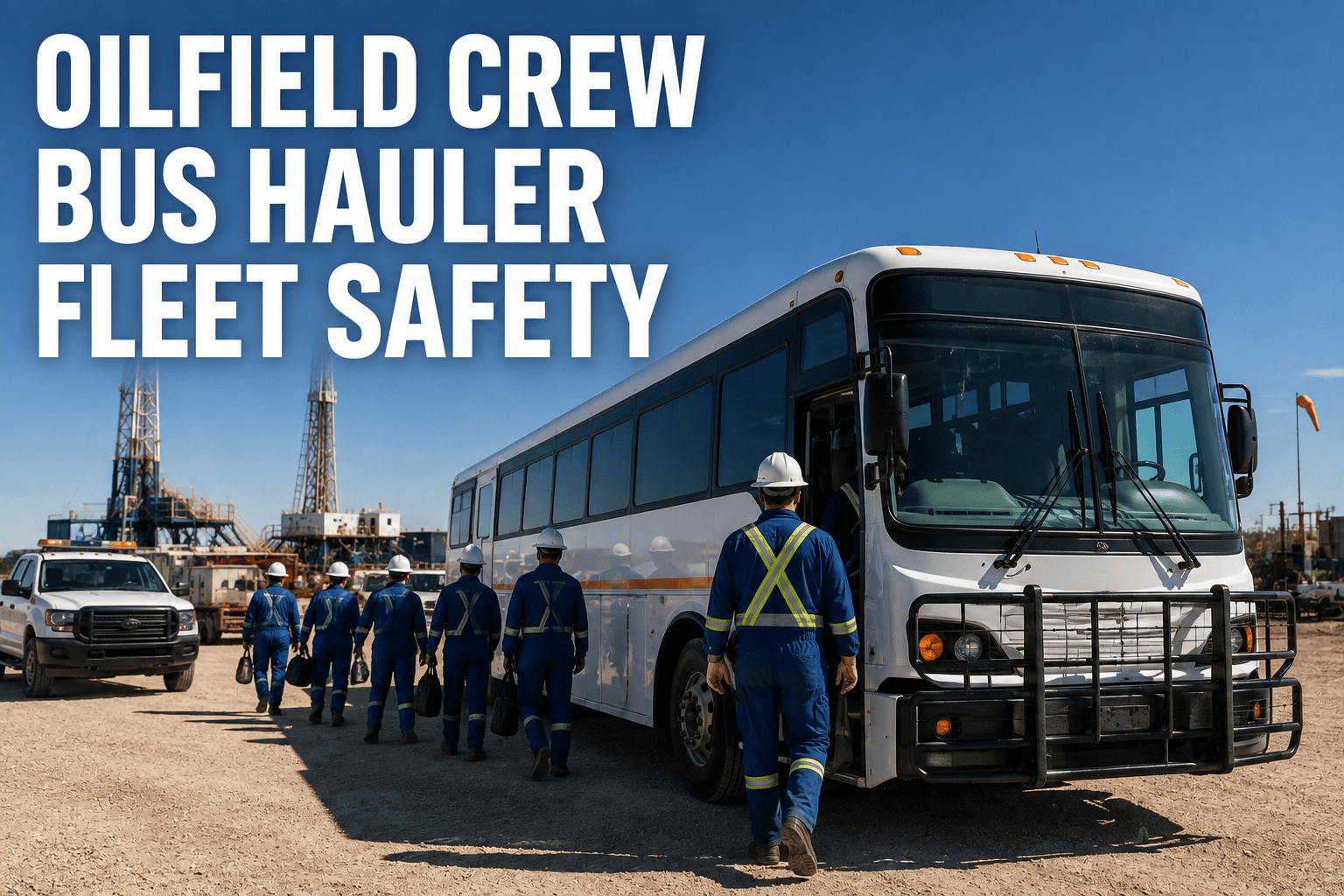
A crew bus carrying a dozen workers back from a twelve-hour shift is not just another vehicle on the fleet roster. It is the vehicle most likely to be involved in the incident that actually hurts someone. Highway and vehicle accidents are consistently cited as one of the leading causes of death in oil and gas operations, and the drivers behind those crashes are frequently coming off a long shift, running on hours that push right up against federal limits, on roads that were never built for heavy passenger traffic. Managing a crew bus and hauler fleet well means treating every trip as a safety event worth tracking, not just a routine transfer from the rig to the yard.
Oilfield crew buses and haulers carry some of the highest safety stakes in the fleet because drivers are often fatigued after long shifts, routes run through remote and poorly lit areas, and a single incident can affect an entire vehicle full of personnel. A real safety program tracks driver hours, requires pre-trip vehicle inspections, and confirms exactly who is on board every trip. FleetRabbit brings driver monitoring, inspection records, and occupant tracking into one system, so crew transport safety is built into the operation rather than left to chance.
Why Crew Transport Carries Outsized Risk
A crew bus looks routine from the outside, but the conditions surrounding a typical oilfield crew transport trip stack several serious risk factors on top of each other.
The Core Pillars Of A Crew Transport Safety Program
A serious safety program for crew buses and haulers rests on a few specific practices, each aimed at one of the risk factors that show up again and again in oilfield transport incidents.
Driver Hours And Fatigue Tracking
Standard hours-of-service rules do not always apply the same way to oilfield transport as they do to general trucking, which makes it even more important for fleets to track driver hours themselves. Monitoring duty status and driving time against safe thresholds, and flagging drivers approaching their limits, addresses the single most cited factor in serious oilfield vehicle crashes.
Pre-Trip Vehicle Inspections
Crew buses and haulers operate under harsh conditions, heavy loads, rough terrain, and frequent stops, all of which accelerate wear on tires, brakes, and steering components. A documented pre-trip inspection catches developing mechanical issues before a vehicle carrying a full crew leaves the yard.
Occupant Accountability And Seatbelt Compliance
Knowing exactly who boarded a specific trip, and confirming seatbelt use, matters because unrestrained occupants have been a factor in some of the most severe oilfield transport fatalities on record. A hard occupancy limit tied to seatbelt-equipped seating capacity should apply on every trip, regardless of how much time pressure a crew change is under.
FleetRabbit centralizes driver hours, pre-trip inspection records, and occupant tracking for your crew bus and hauler fleet, so risk factors become visible before they turn into an incident. Try it on your own fleet with a free trial or walk through your current transport safety setup with our team.
Unmanaged Versus Managed Crew Transport Safety
The gap between a crew transport program that relies on driver judgment alone and one built around tracked data shows up directly in how early a fleet catches a developing risk.
| Safety Factor | Unmanaged Approach | Managed Approach |
|---|---|---|
| Driver Fatigue | Left to the driver's own judgment after a long shift | Hours tracked digitally, with alerts as limits approach |
| Vehicle Condition | Informal walk-around, rarely documented | Digital pre-trip inspection required before every departure |
| Occupant Tracking | Headcount estimated, no formal record of who is aboard | Roster confirmed against seating capacity for every trip |
| Route And Speed | Left to driver discretion on unpaved and lease roads | Speed thresholds enforced through telematics on known routes |
How FleetRabbit Protects Crew Transport Operations
FleetRabbit brings the practices that reduce crew transport risk into one connected system, so fleet managers do not have to piece together driver logs, inspection sheets, and rosters separately.
Hours Of Service And Fatigue Alerts
Driver duty status and driving time are tracked automatically and compared against safe thresholds, with supervisors alerted as a driver approaches a limit rather than discovering a violation after the fact.
Shift Pattern Visibility
Because fatigue builds across multiple days, not just a single shift, the system can surface drivers accumulating risk over a multi-day rotation, even when any single shift looks compliant on its own.
Digital Pre-Trip Inspections
Drivers complete a documented inspection before every trip, giving fleet managers a verifiable record and catching mechanical issues before a fully loaded bus leaves the yard.
Occupant Rosters And Seatbelt Compliance
Every trip can be tied to a confirmed passenger roster checked against seating capacity, with seatbelt compliance tracked as part of the same record. Fleets that sign up for FleetRabbit get this occupant-level accountability built into their crew transport operations from day one.
What A Managed Safety Program Delivers
Fleets that move from informal habits to tracked, documented safety practices tend to see the difference directly in how much earlier a risk gets caught.
Getting Started With Crew Transport Safety
You do not need to overhaul your entire safety program overnight. Many fleets start by tracking hours and inspections on their busiest crew change routes, then expand occupant tracking and speed monitoring as the program matures. You can start a free trial with FleetRabbit to try it on your own fleet, or if you would rather talk through your current crew transport setup first, you can book a short demo with our team.
A crew bus or hauler carries more than cargo, it carries the people your operation depends on. FleetRabbit brings driver hours, pre-trip inspections, and occupant tracking into one system, so risk gets caught before a trip ever leaves the yard. Start your free trial today or book a short demo to see it on your fleet.