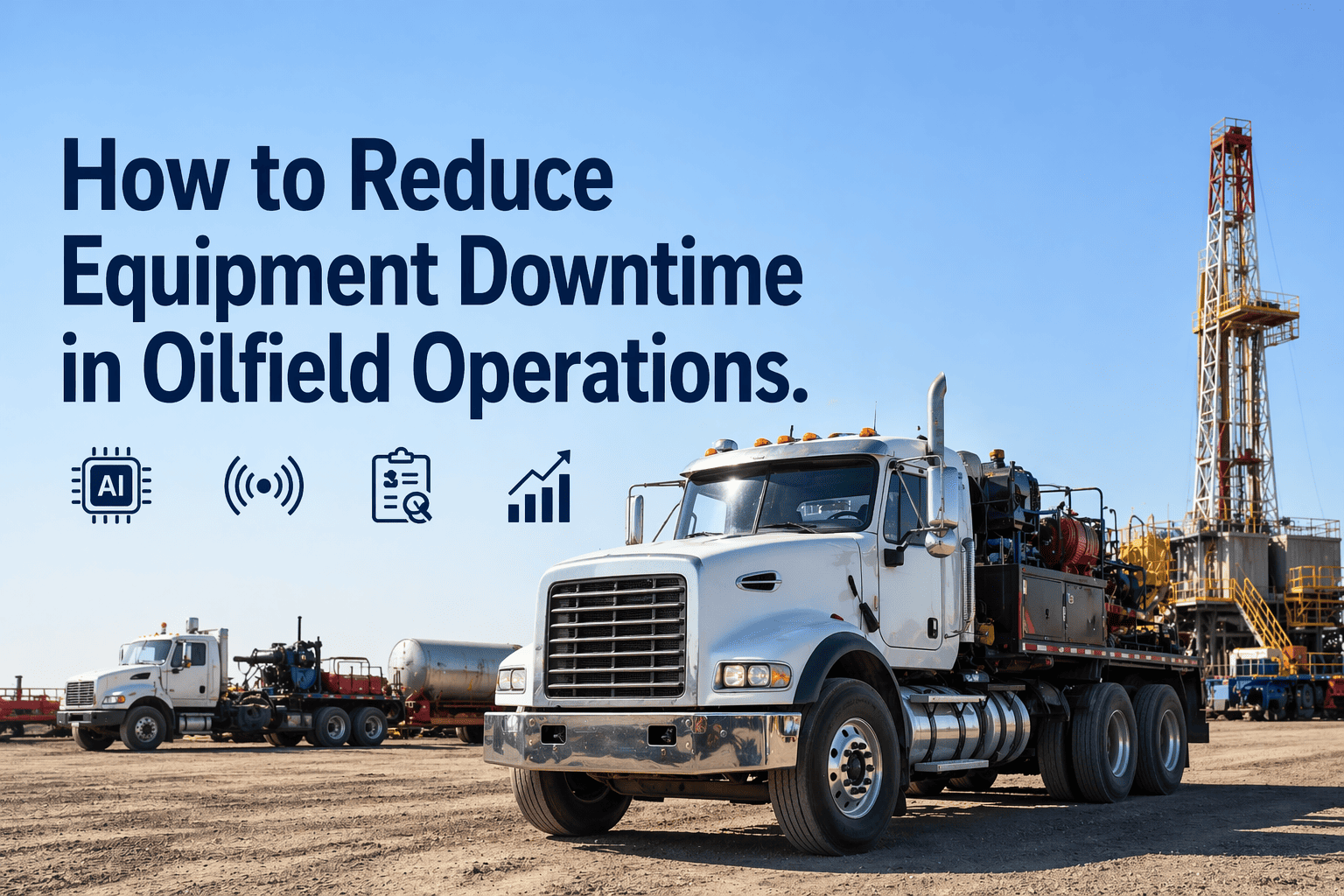
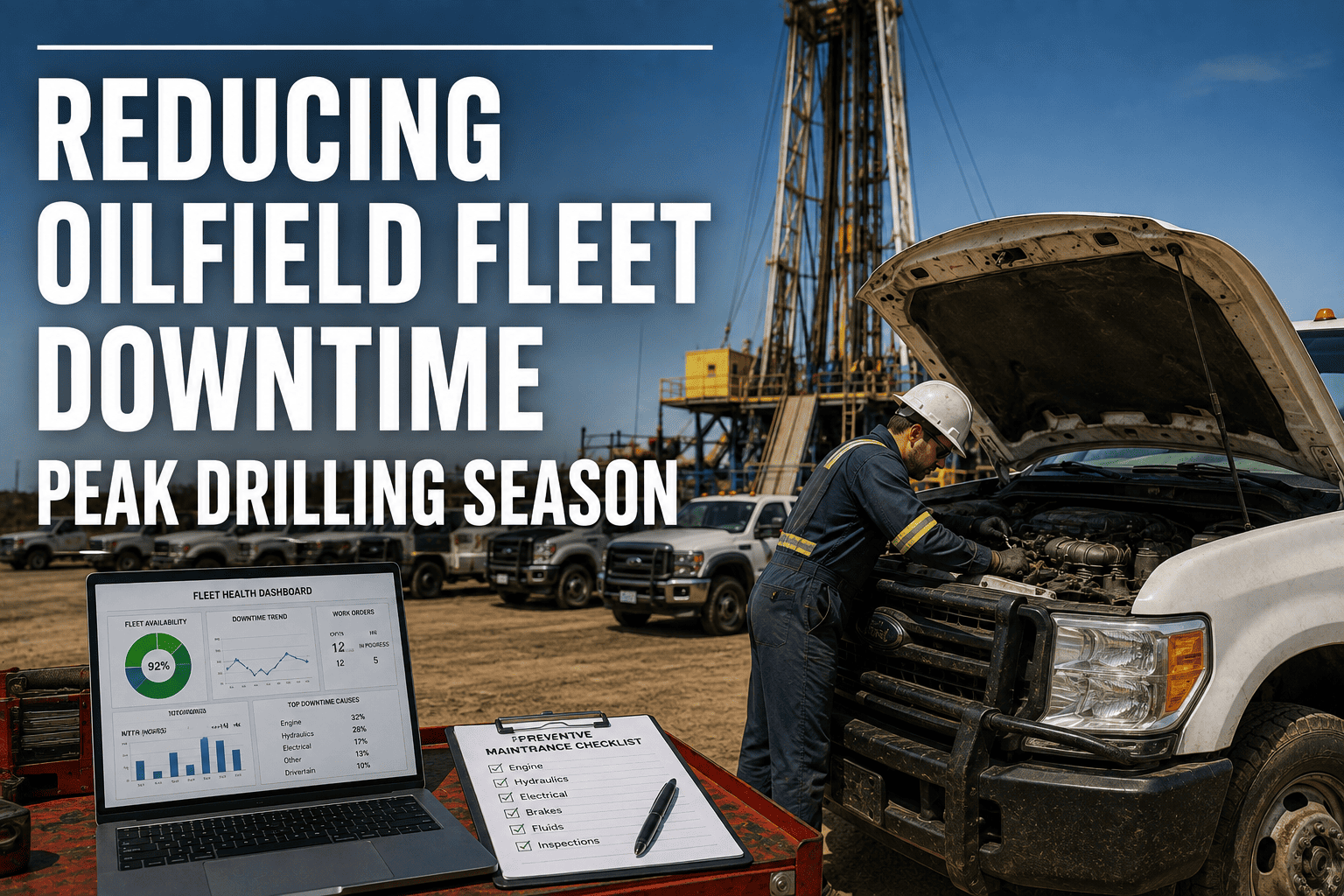
Oilfield operators managing complex fleets of drilling rigs, service trucks, and heavy machinery lose an average of $3.2 million annually to unplanned equipment downtime — with maintenance teams unable to predict failures, track asset health in real-time, or optimize parts inventory across remote sites. When a major Permian Basin operator analyzed their 280-vehicle fleet, they discovered that 78% of catastrophic failures had detectable warning signs weeks in advance — signs invisible to manual inspections but clear to predictive analytics. FleetRabbit’s integrated platform transforms reactive chaos into proactive reliability by combining AI-powered predictive maintenance, real-time GPS visibility, automated work order management, and intelligent parts inventory control — delivering the comprehensive oversight needed to reduce unplanned downtime by 42%, cut emergency repair costs by 55%, and extend equipment service life by 38%. This guide details the strategic framework for eliminating downtime through data-driven fleet management, offering specific implementation steps, quantified ROI metrics, and proven strategies for maintaining operational continuity in high-pressure oilfield environments. Book a demo to see how FleetRabbit eliminates unplanned downtime in your operations.
OPERATIONAL EXCELLENCE
Reduce Equipment in Oilfield Operations
16 min read • 5 core strategies • 42% avg. reduction
PREDICTIVE RELIABILITY FRAMEWORK
Stop Reacting to Failures. Start Predicting Them.
FleetRabbit delivers the only uptime intelligence platform engineered for oilfield complexity — unifying predictive maintenance, real-time tracking, and automated workflows to keep your critical assets running when it matters most.
$1.2M
Avg. Annual Savings
Strategy 1
AI-Powered Predictive Maintenance
Detect bearing wear, misalignment, and vibration anomalies weeks before failure. Shift from calendar-based servicing to condition-based intervention using machine learning models trained on millions of oilfield failure events.
Impact: Prevent 89% of catastrophic failures; reduce emergency repairs by 55%.
Strategy 2
Real-Time Asset Visibility
Know exactly where every asset is and its operational status via GPS and IoT sensors. Eliminate time wasted searching for misplaced equipment across remote sites and ensure optimal utilization of high-value capital assets.
Impact: Reduce asset search time by 87%; improve utilization by 23%.
Strategy 3
Automated Work Order Management
Auto-generate work orders from fault codes, inspection findings, and predictive alerts. Ensure no critical defect slips through the cracks due to manual paperwork or communication delays between field and office.
Impact: Cut response time by 67%; ensure 100% defect resolution.
Strategy 4
Intelligent Parts Inventory
Predict parts needs based on upcoming maintenance schedules and failure predictions. Automate reorders to prevent stockouts that delay critical repairs at remote locations, reducing carrying costs through just-in-time logistics.
Impact: Eliminate 86% of parts-related delays; reduce carrying costs by 18%.
Strategy 5
Executive Reliability Analytics
Translate operational data into strategic insights. Track Mean Time Between Failures (MTBF), Mean Time To Repair (MTTR), and total cost of ownership to drive capital planning decisions and justify fleet investments.
Impact: Make data-driven fleet decisions 4x faster; optimize CapEx spending.
The High Cost of Reactive Maintenance in Oilfields
Most oilfield operators still rely on reactive maintenance models: fix it when it breaks. This approach creates a vicious cycle of emergency premiums, production delays, and cascading equipment damage. A single unplanned failure of a critical pump or compressor can cost $20K–$50K in immediate repairs, plus $10K–$100K per day in lost production depending on the asset's role in the workflow.
The root cause isn't lack of effort — it's lack of visibility. Without real-time condition monitoring, maintenance teams are flying blind. They service healthy equipment unnecessarily while missing early warning signs on failing components until it's too late. FleetRabbit breaks this cycle by providing the data infrastructure needed to transition from reactive chaos to predictive control.
Emergency Premiums
After-hours labor, expedited shipping, and contractor mobilization costs 3–5x more than planned maintenance. Average premium: $15K–$25K per event.
Production Loss
Unplanned downtime halts drilling, completion, or production operations. Lost revenue ranges from $50K to $500K+ per day for critical assets like top drives or frac pumps.
Cascading Damage
A failed bearing can destroy a shaft, housing, and surrounding components. Reactive fixes often require full assembly replacement vs. simple part swap, multiplying material costs.
Reduced Asset Life
Running equipment to failure causes severe internal damage, shortening total service life by 30–50% and accelerating capital replacement cycles, impacting long-term ROI.
UPTIME ASSESSMENT
Eliminate the $3.2M Annual Drain of Unplanned Downtime
See how FleetRabbit’s predictive framework identifies hidden risks in your fleet and converts them into planned, low-cost maintenance interventions.
How FleetRabbit Delivers Predictive Reliability
01
Continuous Condition Monitoring
IoT sensors capture vibration, temperature, pressure, and runtime data every 15–30 minutes. Edge computing processes data locally for immediate anomaly detection, even in offline remote sites, ensuring no data gaps.
↓
02
AI Fault Classification
Machine learning models analyze spectral data to identify specific fault types: bearing defects, misalignment, imbalance, gear wear, or cavitation. Confidence scores prioritize alerts for human review, reducing noise.
↓
03
Automated Work Order Generation
Critical alerts automatically create work orders in FleetRabbit, assigning tasks to qualified technicians based on location, certification, and expertise. Parts requirements are pre-populated from inventory data.
↓
04
Planned Intervention Execution
Technicians receive mobile notifications with fault details, repair instructions, and parts location. Repairs are scheduled during natural downtime windows, avoiding production disruption and overtime costs.
↓
05
Post-Repair Validation & Learning
System monitors equipment post-repair to confirm fault resolution. Successful outcomes feed back into AI models, improving future prediction accuracy for similar assets across the entire fleet.
Critical Equipment Focus: Where Downtime Hits Hardest
Not all assets contribute equally to downtime risk. In oilfield operations, a small subset of critical rotating equipment accounts for the majority of unplanned outages and production losses. FleetRabbit prioritizes monitoring resources on these high-impact assets to maximize ROI and operational stability.
Triplex Mud Pumps
Risk Level: Critical
Heart of drilling operations. Failure stops rig immediately. Common issues: fluid end liner wear, power end bearing seizures, valve seat erosion. Vibration monitoring detects imbalances and bearing defects 4-6 weeks early.
Centrifugal Pumps
Risk Level: High
Used for produced water, crude transfer, and injection. Cavitation and seal failures are leading causes of downtime. Acoustic and vibration sensors identify cavitation onset before impeller damage occurs.
Gas Compressors
Risk Level: Critical
Essential for gathering and processing. Rod knock, valve failures, and crosshead wear lead to catastrophic shutdowns. Time-synchronous averaging isolates mechanical faults from process noise for precise diagnosis.
Electric Motors
Risk Level: Medium-High
Drive pumps, compressors, and drawworks. Rotor bar breakage, air gap eccentricity, and bearing defects are common. Combined vibration and current signature analysis (MCSA) provides complete electrical/mechanical health view.
Heavy Haul Trucks
Risk Level: High
Transporting tubulars and equipment. Brake wear, transmission stress, and tire failures cause roadside breakdowns. Telematics monitor driving behavior and vehicle health to prevent incidents.
Drawworks & Top Drives
Risk Level: Critical
Core drilling components. Gearbox failures and brake band wear can halt operations for days. Thermal imaging and vibration sensors detect overheating and mechanical wear before catastrophic seizure.
Real-World Impact: Case Study Highlights
Challenge: $2.8M annual loss from unplanned downtime; 127 emergency events/year due to lack of visibility.
Solution: Deployed FleetRabbit predictive maintenance + automated work orders across fleet.
Result: 42% downtime reduction in 8 months; $1.18M annual savings; 67% faster response times.
Challenge: Frequent mud pump failures causing rig shutdowns; $120K/day standby costs impacting client contracts.
Solution: Vibration monitoring on triplex pumps + real-time alerting to maintenance supervisors.
Result: Zero unplanned pump failures in Year 1; extended component life by 40%; saved $4.2M in avoided downtime.
Challenge: Compressor station outages due to bearing seizures; poor parts visibility causing 3-day delays.
Solution: Integrated condition monitoring + intelligent parts inventory with auto-reordering.
Result: 86% reduction in parts stockouts; 38% extension in compressor service life; 100% regulatory compliance.
Implementation Roadmap: From Reactive to Predictive
Weeks 1-4
Assessment & Baseline
Catalog critical assets; install IoT sensors on high-priority equipment; integrate existing telematics data; establish baseline health metrics for each asset class to train AI models.
Weeks 5-8
Configuration & Training
Configure alert thresholds and work order workflows; train maintenance teams on mobile app usage; set up parts inventory integration; define escalation protocols for critical alerts.
Weeks 9-12
Pilot Deployment
Launch predictive monitoring on top 20% critical assets; validate alert accuracy; refine threshold settings; measure initial ROI from prevented failures to build internal support.
Weeks 13+
Full Scale & Optimization
Expand coverage to entire fleet; activate automated parts reordering; implement executive dashboards; continuous model refinement based on field data and feedback loops.
Emergency Repair Savings
55%
Average reduction in premium labor, expedited shipping, and contractor costs through planned interventions.
Production Continuity
$100K+
Daily value protected per critical asset kept online through predictive intervention vs. reactive repair.
Labor Efficiency
30%
Time saved by eliminating manual inspections and focusing technician hours on high-value, targeted repairs.
Asset Lifespan
38%
Extension in useful life through condition-based care vs. run-to-failure, delaying capital expenditure.
Typical Payback Period
2–4 Months
Based on preventing just 1–2 major catastrophic failures in first quarter of deployment.
Overcoming Common Implementation Challenges
Challenge: Legacy Equipment Compatibility
Many oilfield assets are older models without built-in digital interfaces or modern controls.
FleetRabbit Solution: Retrofit sensor kits allow non-intrusive installation on legacy pumps, motors, and gearboxes. No wiring changes required. Battery-powered options eliminate need for external power sources, making deployment rapid and safe.
Challenge: Remote Site Connectivity
Cellular signals are often weak or nonexistent at remote well sites, raising concerns about data loss.
FleetRabbit Solution: Edge computing devices store data locally and transmit via satellite or LoRaWAN networks. Data syncs automatically when connectivity is restored, ensuring zero data loss and continuous monitoring regardless of location.
Challenge: Technician Adoption
Field teams may resist new digital workflows and mobile apps, preferring traditional paper methods.
FleetRabbit Solution: Intuitive mobile interface requires minimal training. Offline capability ensures usability anywhere. Gamification and clear demonstration of reduced emergency callouts drive rapid adoption and cultural shift.
Challenge: Data Overload
Thousands of data points can overwhelm maintenance managers, leading to alert fatigue.
FleetRabbit Solution: AI-driven filtering prioritizes only actionable alerts. Executive dashboards summarize key metrics, while detailed views are available for deep dives, ensuring the left information reaches the left person at the left time.
QCan FleetRabbit integrate with our existing CMMS or ERP systems?
Yes. Pre-built connectors for SAP, Oracle, Maximo, and others plus flexible API for custom integrations. Bidirectional sync ensures work orders and parts data stay consistent.
Discuss integrations.
QDoes it work in remote locations with poor connectivity?
Yes. Edge devices process data locally and store alerts when offline. Data syncs automatically when connectivity restores, ensuring no gaps in monitoring.
Review remote options.
QHow accurate are the predictive failure alerts?
85–92% accuracy for common rotating equipment faults (bearings, gears, imbalance) after 30-day baseline period. Accuracy improves continuously as model learns your specific asset behaviors.
See accuracy data.
QWhat is the typical deployment timeline for a 100-asset fleet?
4–6 weeks for full deployment. Includes sensor installation, system configuration, team training, and pilot testing. Critical assets can be live within 2 weeks.
Plan your rollout.
QCan we monitor non-rotating assets like tanks or structures?
Yes. Ultrasonic thickness gauges and corrosion sensors integrate with FleetRabbit to monitor structural integrity and tank levels, expanding predictive capabilities beyond rotating machinery.
Explore asset types.
QHow does pricing work for predictive maintenance?
Flexible subscription models based on number of monitored assets and features. ROI typically achieved in months through prevented failures.
Get a quote.
YOUR UPTIME TRANSFORMATION
Turn Unplanned Downtime Into Predictable Reliability
FleetRabbit delivers the intelligence needed to predict failures before they happen, optimize maintenance workflows, and protect millions in production revenue — all through a single, unified platform built for oilfield reality.
Predictive Maintenance
Real-Time Visibility
Automated Workflows
Parts Intelligence
Executive Analytics
April 23, 2026
By David
All Posts