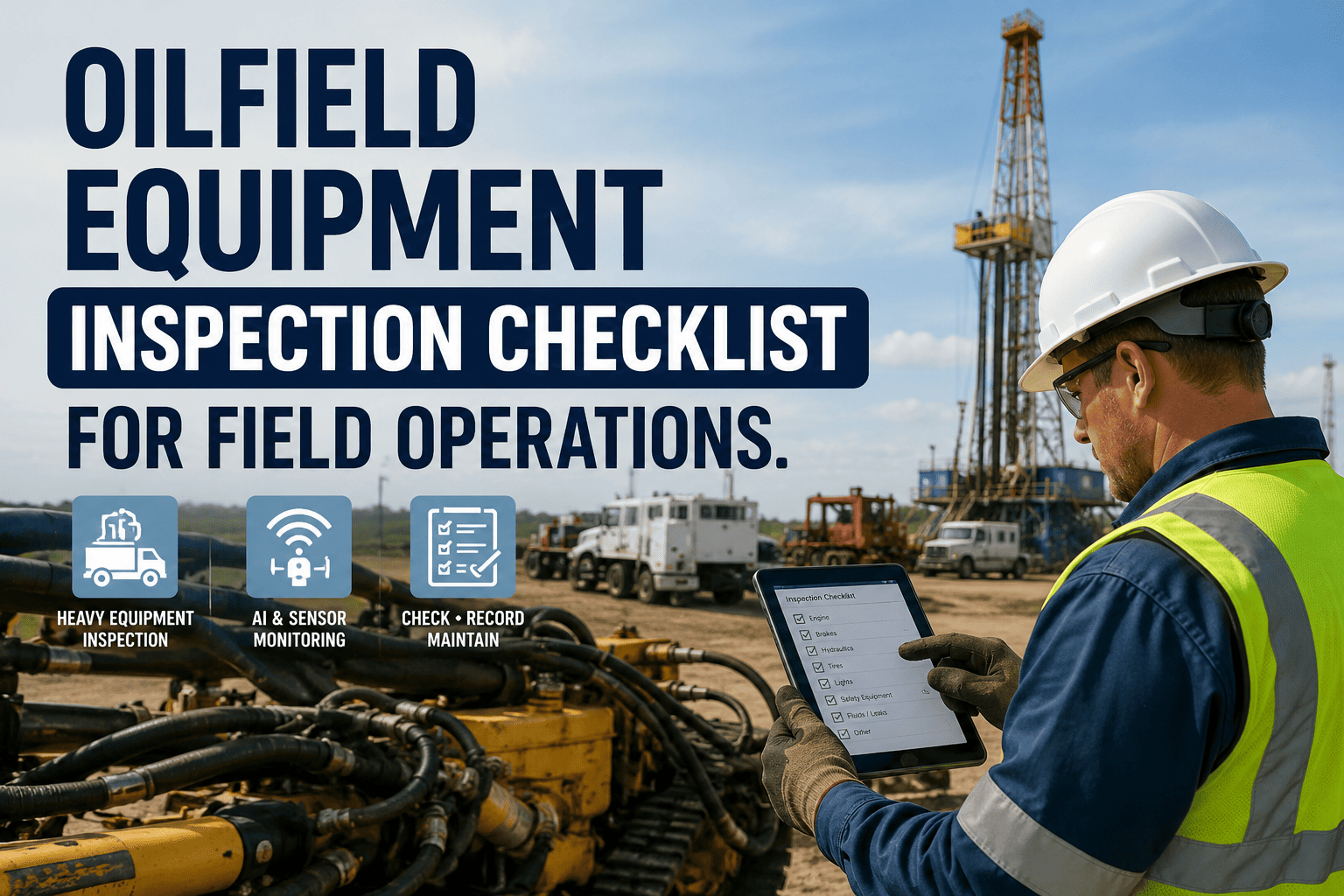
Oilfield Equipment Inspection Checklist for Field Operations

kioilak-best-oil-gas-fleet-management-software

Oilfield equipment inspection in field operations demands precision, accountability, and systematic execution across every rig, pump, separator, valve, and vehicle. When a single missed inspection triggers an unplanned shutdown or regulatory citation, the financial and reputational cost compounds rapidly — equipment failures average $12,000–$28,000 per incident, OSHA violations reach $70,000 per citation, and EPA enforcement carries daily fines up to $50,000. FleetRabbit's digital inspection platform gives fleet managers and operations executives complete visibility across every inspection touchpoint, replacing paper-based guesswork with tamper-evident digital records, real-time defect escalation, and one-click audit-ready compliance packages. Schedule a live demo to see FleetRabbit's oilfield inspection system in action.

2026 FIELD OPERATIONS EDITION DOT · OSHA · API · EPA STANDARDS FLEETRABBIT DIGITAL READY

Oilfield Equipment Inspection Checklist for Field Operations

A comprehensive inspection framework for oilfield fleet managers and operations executives — covering drilling equipment, production assets, transport vehicles, environmental controls, and site safety — built for deployment on FleetRabbit's mobile-first digital inspection platform.

9
Inspection categories covering all oilfield asset types
130+
Field-tested checklist items across equipment domains
5
Regulatory frameworks integrated into one platform

Why Paper Inspections Fail Oilfield Operations at Scale

Oilfield fleet managers overseeing 50 to 500 assets across multiple remote sites face an inspection management problem that paper-based systems cannot solve. Technicians complete forms inconsistently without photographic evidence. Supervisors cannot verify execution without physically visiting each location. Defect escalation depends on phone calls and informal follow-up rather than automated workflows. When regulators arrive for audit or a DVIR dispute arises during a DOT roadside inspection, assembling 6–12 months of paper records consumes 40–60 staff hours — time that could be eliminated entirely.

The operational consequences are direct and measurable. Undetected equipment wear triggers emergency repairs averaging $12,000–$28,000 per incident. OSHA mechanical integrity citations carry $7,000–$70,000 per serious violation. EPA spill prevention failures result in $25,000–$50,000 in daily fines. Fleet safety rating downgrades from DOT out-of-service findings restrict operational capacity and damage contract eligibility with major operators.

$28K
Avg. emergency repair cost per incident
60 hrs
Manual audit prep time eliminated by FleetRabbit
$70K
Max OSHA penalty per serious PSM violation
FLEETRABBIT SOLVES THIS

How FleetRabbit Transforms Oilfield Inspection Management


Mobile inspection app guides technicians through standardized checklists with mandatory photo documentation at point of execution — no office-based backdating possible

GPS and timestamp verification creates tamper-evident audit trails proving inspection occurred at the correct field location and within the required time window

Automated defect escalation routes critical findings to maintenance coordinators and safety managers within minutes — not hours — with photos, location, and severity classification attached

One-click compliance report generation compiles full inspection history, defect remediation records, corrective action timelines, and photographic evidence into DOT, OSHA, EPA, and client HSE audit packages in under 2 hours

Real-time dashboard gives operations executives and fleet managers complete visibility across every asset and site without requiring physical presence at remote locations
See FleetRabbit in Action

FleetRabbit reduces oilfield inspection audit preparation from 40–60 hours to under 2 hours through automated compliance documentation and real-time defect tracking. Start your free trial and deploy digital inspections across your field operations today.

Category 01

Drilling Equipment Inspection

Systematic inspection of drilling rigs, hoisting systems, rotary equipment, and well control devices ensuring mechanical readiness and compliance with API and manufacturer specifications before each operational shift and following equipment mobilization.

APPLICABLE STANDARDS
API RP 7G — Drill Stem Design API RP 8B — Hoisting Equipment OSHA 1910.147 — LOTO API Spec 16A — BOP Equipment
Hoisting System
Rotary and BOP Systems
Mud System and Pumps
FleetRabbit Drilling Equipment Inspection Capabilities
Equipment-specific digital checklists aligned to API RP 7G, 8B, and 16A with required photo documentation for each critical defect
BOP test records with timestamped pressure data automatically compiled into regulatory submission packages
Drill line cutoff scheduling automated by footage drilled with technician notification when cutoff interval reached
Critical well control defect escalation triggers immediate supervisor notification with out-of-service lockout preventing rig operation
Category 02

Production Asset and Separator Inspection

Periodic inspection and preventive maintenance of production separators, treaters, storage tanks, gas compression equipment, and metering systems following API Recommended Practices and manufacturer service intervals to prevent unplanned downtime and regulatory violations.

APPLICABLE STANDARDS
API 510 — Pressure Vessel Inspection API 570 — Piping Inspection OSHA PSM 1910.119 API 653 — Tank Inspection
Three-Phase Separators and Treaters
Storage Tanks and Metering
FleetRabbit Production Asset Management
API 510 and 653 inspection interval scheduling automated by vessel age and operating history with inspector qualification verification
Ultrasonic wall thickness measurements recorded and trended per inspection point to identify accelerating corrosion before failure
Relief valve test records with certification expiration tracking — automated alerts 60 days before recertification required
Tank overfill test documentation with photographic evidence satisfying EPA SPCC inspection records requirement
EXECUTIVE VISIBILITY — REAL-TIME OPERATIONS CONTROL

Give Operations Leaders Complete Inspection Oversight Across Every Remote Site

FleetRabbit's supervisor dashboard provides real-time inspection completion rates, open defect counts, overdue corrective actions, and equipment out-of-service status across your entire oilfield footprint — without requiring physical site visits. Operations executives can drill from fleet-wide summary views down to individual asset inspection records, defect photographs, and technician sign-offs in seconds. When a safety manager or operations VP needs to verify inspection program health before a client audit or regulatory visit, FleetRabbit delivers complete confidence in under five minutes.

95%
Reduction in audit preparation time
2 hrs
Full compliance report generation vs 40–60 hours manual
100%
Inspection execution verification across dispersed fleet
3–4 wks
Full deployment for 50–200 vehicle and asset fleets
Category 03

Oilfield Transport Vehicle DVIR — DOT 49 CFR 396.11

Pre-trip and post-trip driver vehicle inspection reports for all commercial motor vehicles including vacuum trucks, frac tanks, crane trucks, water haulers, and service vehicles — documenting equipment condition before and after each operational shift with mandatory defect identification, supervisor review, and mechanic repair certification.

APPLICABLE STANDARDS
DOT FMCSA 49 CFR 396.11 49 CFR Part 393 — Vehicle Equipment CVSA Out-of-Service Criteria
Brake and Steering Systems
Tires, Wheels, and Lighting
Specialized Oilfield Vehicle Equipment
FleetRabbit Digital DVIR Capabilities
Driver mobile app guides pre-trip and post-trip inspection sequences with mandatory defect photos preventing paper-only documentation backdating
GPS timestamp verification proves inspection occurred at vehicle location satisfying DOT 49 CFR 396.11 audit requirements
Automatic vehicle dispatch blocking when out-of-service defects remain unresolved — mechanics must certify repair before release
DOT safety rating protection through complete, verifiable DVIR records eliminating documentation gaps that trigger compliance review
Category 04

Lifting Equipment and Rigging Inspection — OSHA 1910.179

Pre-use and periodic inspection of cranes, hoists, slings, shackles, wire rope, and below-the-hook devices ensuring safe working load compliance and structural integrity for all lifting operations across oilfield sites and facilities.

APPLICABLE STANDARDS
OSHA 1910.179 — Overhead Cranes ASME B30.9 — Slings ASME B30.5 — Mobile Cranes API RP 2D — Offshore Cranes
Mobile and Truck Cranes
Rigging Hardware and Slings
FleetRabbit Lifting Equipment Inspection Management
Pre-use inspection checklists deployed to riggers via mobile app with photo requirements for all identified defects before lift authorization
Annual inspection certification tracking with expiration alerts 30 and 60 days before deadline — prevents use of non-current equipment
Rigging hardware retirement tracking linking removal-from-service documentation to replacement work orders

FleetRabbit automates inspection scheduling, defect escalation, and compliance reporting across all oilfield asset categories — giving fleet managers complete control without manual administration overhead. Schedule a demo to see how FleetRabbit manages your specific equipment types.

Category 05

Electrical Systems and Hazardous Area Inspection

Periodic inspection of classified electrical installations, temporary power systems, grounding and bonding systems, and motor control equipment in hazardous areas classified under NEC Article 500 and API RP 505 for oilfield locations.

Classified Area Electrical Equipment
Temporary Power and Lockout/Tagout
FleetRabbit Electrical Inspection Capabilities
Hazardous area equipment classification tracking by installation point verifying correct equipment installed in each classified zone
LOTO program integration linking energy control inspection findings to procedure updates and training requirements
Critical electrical defect escalation with immediate notification to electrical supervisor and site safety officer
Category 06

Environmental Compliance Inspection — EPA SPCC and Air Permits

Monthly and periodic inspection of spill prevention controls, secondary containment systems, emissions monitoring equipment, and waste management areas per EPA 40 CFR Part 112 SPCC regulations and applicable state air quality permit conditions.

SPCC Containment and Leak Detection
Air Emissions and Waste Management
FleetRabbit Environmental Inspection Management
Monthly SPCC inspection scheduling with GPS-verified technician completion — proves regulatory inspection occurred at correct facility location
Photographic evidence mandatory for all containment deficiencies supporting EPA enforcement defense and consent decree compliance documentation
Corrective action deadlines enforced with automated escalation to EHS manager when repairs not completed within required timeframe
Annual SPCC inspection report generated automatically from inspection records satisfying PE certification support requirements
Category 07

Pressure Systems and Relief Device Inspection — OSHA PSM

Mechanical integrity inspections for pressurized systems including wellhead equipment, flowline piping, gas compression skids, and relief and safety devices per OSHA 1910.119 PSM mechanical integrity requirements and API 510 pressure vessel inspection codes.

Wellhead and Flowline Equipment
Relief Devices and Safety Systems
FleetRabbit PSM Mechanical Integrity Tracking
API 510 inspection interval management with inspector qualification tracking ensuring only authorized inspectors complete certified inspections
Wall thickness measurement data trending identifying corrosion rate acceleration before fitness-for-service threshold reached
Relief valve recertification scheduling with test bench results documentation linked to individual equipment records
Category 08

Confined Space Entry Preparation

Pre-entry inspection and permit verification for permit-required confined spaces including tanks, vessels, trenches, and pits per OSHA 1910.146 PRCS requirements.

Entry Pre-Qualification Checklist
FleetRabbit Confined Space Permit Management
Digital permit workflow enforces signature sequence — entry cannot be authorized without all required sign-offs completed in order
Atmospheric test results entered into permit record with instrument calibration certificate linkage
Category 09

PPE and Personal Safety Equipment Inspection

Pre-use and periodic inspection of personal protective equipment, gas detection devices, and emergency response equipment per OSHA 1910.132 and site HSE requirements.

Personal Protective and Gas Detection Equipment
FleetRabbit PPE Inspection Tracking
Gas monitor calibration expiration tracking with automated alerts before detection equipment becomes non-compliant
Eyewash and emergency shower weekly test records with GPS timestamp verification satisfying ANSI Z358.1 documentation requirements

How FleetRabbit Deploys Across Your Oilfield Operations

FleetRabbit's implementation team manages the full deployment process from checklist configuration through full fleet activation — with standard regulatory templates for DOT, OSHA, EPA, and API inspections reducing custom configuration time for most operators.

Week 1

Platform Configuration and Checklist Build

FleetRabbit's implementation team configures your equipment inventory, inspection checklists, and scheduling intervals based on your asset register, regulatory obligations, and client HSE specifications. Standard DOT DVIR, OSHA PSM, EPA SPCC, and API inspection templates are loaded immediately. Custom items for manufacturer-specific procedures, client requirements, or jurisdiction-specific standards are added during configuration review sessions with your operations and EHS teams.

Deliverable: Digital checklists deployed, inspection schedules active, equipment inventory mapped
Week 2

Field Technician and Supervisor Training

On-site or virtual training sessions bring field technicians, mechanics, and safety personnel through the mobile app workflow including checklist navigation, defect identification with mandatory photo documentation, GPS verification, and offline operation during connectivity loss in remote locations. Supervisor and management training covers the operations dashboard, defect escalation protocols, corrective action management, and compliance report generation for audit preparation scenarios.

Deliverable: All users trained, pilot validation completed on representative equipment sample
Week 3–4

Full Fleet Activation and Performance Monitoring

Digital inspection system activated across your complete vehicle fleet and facility asset inventory. Real-time completion monitoring identifies execution gaps by equipment, technician, or site. First compliance reports generated and validated against your regulatory submission requirements before a live audit demands them. FleetRabbit's customer success team remains engaged during the activation period to resolve any configuration gaps identified during live operations.

Deliverable: Full deployment active, compliance reports validated, ongoing monitoring established

Common Questions from Oilfield Fleet Managers and Operations Executives

How does FleetRabbit handle inspection execution at remote sites without reliable cellular coverage?
The mobile inspection app operates fully offline storing checklists, photos, and GPS coordinates in local device memory. When connectivity is restored — whether at the wellsite, on return to the yard, or via satellite — all data syncs automatically to the cloud platform with original collection timestamps preserved. Satellite connectivity options are available for operations requiring real-time defect escalation from locations with no cellular coverage.
Can FleetRabbit inspection records satisfy DOT roadside inspection documentation requests and OSHA PSM audit requirements?
Yes. Digital inspection records include tamper-evident timestamps, GPS location verification, photographic evidence, and electronic inspector signatures meeting DOT 49 CFR 396.11 and OSHA PSM mechanical integrity documentation standards. The export function generates audit packages in regulator-specified formats with complete inspection history, defect remediation records, and corrective action timelines within 2 hours of an audit request.
What happens immediately when a technician identifies a critical defect during a field inspection?
Critical defect identification triggers automated notification to maintenance coordinators and safety managers via email and SMS within minutes of the finding being recorded — including defect photos, GPS location, equipment identification, and severity classification. Equipment is automatically tagged out-of-service in the dispatch system preventing operational assignment until a mechanic uploads repair certification with before-and-after photo documentation.
How does FleetRabbit manage inspector qualification tracking for specialized ASME and API inspection categories?
The platform tracks individual technician certifications including API 510 and 653 authorizations, ASME National Board commissions, and client-specific training completions with expiration date monitoring. The system validates inspector credentials against equipment inspection requirements before allowing a specialized inspection to be submitted — preventing unqualified personnel from completing and signing off on certified inspection categories.
Can inspection checklists be customized for client-specific HSE requirements from major operators like ADNOC, ONGC, or large independents?
Yes. FleetRabbit's checklist builder supports unlimited custom inspection items, equipment-specific procedures, and client HSE specification integration. Multiple client requirement sets can be maintained simultaneously and deployed to specific work orders or equipment categories. Standard regulatory templates are provided as the baseline with full customization flexibility on top.
What is the typical deployment timeline for a mid-size oilfield operator with 100–300 assets across multiple field locations?
Standard deployment completes in 3–4 weeks including configuration, training, pilot validation, and full fleet activation. Multi-site operations with extensive custom checklist requirements or large asset inventories may extend to 5–6 weeks. FleetRabbit's standard template library covers the majority of DOT, OSHA, EPA, and API inspection requirements without significant custom development for most onshore US operators.

Deploy FleetRabbit Across Your Oilfield Fleet and Eliminate Inspection Documentation Risk

Manual paper inspection systems create systematic compliance exposure — incomplete records during DOT roadside inspections trigger vehicle out-of-service orders, OSHA PSM audit failures carry $7,000–$70,000 penalties per citation, and EPA enforcement actions from inadequate SPCC inspection records result in $25,000–$50,000 daily fines. FleetRabbit's digital inspection platform eliminates these risks through mobile checklists with mandatory photo documentation, GPS-verified tamper-evident audit trails, automated defect escalation, real-time completion monitoring across dispersed sites, and one-click compliance report generation in under 2 hours — covering 9 inspection categories and 130+ checklist items across DOT, OSHA, EPA, API, and client HSE frameworks.

Mobile offline inspection app GPS timestamp verification Automated defect escalation Real-time completion dashboard 2-hour audit report generation 9 categories — 130+ checklist items DOT DVIR compliance 3–4 week deployment