A water hauler finishes its last run of the day forty miles from the nearest paved road, well outside cell coverage. The driver notices a slow leak at a brake connection and needs to log it before the truck goes back out at 5 a.m. On a normal fleet, that is a two-minute task. On a location with no signal, it becomes a choice between driving toward coverage to file the report or writing it on paper and hoping it makes it into the system before the truck rolls again. Oilfield fleets do not just have to comply with 49 CFR 396.11, they have to comply with it in places the rule's authors never had to think about.
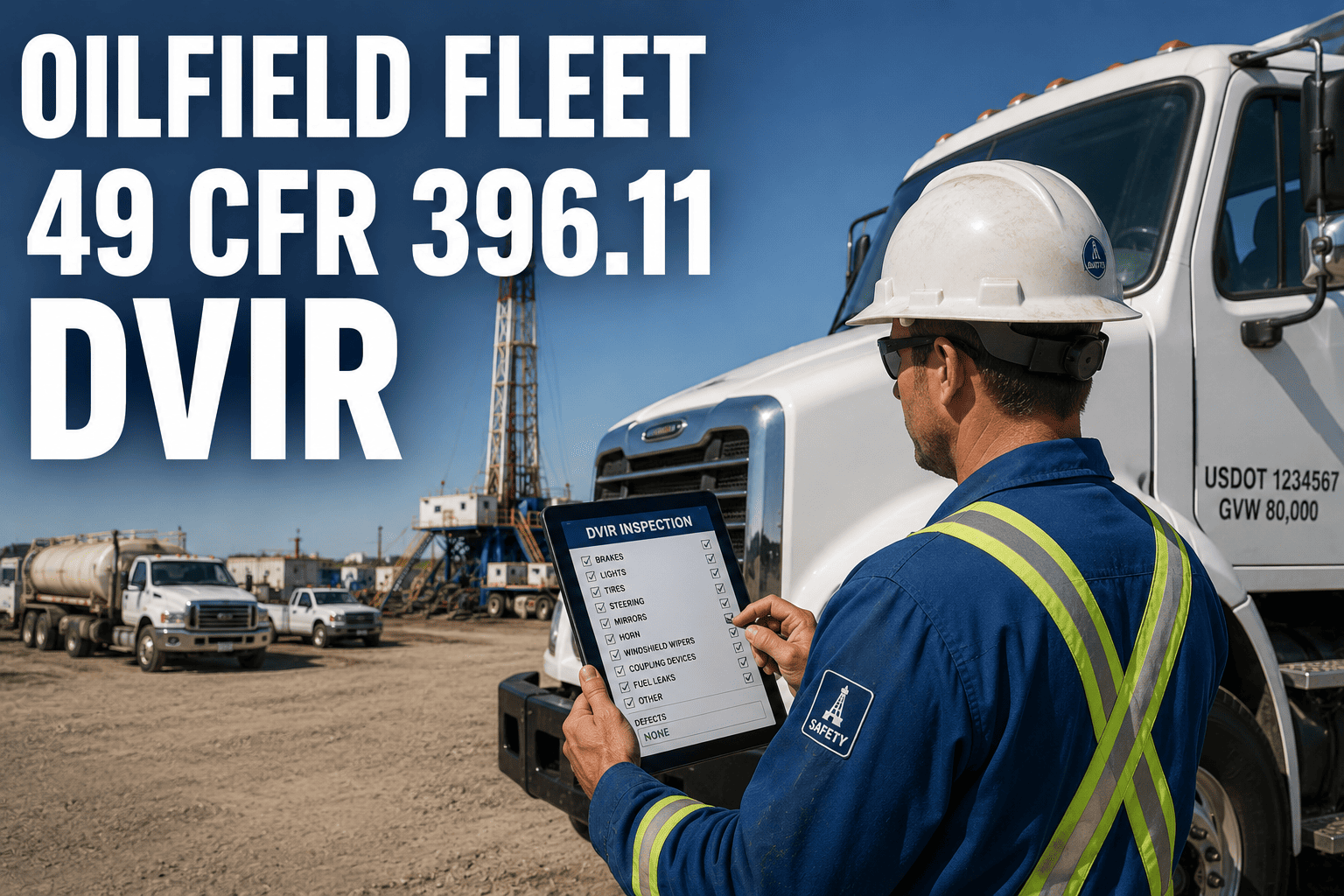
49 CFR 396.11 requires commercial drivers to inspect their vehicle at the end of each working day and file a written report on any defect affecting safety or likely to cause a breakdown, covering 11 required categories such as brakes, steering, tires, and lights. As of March 2026, FMCSA rules explicitly allow fully electronic DVIRs, and reports must be retained for at least three months. For oilfield fleets operating without reliable signal, the compliance challenge is less about knowing the rule and more about capturing it accurately from a location with no connection. See how offline-capable DVIRs work with a free FleetRabbit trial.
What 49 CFR 396.11 Actually Requires
Stripped of legal language, the rule comes down to three obligations that repeat every working day, for every driver, on every covered vehicle.
Why Oilfield Fleets Hit This Rule Differently
The regulation itself does not change for oilfield operations, but the operating environment makes routine compliance harder than it is for a fleet running fixed routes with steady signal.
No Connectivity at the Wellsite
Many well pads and remote batteries sit well outside cellular coverage. A DVIR process built around real-time upload assumes a connection the driver may not have until they are back at a yard or camp hours later.
Mixed Owned and Contractor Fleets
A single location often sees company trucks, contracted water haulers, and third-party equipment operating side by side. Each may run a different inspection process, making it difficult for a safety manager to confirm every vehicle on site is actually covered.
Audit Trail Across Remote Crews
With drivers spread across multiple pads and camps, paper DVIRs are easy to lose, easy to backdate incorrectly, and hard to produce quickly when an auditor asks for three months of records on short notice.
| Challenge | Standard Fleet | Oilfield Fleet |
|---|---|---|
| Connectivity | Consistent signal along fixed routes | Frequent dead zones at remote pads and batteries |
| Fleet Composition | Uniform equipment under one inspection process | Mixed owned and contractor vehicles at the same site |
| Record Retrieval | Centralized filing at a single terminal | Records scattered across multiple remote crews and camps |
| Audit Readiness | Pull records from one system on demand | Reconcile paper and digital reports from several locations |
FleetRabbit lets drivers complete a compliant DVIR offline at the wellsite, then syncs automatically the moment a connection is available, so no report is lost to a dead zone. Try it free with your current fleet, or walk through offline inspection capture with our team.
The Signature Chain Most Fleets Miss
A DVIR is not complete with just a driver's signature. FMCSA looks for a traceable chain across up to three signatures, and missing any link is one of the most commonly cited findings in roadside and compliance reviews.
Driver Reports the Defect
The driver who finds or is told about a defect signs the original report at the end of the working day, before the vehicle is parked for the night.
Mechanic Certifies the Repair
Whoever performs or verifies the repair signs to certify either that the defect was corrected or that correction is not necessary for safe operation.
Next Driver Acknowledges the Record
Before operating the vehicle, the next driver reviews the prior report and defect certification, confirming they are aware of the vehicle's condition before departure.
What Changed With the 2026 Electronic DVIR Rule
FMCSA's March 2026 final rule removed any ambiguity about whether digital reports satisfy the written-report requirement under 396.11, explicitly authorizing DVIRs to be created, signed, maintained, and transmitted electronically. For oilfield fleets, that clarity matters because it validates exactly the kind of offline-capable digital workflow remote operations need. A driver at a wellsite with no signal can complete a fully compliant electronic inspection the moment they finish their shift, with the record syncing and retaining its timestamped signature chain once connectivity returns, instead of relying on a paper form that has to be manually reconciled back at the yard days later. If you want to see how this looks for your own remote crews, it is worth taking a few minutes to book a demo with the FleetRabbit team.
For an oilfield fleet, compliance with 49 CFR 396.11 is rarely about understanding the rule. It is about capturing it reliably from locations the rule's paperwork was never designed for. A digital process that works without signal removes that gap entirely, keeping every report accurate and every record ready before an auditor ever asks for it. If your fleet is ready to move DVIRs off paper and out of the dead zones, start a free trial with FleetRabbit or book a short demo to see offline inspection capture in action.
FleetRabbit captures 49 CFR 396.11 compliant DVIRs offline, syncs automatically, and keeps three-plus months of audit-ready records for every truck in your oilfield fleet. Get started today, no credit card required.