Managing an oilfield fleet means navigating hazardous environments, driver fatigue, and strict regulatory oversight. When an accident occurs, a safety program isn't just about prevention—it must be legally defensible. Without proper documentation, your operation is exposed to massive liability, DOT fines, and lost contracts. FleetRabbit provides the digital tools to maintain, organize, and prove your HSE (Health, Safety, and Environment) standards. You can sign up for FleetRabbit to secure your operations today, or book a demo to explore our safety documentation platform.
A defensible oilfield safety program requires verifiable, timestamped documentation. Fleets relying on paper logs face a 60 percent higher rate of compliance penalties during audits. Implementing digital safety management systems reduces DOT fines by up to 45 percent and provides the critical evidence needed to defend against liability claims following accidents.
What Makes an Oilfield Safety Program Defensible?
A defensible safety program is built on the principle of continuous, verifiable evidence. It is not enough to simply have safety policies written in a manual; you must be able to prove those policies were actively enforced, acknowledged, and practiced by your drivers every single day. In the high-stakes oilfield industry, where heavy equipment and hazardous environments are the norm, post-incident investigations are rigorous. A defensible program means you can produce a complete, timestamped history of vehicle maintenance, driver training, and behavioral coaching within minutes of a request.
The Core Elements of HSE Defense
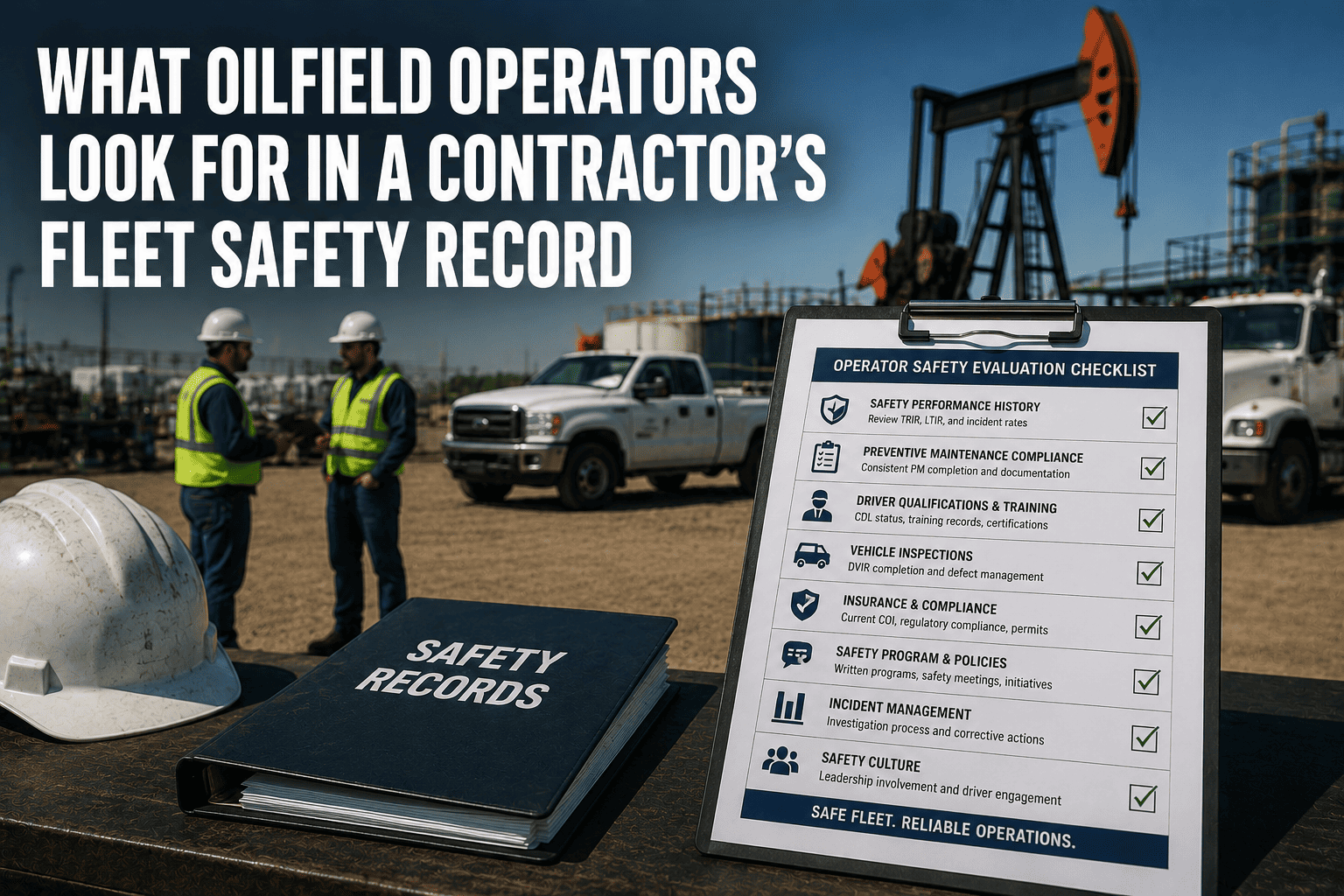
Building a strong legal defense requires several digital pillars. First, you need electronic Daily Vehicle Inspection Reports (DVIRs) that guarantee drivers inspect equipment before every trip. Second, you need documented driver coaching sessions triggered by telematics data, such as harsh cornering or speeding. Third, you need an incident management system that logs corrective actions the moment they occur. When these three elements are connected in a centralized platform, you create an undeniable chain of custody for your safety culture.
Digitized Daily Vehicle Inspection Reports (DVIRs)
Paper DVIRs are the weakest link in a safety defense. Drivers can easily backfill paper logs, and supervisors can lose them in transit. Digitized DVIRs require the driver to physically interact with a mobile app at the exact time of inspection, capturing GPS coordinates and timestamps. If a defect is found, the system automatically locks the vehicle out of service until a mechanic signs off on the repair. This creates an unbreakable digital trail proving the fleet prioritized safety over schedule.
The Financial Impact of Undocumented Safety
The financial impact of a poorly documented safety program extends far beyond the immediate costs of an accident. When an oilfield fleet cannot prove they maintain their vehicles or coach their drivers, they face a cascade of financial penalties. Insurance premiums skyrocket, often increasing by 20 to 40 percent after a single undefensible accident. DOT audits result in severe fines for missing records, and oilfield operators will terminate contracts with fleets that hold low CSA (Compliance, Safety, Accountability) scores, prioritizing operators who can prove their safety compliance.
| Safety Challenge | Typical Financial Impact | Documentation Failure | FleetRabbit Solution |
|---|---|---|---|
| Post-Accident Liability | 100,000 to 500,000 dollars | No proof of pre-trip inspection or driver coaching history | Timestamped digital DVIRs and automated coaching logs |
| DOT Audit Penalties | 5,000 to 15,000 dollars | Missing or incomplete maintenance records during inspections | Centralized, cloud-based maintenance and inspection history |
| Insurance Premium Hikes | 20 to 40 percent increase | Inability to demonstrate active safety management to underwriters | Comprehensive safety reports proving proactive risk mitigation |
| Contract Termination | Loss of total route revenue | Low CSA scores due to unreported defects or untrained drivers | Real-time defect resolution and digital policy sign-offs |
| Unresolved Corrective Actions | 2,000 to 8,000 dollars | Verbal warnings with no written record of follow-up training | Digital incident logging with mandatory corrective action tracking |
Building Your Proactive Safety Defense
A proactive safety defense shifts your focus from reacting to accidents to preventing them through data. By utilizing telematics, fleet managers can monitor driver behavior in real-time. Harsh braking, rapid acceleration, and unauthorized route deviations are logged automatically. Instead of waiting for an accident to occur, managers can identify high-risk drivers and intervene with targeted coaching before an incident happens. This proactive approach not only reduces accident rates but builds a massive repository of evidence proving the fleet actively manages safety.
Driver Behavior Telematics and Coaching
Telematics data is your best defense against fraudulent accident claims. If another driver claims your oilfield truck was speeding or driving recklessly, your telematics data can definitively prove otherwise with exact GPS coordinates and speed logs. Furthermore, when telematics detects a harsh event, FleetRabbit automatically generates a coaching task. Managers document the conversation, the driver acknowledges the coaching via a digital signature, and the record is permanently stored. To implement this defense, you can sign up for FleetRabbit to secure your operations today, or book a demo to explore our telematics integration.
Corrective Action Records
When an incident does occur, documenting the corrective action is where many fleets fail. A defensible program requires that every incident, no matter how minor, triggers a documented workflow. The driver submits a digital incident report, the safety manager investigates, and a corrective action—such as remedial training or a vehicle repair—is logged, assigned a deadline, and verified upon completion. This proves to regulators and lawyers that the fleet does not tolerate negligence and actively remediates risks.
FleetRabbit centralizes your DVIRs, driver coaching, and incident records into a single, defensible platform. Stop relying on paper logs and protect your oilfield operation from massive liability and DOT fines. Start your free trial today to build your legal defense.
How FleetRabbit Centralizes HSE Management
Modern HSE management requires technology that connects the field to the back office instantly. FleetRabbit's integrated platform combines digital DVIRs, telematics, and incident management into one dashboard. Drivers use a mobile app to complete inspections and submit incident photos, automatically syncing with the cloud. Safety managers receive instant alerts for critical defects or harsh driving events, allowing immediate intervention. This integration eliminates the blind spots of manual data entry and ensures safety records are 100 percent accurate and immediately accessible.
Audit-Ready Reporting
When a DOT auditor or legal counsel requests your safety records, FleetRabbit generates a comprehensive report in seconds. You can filter by driver, vehicle, or date range to produce exact proof of compliance. Digital logs show exactly when an inspection was completed, who signed off on a repair, and when a driver received coaching. This rapid response capability demonstrates operational control and significantly deters deep-dive penalties during audits.
Incident Management and Evidence
In the event of a major accident, FleetRabbit captures the critical moments leading up to the incident. Speed, braking patterns, and engine data are locked into an unalterable record. This data is invaluable for accident reconstruction and exonerating drivers from false claims. Digital incident logs allow managers to attach photos, police reports, and witness statements directly to the event file, creating a single source of truth that stands up in court.
Key Takeaways for Defensible Safety
Building a defensible oilfield safety program is the most critical operational requirement for modern fleet managers. A single accident without documentation can cost millions in damages and lost contracts. Fleets relying on paper logs and verbal warnings are completely exposed to negligence claims and regulatory fines. A defensible program shifts the burden of proof back to the data, demonstrating that the fleet actively manages, coaches, and maintains its operations to the highest standards.
Implementing a comprehensive digital safety system reduces DOT fines by 45 percent and exonerates drivers in accident claims. The return on investment is immediate, not just in prevented fines, but in secured contracts, lower insurance premiums, and protected reputations. Oilfield operators demand proof of safety, and FleetRabbit provides the exact documentation they require.
The path forward is clear. Evaluate your current safety documentation and ask if it would hold up in court tomorrow. If you are relying on paper, you are at risk. Fleet managers who address safety documentation systematically protect their profitability and operational reliability. You can sign up for FleetRabbit to secure your operations today, or book a demo to explore our safety documentation platform.
Frequently Asked Questions About Safety Programs
Every day without digital safety documentation is a massive liability risk. FleetRabbit transforms your paper logs into an undeniable, audit-ready legal defense, protecting your fleet from negligence claims and DOT fines. See a 45 percent reduction in compliance penalties within weeks. Start your free trial today with no credit card required.