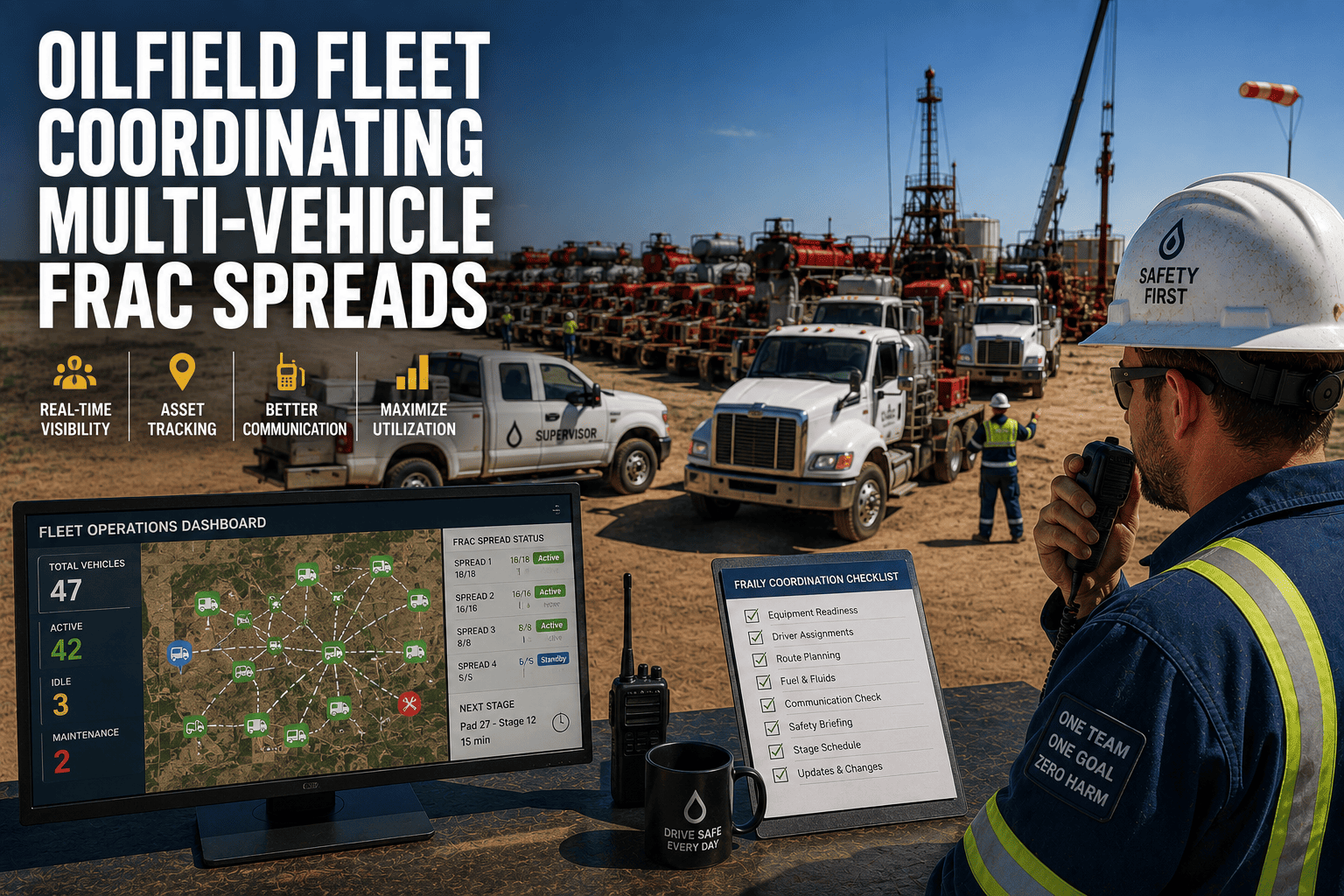
A modern frac spread is really dozens of moving parts pretending to be one operation. Sand haulers, water transfer trucks, fuel trucks, chemical trailers, and crew vehicles all have to reach the same pad, in the right order, without ever letting the blender run dry. When that choreography breaks down even slightly, a multi-million dollar completion crew ends up standing idle waiting on a truck that is stuck at a load-out queue three miles away.
Coordinating a multi-vehicle frac spread means synchronizing sand, water, fuel, and crew arrivals against the blender's real-time consumption rate. Sand haulers alone can spend 40 to 60 percent of a shift waiting in load-out or wellpad queues when dispatch runs on phone calls instead of live location data. Fleets using real-time GPS visibility and geofenced arrival alerts cut non-productive time by up to 35 percent.
Why Coordinating a Frac Spread Is So Difficult
A single frac crew pumping at high intensity can burn through more than 130 truckloads of sand in a single day, alongside a constant stream of water transfer and fuel deliveries. Every one of those vehicles is operated by a different driver, sometimes a different company, converging on one pad where space for staging and unloading is limited. Coordination difficulty does not come from any single vehicle, it comes from the sheer number of moving assets that all have to land in the right sequence.
The Cost of an Uncoordinated Spread
Idle time on a frac site is expensive in a way few other operations can match, because the entire crew and equipment package is billed by the hour regardless of whether sand is flowing. A sand hauler billed at a fully burdened rate loses a significant share of that value every hour it sits stationary in a queue, and a stalled blender means the entire completion crew, pumps, and wireline units are also waiting rather than producing.
FleetRabbit gives dispatchers one view of every sand, water, fuel, and crew vehicle heading to the pad, with geofenced alerts before each arrival. Try it with a free sign up or see it running on a live spread.
The Moving Pieces of a Coordinated Frac Spread
Each asset type on a frac site has its own coordination requirement, and understanding those differences is the first step to building a schedule that actually holds together.
| Asset Type | Coordination Requirement | Risk if Uncoordinated |
|---|---|---|
| Sand Haulers | Staggered dispatch matched to blender consumption rate | Wellpad queues, safety hazards, and gaps in sand supply |
| Water Transfer Trucks | Continuous supply timed to pumping schedule | Stage delays if source tanks run low mid-pump |
| Fuel Trucks | Delivery scheduled around stage transitions only | A mid-stage arrival can halt pumping entirely |
| Chemical and Additive Trailers | Inventory tracked against blend recipe usage | Formula substitutions or pump-down delays |
| Crew and Support Vehicles | Valid certifications and current gate access records | Vehicles or personnel turned away at the gate |
Building a Coordinated Dispatch Workflow
Most operators tighten up frac spread coordination by moving through four practical stages rather than replacing their entire logistics setup at once.
Step 1: Put Every Vehicle on One Live Map
Sand, water, fuel, and crew vehicles all report location in real time, so dispatchers see the full spread instead of piecing it together from radio calls.
Step 2: Set Geofenced Arrival Alerts
Load-out teams and pad supervisors get automatic notice minutes before a truck arrives, giving them time to prepare the unloading slot instead of reacting cold.
Step 3: Match Dispatch Timing to Blender Consumption
Instead of sending trucks on a fixed schedule, dispatch staggers departures based on how fast the pad is actually consuming sand and water.
Step 4: Track Certifications and Access Alongside Location
Driver certifications, gate codes, and site access details travel with the vehicle record, so a truck never rolls up to a locked gate or an expired credential.
Why Consolidated Visibility Matters More Than Any Single Fix
Operators who fix one link in the chain, like adding more sand trucks, often find the bottleneck simply moves to water or fuel. The lasting fix is a single system where every vehicle type reports into the same dashboard, so dispatchers can see the whole spread's rhythm and adjust before a queue forms rather than after.
FleetRabbit connects sand, water, fuel, and crew logistics into a single live view so your spread runs on schedule. Get started with a free sign up, or book a demo to see it mapped to your next completion.
Frequently Asked Questions
Every minute your blender waits on a delayed truck is a minute your entire completion crew is idle too. FleetRabbit gives you one live view of sand, water, fuel, and crew vehicles so your spread runs on schedule. Start with a free sign up or book a short demo to see it on your next pad.