Driver safety in oilfield fleet operations is simultaneously a safety management obligation, a regulatory compliance requirement, and a financial risk management discipline — because the consequences of driver safety programme failure in oilfield environments are more severe than in highway commercial transport across all three dimensions. A preventable vehicle accident in an oilfield environment frequently involves remote location medical response delays, HAZMAT spill consequences from cargo carried by the vehicle, drilling programme disruption from equipment damage, and a regulatory investigation that examines not just the immediate incident but the carrier's entire driver safety management programme. The financial consequences — direct injury costs, equipment repair, HAZMAT remediation, regulatory penalties, insurance premium increases, and civil litigation — commonly exceed $1 million for a single serious incident, with larger incidents reaching $5–$10 million when all components are included. The safety management implication is straightforward: an oilfield fleet operator whose driver safety programme prevents one serious incident per year has typically recovered the cost of that programme by a significant multiple. Building an effective oilfield driver safety programme in 2026 requires four integrated components that paper-based and siloed digital systems cannot deliver simultaneously: continuous behaviour monitoring that identifies high-risk driving patterns before they escalate to incident events; data-driven coaching that converts specific behaviour event records into objective coaching conversations rather than subjective safety reminders; compliance management that tracks driver certifications, training records, and regulatory qualification status with automated enforcement; and safety record generation that produces the tamper-evident, GPS-verified documentation that FMCSA compliance reviews, OSHA investigations, and insurance underwriting processes require. FleetRabbit's oilfield driver safety platform integrates all four components — deployed from the first day of platform activation at any fleet size, providing the data infrastructure that makes evidence-based driver safety management possible where previously only subjective observation and periodic training existed. Book a demo to see FleetRabbit's oilfield driver safety programme platform for your fleet operation.
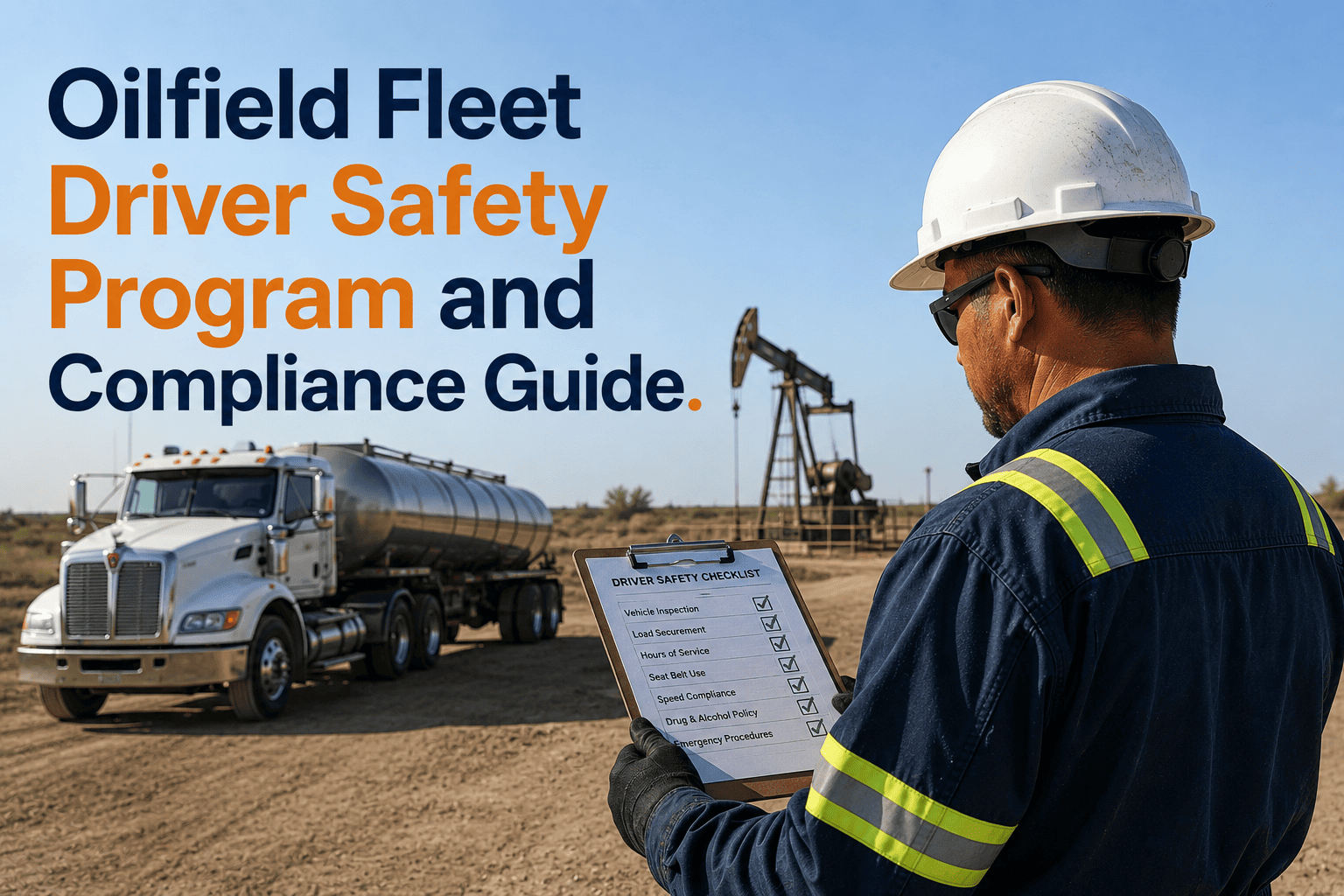
Oilfield Fleet Driver Safety Program and Compliance Guide
An effective oilfield driver safety programme requires four integrated components: continuous behaviour monitoring, data-driven coaching, compliance management, and tamper-evident safety records. FleetRabbit delivers all four simultaneously — reducing harsh driving events by 34–47% within 60 days, achieving 91% driver safety engagement, and producing the documentation that satisfies FMCSA, OSHA, and insurance underwriting requirements.
The Four Integrated Components of an Effective Oilfield Driver Safety Programme
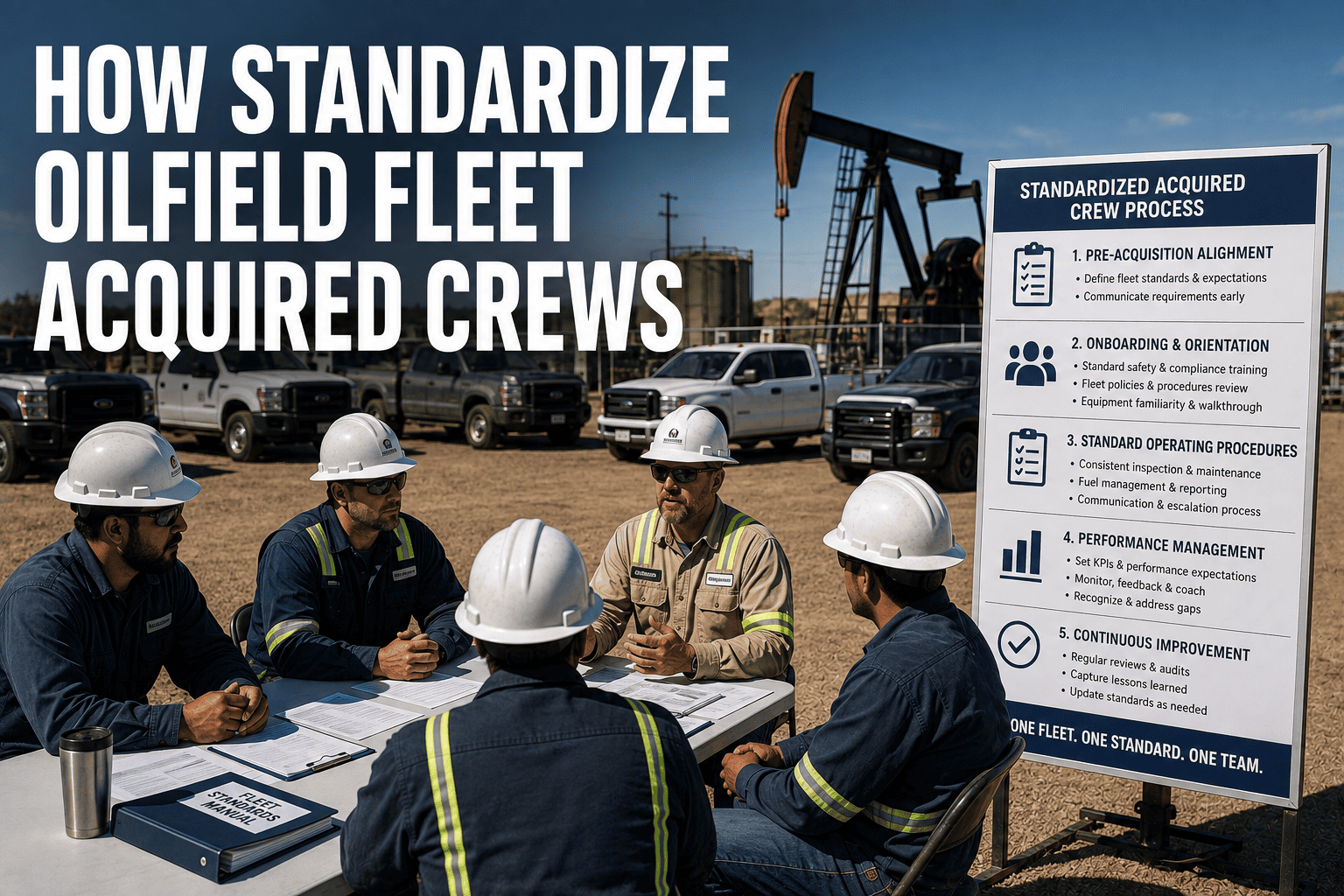
Each component of an effective oilfield driver safety programme reinforces the others — behaviour monitoring provides the data for coaching; coaching produces the improvement that shows in safety records; safety records support insurance and regulatory compliance; compliance management prevents the certification gaps that turn regulatory audits into enforcement actions.
Continuous Behaviour Monitoring — Identifying High-Risk Patterns Before They Escalate
Traditional driver safety monitoring in oilfield operations relied on supervisor observation at wellsite visits — a method that captures a fraction of actual driver behaviour and is inherently subject to observer effect and availability bias. A supervisor present during a wellsite visit sees approximately 2–3 hours of a driver's shift; FleetRabbit monitors all hours simultaneously across all vehicles in the fleet without any supervisor physical presence required. The specific behaviours monitored — hard braking events, harsh acceleration, speeding against zone-specific thresholds, seatbelt non-compliance, geofence violations, and hours-of-service approaching-limit indicators — are the leading indicators that research consistently identifies as precursors to serious incident events, not lagging indicators that are only examined after an incident has occurred.
Data-Driven Coaching — Specific Event Records That Make Coaching Conversations Objective
The coaching conversation that produces behaviour change is fundamentally different from the general safety reminder that produces temporary awareness. When a fleet manager sits down with a driver to discuss a specific GPS-timestamped hard braking event on a named lease road at 14:23 on a specific date — with the following distance, speed at brake application, and deceleration rate visible in the data — the conversation is grounded in an objective event record that neither the driver nor the manager can dispute or reframe through selective memory. Studies of oilfield fleet coaching programme effectiveness consistently find that the shift from observation-based to data-based coaching produces 3–5x better behaviour change outcomes — not because the coaching approach changes, but because the objective specificity of the event record makes the coaching conversation qualitatively different.
Compliance Management — Certification Tracking With Automated Dispatch Blocking
Driver compliance management in oilfield operations is more complex than in highway commercial transport because the certification requirements layer across multiple regulatory frameworks and client operator prequalification standards simultaneously. A driver assigned to a North Sea offshore support location may require simultaneous currency in CDL, DOT medical certificate, BOSIET, GWO, OPITO, H2S awareness, and the client operator's site-specific induction — each with a different expiry date, issuing body, and renewal lead time. Managing this across 50–200 drivers using supervisor spreadsheets produces the systematic certification gaps that cause gate refusals and FMCSA citation events. FleetRabbit's certification tracking module manages unlimited certificate types per driver with automated 60/30/7-day renewal alerts and dispatch blocking when Critical certifications lapse.
Safety Record Generation — Tamper-Evident Documentation for FMCSA, OSHA, and Insurance
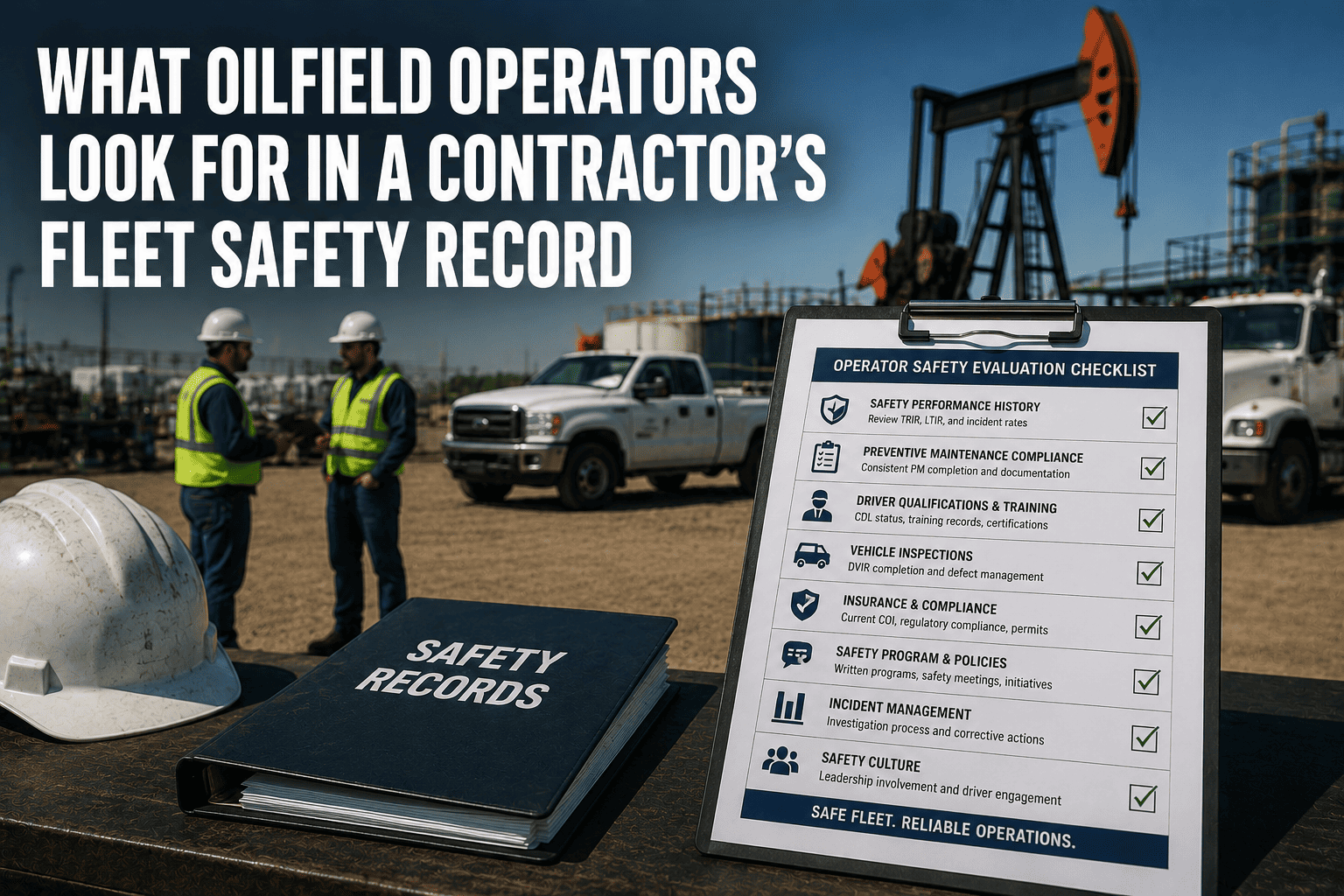
The safety records generated by a driver safety programme serve three distinct purposes that require different evidence standards: FMCSA driver qualification file compliance under 49 CFR Part 391, OSHA recordkeeping under 29 CFR Part 1904, and insurance underwriting evidence at policy renewal and post-incident investigation. Paper-based and manually compiled digital safety records are consistently rejected as insufficient primary evidence by FMCSA compliance reviewers and insurance underwriters — not because the underlying safety practices were inadequate, but because the records cannot demonstrate that the documented practices actually occurred. FleetRabbit's tamper-evident, GPS-timestamped safety records satisfy all three evidence standards from a single platform without requiring separate documentation systems per regulatory audience.
All Four Safety Programme Components — Deployed Simultaneously From Day One at $3/Vehicle/Month
FleetRabbit deploys all four oilfield driver safety programme components simultaneously — behaviour monitoring, data-driven coaching, certification compliance management, and tamper-evident safety record generation — from the first day of platform activation at any fleet size, with no separate modules, no implementation fee, and no specialist consultants required.
How to Build an Oilfield Driver Safety Programme Using FleetRabbit — Implementation Framework
Baseline Establishment and Certification Audit
Deploy FleetRabbit across the fleet and conduct the initial driver certification audit — importing existing records from supervisor spreadsheets and identifying all gaps before the first dispatch cycle following deployment. FleetRabbit's initial certification audit at deployment consistently identifies 15–30% of drivers with at least one expired or near-expiry critical certification that would have caused a gate refusal or FMCSA citation without intervention.
Behaviour Baseline and Score Band Identification
FleetRabbit's scoring engine calibrates per-driver baselines during the first 14 days — accounting for individual routes, terrain, and operational conditions before scoring activates. At the end of the calibration period, the fleet manager receives the first driver score distribution report showing the Red (high-risk), Amber (improvement needed), and Green (performing) driver bands across the full fleet. This is the first evidence-based view of the fleet's safety risk distribution that most oilfield fleet managers have ever seen at this level of specificity.
Coaching Programme Activation and Behaviour Change
Fleet managers conduct data-based coaching sessions with Red-band drivers using FleetRabbit's specific event records — GPS-timestamped hard braking events, harsh acceleration instances, speeding by zone, and seatbelt compliance rates — as the primary coaching evidence. In-cab real-time alerts are active for all drivers, providing immediate feedback at the moment of each event rather than only at periodic coaching sessions. The combination of real-time in-cab awareness and specific event record coaching consistently produces 34–47% harsh event reduction within 60 days of this two-pronged approach.
Recognition Programme and Safety Culture Transformation
Top-performing drivers in the Green band are recognised through formal recognition mechanisms linked to FleetRabbit score data — safety awards, performance bonuses, scheduling preferences, or public recognition in yard meetings. The visibility of scores and the formal link between safety performance and recognition produces the cultural shift from safety as compliance obligation to safety as performance metric with visible consequences. Driver safety engagement rate increases from the typical 38% baseline in paper-based programmes to the 87–91% engagement rates observed at FleetRabbit deployments within this period.
What FleetRabbit's Driver Safety Programme Delivers for Operations Leadership
Evidence-Based Safety Programme Defence for Regulatory and Legal Proceedings
When OSHA investigates a serious vehicle incident or FMCSA conducts a compliance review, the HSE director's ability to demonstrate systematic safety management — rather than reactive incident response — determines whether the outcome is a manageable regulatory citation or a pattern-of-neglect finding that elevates enforcement consequences. FleetRabbit's continuous monitoring records, coaching documentation, and tamper-evident safety event histories provide the programme evidence that supports systematic safety management claims under regulatory scrutiny.
Telematics-Verified Safety Performance for Premium Reduction Submissions
Insurance underwriters pricing oilfield fleet coverage distinguish between operators who claim improved safety management and operators who can verify it. FleetRabbit's continuous telematics-verified safety records — inspection completion rates, driver behaviour event frequency trending, coaching programme documentation, and incident record quality — provide the evidence package that supports 18–22% premium reductions at policy renewal. The insurance saving at a 100-vehicle fleet typically exceeds the annual platform cost by 15–20x.
Fleet-Wide Safety Risk Visibility Without Field Supervisor Data Assembly
Operations VPs receive automated weekly safety performance digests showing fleet-wide driver score distribution, harsh event frequency trends, Red-band driver coaching status, and certification compliance rates — without requiring field supervisors to compile and submit safety reports. The VP who identifies from the FleetRabbit digest that three drivers across different Basin districts are simultaneously in the Red band can initiate a portfolio-level coaching priority before the next incident occurs.
Specific Event Records That Make Every Coaching Conversation Objective
Fleet managers using FleetRabbit's per-driver event records report that coaching conversations change in character when objective GPS-timestamped data replaces subjective observation. Drivers who would reframe or dispute observer-based safety feedback cannot dispute their own vehicle's sensor data showing a specific deceleration event at a specific location and time. This objectivity converts coaching resistance into coaching engagement — the primary mechanism through which 91% driver safety programme participation is achieved.
Build the Evidence-Based Driver Safety Programme That Reduces Oilfield Fleet Incidents and Satisfies FMCSA, OSHA, and Insurance Requirements
FleetRabbit deploys all four driver safety programme components — continuous behaviour monitoring, data-driven coaching, certification compliance management, and tamper-evident safety records — across your oilfield fleet in 5–7 working days at $3/vehicle/month. The same platform that achieved 91% driver safety engagement and 47% harsh event reduction for deployed oilfield fleets is available on your operation from Day 1.