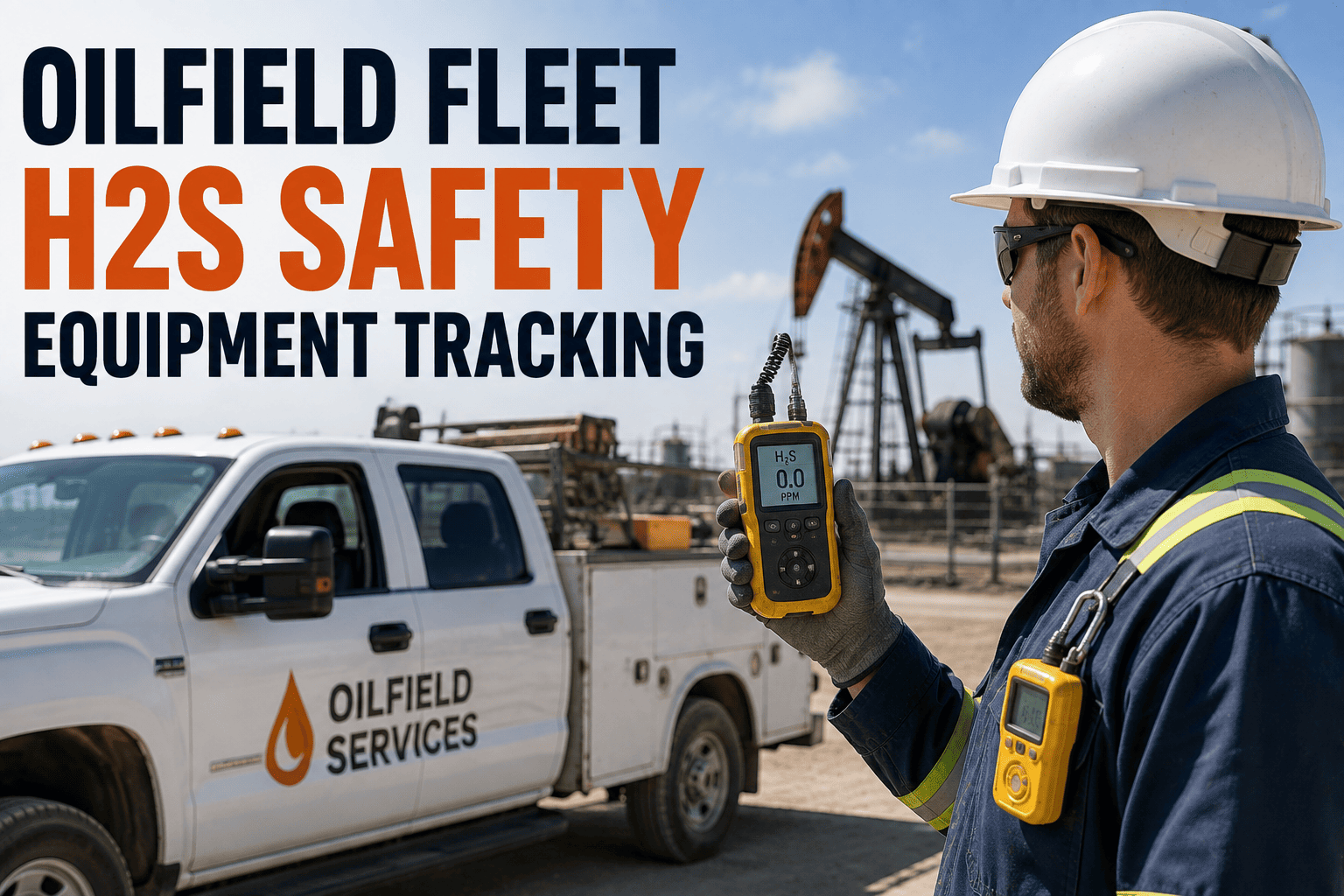
Hydrogen sulfide is invisible, heavier than air, and capable of killing a worker in a single breath at high concentrations. For oilfield fleets running wellsite crews, tanker trucks, and service vehicles through sour gas zones, H2S is not an occasional hazard, it is a daily operating condition. The gas collects in cellars, tank bottoms, sumps, and low-lying pits, and it disables the human sense of smell within minutes of exposure, which means crews cannot rely on their nose to warn them. Keeping people safe depends entirely on whether the right equipment is on the truck, calibrated, and inspected on schedule, and whether every driver and technician holds a current H2S certification. Fleet managers who track this equipment manually through spreadsheets and paper logs are the ones most likely to discover a gap only after an incident.
OSHA sets the permissible exposure ceiling for H2S at 20 ppm, never to be exceeded during a shift except for a brief 50 ppm peak lasting no more than 10 minutes. The NIOSH immediately dangerous to life or health level is 100 ppm, and concentrations above 700 ppm can cause collapse and death within minutes. H2S is heavier than air and pools in low areas, and most safety programs set an early warning alarm at 5 to 10 ppm so crews can retreat before reaching a dangerous threshold.
How Hydrogen Sulfide Concentration Changes the Danger Level
Understanding H2S risk starts with recognizing that the danger is not linear, it accelerates sharply as concentration rises. A crew member exposed to 2 to 5 ppm over a long shift may only notice mild headaches or eye irritation. Push past 100 ppm and the sense of smell shuts down within two minutes, stripping away the body's natural warning system exactly when it is needed most. This is why gas detection equipment, not the human nose, has to be the frontline defense on every sour service jobsite.
Why Oilfield Fleets Need a System, Not a Spreadsheet
Every sour service operation depends on a chain of equipment that has to work every single time: personal gas monitors, fixed area detectors, self-contained breathing apparatus, wind socks, and escape respirators. A single expired calibration or an SCBA cylinder that was never refilled after the last drill turns a manageable gas release into a fatality. Regulatory bodies do not just check whether a fleet owns the right equipment, they check whether records prove it was inspected, calibrated, and assigned to a currently certified worker. Manual tracking across paper logs, whiteboards, and disconnected spreadsheets makes it nearly impossible to catch a lapsed calibration before it matters, especially across a fleet spread over multiple wellsites and shifts.
Digitizing this process changes the entire risk posture of a fleet. Instead of maintenance staff hunting through binders to confirm a monitor was calibrated this quarter, a connected system flags the gap automatically and stops that vehicle from being dispatched to a sour service job until the equipment is current. Fleet managers who want to see how this looks in practice can sign up for a free trial and load their own equipment roster to test it against a real jobsite scenario.
FleetRabbit tracks gas monitor calibration dates, SCBA inspection cycles, and driver H2S certifications in one dashboard, so nothing expires without a warning reaching your team first. Get audit-ready records without the spreadsheet chase.
The Equipment Every Sour Service Vehicle Should Carry
An H2S-ready oilfield vehicle is more than a truck with a gas detector clipped to the dash. A complete safety loadout combines personal detection, escape capability, and rescue readiness, and each piece has its own inspection interval that a fleet management system needs to track separately.
| Equipment | Purpose On Site | Typical Check Interval | Failure Consequence |
|---|---|---|---|
| Personal Gas Monitor | Worn by each individual, gives first alert as soon as H2S is detected in the breathing zone | Bump test daily, full calibration monthly | Worker enters a hazardous atmosphere with no warning |
| Fixed Area Detector | Monitors wellhead, tank battery, or cellar continuously for background gas buildup | Calibration every 3 to 6 months | Slow gas accumulation goes unnoticed until concentration is already high |
| SCBA Units | Supplied air breathing apparatus for entry into confirmed high concentration zones | Visual inspection monthly, full service annually | Rescuer or entrant loses air supply during a critical response |
| Escape Respirators | Short-duration air supply allowing workers to exit a contaminated area safely | Seal and pressure check monthly | Worker cannot safely evacuate during an unexpected release |
| Wind Direction Indicators | Shows crews the safe upwind escape route during a release | Visual condition check weekly | Crew evacuates directly into the gas plume instead of away from it |
Driver and Technician H2S Certification
Equipment alone does not keep a crew safe if the people using it were never trained to recognize the thresholds, don an SCBA under pressure, or execute a buddy rescue. Most operators require H2S clear certification renewal every one to two years, and a fleet running sour service routes needs a single source of truth showing exactly which drivers are current, which are expiring soon, and which should not be dispatched to a wellsite until retrained.
What A Certification Tracking Record Should Include
A defensible record ties the driver's name to their certifying body, issue date, expiration date, and the specific wellsite or client contract requiring that credential. When an auditor or client safety officer asks for proof, a fleet manager should be able to pull that record in seconds rather than searching through old training folders.
Building an H2S Safety Program Fleet Managers Can Trust
A strong H2S program is built in layers, starting with hazard assessment and ending with documented, repeatable response drills. Site-specific hazard assessments identify where gas is likely to accumulate, based on well history, geology, and known sour service zones. Alarm thresholds are then set with margin, commonly a first alert around 5 to 10 ppm and a mandatory evacuation trigger at the 20 ppm regulatory ceiling, giving crews time to retreat before exposure becomes dangerous. Every worker entering a sour service area needs a buddy system and a designated safety watch trained in rescue and retrieval, since low areas like cellars and sumps can also qualify as permit-required confined spaces under separate regulations.
Regular drills matter as much as the equipment itself. A crew that has practiced donning an SCBA and executing an evacuation route under time pressure responds faster and more safely than one relying on training from a year ago. Fleet managers considering how to formalize this across multiple crews and job sites can book a free demo to walk through how equipment records, certification tracking, and dispatch rules can work together inside one platform.
Tracking Compliance Across A Growing Fleet
As an oilfield fleet scales from a handful of trucks to dozens of vehicles spread across multiple basins, manual tracking breaks down quickly. A calibration due date tracked on one supervisor's spreadsheet does not help a dispatcher two time zones away trying to assign a truck to an emergency call. Centralizing equipment status, certification expiry, and inspection history means every dispatcher, safety officer, and field supervisor sees the same real-time picture, and vehicles missing current H2S equipment or certified drivers are automatically flagged before they are sent to a sour service location.
This visibility also strengthens audit readiness. Regulatory inspections and client safety audits often request calibration logs, inspection records, and training certificates going back months or years. A digital system that timestamps every check and every certification renewal turns what used to be a days-long document hunt into a report generated in minutes.
From gas monitor calibration to SCBA inspection cycles and driver certification renewals, FleetRabbit keeps your entire sour service compliance picture current and instantly reportable. Stop chasing paperwork and start preventing exposure incidents before they happen.
H2S does not give second chances, and neither should your equipment tracking process. FleetRabbit keeps gas monitors, SCBA units, and driver certifications current and visible across your entire fleet, so every crew heads into a sour service site fully protected. Get started with no credit card required.