Oilfield fleet inspection logs create the daily safety verification record that connects driver accountability to vehicle condition monitoring across commercial vehicle operations, process equipment deployments, and facility safety systems. The difference between a paper inspection log completed at the yard before departure and a GPS-verified digital inspection completed at the wellsite is the difference between documentation that satisfies a form requirement and documentation that proves the safety verification actually happened where and when it was supposed to. FleetRabbit's digital inspection log platform enforces the inspection execution quality that paper templates cannot — blocking vehicle dispatch until inspection is complete, requiring photographic evidence for every identified defect, verifying technician location at point of submission, and escalating critical findings to maintenance coordinators within 60 seconds of recording rather than 24-72 hours later through paper collection chains. Schedule a demonstration to see how FleetRabbit transforms daily fleet inspection documentation for oilfield operations.
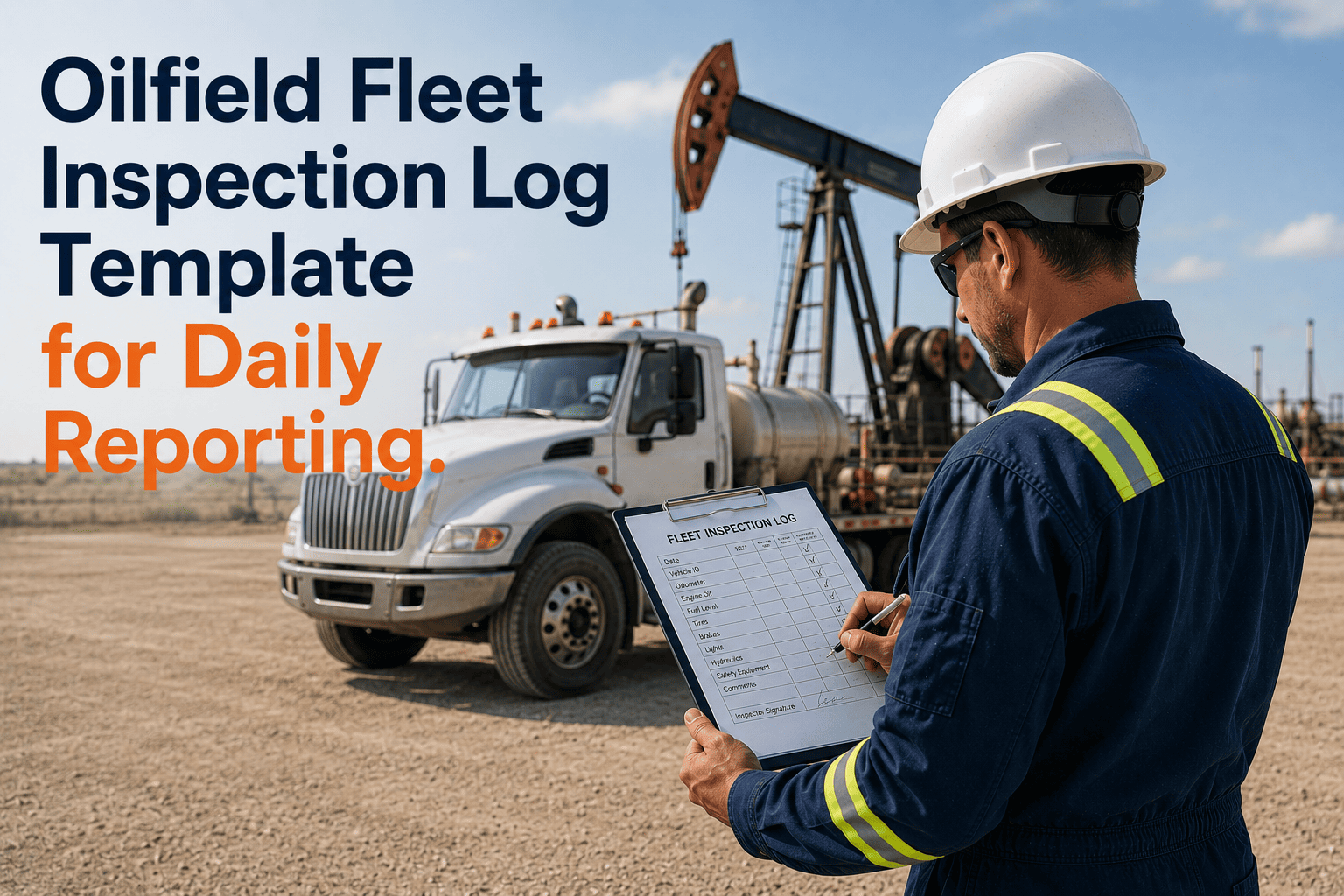
Oilfield Fleet Inspection Log Template for Daily Reporting
A comprehensive daily fleet inspection log framework covering pre-trip vehicle verification, equipment condition checks, safety system status, and regulatory compliance documentation — with FleetRabbit's digital platform enforcing GPS-verified completion, mandatory photo evidence, and automatic defect escalation across every shift across your entire oilfield fleet.
FleetRabbit deploys GPS-verified digital inspection logs across oilfield fleets in 5-7 days at $3 per vehicle per month — including dispatch blocking, automatic defect escalation, and engine-hour PM scheduling.
Paper Inspection Logs Create Documentation — Not Safety Assurance
Paper fleet inspection log templates generate the visual structure of systematic safety management without the enforcement mechanisms that make inspection programs genuinely effective. An oilfield driver completing a paper inspection log at highway speed in the cab — checking boxes for brake systems, tires, and lighting without physically examining any system — produces a paper record that cannot be distinguished from a thorough 35-minute inspection at the wellsite. The regulatory and operational consequence of this execution quality gap is identical: equipment failures that systematic inspection would have prevented continue undetected until field breakdown.
FleetRabbit's digital inspection log platform closes the execution gap through three enforcement mechanisms that paper templates cannot replicate: dispatch blocking that prevents vehicle assignment until inspection submission is complete, GPS verification proving the inspection occurred at the vehicle location, and mandatory photographic documentation that blocks submission without visual evidence of any identified defect. These three mechanisms transform daily inspection logging from a compliance exercise into a genuine vehicle condition monitoring program.
FleetRabbit eliminates all four paper inspection log failure modes simultaneously — 96% completion through dispatch blocking, GPS-verified execution location, 60-second defect escalation, and FMCSA-compliant digital records built automatically from every field submission. Start free — digital inspection logs live across your oilfield fleet in 5-7 days.
Daily Pre-Trip Inspection Log — FMCSA 49 CFR Part 396.11 Required Categories
Every commercial motor vehicle operating in oilfield fleet service must complete a pre-trip driver vehicle inspection report before each shift. The following log framework covers all FMCSA-required inspection categories plus oilfield-specific safety items applicable to Basin service vehicle operations across remote well pad and lease road environments.
Oilfield-Specific Equipment and Process System Inspection Log
Oilfield fleet vehicles carry process equipment and safety systems beyond standard commercial vehicle inspection categories — frac truck fluid ends, crude tanker cargo systems, HAZMAT documentation, and H2S safety equipment require systematic logging that generic DVIR templates do not address. The following equipment-specific log items cover the most critical oilfield service vehicle categories.
Every Vehicle Type Gets the Right Inspection Log — Automatically Assigned by FleetRabbit
FleetRabbit assigns vehicle-type-specific inspection logs automatically at dispatch — crude tankers receive cargo documentation prompts, frac trucks receive fluid end and high-pressure iron items, service trucks receive standard CMV checks. No driver selecting wrong forms. No missing oilfield-specific items on generic DVIR templates.
Post-Trip Inspection Log and Shift-End Vehicle Condition Report
Post-trip inspection log requirements under FMCSA 49 CFR Part 396.11 mandate driver certification of vehicle condition at shift end — documenting any defects developed during operation that must be repaired before the next operational shift. Post-trip logs that fail to capture shift-end defects create the overnight maintenance window gap where vehicle condition deteriorates undetected between inspection cycles.
Vehicle Defect Tracking Log and Corrective Action Record Template
Defect tracking logs create the evidence chain from initial identification through repair verification — satisfying FMCSA Part 396.3 requirements for documented defect remediation and establishing the vehicle condition history that supports warranty claims, insurance documentation, and audit defense when regulatory enforcement challenges the adequacy of maintenance program execution.
FleetRabbit's defect tracking creates a GPS-verified, photo-documented audit chain from identification through repair verification — satisfying FMCSA Part 396.3 and warranty administrator documentation requirements that paper defect logs cannot meet when challenged during enforcement or claim review. Book a demonstration to see defect tracking and work order automation in action.
From Paper Inspection Logs to Automated Digital Safety Management
FleetRabbit replaces all four inspection log template sections with an integrated digital platform — enforcing execution quality, verifying location, escalating defects automatically, and building the FMCSA-compliant inspection record database that audit-ready oilfield fleet operations require.
Dispatch Block Until Log Complete
No vehicle can be assigned to any route until a completed GPS-verified pre-trip inspection record exists in FleetRabbit for that unit on that shift. This single enforcement mechanism drives the 96% completion rate from Day 1 — because dispatchers cannot move vehicles that have not been inspected, the inspection actually happens rather than being deferred until after departure.
GPS Location Verification at Submission
Every inspection log submission captures GPS coordinates from device sensor at point of completion — proving the inspection occurred at the vehicle location, not in the cab en route to the wellsite. Tamper-evident records cannot be backdated or location-modified after submission. FMCSA evidentiary standard automatically satisfied for every submission.
Mandatory Photographic Evidence
Defect submission is blocked without mandatory photographs of identified conditions — preventing the "verbal description only" defect records that fail warranty claims and provide inadequate evidence during regulatory enforcement. Before-and-after photography creates the defect-to-repair visual chain that audit reviewers and warranty administrators accept as verification of genuine maintenance execution.
60-Second Defect Escalation
Critical defect recorded at 05:30 — maintenance supervisor notified at 05:31 — work order generated automatically — vehicle dispatch block active for that unit. The 27.5-hour paper reporting lag is eliminated permanently. Fleet managers see every defect in real time across all vehicles and locations without requiring any manual notification chain or supervisor follow-up.
Engine-Hour PM Scheduling Integration
Odometer and engine hours captured at every inspection submission automatically update PM scheduling calculations — triggering service alerts at configured lead times before each maintenance threshold. No manual hour recording. No spreadsheet monitoring. The right service at the right interval for each vehicle type in each duty cycle class, driven automatically by inspection log data.
FMCSA-Compliant Record Database
Every pre-trip log, post-trip log, defect finding, and return-to-service certification stored in FleetRabbit's compliance database with tamper-evident timestamps. Complete FMCSA Part 396.3 maintenance and inspection records exportable for any vehicle and any date period within 2 hours — versus 40-60 hours of manual paper file retrieval from dispersed field office locations.
Common Questions About FleetRabbit Digital Inspection Logs
Replace Paper Inspection Logs With GPS-Verified Digital Safety Documentation — Live in 5-7 Days
FleetRabbit's integrated inspection log platform covers all four template sections — daily pre-trip DVIR with dispatch enforcement, oilfield equipment-specific checklists, post-trip vehicle condition logs, and defect tracking with corrective action management — in a single digital platform deployable across oilfield fleets of any size in 5 to 7 working days at $3 per vehicle per month. GPS-verified inspection location, mandatory photographic evidence, 60-second defect escalation, and FMCSA-compliant record database replace paper inspection logs that create documentation without enforcement across remote oilfield driver populations.