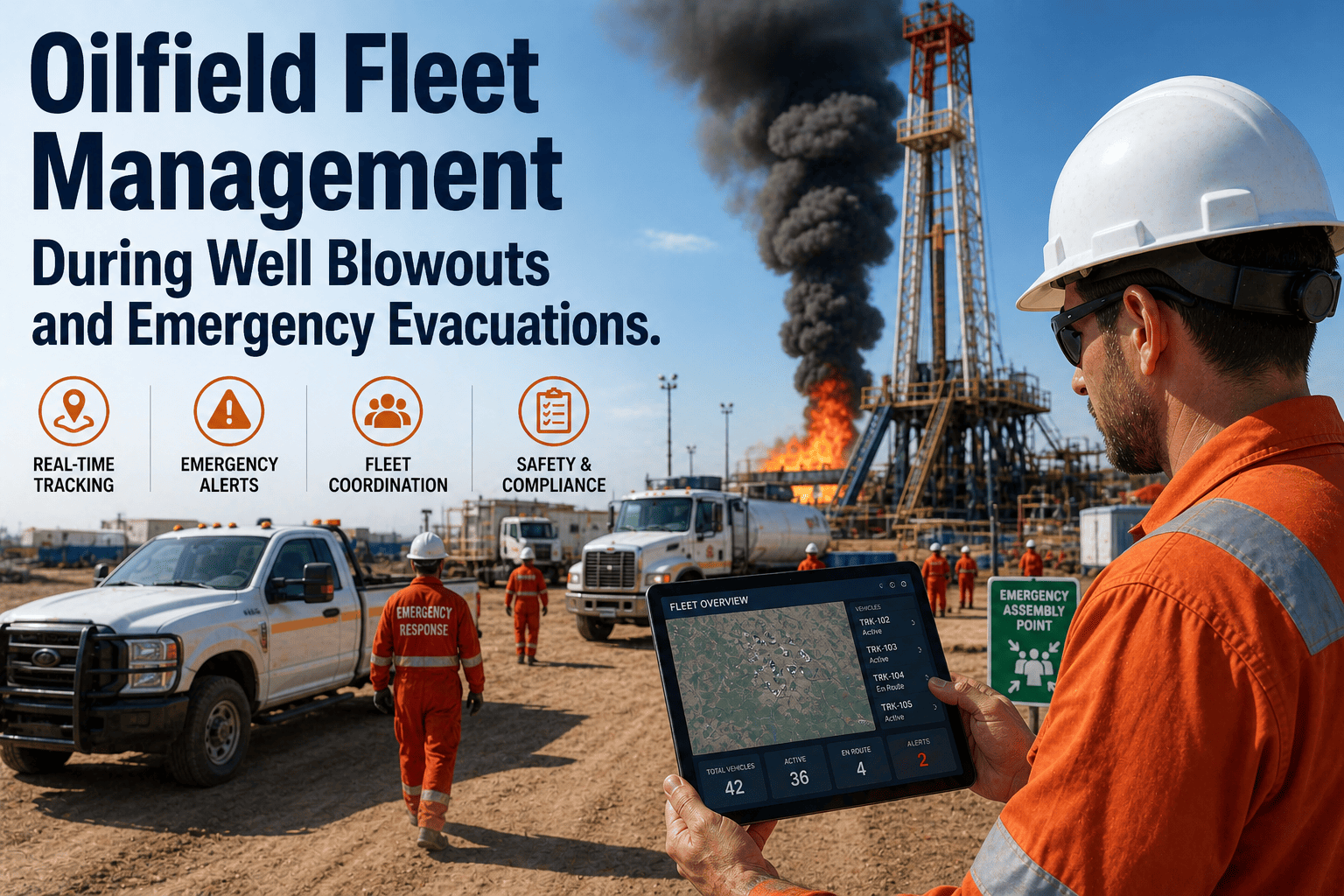
A well blowout at an active drilling site is the highest-intensity fleet management scenario in oil and gas operations — because the decisions made in the first 8–12 minutes determine whether the incident results in a managed evacuation or a casualty event. Fleet managers and operations coordinators responding to a blowout emergency need to simultaneously confirm the location and status of every vehicle at or near the affected site, initiate evacuation routes for crew transport vehicles, account for every driver against the site muster register, dispatch emergency response assets to support well control operations, and communicate with HSE coordinators, regulatory authorities, and senior management — all while the situation at the wellsite is continuing to develop. Manual systems — phone trees, paper muster registers, radio check-ins — fail in this scenario not because of any single failure mode but because they require human coordination across multiple channels simultaneously at exactly the moment when human attention is most constrained by the emergency itself. FleetRabbit's emergency fleet management capabilities are not a separate emergency module added to a standard fleet platform — they are the operational consequence of continuous real-time GPS tracking, live driver certification visibility, satellite connectivity at remote wellsites, automated SOS alert workflows, and digital muster registers that are maintained as a function of normal daily fleet operations and become the evacuation coordination infrastructure when emergency conditions require them. This article details the specific FleetRabbit capabilities that enable oilfield fleet managers to coordinate vehicle and personnel accountability during well blowout and emergency evacuation scenarios — and how those capabilities are deployed from the same platform that manages routine daily fleet operations. Book a demo to see FleetRabbit's emergency fleet coordination capabilities for oilfield operations.
Oilfield Fleet Management During Well Blowouts and Emergency Evacuations
When a well blowout occurs, fleet managers need real-time vehicle positions, instant driver accountability, automated SOS routing, and satellite connectivity that works when cellular networks fail. FleetRabbit provides all of these as continuous operational capabilities — not emergency-mode add-ons.
The Four Critical Failures of Manual Fleet Systems During Oilfield Emergency Evacuations
The limitations of paper muster registers, phone-tree evacuation protocols, and radio check-in systems are well understood in normal operations. In a well blowout or H2S release emergency, these limitations become life-safety failures — because the information required to account for every person on site is distributed across systems and people who are themselves managing the emergency.
Vehicle Position Unknown Beyond the Immediate Site Area
Paper site access logs record vehicle arrival but not current position. A driver who departed the main pad location for a secondary wellsite 3 km away on an access road — and who did not radio in the departure — is unknown to emergency coordinators managing the evacuation from the main site. With no real-time GPS data, the fleet manager cannot answer the first question asked by emergency response: where is everyone.
Muster Register Takes 20+ Minutes to Complete Manually
Paper muster processes require a trained muster controller to physically collect names, compare them against an entry register, identify discrepancies, and cross-reference against contractor crew lists maintained by separate companies on separate forms. Under emergency conditions with personnel moving between assembly areas, this process routinely takes 20–45 minutes — during which the status of every unaccounted person is unknown.
Phone Tree Evacuation Fails When Cellular Network Is Saturated or Lost
Blowout events frequently cause rapid deterioration of site conditions including H2S release, which overwhelms cellular network capacity as every person on site attempts to contact family, supervisors, and emergency services simultaneously. Evacuation communications that depend on cellular voice calls become unreliable at exactly the moment they are most needed.
Emergency Response Vehicle Dispatch Without Real-Time Asset Visibility
Emergency coordinators dispatching ambulances, fire response vehicles, and well control equipment cannot optimise routing or estimate arrival times without knowing the real-time positions of those assets. A well control crew dispatched from the nearest yard takes the optimal route to a site only if the dispatcher has real-time GPS data — not if they are relying on radio check-ins from vehicles already in transit.
Real-Time GPS. Satellite Connectivity. Digital Muster. Automated SOS Alerts. All Active Before the Emergency Starts.
FleetRabbit's emergency response capabilities are not activated when an emergency occurs — they are continuous operational capabilities that become emergency infrastructure because they were already running. GPS positions, driver muster records, and satellite communications are available from the first second of any incident, not after a setup process that takes minutes you do not have.
How FleetRabbit Supports Oilfield Fleet Management During Well Blowout and Emergency Evacuation Events
Continuous GPS Position for Every Vehicle — Including Satellite Coverage at Remote Wellsites
FleetRabbit maintains 30-second GPS position updates for every vehicle in the fleet at all times — using satellite fallback connectivity at remote wellsite locations beyond cellular coverage. When a well blowout occurs, the emergency coordinator's FleetRabbit dashboard shows the real-time position of every vehicle at or near the affected site without any setup step: vehicles inside the site exclusion zone are visible, vehicles on access roads are visible, vehicles recently departed toward secondary wellsites are visible with their current position and direction of travel. This situational picture — which would require 15–20 minutes of radio contact to assemble manually — is available within seconds of the emergency declaration.
Digital Muster Register — Driver Status Confirmed Within Minutes, Not the 20–45 Minutes of Manual Paper Process
FleetRabbit maintains a digital muster register linked to driver assignments and vehicle GPS positions. When emergency conditions require muster confirmation, fleet managers initiate a digital muster broadcast through the FleetRabbit platform — pushing a safety status confirmation request to every driver's mobile device simultaneously. Drivers confirm their safe status and current location from the FleetRabbit mobile app. The muster dashboard updates in real time showing confirmed-safe, unconfirmed, and last-known-position for every driver on the assignment register. Unaccounted drivers are identified by name with their last GPS-confirmed position and time — providing search and rescue coordinators with the specific information required to direct a search, not a generic "we have X people unaccounted for" status.
Automated SOS Alert Routing — From Driver Device to Emergency Response Chain Without Manual Relay
FleetRabbit's SOS capability allows any driver to initiate an emergency alert from their mobile device or vehicle-mounted unit — transmitting GPS position, vehicle identity, driver identity, and alert timestamp to the configured emergency response chain simultaneously and automatically. For oilfield operations, this chain is configured to include the fleet manager, HSE coordinator, operations supervisor, and site emergency response team — all receiving the same GPS-precise alert within seconds of initiation without the information degradation that occurs through manual relay from dispatcher to supervisor to emergency coordinator. SOS alerts transmitted via satellite at remote wellsite locations reach the response chain even when cellular networks are congested or unavailable following a blowout event.
Real-Time Emergency Asset Positioning for Optimal Response Route Assignment
Well blowout response requires the rapid deployment of specific emergency assets — well control crews, fire response vehicles, medical transport, and H2S monitoring equipment — from locations that may be distributed across a wide basin area. FleetRabbit's dispatch capability shows emergency coordinators the real-time position of every available response asset, enabling optimal assignment based on actual proximity rather than theoretical nearest-depot calculations that may not reflect current vehicle positions. Response vehicle routes can be set via FleetRabbit dispatch with geofenced arrival confirmation at the wellsite exclusion zone perimeter — verifying that response assets have reached their designated positions without requiring radio check-in at each waypoint.
Post-Incident Documentation and Regulatory Reporting — The Fleet Management Obligation That Follows Every Oilfield Emergency
The regulatory and legal documentation obligations following a well blowout event are substantial and time-sensitive. PHMSA, OSHA, state oil and gas regulatory authorities, and insurance carriers each have specific documentation requirements with defined reporting windows. Fleet management records — vehicle positions at time of incident, driver assignment logs, SOS alert timestamps, muster completion records, and emergency vehicle dispatch documentation — form a critical component of the incident evidence package that these authorities require.
Tamper-Evident Vehicle Position Timeline
FleetRabbit's GPS records provide a tamper-evident, GPS-timestamped vehicle position timeline for the entire incident period — showing exactly where every vehicle was at every minute before, during, and after the blowout event. This timeline satisfies the post-incident investigation requirements of OSHA, BSEE, and state regulatory authorities — and provides the fleet management team with evidence that evacuation protocols were followed correctly.
Complete Muster Completion Documentation
FleetRabbit's digital muster records document the complete muster sequence — alert initiation timestamp, each driver's confirmation timestamp and GPS position, and any drivers who remained unaccounted with their last known position. This documentation satisfies the personnel accountability record requirements included in post-incident regulatory submissions and supports insurance claim processing where the timeline of personnel confirmation is material to coverage determination.
Driver Certification Status at Time of Incident
Post-incident investigations frequently examine whether drivers operating at the affected site held current certifications — H2S awareness, site access credentials, emergency response training — at the time of the incident. FleetRabbit's certification tracking records provide point-in-time certification status documentation for every driver on the site assignment log, confirming compliance with HSE qualification requirements as of the incident date without requiring retroactive records assembly.
Emergency Response Dispatch Audit Trail
Every emergency vehicle assignment, route instruction, and geofenced arrival confirmation during the incident response is logged in FleetRabbit with timestamps and GPS coordinates — creating a complete dispatch audit trail that demonstrates the systematic and timely activation of emergency response protocols. This documentation supports both regulatory compliance submissions and demonstrates due diligence in emergency response management to legal proceedings that may follow significant well control incidents.
Deploy the Emergency Fleet Coordination Capability That Oilfield Operations Require — Before You Need It
FleetRabbit's emergency fleet management capability — continuous satellite GPS, digital muster, automated SOS routing, and real-time emergency dispatch — is deployed as a standard function of the platform at $3/vehicle/month. There is no emergency module premium. The capability that accounts for every driver in 8 minutes instead of 45 minutes is the same platform that manages routine daily fleet operations.