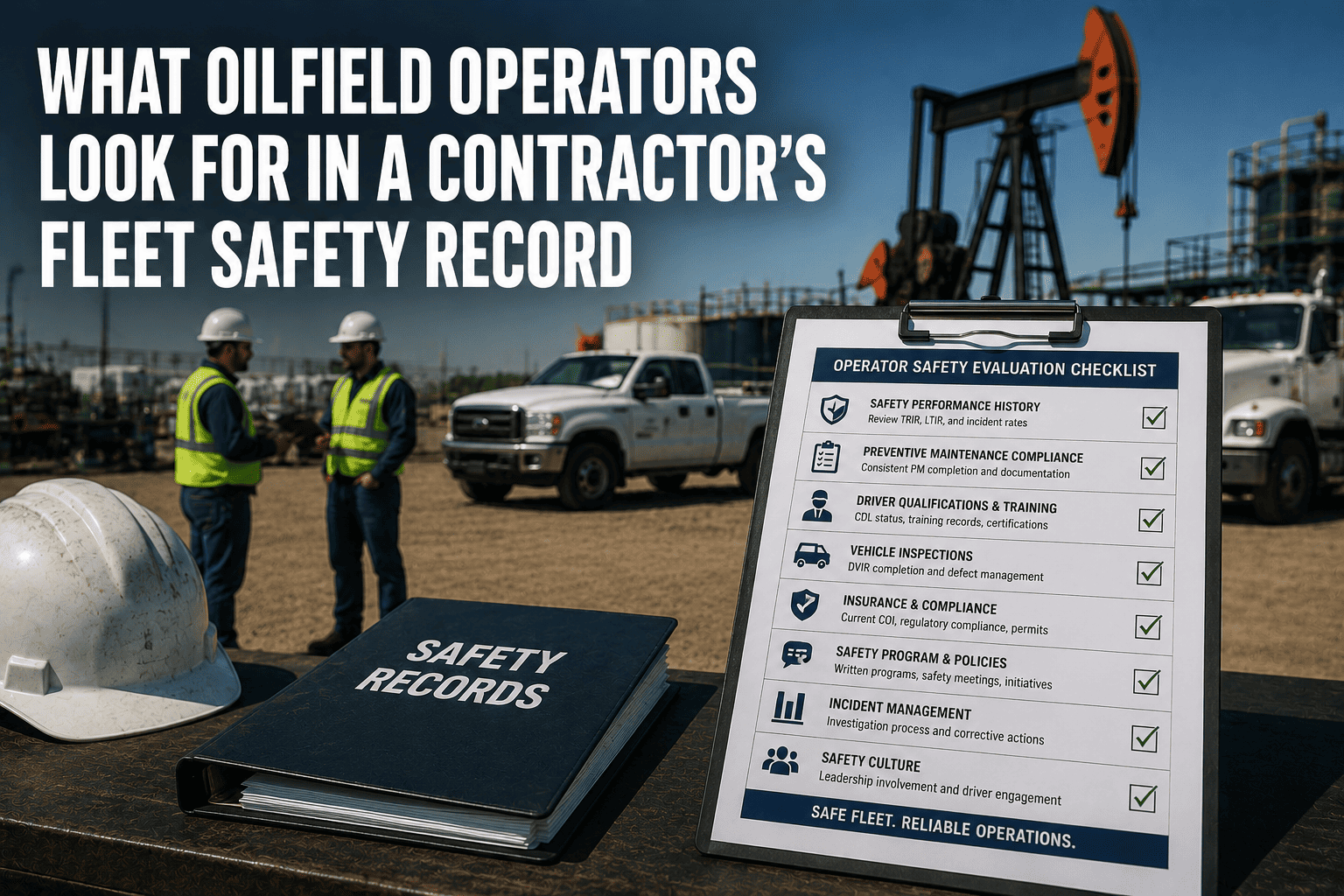
A service fleet rarely works for just one operator. The same truck that ran a hauling job on a Monday pad might be dispatched to a completely different operator's location on Wednesday, and each site can come with its own safety induction, its own inspection checklist, and its own access credential that has nothing to do with the one issued the day before. Major operators require contractors to prove documented inspection programs and current certifications before a vehicle is even allowed through the gate, and a service company running a fleet across a dozen or more client sites is effectively managing a dozen or more separate rulebooks at once, often with nothing more than a shared spreadsheet trying to keep track of it all.
Service fleets working across multiple operator sites face different HSE inductions, inspection checklists, and access credentials at every location, and typical 100-vehicle fleets spend 15 to 20 hours weekly on compliance administration alone. Site-specific configuration, where each vehicle automatically sees the correct checklist and credential status for wherever it is dispatched, replaces that manual tracking with a system that flags a mismatch before the truck ever leaves for the gate.
Why One Fleet Has To Follow Many Different Rulebooks
Every operator sets its own standard for what a compliant contractor vehicle looks like on their location, and those standards rarely match from one company to the next. A service fleet moving between sites has to satisfy all of them simultaneously, without mixing up which rule applies where.
Why This Adds Up To Real Risk, Not Just Extra Paperwork
Operators carry HSE responsibility for contractor vehicles working on their leases and pads, regardless of who owns the truck. If a service company vehicle arrives at a site with an expired induction or the wrong checklist, that is not just an inconvenience for the dispatcher, it is a compliance failure that lands on the operator's audit record as much as the service company's. A single missed detail, one expired credential sent to the wrong site, can jeopardize the entire contract relationship, not just that one trip.
FleetRabbit applies the correct checklist, induction status, and access requirements automatically based on which operator site a vehicle is dispatched to, so nothing slips through when your fleet moves between clients.
What Actually Changes From One Operator's Pad To The Next
Understanding what varies by site is the first step toward tracking it properly. The table below outlines the most common differences a service fleet encounters moving between operator locations.
| Requirement Type | What Typically Varies | Consequence If Mismatched |
|---|---|---|
| Safety Orientation | Renewal cycle, content, and delivery method differ by operator program | Driver denied site access or dispatched without valid clearance |
| Inspection Checklist | Specific inspection items and documentation formats differ by client specification | Incomplete or wrong checklist flagged during an operator audit |
| Access Credential | Gate codes, badges, and journey authorizations are typically timed to a specific assignment | Vehicle arrives at the gate without valid entry authorization |
| Environmental Protocol | Sour gas, confined space, and exclusion zone rules vary by pad type and location | Crew unprepared for a hazard specific to that site type |
Letting Site Location Trigger The Right Rules Automatically
Rather than relying on a dispatcher remembering which client requires what, geofence-based configuration can apply the correct protocol the moment a vehicle enters a specific site boundary, whether that means a drilling pad's sour gas procedures, a pipeline corridor's exclusion zone alerts, or a processing facility's contractor verification requirement. The rule follows the location, not the memory of whoever built the dispatch schedule that morning.
Journey Management Across Multiple Clients
Many operator HSE programs require a documented journey authorization before every trip. When a fleet works across several clients, tracking which trip needs which authorization, and confirming it was actually completed, becomes far easier when the record is generated automatically from the route and destination rather than filled in manually per job.
Staying Audit-Ready Across Every Client Relationship
A service company's reputation with any one operator depends partly on how clean its compliance record looks across all of them, since a pattern of documentation gaps at one site can raise questions during the next contract renewal elsewhere. Centralizing every vehicle, driver, and credential in one dashboard, regardless of which client site it was last dispatched to, means a fleet manager can pull a complete audit-ready package for any operator relationship in minutes rather than assembling it from scattered records after the request comes in. Fleet managers running crews across multiple operator sites can sign up for a free trial and load their current client roster to see how site-specific requirements map automatically against their existing fleet.
This visibility also protects against the more subtle risk, a vehicle or driver whose credentials are current for one client but quietly expired for another. Fleet managers looking to see how automatic site-matching and credential tracking work together across multiple operator relationships can book a free demo and walk through a real multi-site dispatch scenario.
FleetRabbit keeps site-specific inductions, checklists, and access credentials current for every vehicle across every operator your fleet serves, so you can produce a clean compliance record for any client on demand.
Keeping induction status, checklists, and access credentials straight across multiple operator relationships should not depend on someone remembering the details correctly. FleetRabbit applies the right requirement automatically for every site your fleet serves, so nothing gets missed between one client's pad and the next. Get started with no credit card required.