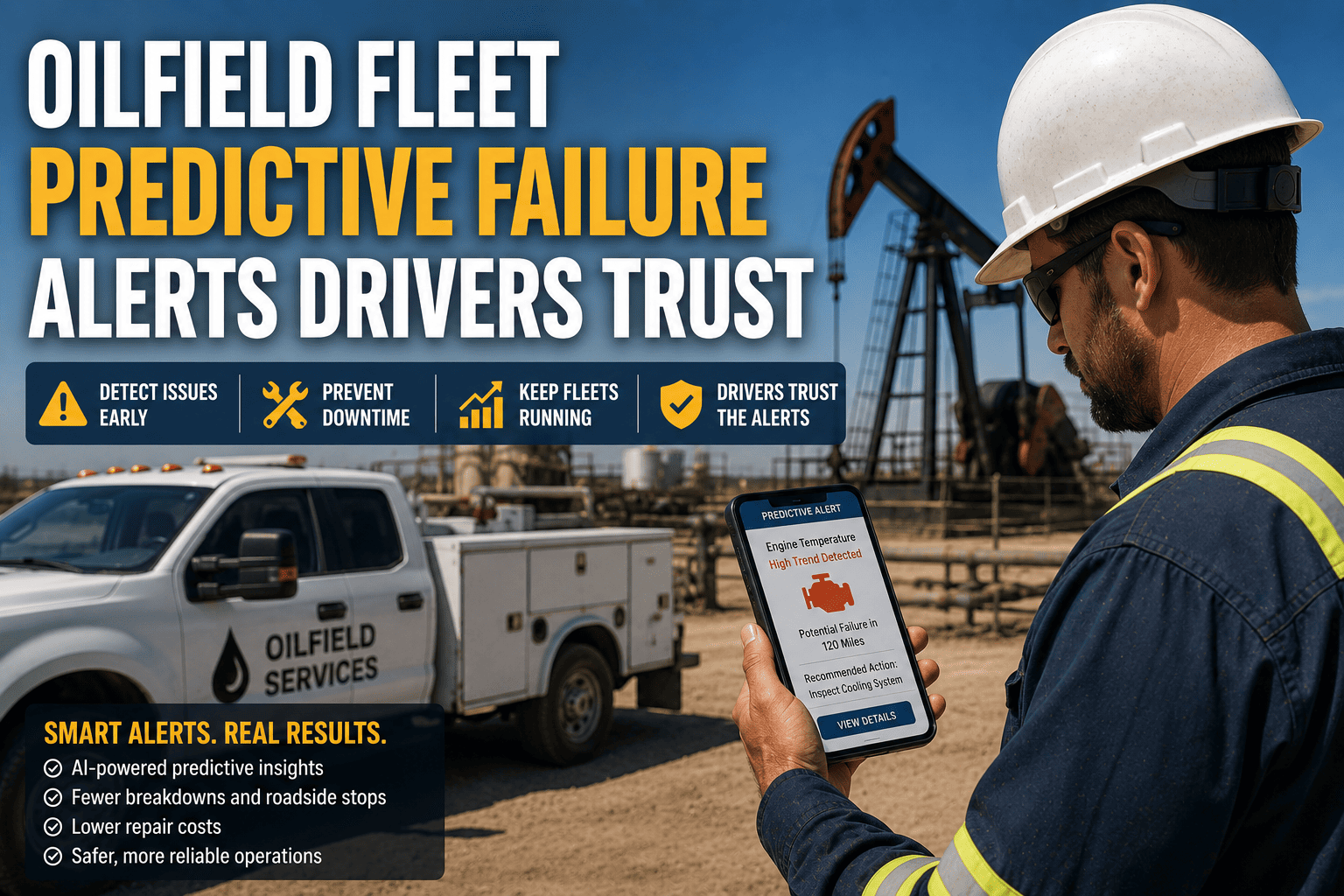
The first time a dashboard warning turns out to be nothing, a driver notices. The third time, they start dismissing it before they even read what it says. Predictive maintenance is supposed to catch a failing component weeks before it strands a truck on a remote lease road, but that only works if the driver receiving the alert actually trusts it enough to act on it. A system that fires too often, or fires without context, trains the exact behavior it was built to prevent: drivers learning to ignore the warning light.
Early predictive maintenance deployments often start with false positive rates of 15 to 20 percent, but well-tuned systems bring that below 8 percent within about 90 days as the model learns each vehicle's actual operating baseline. A dispatch sent on a false alert wastes 45 to 90 minutes on average, and a team fielding a dozen or more bad alerts a day can lose over 25 hours of productive time in a single week. Once trust in the system breaks, teams quietly revert to reactive maintenance, and rebuilding confidence afterward takes months.
Why Drivers Start Tuning Out Predictive Alerts
Alert fatigue is not a driver discipline problem, it is a system design problem. When every anomaly, no matter how minor, triggers the same urgent-looking notification, drivers lose the ability to tell a real warning from routine noise, and the rational response is to stop treating any of it as urgent.
The Cost Of A System Nobody Trusts Anymore
Once confidence in predictive alerts erodes, the damage does not stop at one ignored warning. Maintenance teams quietly slide back into reactive habits, waiting for a full breakdown instead of acting on early signals, which is exactly the outcome predictive maintenance was supposed to eliminate. And when a vehicle does fail after an alert was dismissed, there is often no clear record of whether that alert was ever reviewed, which turns a preventable breakdown into a documentation gap during any post-incident review.
FleetRabbit tunes predictive alerts against each vehicle's own operating baseline, cutting false positive rates dramatically within the first few months so drivers and technicians can trust the warning the moment it appears.
What Makes A Predictive Alert Actually Worth Trusting
Trustworthy alerting is not about catching every possible anomaly, it is about only surfacing the ones that genuinely matter, ranked by urgency, with enough context for the person receiving it to know exactly what to do next.
| Design Element | What It Does | Why It Builds Trust |
|---|---|---|
| Vehicle-Specific Baseline | Compares readings against that individual vehicle's own normal range, not a generic fleet-wide limit | Avoids flagging routine variation as a fault, cutting noise dramatically |
| Correlated Evidence | Requires multiple signals moving together in a known failure pattern before firing | A single odd reading no longer triggers a false alarm on its own |
| Tiered Urgency Levels | Separates warnings into monitor, scheduled inspection, and immediate action categories | Drivers instantly know how seriously to treat each specific alert |
| Feedback Loop | Technician outcomes feed back into the model, refining accuracy over time | The system visibly gets better the longer it runs, reinforcing confidence |
Piloting Before Going Live Fleet-Wide
Some of the strongest rollouts run predictions silently for several weeks before any alert reaches a driver, comparing what the model would have flagged against what actually happened. That shadow period lets a fleet tune thresholds and cut false positive rates sharply before the first live alert ever interrupts a route, so the very first warning a driver sees already has a track record behind it.
Giving Drivers A Reason To Believe The Next Alert
Trust builds fastest when drivers see a prediction pay off. A warning that correctly flags a failing bearing weeks before it would have caused a roadside breakdown does more to change driver behavior than any amount of training material, because it proves the system caught something a routine glance under the hood never would have.
Turning Trusted Alerts Into Completed Repairs
An alert a driver trusts is only half the equation, it also needs to route to the right technician with the right context automatically. When a high-priority alert generates a work order complete with the vehicle's service history and the specific sensor pattern that triggered it, the technician arrives already knowing what to check, which shortens the time between the warning and the actual fix. Fleet managers curious how their current alert volume compares to a well-tuned system can sign up for a free trial and see how many of their existing notifications would qualify as genuine, actionable warnings.
The payoff compounds over time. Every alert that turns out to be accurate reinforces driver confidence in the next one, and every false alarm eliminated buys back hours that would otherwise be spent chasing nothing. Fleet managers looking to walk through how alert tuning, driver notification, and technician dispatch fit together can book a free demo and see a live prediction move from warning to work order.
FleetRabbit ranks predictive alerts by real failure risk, attaches full context, and routes high-priority warnings straight into a work order, so drivers and technicians spend their attention on the alerts that matter.
A predictive alert only prevents a breakdown if someone trusts it enough to act. FleetRabbit tunes every warning against real vehicle data so drivers and technicians can tell the difference between noise and a genuine early warning, before it becomes a roadside failure. Get started with no credit card required.