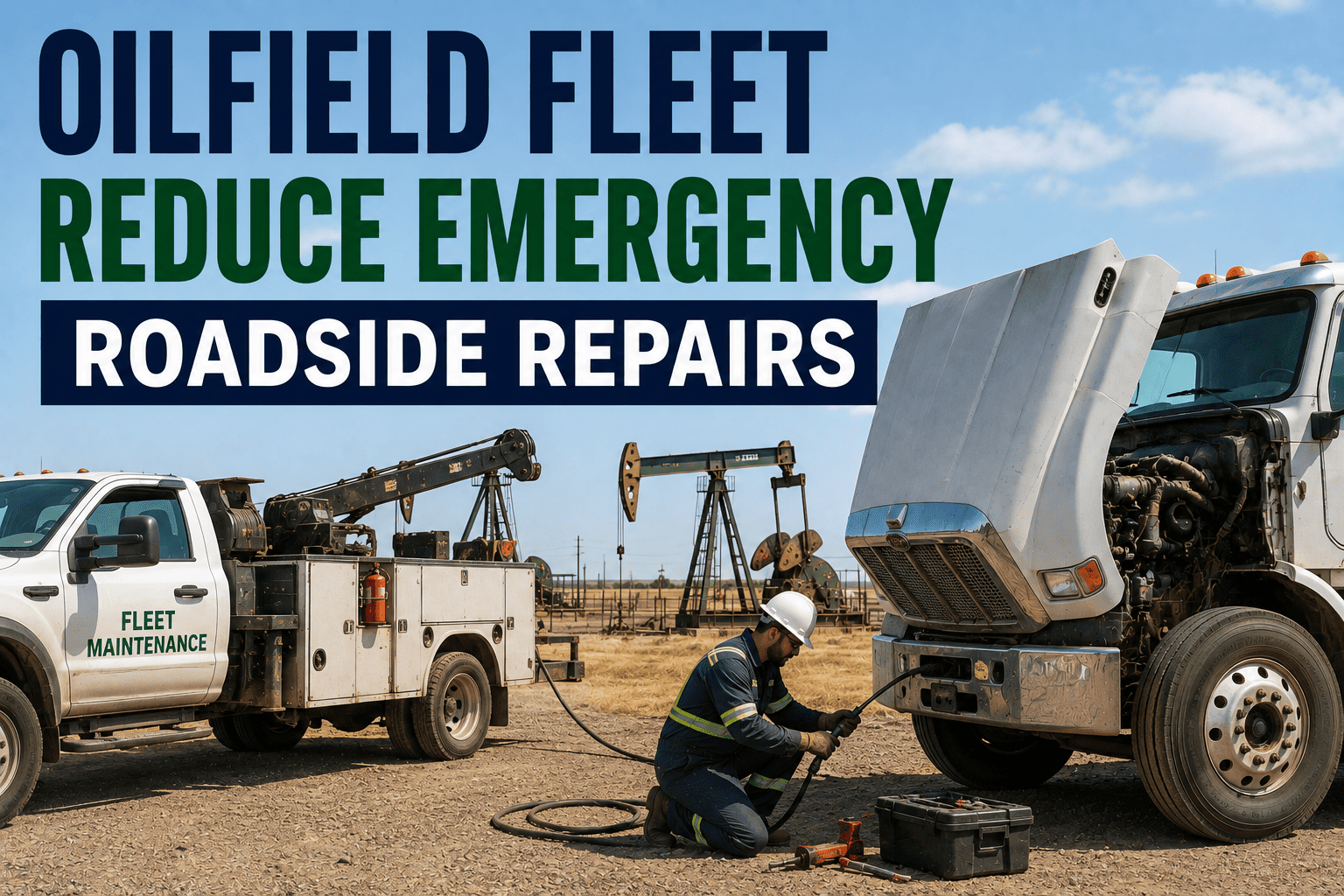
Managing an oilfield fleet means dealing with harsh realities, and few things are as frustrating or expensive as a truck breaking down on a remote lease road. Emergency roadside repairs drain your maintenance budget, halt production, and put drivers in dangerous situations. When a water tanker or service truck goes down in the field, the costs multiply rapidly through towing fees, field mechanic premiums, and lost revenue. The key to profitability is keeping repairs inside the shop and out of the dirt. FleetRabbit provides the predictive maintenance and digital inspection tools necessary to catch failures before they strand your assets in the field. You can sign up today to shift your operation from reactive to proactive.
Emergency roadside repairs cost up to four times more than planned shop maintenance due to towing fees and field labor premiums. Implementing predictive maintenance and digital vehicle inspections reduces unexpected roadside breakdowns by forty percent. You can sign up for FleetRabbit to keep your repairs in the shop and your trucks on the road.
The Exponential Cost of Field Breakdowns
In oilfield logistics, a breakdown is never just the cost of the broken part. When a truck fails on a remote lease road, the financial impact cascades rapidly. A simple alternator failure that costs three hundred dollars to fix in the shop can easily spiral into a three thousand dollar ordeal when you factor in the tow truck, the field mechanic's minimum call-out fee, and the lost revenue of a truck sitting idle for twenty-four hours.
The Hidden Towing and Labor Premiums
Heavy-duty wreckers are scarce in oilfield regions, and getting a rig out to a remote well pad often requires special off-road recovery equipment. Once the truck is finally towed back to the yard, you are now paying overtime rates for a mechanic to work nights or weekends to get the asset back into service. This reactive cycle destroys maintenance budgets. To understand how predictive scheduling eliminates these premiums, you can book a demo with our team.
Calculating True Downtime Impact
Production stops when a critical service truck is offline. If a fuel truck cannot deliver to a generator, the entire well pad shuts down. The cost of deferred production falls squarely on the fleet manager's shoulders. By tracking engine hours and component wear digitally, FleetRabbit ensures that a suspect fuel pump is replaced during a planned maintenance window, not on the side of a dirt road. You can sign up to start calculating and cutting your true downtime costs.
| Repair Scenario | Average Cost | Time Out of Service |
|---|---|---|
| Planned Shop Repair | 300 to 800 dollars | 4 to 8 hours during off-shift |
| Emergency Roadside Repair | 1,500 to 4,000 dollars | 24 to 48 hours including towing |
| Catastrophic Engine Failure | 15,000 to 25,000 dollars | 2 to 3 weeks in overhaul shop |
Do not let a fifty-dollar sensor cause a three-thousand-dollar tow bill. FleetRabbit uses telematics and digital inspections to catch failures before they leave the yard. You can sign up now or book a demo to see the platform in action.
Strategies to Keep Repairs in the Shop
The extreme environment of the oil patch demands a rigorous, proactive maintenance strategy. Dust, extreme heat, and constant heavy vibration destroy components faster than standard highway use. Reactive maintenance is entirely unfeasible when a failure means stranding a truck fifty miles from the nearest paved road. Maintenance teams must transition from reactive fixes to condition-based interventions.
Leveraging Telematics for Predictive Maintenance
Standard preventive maintenance relies on arbitrary calendar dates or odometer readings, which fail to capture the severe duty cycles of oilfield work. FleetRabbit integrates directly with your engine control modules to monitor real-time data like coolant temperature, oil pressure, and RPM fluctuations. When a water truck shows an abnormal spike in transmission temperature, the system immediately flags it for inspection, preventing a complete transmission failure on a lease road. To implement telematics-driven maintenance, sign up for FleetRabbit today.
Digitizing the Pre-Trip Inspection Process
Paper inspection reports are easily ignored or faked. A driver rushing to a well pad might skip checking the air compressor, leading to a roadside brake failure hours later. FleetRabbit forces drivers to complete digital DVIRs on their mobile devices before the truck can move. They must photograph tire conditions and listen for abnormal noises, instantly syncing the data to the shop floor. This ensures that minor defects are fixed in the bay before they become major roadside emergencies. To improve your inspection compliance, book a demo to explore our mobile features.
Do not let preventable failures strand your trucks on remote lease roads. FleetRabbit equips your fleet with the predictive maintenance, digital inspections, and real-time tracking needed to eliminate emergency repairs. Sign up today or book a demo to see how we can transform your operations.