Every morning, oilfield vacuum truck fleets across the Permian, Eagle Ford, and Bakken send dozens of trucks out to well pads and tank batteries with one job: pull produced water, flowback, or drilling fluid and haul it to disposal. Yet anyone who has run these fleets knows a quiet truth. A surprising share of those dispatches end up as empty or partially empty trips. The truck shows up to a tank that is not ready, runs back empty after dumping, or gets sent on a level guess instead of an actual reading. Those empty miles look small on a single ticket. Across a year and a 10-truck fleet, they quietly consume tens of thousands of dollars in fuel, hours, and equipment wear. This guide shows how tank-level-aware dispatch eliminates that hidden cost.
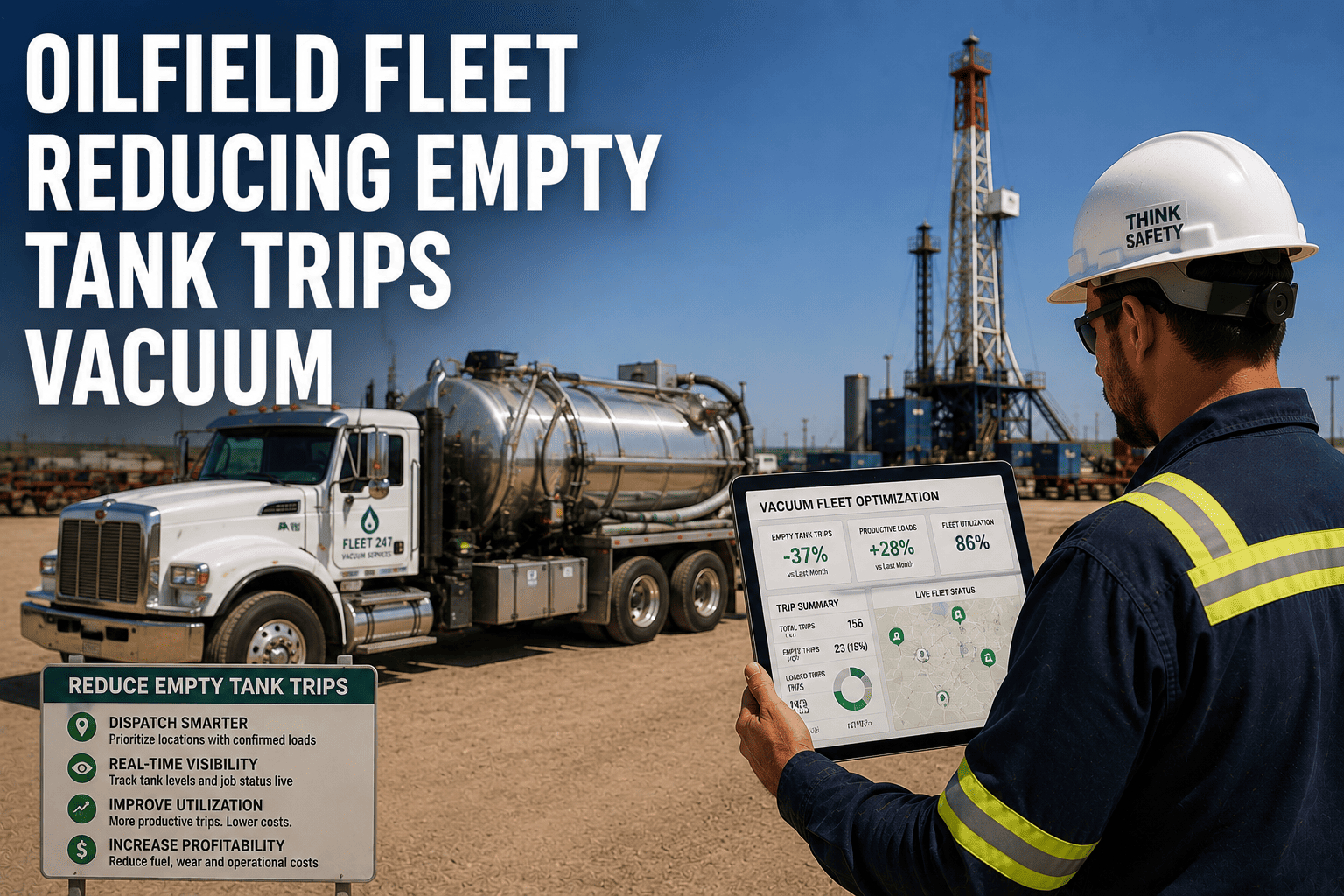
In poorly managed oilfield vacuum fleets, 35 to 50 percent of total annual miles are empty or deadhead miles. At an operating cost of 0.55 to 0.75 dollars per mile, a 10-truck fleet running 100,000 miles annually burns 19,000 to 37,000 dollars on empty miles alone. Add missed revenue from trips that could have hauled loaded product and total annual waste reaches 60,000 to 110,000 dollars. Tank-level-aware dispatch cuts empty miles by 25 to 40 percent within the first 90 days.
Why Vacuum Trucks Run Empty So Often
Empty vacuum truck trips are rarely caused by driver error. They are caused by information gaps between the wellsite and the dispatcher. Most oilfield vacuum fleets still dispatch trucks based on a pumper's morning phone call estimating how full the tank is. That estimate is often hours old by the time a truck arrives, and pumpers routinely overestimate because they would rather call a truck early than let a tank overflow onto a location.
Once a truck arrives at a tank that is not ready, three things happen. The driver waits, leaving the truck idling and burning fuel. The truck pulls a partial load below capacity, leaving revenue on the table. Or the truck leaves empty and the trip was effectively wasted. After the disposal dump, the return leg to the next wellsite is almost always empty unless dispatch has proactively matched a backhaul, and most legacy dispatch systems cannot match loads in real time.
Add in deadhead miles from the yard to the first pickup, between disposal runs, and back to the yard at shift end, and even well-run fleets struggle to keep empty miles under 30 percent. Poorly managed fleets routinely run 40 to 50 percent empty. Every one of those miles burns fuel, hours, and equipment life without producing a single dollar of revenue.
Traditional Dispatch Cycle Versus Tank-Aware Dispatch Cycle
The difference between a fleet that runs 40 percent empty and a fleet that runs 18 percent empty is not better drivers or newer trucks. It is the dispatch cycle. The graphic below shows what happens when dispatch relies on pumper estimates versus what happens when dispatch is driven by confirmed tank levels and automatic backhaul matching.
Traditional Dispatch Cycle
Tank-Aware Dispatch Cycle
The Real Cost Of Empty Tank Trips
Empty miles in a vacuum fleet compound costs across multiple line items. Fuel is the most visible, but driver hours, equipment hours, tire wear, and missed revenue opportunity often exceed fuel alone. The table below shows where the money actually goes when a 10-truck fleet runs at 40 percent empty miles, which is the industry baseline for fleets still dispatching on pumper phone calls.
| Cost Component | Annual Impact For 10-Truck Fleet | Cost Driver |
|---|---|---|
| Fuel Burned On Empty Miles | 9,000 to 15,000 dollars | 40,000 empty miles at 6 to 7 mpg and 3.25 dollar diesel |
| Driver Pay On Empty Hours | 8,000 to 14,000 dollars | 800 to 1,200 empty driver hours at 18 to 22 dollars per hour |
| Equipment Hours And Depreciation | 6,000 to 10,000 dollars | Wear on power takeoff, pump, and vacuum system during deadhead operation |
| Tire And Maintenance Wear | 3,000 to 5,000 dollars | 40,000 empty miles still consume tires, brakes, and drivetrain |
| Missed Revenue From Partial Loads | 20,000 to 50,000 dollars | Trucks running at 60 to 80 percent capacity instead of full |
| Missed Revenue From No Backhaul | 15,000 to 25,000 dollars | Return legs that could have hauled product to next pickup |
| Total Annual Waste | 61,000 to 119,000 dollars | Combined impact across all categories for a single 10-truck fleet |
FleetRabbit connects tank-level visibility to dispatch, so your vacuum trucks only roll when there is confirmed product to haul. Match backhauls automatically, capture every loaded mile, and recover 60,000 to 110,000 dollars per 10 trucks every year. Start free or book a 30-minute walkthrough to see it running on your routes.
The 5-Step Framework To Eliminate Empty Trips
Eliminating empty miles is not a software switch you flip overnight. It is a five-step framework that moves a fleet from reactive pumper-call dispatch to data-driven, tank-aware dispatch. Each step is sequential, and each one builds measurable savings on top of the last.
Measure Current Empty Mile Ratio
Pull 90 days of GPS and load ticket data. Divide empty miles by total miles. Most fleets are shocked to find 35 to 50 percent. That number becomes the baseline every improvement gets measured against.
Connect Tank Level Visibility To Dispatch
Install tank level sensors or integrate existing SCADA readings so dispatch sees actual tank levels instead of pumper estimates that are six hours old by the time a truck rolls.
Dispatch By Confirmed Level, Not Estimate
Only send a truck when a tank hits a confirmed pickup threshold. Hold trucks at the yard or send them to a different confirmed-full tank rather than sending them on guesses.
Match Return Loads As Backhauls
Treat the disposal facility and nearby wellsites as a two-way market. When a truck dumps, automatically identify the nearest confirmed-full tank and dispatch that truck directly rather than deadheading back to the yard.
Audit Weekly With Trip-Level Reports
Pull weekly empty mile reports by truck, driver, and route. Patterns emerge fast. One driver, one well pad, or one dispatcher often accounts for the majority of preventable empty miles.
How FleetRabbit Eliminates Empty Miles
FleetRabbit was built for oilfield waste and vacuum fleets, where the margin between profit and loss is measured in loaded miles per shift. Every feature in the platform is designed to ensure trucks roll only when there is revenue to capture, and that every loaded mile is documented for billing.
Tank-Level-Aware Dispatch
Dispatch sees the same tank level data the operator sees. Trucks are only sent to tanks confirmed full, eliminating the partial-load and false-trip problem at the source.
Automatic Backhaul Matching
When a truck dumps at disposal, FleetRabbit automatically identifies the nearest confirmed-full tank and dispatches the truck directly, turning deadhead return legs into loaded revenue miles.
Real-Time GPS And Load Tracking
Every truck's location, loaded status, and route progress is visible on a single dispatch screen, so backhaul matching and repositioning decisions are made with live data instead of radio calls.
Weekly Empty Mile Reports
Automated weekly reports break empty miles down by truck, driver, route, and dispatcher, so the patterns driving waste are visible and correctable within days instead of quarters.
Getting started takes a few minutes. You can start a free FleetRabbit account and connect your first vacuum trucks today, or book a 30-minute demo and we will walk through the exact empty miles your fleet is burning right now and what tank-level dispatch would recover.
Frequently Asked Questions About Empty Vacuum Truck Trips
Key Takeaways On Reducing Empty Tank Trips
Empty vacuum truck trips are not a cost of doing business. They are a symptom of dispatching without tank-level visibility. A 10-truck fleet running 40 percent empty miles is quietly burning 60,000 to 110,000 dollars every year in fuel, hours, equipment wear, and missed revenue. Across a 30-truck fleet, that number scales to nearly a third of a million dollars annually.
The fix is not more trucks or more drivers. It is sending the trucks you already have only when there is confirmed product to haul. Tank-level-aware dispatch, automatic backhaul matching, and weekly empty mile reports cut empty miles by 25 to 40 percent within 90 days, recovering revenue that is already leaking out of your operation. The fleet that fixes this wins bids on tighter margins because its cost per loaded mile is structurally lower than the fleet still running 40 percent empty.
Every empty mile is fuel, hours, and equipment life you will never recover. FleetRabbit connects tank-level visibility to dispatch so your vacuum trucks only roll when there is revenue to capture. Start free today or book a 30-minute demo and we will show you exactly how many empty miles your fleet is burning right now.