Oilfield fleet regulatory compliance represents the operational discipline separating professional operators achieving zero violations during DOT roadside inspections, OSHA workplace audits, EPA environmental reviews, and PHMSA pipeline facility examinations from non-compliant competitors accumulating $50,000-$150,000 annual citation penalties, suffering vehicle out-of-service orders disrupting customer commitments, and experiencing safety rating downgrades threatening operating authority and insurance coverage. The fundamental compliance challenge stems from regulatory complexity spanning multiple jurisdictional frameworks with independent enforcement mechanisms — DOT Federal Motor Carrier Safety Administration regulations under 49 CFR governing commercial vehicle maintenance, driver qualification, hours-of-service, and hazardous materials transportation with roadside inspection enforcement and carrier safety rating systems, OSHA occupational safety standards under 29 CFR requiring process safety management, mechanical integrity programs, hazard communication, and confined space entry procedures with citation authority ranging from $7,000-$70,000 per serious violation, EPA environmental protection regulations under 40 CFR mandating spill prevention control and countermeasure plans, storm water pollution prevention, air quality permits, and hazardous waste management with daily penalty assessments reaching $25,000-$50,000 for continuing violations, and PHMSA pipeline safety requirements under 49 CFR Part 195 establishing corrosion control, leak detection, emergency response, and public awareness obligations with enforcement actions including corrective action orders and civil penalties. Manual paper-based compliance management systems create systematic documentation gaps where fleet managers cannot verify inspection completion across dispersed operations, certification expiration tracking depends on spreadsheet management vulnerable to oversight errors, incident documentation lacks photographic evidence and GPS verification making regulatory audit defense difficult, training record maintenance relies on file cabinet storage requiring hours of manual retrieval when auditors request verification, and regulatory report generation consumes 20-40 hours staff time quarterly assembling data from multiple disconnected sources. Progressive oilfield operators deploy integrated digital compliance platforms transforming reactive violation response into systematic proactive management — FleetRabbit's compliance engine automates certification tracking sending alerts 30-60-90 days before driver licenses, medical cards, HAZMAT endorsements, and equipment inspections expire preventing inadvertent operation with expired credentials, maintains tamper-evident audit trails with GPS timestamps and photographic evidence satisfying DOT, OSHA, EPA burden-of-proof requirements, generates regulator-formatted compliance reports within 2 hours versus 20-40 hours manual assembly, and enforces operational restrictions blocking vehicle dispatch when critical maintenance overdue or driver certification expired eliminating human oversight failures. Book a demo to see FleetRabbit's compliance management demonstrated with actual DOT, OSHA, EPA, and PHMSA audit scenarios.
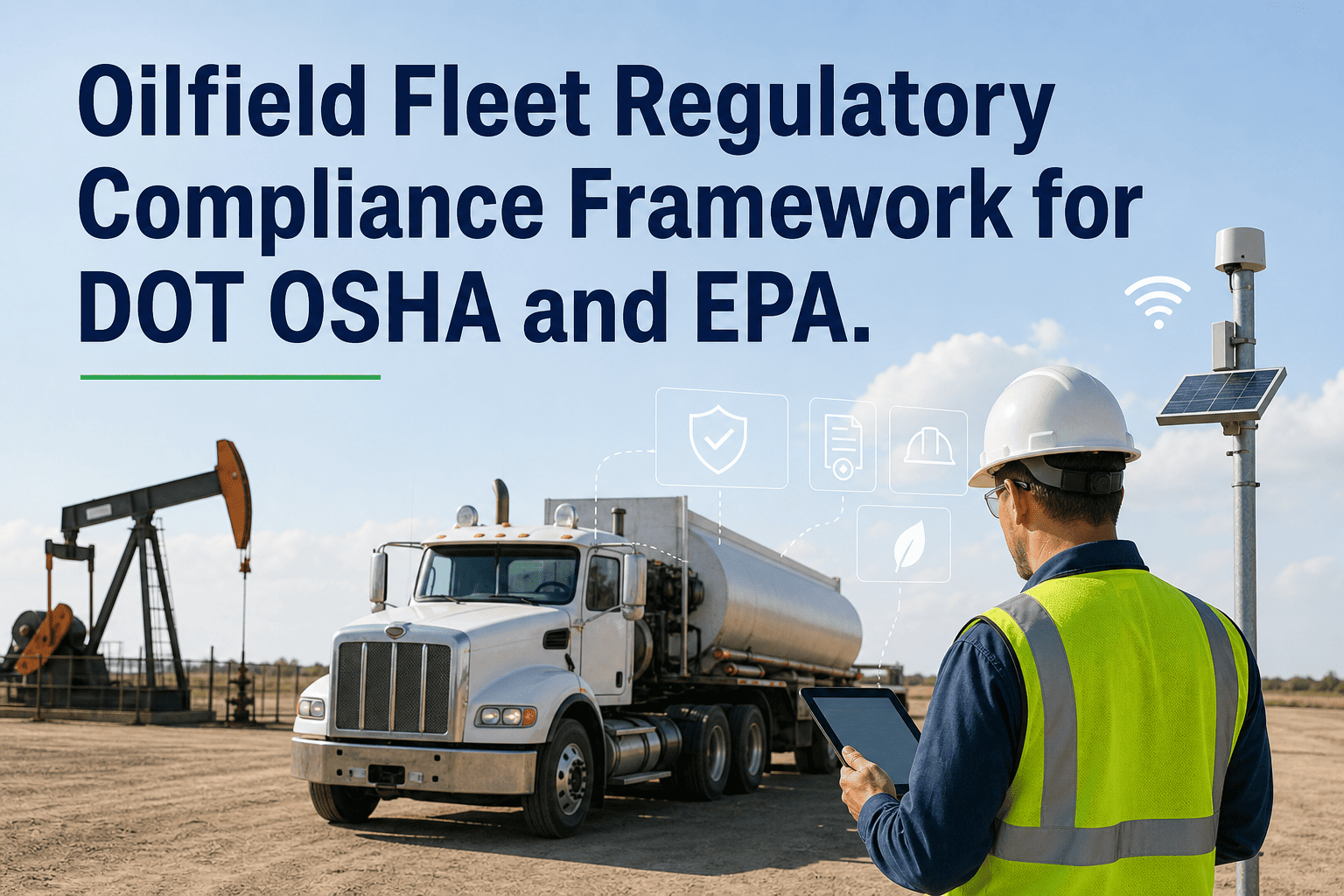
Oilfield Fleet Regulatory Compliance Framework for DOT, OSHA, and EPA
Manual paper-based compliance management creates systematic documentation gaps where certification tracking depends on spreadsheet oversight, inspection verification requires physical site visits, incident documentation lacks photographic evidence, and regulatory report generation consumes 20-40 hours quarterly. FleetRabbit's integrated compliance platform automates certification expiration alerts, maintains tamper-evident audit trails with GPS timestamps, generates regulator-formatted reports within 2 hours, and enforces operational restrictions blocking non-compliant vehicle dispatch.
Four Independent Regulatory Frameworks Governing Oilfield Fleet Operations
Oilfield fleet compliance requires simultaneous adherence to four separate federal regulatory frameworks each administered by independent agencies with distinct enforcement mechanisms, documentation standards, and penalty structures — creating compliance complexity exceeding single-jurisdiction commercial vehicle operations.
FleetRabbit integrates DOT, OSHA, EPA, and PHMSA compliance requirements into unified digital platform — eliminating multi-system documentation gaps and reducing regulatory audit response time from 20-40 hours to under 2 hours. Start a free trial to deploy integrated compliance management across your oilfield operations →
Why Paper-Based Compliance Systems Create Systematic Violation Risk
Certification Expiration Oversight
Manual certification tracking through spreadsheets or paper files creates systematic oversight failures where fleet managers rely on periodic manual review identifying approaching expiration dates — a process vulnerable to human error during high-workload periods when dozens of certifications require simultaneous monitoring across driver licenses (state-specific renewal cycles), CDL medical cards (typically 1-2 year validity), HAZMAT endorsements (5-year renewal with background checks), equipment annual inspections (DOT-mandated yearly requirements), and specialized certifications including forklift operator training, confined space entry authorization, and HAZMAT handling credentials each following independent renewal schedules.
The operational consequence manifests when drivers dispatched with expired medical cards discovered during roadside inspections triggering vehicle out-of-service orders, expired HAZMAT endorsements identified during customer facility entry creating contract compliance violations, or overdue equipment inspections detected during DOT compliance reviews generating systematic violation patterns affecting carrier safety ratings. A single driver operating 30 days with expired medical card creates 30 separate daily violations at $1,000-$2,500 potential penalty per occurrence — totaling $30,000-$75,000 exposure from single oversight failure that automated expiration monitoring prevents through 30-60-90 day advance alerts enabling proactive renewal scheduling.
Inspection Documentation Gaps
Paper-based inspection systems create documentation gaps where field technicians complete inspection forms inconsistently, supervisors cannot verify inspection execution across multiple dispersed locations without physical presence, completed inspection records stored in file cabinets require manual retrieval when regulators request compliance verification, and photographic evidence of inspection findings and corrective actions remains unavailable making post-incident analysis and regulatory audit defense difficult. DOT requires tamper-evident inspection records with timestamps proving inspection occurred before vehicle operation — paper DVIR forms signed by drivers provide minimal verification of actual inspection execution versus cursory checkbox completion without genuine equipment examination.
During regulatory audits, inability to produce complete inspection documentation within examiner-specified timeframes creates adverse inference where missing records presumed to indicate non-compliance rather than documentation failures — burden of proof rests with operator to demonstrate compliance occurred even when records incomplete. Digital inspection systems with GPS timestamps, mandatory photographic documentation, and automatic cloud storage create tamper-evident audit trails satisfying regulatory burden-of-proof requirements while enabling 2-hour compliance package assembly versus 20-40 hours manual file retrieval and photocopying.
Multi-System Fragmentation
Operators managing DOT compliance through one software platform, OSHA documentation in separate safety management system, EPA environmental records in standalone environmental database, and PHMSA pipeline records in independent integrity management software create information silos preventing holistic compliance analysis and requiring quadruple data entry when single operational event triggers multiple regulatory documentation requirements — such as vehicle accident requiring DOT accident report, OSHA injury recordkeeping if driver injured, EPA spill documentation if fuel released, and PHMSA incident notification if pipeline infrastructure damaged.
Seven Integrated Capabilities Eliminating Compliance Violation Risk
FleetRabbit's compliance management platform delivers automated certification tracking, tamper-evident audit trails, regulator-formatted reporting, operational dispatch restrictions, multi-agency integration, mobile field documentation, and continuous compliance monitoring — achieving zero-violation performance during DOT, OSHA, EPA, and PHMSA audits.
Automated Certification and Expiration Management
FleetRabbit tracks unlimited certification types per driver and vehicle with automated expiration alerts sent via email and SMS at 90-day, 60-day, 30-day, and 7-day intervals before renewal deadlines. Certification categories monitored include driver licenses with state-specific renewal tracking, CDL medical cards with FMCSA medical examiner registry integration, HAZMAT endorsements with TSA background check renewal coordination, vehicle annual inspections with state inspection program compliance, equipment certifications including pressure vessel inspections and LOLER/PUWER compliance in international operations, and training credentials covering confined space entry, lockout/tagout procedures, forklift operation, and hazardous waste handling.
Tamper-Evident Audit Trails with GPS Verification
All compliance-related activities in FleetRabbit generate tamper-evident audit records with GPS timestamps, user identification, and photographic evidence creating comprehensive documentation satisfying regulatory burden-of-proof requirements. Inspection completion timestamps linked to GPS coordinates prove inspection occurred at actual vehicle location not from office or remote site. Digital signatures with device identification and IP address logging verify inspector identity and prevent fraudulent record creation. Photo requirements enforce visual documentation of inspection findings, defect conditions, and post-repair verification creating irrefutable evidence for regulatory audit defense and warranty claim support.
Regulator-Formatted Compliance Report Generation
FleetRabbit generates compliance reports in formats specified by DOT, OSHA, EPA, and PHMSA regulations eliminating manual data assembly and reformatting requirements. DOT compliance review packages include complete driver qualification files, vehicle maintenance records, hours-of-service logs, accident reports, and drug/alcohol testing documentation formatted per FMCSA specifications. OSHA mechanical integrity reports compile pressure vessel inspection records, relief device testing certifications, and process equipment maintenance histories. EPA environmental documentation generates SPCC inspection logs, hazardous waste manifests, and spill incident reports. PHMSA pipeline integrity packages export patrol verification records, leak survey results, and corrosion monitoring data.
Operational Dispatch Blocking and Compliance Enforcement
FleetRabbit enforces compliance through automated operational restrictions preventing non-compliant vehicle dispatch and driver assignment eliminating human oversight failures. Vehicle dispatch blocking activates when critical preventive maintenance overdue based on mileage, engine hours, or calendar intervals preventing operation with expired inspections or overdue service. Driver assignment restrictions prevent dispatch to drivers with expired certifications including licenses, medical cards, or HAZMAT endorsements. Load-specific compliance verification blocks HAZMAT assignments to drivers lacking current dangerous goods certifications and prevents overweight loads exceeding vehicle GVWR or axle ratings.
Automated dispatch blocking prevents compliance violations from human oversight — eliminating vehicle out-of-service risk and protecting carrier safety ratings through systematic enforcement impossible with manual compliance management. Schedule a demo to see compliance enforcement demonstrated with actual dispatch blocking scenarios →
FleetRabbit Compliance Platform Implementation Timeline
Compliance Requirements Analysis and System Configuration
FleetRabbit implementation team conducts comprehensive compliance requirements analysis identifying applicable DOT, OSHA, EPA, and PHMSA regulations based on operational scope, jurisdictional coverage, and customer specifications. Certification tracking configured for all required credentials with expiration alert schedules customized per certification type. Inspection checklists loaded covering DOT DVIR, OSHA mechanical integrity, EPA environmental monitoring, and PHMSA pipeline patrol requirements. Compliance report templates configured matching regulator-specified formats for audit response.
Historical Records Import and Data Migration
Existing compliance records imported from legacy systems including driver qualification files, vehicle inspection histories, certification records, training documentation, and incident reports. Data validation performed ensuring completeness and accuracy of migrated information. Document scanning service available for paper-only records requiring digitization. Initial compliance status assessment generated identifying approaching certification expirations, overdue inspections, and documentation gaps requiring immediate attention before go-live.
User Training and Mobile Application Deployment
Administrator training covers certification management, compliance reporting, dispatch blocking configuration, and audit preparation workflows. Field technician training demonstrates mobile inspection applications, photo documentation requirements, GPS verification, and offline operation. Driver training covers mobile DVIR completion, certification renewal notifications, and compliance status visibility. Pilot deployment to representative equipment subset validates workflows before full fleet rollout.
Full Deployment and Continuous Compliance Monitoring
Compliance platform activated across entire fleet with automated certification tracking, inspection scheduling, and dispatch blocking operational. Continuous monitoring tracks certification expiration dates, inspection completion rates, and documentation completeness. Weekly compliance dashboards review pending expirations, overdue inspections, and documentation gaps requiring attention. Monthly executive reports demonstrate compliance performance trends and regulatory audit readiness. Quarterly mock audits simulate regulator inspections validating documentation completeness and report generation capabilities.
Common Questions About Compliance Management
Eliminate $50K-$150K Annual Violation Penalties Through Systematic Compliance
FleetRabbit's integrated compliance platform transforms reactive violation response into proactive systematic management through automated certification tracking sending 30-60-90 day expiration alerts preventing inadvertent operation with expired credentials eliminating $30,000-$75,000 penalty exposure from single medical card oversight, tamper-evident audit trails with GPS timestamps and photographic evidence creating legally defensible documentation satisfying DOT, OSHA, EPA burden-of-proof requirements, regulator-formatted compliance reports generated within 2 hours versus 20-40 hours manual assembly enabling rapid audit response, operational dispatch blocking preventing non-compliant vehicle operation through automated restrictions eliminating human oversight failures, multi-agency integration consolidating DOT, OSHA, EPA, PHMSA documentation in unified platform eliminating information silos and duplicate data entry, mobile field documentation with offline capability enabling inspection completion and certification verification at remote locations without connectivity, and continuous compliance monitoring tracking certification currency, inspection completion rates, and documentation completeness providing executive visibility into regulatory compliance status — delivering zero-violation performance during regulatory audits, protecting carrier safety ratings from systematic violation patterns, and eliminating $50,000-$150,000 annual citation penalties typical of manual paper-based compliance management creating ROI within first audit cycle.
Transform Compliance Management Through Integrated Digital Platform
Manual paper-based compliance management creates systematic violation risk where certification tracking depends on spreadsheet oversight vulnerable to human error during high-workload periods, inspection documentation gaps prevent complete regulatory audit response requiring 20-40 hours manual file retrieval and photocopying, multi-system fragmentation forces duplicate data entry when single operational event triggers documentation requirements across DOT accident reporting, OSHA injury recordkeeping, EPA spill notification, and PHMSA incident reporting, and lack of operational enforcement enables inadvertent non-compliant vehicle dispatch with expired inspections or driver certification creating vehicle out-of-service risk and carrier safety rating downgrades. FleetRabbit's integrated compliance platform eliminates these failures through automated certification tracking monitoring unlimited credential types with 30-60-90 day expiration alerts preventing inadvertent operation with expired driver licenses, medical cards, HAZMAT endorsements, or equipment inspections, tamper-evident audit trails with GPS timestamps, device identification, and photographic evidence creating legally defensible documentation satisfying regulatory burden-of-proof requirements, regulator-formatted compliance report generation within 2 hours compiling complete DOT compliance review packages, OSHA mechanical integrity documentation, EPA environmental records, and PHMSA pipeline integrity reports in agency-specified formats, operational dispatch blocking enforcing compliance through automated restrictions preventing vehicle operation with overdue maintenance or driver assignment with expired certifications eliminating human oversight failures, multi-agency integration consolidating DOT, OSHA, EPA, PHMSA requirements in unified platform with single data entry propagating across all applicable regulatory frameworks, mobile field documentation enabling inspection completion and certification verification at remote locations with offline capability and automatic cloud synchronization, and continuous compliance monitoring providing executive visibility into certification currency, inspection completion rates, documentation completeness, and regulatory audit readiness — achieving zero-violation performance during DOT roadside inspections, OSHA workplace audits, EPA environmental reviews, and PHMSA pipeline facility examinations while eliminating $50,000-$150,000 annual citation penalties typical of manual compliance systems and protecting carrier safety ratings from systematic violation patterns threatening operating authority and insurance coverage.