Risk assessment in oilfield fleet operations is both a regulatory compliance obligation and a financial risk management discipline — because the risk events that fleet assessment identifies and prevents are not abstract safety statistics but quantifiable financial exposures with predictable cost ranges. A vehicle with a developing brake system fault operating on a remote Permian Basin lease road carries an expected breakdown cost of $28,500–$500,000 depending on whether it is identified as a maintenance risk three weeks before failure or discovered as an emergency breakdown 80 miles from the nearest yard during an active frac stage. A driver whose telematics data shows a pattern of aggressive braking events on specific route types carries a statistically elevated incident probability that translates to expected insurance claim frequency and severity. A fleet operation with 23 expired or near-expiry driver certifications carries specific regulatory citation exposure — calculable per citation by FMCSA and OSHA enforcement schedules — that becomes actual cost the moment an auditor arrives. Effective oilfield fleet risk assessment converts these risk probabilities into specific, measurable, time-bounded management interventions. It requires continuous monitoring data across vehicle condition, driver behaviour, certification currency, and maintenance programme execution — not periodic paper checklists that identify risks retrospectively after they have already produced the outcomes they were designed to prevent. FleetRabbit's oilfield fleet platform provides the real-time risk intelligence that makes continuous fleet risk assessment an operational reality rather than a periodic administrative exercise — generating risk-rated alerts across vehicle health, driver safety, compliance certification, and fuel anomalies that give fleet managers and operations executives the information they need to prevent risk events rather than manage their consequences. Book a demo to see FleetRabbit's oilfield fleet risk assessment intelligence for your operation.
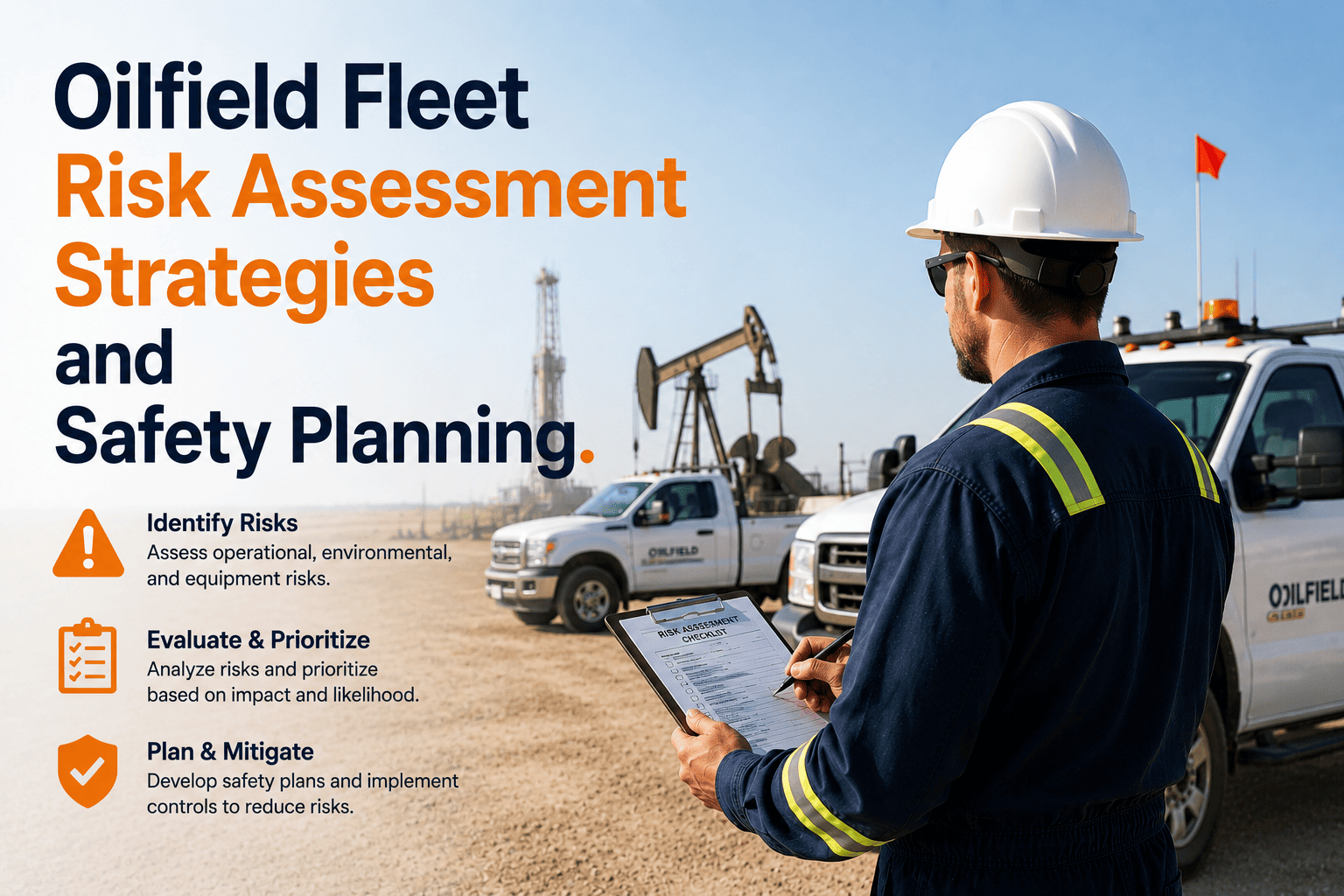
Oilfield Fleet Risk Assessment Strategies and Safety Planning
Effective oilfield fleet risk assessment converts specific risk probabilities into time-bounded management interventions — before breakdown events, compliance citations, and safety incidents become financial consequences. FleetRabbit provides the continuous real-time risk intelligence that makes prevention possible.
Four Oilfield Fleet Risk Categories — and How FleetRabbit Monitors Each Continuously
Comprehensive oilfield fleet risk management requires simultaneous monitoring across four distinct risk categories — each with different data sources, different intervention windows, and different financial consequence magnitudes when unaddressed.
Vehicle Mechanical Risk
Developing fault patterns in engine, drivetrain, brake, and hydraulic systems that precede unplanned breakdowns — detectable from OBD-II parameter monitoring 3–6 weeks before failure threshold when AI anomaly detection is applied. Without continuous monitoring, these patterns are invisible until the vehicle fails at the worst possible time and location.
AI engine monitoring 36+ OBD-II parameters per vehicle, establishing per-vehicle baselines within 14 days and generating risk-rated fault alerts at the 3–6 week intervention window. Engine-hour PM scheduling prevents the maintenance-miss breakdown class. 73% fewer unplanned breakdowns within 12 months.
Driver Behaviour Risk
Hard braking frequency, harsh acceleration patterns, speeding against zone-specific thresholds, seatbelt non-compliance, and hours-of-service approaching-limit indicators — the leading behavioural indicators that predict serious incident probability at statistically elevated levels when they cluster above calibrated baselines in individual driver data.
Continuous telematics behaviour monitoring with daily composite safety scores per driver. In-cab real-time alerts at event occurrence. Automated coaching intervention workflows for Red-band drivers with specific GPS-timestamped event records. 34–47% harsh event reduction within 60 days.
Regulatory Compliance Risk
Expired or near-expiry driver certifications, vehicle documentation gaps, DVIR completion below 100%, maintenance record deficiencies, and HAZMAT documentation incompleteness — compliance risks that produce regulatory citation exposure, wellsite gate refusals, and client operator prequalification failures when discovered rather than prevented.
Automated 60/30/7-day certification renewal alerts with dispatch blocking. Digital DVIR enforcement before dispatch. Multi-jurisdiction audit pack generation in under 2 hours. Zero FMCSA citation events from certification failures at deployed fleets within 14-month post-deployment periods.
Fuel and Financial Risk
Off-hours fuel drain events at remote wellsite bowsers and tanker vehicles, excessive idle accumulation that advances maintenance intervals without corresponding productive output, and mileage-based consumption models that systematically underestimate Basin duty cycle fuel requirements — creating budget variances that appear as financial surprises rather than preventable operational issues.
Multi-variable fuel anomaly detection under 8 minutes. Engine-hour consumption baselines replacing mileage assumptions. In-cab idle reduction alerts achieving 25–35% idle reduction within 60 days. 20% average fuel cost reduction at deployed oilfield fleets within 90 days.
Continuous Real-Time Risk Assessment Across All Four Domains — At $3/Vehicle/Month
FleetRabbit monitors all four oilfield fleet risk categories simultaneously — vehicle mechanical risk, driver behaviour risk, regulatory compliance risk, and fuel risk — generating risk-rated alerts in real time without requiring manual monitoring by the fleet manager. Deployed in 5–7 working days with no implementation fee.
Building a FleetRabbit-Based Oilfield Fleet Risk Assessment Programme
Deploy and Establish Baseline Risk Profile
FleetRabbit deployment activates the initial risk identification phase — the AI engine begins building vehicle-specific mechanical baselines, the certification audit identifies all existing compliance gaps, and the driver behaviour scoring starts calibrating per-driver baselines. By Day 14, the fleet's complete risk profile across all four domains is visible for the first time at this level of specificity.
Prioritise and Intervene on Identified Risks
FleetRabbit's risk-rated alert system prioritises identified risks by category and severity — Critical vehicle faults, Red-band driver behaviour, expired certifications, and fuel drain anomalies each generate specific intervention workflows with responsible party assignment and resolution tracking. The fleet manager works a prioritised risk queue rather than a generic alert list.
Monitor Risk Reduction and Maintain Continuous Coverage
FleetRabbit tracks risk reduction over time — showing vehicle health score improvement following predictive maintenance interventions, driver safety score band migration following coaching programmes, and compliance currency maintenance following certification renewal workflow adoption. The executive dashboard provides portfolio-level risk trending without requiring manual data assembly from field supervisors.
Generate Risk Evidence for Regulatory and Insurance Purposes
FleetRabbit's continuous risk monitoring creates the tamper-evident documentation trail that FMCSA compliance reviews, OSHA investigations, and insurance underwriting assessments require to verify systematic risk management practice. Complete risk management evidence packages — maintenance histories, safety records, compliance documentation — are generated in under 2 hours for any period and asset range.
Fleet Risk Assessment Intelligence for Every Level of Operations Management
Real-Time Risk Queue Replacing Reactive Discovery
Fleet managers working from FleetRabbit's risk-prioritised dashboard address specific, actionable risk events — a specific vehicle with a developing hydraulic fault, a specific driver with 7 hard braking events in 5 days, a specific certification expiring in 6 days — rather than discovering them as incidents, citations, and gate refusals after intervention windows have closed.
Systematic Risk Management Evidence for Regulatory Defence
When OSHA investigates a serious vehicle incident or FMCSA conducts a compliance review, the HSE director's ability to demonstrate systematic risk management — continuous monitoring records, risk-rated alert histories, intervention documentation, and coaching programme evidence — determines enforcement outcome. FleetRabbit's continuous risk records provide this defence.
Portfolio Risk Distribution Visibility Without Manual Assembly
Operations VPs receive automated weekly risk summary reports showing fleet-wide risk distribution by category and by district — vehicle health score distribution, driver safety band breakdown, certification compliance percentage, and fuel variance summary — without requiring field supervisor data consolidation or manual report preparation.
Risk Cost Quantification for Insurance and Financial Planning
FleetRabbit's risk data enables finance teams to quantify expected risk event costs, model the financial impact of risk reduction initiatives, and produce the insurance evidence package that supports 18–22% premium reduction at policy renewal — converting fleet risk management from an unquantified safety function into a measurable financial performance discipline.
Deploy Continuous Oilfield Fleet Risk Assessment — Real-Time Intelligence Across All Four Risk Domains
FleetRabbit provides continuous real-time risk assessment across vehicle mechanical risk, driver behaviour risk, regulatory compliance risk, and fuel risk — generating prioritised intervention alerts without manual monitoring — deployed in 5–7 days at $3/vehicle/month with no implementation fee.