Oilfield truck breakdowns do not happen in parking lots. They happen on lease roads thirty miles from pavement, in mud that swallowed the shoulder, at 2 AM when the temperature dropped and the air system froze. The driver is alone, the truck is disabled, and the nearest wrecker is two hours away. What happens in the next thirty minutes determines whether the incident is a minor delay or a six-figure problem. A properly stocked roadside emergency kit and a practiced response protocol turn a roadside breakdown from a crisis into a managed event. This guide shows exactly what every oilfield truck must carry, how to respond when the truck goes down, and how to track kit readiness so no truck rolls without its gear.
Oilfield truck breakdowns occur 30 to 100 miles from the nearest service facility, often in areas with limited cell service and extreme weather. Fleets without standardized emergency kits face wrecker costs of 500 to 3,000 dollars per incident, roadside repair premiums of 2 to 3 times shop rate, and driver exposure risks in extreme conditions. A complete roadside emergency kit covers five categories: recovery gear, safety equipment, communication tools, field repair supplies, and survival provisions. Fleets that standardize kits and track readiness reduce roadside incident costs by 40 to 60 percent and cut average breakdown resolution time from 4 hours to under 90 minutes.
What a Real Oilfield Roadside Emergency Kit Contains
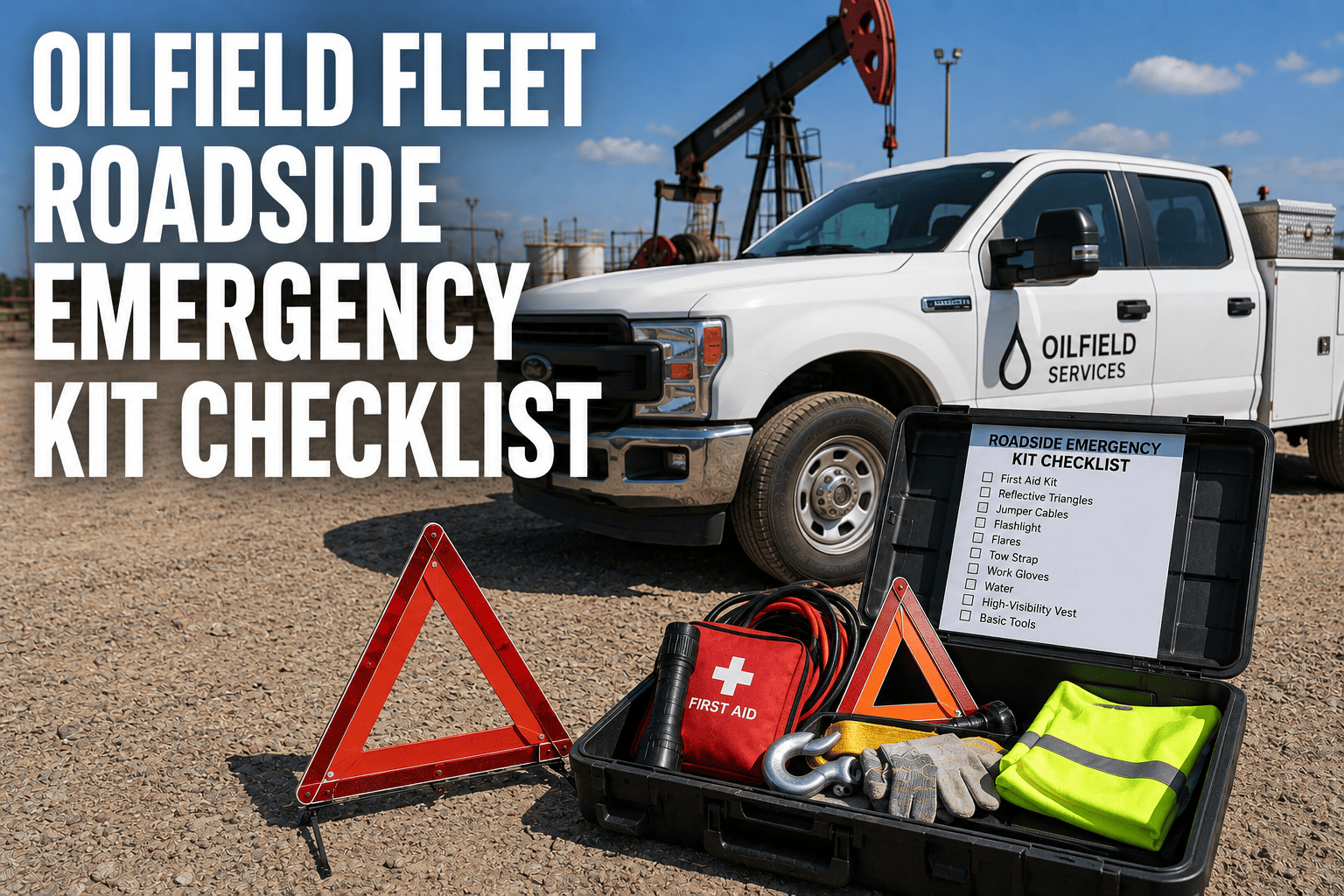
Every oilfield truck must carry the same five categories of emergency gear, standardized across the fleet so any driver stepping into any truck finds the same kit in the same place. The checklist below shows the required inventory, with checked items verified present and unchecked items flagged for restocking. This is what a real kit inspection looks like when someone actually opens the box and counts.
Oilfield Roadside Emergency Kit
Required inventory for every truck — verified at each PM interval1. Recovery Gear
2. Safety Equipment
3. Communication
4. Field Repair Supplies
5. Survival Provisions
The 7-Step Breakdown Response Protocol
Having the kit is only half the equation. The other half is knowing what to do with it when the truck goes down on a lease road at 2 AM. The protocol below gives every driver the same sequence of actions, so the response is predictable, safe, and fast regardless of who is behind the wheel.
Secure the Scene
Place reflective triangles 50, 100, and 200 feet behind the truck. Activate the LED strobe. Don a safety vest. Move to a safe position off the roadway and away from traffic.
Assess the Situation
Identify what failed. Is the truck drivable, repairable roadside, or in need of recovery. Is the load secure. Is there a spill risk. Is the driver in a safe location relative to traffic and terrain.
Communicate
Contact dispatch with location, situation, and assessment. If cell service is unavailable, use satellite phone or messenger. Provide GPS coordinates and estimated need for field repair, wrecker, or self-recovery.
Protect the Load
If hauling hazmat or produced water, deploy spill containment. If the load is valuable, ensure security. Do not leave the load unattended unless safety requires moving away from the vehicle.
Attempt Field Repair
If the failure is safe to address roadside, attempt repair using kit supplies. Tire plugs, belt replacement, hose repair, fluid top-off, and fuse replacement are all field-repairable. Do not attempt repairs that require being under the truck in traffic.
Call for Recovery
If field repair is not possible, dispatch a wrecker or service truck. Provide exact location, vehicle type, and recovery requirements. Stay with the vehicle until recovery arrives. Keep communication open with dispatch throughout.
Document and Report
Photograph the failure, the scene, and any damage. Note time, location, and conditions. Submit the breakdown report through FleetRabbit so maintenance can identify root cause and prevent recurrence across the fleet.
The Cost of Being Unprepared
The difference between a prepared and an unprepared fleet is not measured in convenience. It is measured in dollars per incident and hours of resolution time. The table below shows what each scenario costs when a truck breaks down on a lease road, comparing a fleet with standardized kits and a practiced protocol against a fleet where drivers improvise with whatever is in the cab.
| Scenario | Prepared Fleet | Unprepared Fleet |
|---|---|---|
| Wrecker Calls | Avoided through field repair in 40% of incidents | Required in 70% or more of incidents |
| Average Resolution Time | Under 90 minutes | 3 to 5 hours |
| Roadside Labor Premium | Field repair at no labor premium | 2 to 3 times shop rate for roadside service |
| Driver Exposure Risk | Minimal with warm, hydrated, visible driver | High with cold, dehydrated, low-visibility driver |
| Load Protection | Spill kit and containment on hand | No containment, hazmat exposure risk |
| Per-Incident Cost | 200 to 800 dollars | 1,500 to 5,000+ dollars |
| Annual Impact Per 10 Trucks | 8,000 to 20,000 dollars | 30,000 to 80,000+ dollars |
FleetRabbit maintains a digital emergency kit checklist per truck, alerts on expiring consumables, tracks kit deployments during roadside incidents, and verifies restocking before the truck returns to service. Know which trucks are rolling with incomplete kits before the next breakdown finds them. Start free or book a 30-minute walkthrough to see your fleet's kit readiness score.
Building a Kit Readiness Culture
A standardized kit is only effective if it is actually in the truck when the breakdown happens. The fleets that consistently achieve 90-minute roadside resolution times share three readiness practices, and every one of them is enforceable with the right system.
Standardize the Kit
Every truck carries the same kit with the same items in the same quantities. No driver decides what to bring. The standardized list is the minimum, and every truck is inspected against it at every PM interval.
Inspect Monthly
Kit contents are verified at every preventive maintenance interval. Missing items, expired consumables, and used supplies are flagged and replaced before the truck returns to service. No truck clears PM with a partial kit.
Replace After Use
Any kit item deployed during a roadside incident is restocked within 24 hours. A kit that was used yesterday and not restocked is a kit that will fail the next breakdown. Restocking is verified, not assumed.
How FleetRabbit Tracks Kit Readiness
FleetRabbit was built for oilfield fleets where a missing tow strap or an expired fire extinguisher is not a paperwork issue. It is a safety issue that surfaces at 2 AM on a lease road when the driver needs the gear and it is not there. The platform tracks kit readiness digitally so no truck rolls without its full kit verified.
Digital Kit Checklist Per Truck
Every truck has a digital kit inventory that drivers and maintenance verify against. The checklist is standardized fleet-wide, and verification takes minutes instead of a paper binder scavenger hunt through the cab.
Expiration Alerts for Consumables
Coolant, oil, fire extinguisher charge, and first aid supplies carry expiration dates. FleetRabbit alerts maintenance 30, 60, and 90 days before any consumable expires so it gets replaced before it fails an inspection or a real emergency.
Deployment Tracking
When a kit is used during a roadside incident, the deployment is logged against the truck and the specific items consumed. The restock list generates automatically, and the kit is verified complete before the truck returns to service.
Restock Verification
After any roadside incident, restocked items are verified against the standard list before the truck clears for dispatch. No truck rolls with a partial kit because someone forgot to replace the tow strap or the expired fire extinguisher.
You can start a free FleetRabbit account and see your fleet's kit readiness scores within days, or book a 30-minute demo and we will show you exactly which trucks are rolling with incomplete kits right now and what it takes to close every gap.
Frequently Asked Questions About Roadside Emergency Kits
Key Takeaways on Roadside Emergency Kits
An oilfield roadside emergency kit is not a suggestion. It is the difference between a thirty-minute field repair and a five-hour wrecker ordeal that costs 1,500 to 5,000 dollars and puts the driver at risk in extreme conditions. Every truck must carry the same five categories of gear, verified monthly and restocked within 24 hours of any deployment.
The breakdown response protocol is straightforward. Secure the scene, assess, communicate, protect the load, attempt field repair, call for recovery if needed, and document. Fleets that standardize the kit, inspect it monthly, and restock after every deployment cut roadside incident costs by 40 to 60 percent and reduce average resolution time from 4 hours to under 90 minutes. FleetRabbit was built to track kit readiness digitally so no truck rolls without its gear, and the first readiness gaps typically surface within days of onboarding.
Every oilfield truck that rolls without a complete emergency kit is one breakdown away from a 1,500 to 5,000 dollar incident. FleetRabbit tracks kit readiness per truck, alerts on expiring consumables, and verifies restocking after every deployment. Start free today or book a 30-minute demo and we will show you exactly which trucks in your fleet are rolling with incomplete kits right now.