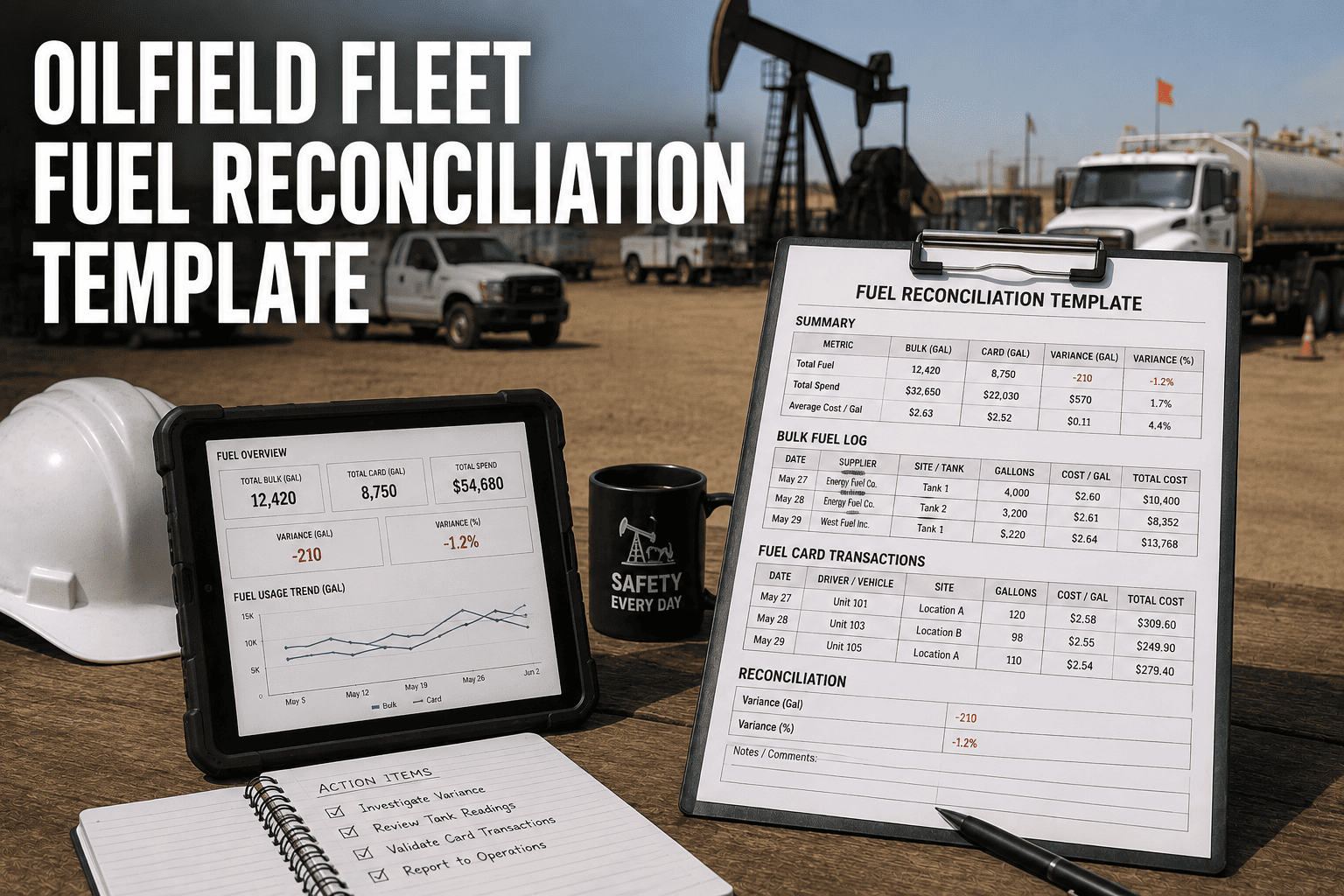
Oilfield Fleet Service Record Template Download

kioiladq-best-oil-gas-fleet-management-software

Oilfield fleet service records provide the longitudinal maintenance history that distinguishes proactive fleet management from reactive breakdown response — capturing every oil change, filter service, tire rotation, brake adjustment, and repair event against the specific vehicle identification number that creates the per-unit service chain required for warranty validation, regulatory compliance during DOT audits, and the historical data foundation that predictive maintenance programs depend on to generate reliable fault forecasts. When oilfield operators maintain service records through paper forms collected from dispersed field locations, the service history becomes fragmented, incomplete, and practically inaccessible for the analytical use cases that justify maintaining it in the first place. FleetRabbit's digital service record platform creates comprehensive, searchable, GPS-verified service history automatically at point of execution — transforming maintenance documentation from a compliance obligation into an operational intelligence asset that fleet managers and executives use to reduce costs, extend asset life, and prevent the catastrophic failures that disrupt drilling programs. Schedule a demonstration to see how FleetRabbit builds complete service record intelligence for oilfield fleet operations.

FREE RESOURCE — 2026 API · DOT · OSHA READY DIGITAL PLATFORM INCLUDED

Oilfield Fleet Service Record Template — Complete Maintenance History Framework

A professional service record framework tracking preventive maintenance events, repair history, parts consumption, fluid analysis data, and inspection records per individual vehicle VIN — with the FleetRabbit digital platform that builds this service history automatically at point of maintenance execution across your entire oilfield fleet.

FleetRabbit builds per-unit service history automatically from technician mobile submissions — GPS-verified, timestamped, and photo-documented without requiring manual records entry or paper form management across dispersed oilfield field locations.

Unit 34 — Service Record
Active
VIN:1FTNW2E52HED12847
Type:2024 Ford F-450 Service Truck
Odometer:47,224 miles — Updated Today
Engine Hrs:2,847 hours
Recent Service Events
Oil Change — 47,200 mi — Tech Verified — Photo
Tire Rotation — 45,000 mi — Torque Logged
Brake Pad Replace — 44,100 mi — WO #2291
DOT Annual Inspection — 43,800 mi — Pass
Next PM Due: 52,000 mi · Air Filter: 500 hrs
24 mo
Per-unit service history retention with instant search and retrieval

100%
GPS-verified service execution evidence for audit defense and warranty claims

28%
Component life extension through consistent interval compliance

3-4 wks
Full digital deployment for 50-200 vehicle oilfield operations
THE SERVICE RECORD LIMITATION

Why Paper Service Record Templates Fail Oilfield Fleet Management

Paper fleet service record templates capture the structural framework for maintenance documentation but cannot produce the analytical intelligence that justifies maintaining service history in the first place. A paper service record filed at a remote field office location is operationally inaccessible to the fleet manager making replacement timing decisions at headquarters, the warranty administrator evaluating a claim submission, or the predictive maintenance model that requires complete service history to generate reliable fault predictions. The service record exists on paper but delivers no operational value beyond confirming that someone completed the form.

FleetRabbit's digital service record platform transforms maintenance documentation from a paper compliance exercise into a searchable, analyzable operational database — enabling fleet managers to query specific VIN service history in seconds, identify vehicles with abnormal maintenance cost patterns suggesting replacement timing, validate warranty claims with GPS-verified service evidence, and provide the historical data foundation that AI fault prediction algorithms require to generate reliable advance warning before catastrophic equipment failures occur.

Paper Service Record Failure Points
Service History Fragmentation
Records distributed across multiple field office locations, service contractor files, and vehicle gloveboxes create incomplete per-unit histories that cannot support predictive analytics or warranty claims
Execution Quality Unverifiable
Paper service records cannot prove that documented maintenance was actually performed at the vehicle location — creating warranty claim vulnerability when manufacturers challenge service execution evidence
Zero Analytical Capability
Paper records require manual data entry before any cost analysis, trend identification, or replacement timing optimization is possible — a process that consumes more time than the analysis is worth for most fleets
Interval Tracking Failures
Multi-parameter tracking across mileage, engine hours, and calendar intervals simultaneously is practically impossible with paper records — creating missed service intervals that void warranties and accelerate component wear

FleetRabbit builds GPS-verified digital service records automatically at point of maintenance execution — creating the searchable per-unit history that transforms documentation from a compliance cost into a fleet management intelligence asset. Start your free trial and build digital service records for your oilfield fleet today.

Template Section 01
PREVENTIVE MAINTENANCE HISTORY

PM Service Record Template — Per-Vehicle Maintenance History

Preventive maintenance service records document every scheduled service event against the specific vehicle VIN — creating the service chain that warranty administrators require for claim validation and that predictive maintenance models use to establish normal service consumption patterns against which developing anomalies are detected. The following template framework captures every required PM service record element for oilfield commercial vehicle operations.

Engine Oil and Filter Service
Service Date:_________________ Odometer: _______
Engine Hours:_______ hours at service execution
Oil Grade / Type:___________ Quantity: _______ qts
Filter Part No.:_______ Brand: ____________
Sample Taken:Yes / No — Lab Ref: _________
Technician ID:_________ Certification: ______
Next Due:________ mi or ________ hours
FleetRabbit auto-populates vehicle data, timestamps service at execution point, and schedules next interval automatically
Transmission and Drivetrain Service
Service Date:_________________ Odometer: _______
Service Category:Trans / Differential / Transfer
Fluid Part No.:_______ Volume: _______ qts
Filter Replaced:Yes / No — Part No.: __________
Fluid Condition:Normal / Discolored / Burnt
Technician ID:_________ Certification: ______
Next Service:________ miles / ________ date
Fluid condition photos mandatory — FleetRabbit blocks submission without before-and-after photographic evidence
Brake System Service Record
Inspection Date:_____________ Odometer: _________
Lining Thickness:Front: ___/32" Rear: ___/32"
Replacement:Front Yes/No — Rear Yes/No
Rotor/Drum:Thickness: ________ Min: _______
Parts Used:Part No.: ________ Brand: _______
Air System:Pressure test result: _____ PSI
Next Inspect:________ miles — DOT cycle
FleetRabbit auto-escalates brake defects to critical priority — dispatch blocked until mechanic certification uploaded
Tire and Wheel Service Record
Service Date:_____________ Odometer: _________
Position:LF / RF / LR / RR / Spare
Tread Depth:___/32" — Replace threshold: 4/32"
Inflation PSI:Spec: ______ Actual: ________
Tire Brand/Size:_________________ DOT ID: ___
Rotation:Pattern applied: ____________
Lug Torque:_____ ft-lbs — Spec: ________
Tire history per position tracks wear patterns across rotations — identifies alignment and suspension issues early
FleetRabbit Builds All Four PM Records Automatically
Engine hours and odometer readings from GPS telematics trigger PM work orders automatically when any service threshold approaches — technicians receive mobile work orders with vehicle-specific checklists requiring photo documentation at each service step, and all data records to the vehicle's digital service history without manual entry, creating the complete per-unit documentation that paper templates require manual effort to produce.
See PM Record Automation

FleetRabbit's digital service records eliminate the manual data entry, fragmented filing, and execution quality gaps that make paper service record templates operationally useless for predictive maintenance programs, warranty claim support, and fleet replacement timing decisions across oilfield operations. Start free trial — deploy digital service records in 3-4 weeks.

Template Section 02
CORRECTIVE MAINTENANCE HISTORY

Repair and Corrective Maintenance Record Template

Repair history records linked to vehicle VIN provide the defect pattern data that distinguishes an isolated mechanical failure from a systemic component reliability issue requiring fleet-wide intervention. When third brake lamp assemblies fail repeatedly on the same vehicle model across a fleet, the pattern visible in complete repair records drives a corrective parts specification change that prevents future failures — but only if repair events are systematically recorded with part numbers, failure descriptions, and vehicle identification that enables pattern analysis.

Repair Work Order Record Elements
Defect Report Date: Timestamp of initial defect identification by driver or inspection technician
Defect Description: Specific symptom with system affected — not "brake problem" but "front left brake pedal soft with excessive travel on hills"
Defect Photography: Minimum 3 photos per defect showing condition at time of identification — required for warranty and insurance documentation
Severity Classification: Safety-critical out-of-service / Operational defect address next service / Advisory monitor and track
Root Cause Determination: Technician root cause assessment — wear, fatigue, impact damage, manufacturing defect, or improper previous repair
Parts Used: Part numbers, quantities, unit costs, supplier name, and warranty status for each component installed
Labor Hours: Technician hours recorded at completion — enables cost-per-repair analysis and technician efficiency tracking
Return-to-Service Verification: Post-repair photos confirming defect correction and function verification before authorization
FleetRabbit Repair Intelligence
Auto
Work orders created from inspection defects — no manual paperwork initiation required
Fleet
Pattern analysis identifies recurring defects across vehicle models for specification corrections
Cost
Per-unit repair cost accumulation signals economic replacement threshold before costs exceed value
Build Repair Records Free
SERVICE RECORD INTELLIGENCE PLATFORM

Transform Service Record Templates Into Actionable Fleet Management Intelligence

FleetRabbit's digital service records enable fleet managers to query specific VIN maintenance history instantly, identify cost outliers requiring replacement evaluation, validate warranty claims with GPS-verified evidence, and provide the historical data foundation that AI predictive maintenance requires — capabilities that paper service record templates cannot deliver regardless of how carefully they are maintained.

40%
Downtime reduction through complete digital service history
28%
Component life extension through interval compliance
Start Free Trial Book Demo
Template Section 03
OIL ANALYSIS · COOLANT · HYDRAULIC

Fluid Analysis and Sample Tracking Record Template

Fluid analysis programs provide early warning of internal component wear 2-4 oil changes before physical failure — but only when sample results are tracked against the same vehicle across multiple consecutive samples to identify trend progression rather than evaluating each sample result in isolation. Per-VIN fluid analysis tracking in FleetRabbit links each laboratory report to the vehicle's complete service history, enabling trend analysis that identifies developing bearing wear, coolant system contamination, or hydraulic pump degradation months before breakdown occurs.

Engine Oil Analysis Record
Sample Date:_______ Engine Hours: _______
Lab Reference:______________________________
Iron (Fe) ppm:_______ Baseline: ____________
Copper (Cu) ppm:_______ Trend: ____________
Viscosity cSt:_______ Spec: _______________
Water Contamination:______ % — Action: _____
Lab Recommendation:Normal / Investigate / Change
FleetRabbit plots wear metal trends across consecutive samples per VIN — detecting developing failures before Lab "Investigate" threshold is reached
Coolant and Engine Condition
Test Date:_______ Engine Hours: _______
Freeze Point:______°F — Target: -34°F
pH Level:_______ Spec: 7.5-11.0
Inhibitor Conc.:_______ % — Min: ________
Contamination:Oil / Rust / None Detected
Pressure Test:Cap hold: _____ PSI — Pass/Fail
Next Change:_______ miles or _______ months
Coolant contamination with oil indicates head gasket degradation — FleetRabbit flags abnormal results for immediate maintenance review
Hydraulic Fluid Analysis
Sample Date:_______ Operating Hours: ______
ISO Cleanliness:_______ Target: 16/14/11
Viscosity @ 40°C:_______ cSt Spec: _________
Water Content:_______ ppm — Max: 500 ppm
Acidity (TAN):_______ mg KOH/g — Limit: ___
Additive Depletion:_____ % remaining — Action: ___
Filter Bypass:Normal / Clogged — Action: ___
Degraded hydraulic fluid causes accelerated pump wear — FleetRabbit tracks ISO cleanliness trends and auto-schedules fluid changes before damage thresholds
Template Section 04
ASSET LIFECYCLE AND REPLACEMENT ANALYTICS

Fleet Lifecycle Cost Record and Replacement Timing Framework

Complete per-unit service records enable the lifecycle cost analysis that determines whether retaining an aging vehicle with escalating maintenance costs delivers better economic value than capital replacement — a calculation that requires accurate cumulative maintenance spend, reliability data, and residual value estimation that paper service records cannot support because historical maintenance costs cannot be reliably extracted from fragmented paper filing systems.

Lifetime Cost Accumulation Per Vehicle VIN
Acquisition Cost: Purchase price, delivery, and initial equipment installation at vehicle commissioning
Cumulative PM Cost: All preventive service labor and materials accumulated across vehicle lifetime
Cumulative Repair Cost: All corrective maintenance labor, parts, and third-party service costs per vehicle
Downtime Cost: Revenue impact from vehicle unavailability during breakdown and extended repair events
Fuel Cost Per Mile: Fuel consumption trend tracking showing efficiency degradation as powertrain ages
Insurance Cost: Annual insurance premium and claims history per vehicle identification number
Replacement Decision Indicators
12-Month Maintenance Trend: Annual maintenance cost as percentage of current market value — above 30% signals replacement candidacy
Breakdown Frequency: Unplanned failure events per 10,000 miles — increasing frequency indicates approaching economic end-of-life
Oil Analysis Wear Trend: Increasing wear metal levels across consecutive samples indicating accelerating internal component degradation
Availability Rate: Percentage of scheduled operating time vehicle was available versus in maintenance — below 90% triggers review
FleetRabbit Lifecycle Analytics
$284K
Average annual fleet savings from data-driven replacement timing vs intuition-based decisions
12-18%
Lifecycle cost reduction through optimal replacement timing based on complete service record analytics
Instant
Per-vehicle lifetime cost query versus manual calculation from fragmented paper records
See Lifecycle Analytics Demo
FLEETRABBIT DIGITAL SERVICE RECORD PLATFORM

From Manual Service Record Templates to Automated Fleet History Intelligence

FleetRabbit replaces all four service record template categories with an integrated digital platform that builds comprehensive per-unit maintenance history automatically at point of execution — creating the searchable, analyzable service record database that transforms documentation from a compliance cost into a strategic fleet management asset.

01

Automatic Service History Building

Every technician mobile submission — PM service, repair work order, fluid sample, or inspection — records automatically to the vehicle's digital service history with GPS-verified timestamp and technician identity. No manual records entry, no paper form management, no dispersed filing system to reconcile. Complete per-unit service history builds continuously from field activity without dispatcher or administrative effort.

02

Multi-Parameter Interval Scheduling

Mileage, engine hours, and calendar intervals tracked simultaneously per vehicle — PM work orders generate before any threshold expires regardless of which parameter triggers first. A heavy service truck requiring oil change at 15,000 miles and 400 engine hours receives alerts based on whichever limit approaches first given its specific operational duty cycle, not on a generic schedule applying equally to all vehicles.

03

Per-VIN Cost Analytics Dashboard

Cumulative maintenance spend per vehicle searchable instantly — fleet managers query any VIN to see complete lifetime PM costs, repair history, fluid analysis results, and downtime events in a single dashboard view. Cost per mile trending, year-over-year maintenance spend comparison, and replacement timing economic modeling replace the manual calculation from paper records that practically no fleet performs consistently.

04

Warranty Claim Documentation

GPS-verified service records with photographic evidence of parts installation, fluid type and quantity, and service execution location provide the audit-defensible documentation that warranty administrators require when challenging claim validity. Digital records with device-captured timestamps prove service was performed at the vehicle location on the claimed date — eliminating the documentation vulnerability that causes warranty claim denials for fleets relying on paper service records.

05

Predictive Maintenance Intelligence

AI algorithms analyze complete per-unit service history alongside real-time operating data to generate fault predictions 1-3 weeks before breakdown probability spikes — identifying developing engine bearing issues, hydraulic pump degradation, and brake system wear patterns before they produce field failures at $4,200 to $8,500 per unplanned breakdown incident in remote oilfield locations.

06

Audit Package Generation

Complete DOT, OSHA, EPA, and client HSE audit packages generated within 2 hours from digital service records spanning any requested date range — covering inspection records, PM history, defect documentation, repair records, and fluid analysis results without manual retrieval from multiple dispersed paper filing locations that currently requires 40-60 hours of administrative effort per major audit response.

DIGITAL SERVICE RECORD PLATFORM — FLEET OUTCOMES
40%
Fleet downtime reduction through predictive analytics from complete service history
12-18%
Lifecycle cost reduction through data-driven replacement timing optimization
90%+
PM adherence rate versus 35% paper template baseline programs
2 hrs
Complete audit package generation vs 40-60 hours manual records assembly
FREQUENTLY ASKED QUESTIONS

Common Questions About FleetRabbit Digital Service Records

How does FleetRabbit build service history at remote oilfield sites without cellular connectivity?
Mobile app operates fully offline — technicians complete PM service records, upload photos, and log parts consumption without signal. GPS coordinates and timestamps capture from device hardware at point of service execution, not at connectivity restoration. Data synchronizes automatically when connectivity restores with original field timestamps preserved, creating unbroken service history without manual reconciliation.
Can FleetRabbit service records satisfy manufacturer warranty documentation requirements?
Yes. Digital records include GPS-verified location proving service occurred at vehicle location, timestamps from device hardware at execution time, photographic evidence of parts installation and fluid service, and technician identity with certification data. This documentation architecture satisfies manufacturer warranty verification requirements that paper records cannot meet when administrators challenge service execution evidence during claim review.
How does per-VIN service history enable fleet replacement timing decisions?
FleetRabbit calculates cumulative maintenance cost per vehicle including all PM services, repairs, and downtime events — enabling direct comparison of annual maintenance cost as a percentage of current market value. Vehicles exceeding 30% annual maintenance-to-value ratio and showing increasing breakdown frequency and oil analysis wear trends are identified automatically as replacement candidates with documented financial justification for capital authorization requests.
Can existing paper service records be migrated into the FleetRabbit digital platform?
Yes. FleetRabbit's implementation team supports historical data migration from paper records, Excel spreadsheets, and other fleet management systems — digitizing vehicle profiles, service history, and driver records into the platform database during the deployment phase. Historical data quality determines migration completeness; incomplete paper records produce partial digital history that improves continuously as new service events are recorded digitally from platform activation.
Does FleetRabbit support fluid analysis laboratory integration for automatic result upload?
Yes. FleetRabbit integrates with major oil analysis laboratories including Polaris, Blackstone, and Fluid Life for automatic result import linked to the vehicle VIN and sample date. Wear metal results plot automatically against previous samples for trend visualization, and threshold exceedances generate maintenance alerts without requiring manual result review by fleet managers across large fleets generating hundreds of samples monthly.
What is the deployment timeline for implementing digital service records across an active oilfield fleet?
Standard deployment completes in 3 to 4 weeks covering vehicle profile setup, PM schedule configuration, technician and supervisor mobile app training, and executive analytics dashboard activation. Service history begins building from the first mobile PM submission — digital records improve in completeness daily as field activity is captured. Multi-site operations with extensive equipment customization may extend to 5 to 6 weeks.
DIGITAL SERVICE RECORD PLATFORM FOR OILFIELD FLEETS

Build Complete Per-Unit Fleet Service History Automatically — No Manual Records Entry Required

FleetRabbit's integrated service record platform covers all four template categories — preventive maintenance records, corrective repair history, fluid analysis tracking, and lifecycle cost accumulation — building comprehensive per-VIN service history automatically from technician mobile submissions across 50 to 200 vehicle oilfield fleets. GPS-verified timestamps, mandatory photographic evidence, multi-parameter PM scheduling, and predictive analytics transform service documentation from a paper compliance exercise into the operational intelligence foundation that enables data-driven fleet management decisions across drilling, completion, and production support operations.


Automatic per-VIN service history from field submissions
Multi-parameter PM scheduling — hours, miles, calendar
GPS-verified warranty claim documentation evidence
Fluid analysis trend tracking per vehicle VIN
Lifecycle cost analytics and replacement timing signals
Full offline capability across cellular dead zones
AI predictive fault detection from service history data
2-hour audit packages — DOT, OSHA, EPA, HSE

May 16, 2026 By David
All Posts

Share This Story, Choose Your Platform!

Latest Posts

Scroll