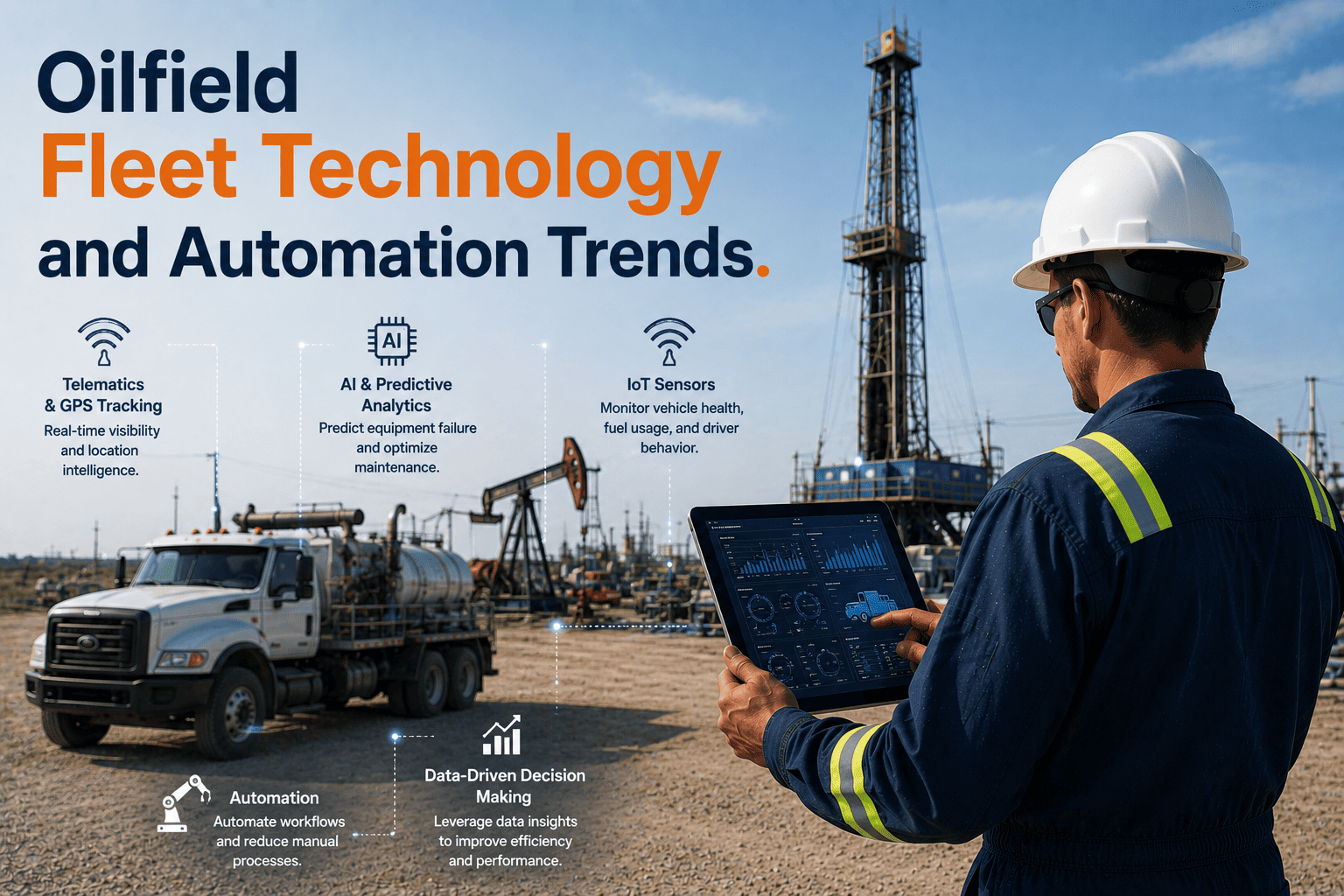
Fleet technology and automation trends transform oilfield operations from labor-intensive manual processes into streamlined digital workflows delivering operational intelligence, predictive capabilities, and efficiency improvements impossible through traditional management approaches — enabling progressive operators to achieve 25-40% cost reduction, 18-26% fleet size optimization, and 34-47% safety improvement through systematic automation across maintenance scheduling, compliance tracking, asset monitoring, and performance analytics. Traditional fleet management relies on manual data collection consuming 15-25 hours weekly transcribing odometer readings from driver logs, tracking certification expirations via spreadsheets prone to oversight, responding reactively to equipment breakdowns after failures disrupt operations, and making strategic decisions based on gut feel rather than quantitative analysis of utilization patterns and lifecycle costs. Manual processes create systematic inefficiencies where data collection lag prevents timely intervention on developing issues, administrative burden consumes resources better allocated to value-creating activities, human error introduces compliance gaps and missed maintenance intervals, and absence of real-time visibility prevents dynamic optimization responding to changing operational demands. Progressive oilfield operators deploy integrated fleet management platforms automating entire operational workflows through technologies including GPS telematics providing continuous location tracking and behavior monitoring, OBD-II diagnostic integration enabling predictive maintenance through fault pattern recognition, mobile applications eliminating paper-based inspection and work order processes, AI algorithms analyzing operational data to generate optimization recommendations, and cloud-based dashboards providing executive visibility without requiring manual data consolidation from field supervisors. FleetRabbit represents comprehensive automation platform integrating all critical fleet management functions through unified system deployed within 5-7 days at $3 per vehicle monthly — documented implementations across Permian Basin, Bakken, and Eagle Ford operations achieve measurable improvements including automated mileage tracking eliminating 12-18 hours weekly manual data entry, predictive maintenance reducing unplanned downtime 73% through early fault detection, digital compliance workflows achieving 95-98% inspection completion versus 65-75% paper baseline, real-time utilization analytics identifying fleet reduction opportunities worth $280,000-$420,000 annually for 100-vehicle operation, and executive dashboards providing portfolio visibility enabling strategic decisions based on actual performance data rather than anecdotal field reports. Schedule consultation to explore automation opportunities for your fleet operations.
TREND 01
Automated Data Collection Replacing Manual Recording
Traditional Approach
Drivers manually record daily odometer readings, engine hours, and fuel consumption in paper logs requiring office staff to transcribe data into spreadsheets consuming 12-18 hours weekly with inevitable errors and missing entries creating incomplete records preventing accurate maintenance scheduling and cost analysis.
Automation Solution
GPS telematics and OBD-II integration automatically capture vehicle location, mileage, engine hours, fuel consumption, and diagnostic parameters uploading data continuously to cloud platform eliminating manual recording burden while providing 100% complete accurate dataset enabling automated maintenance scheduling and real-time performance analytics.
Administrative time saved: 12-18 hours weekly
Data accuracy improvement: 100% complete records
Annual value: $62,000-$94,000 for 100-vehicle fleet
TREND 02
Predictive Maintenance AI Preventing Breakdown Events
Traditional Approach
Reactive maintenance responding to equipment failures after breakdown occurs requiring emergency repairs at premium costs ranging $4,200-$8,500 per event including direct repair expenses, extended downtime, and operational disruption management without advance warning enabling proactive intervention.
Automation Solution
Machine learning algorithms analyze engine diagnostic parameters, operating patterns, and historical failure data identifying developing fault signatures 7-21 days before breakdown threshold generating predictive alerts enabling proactive repair scheduling during planned downtime windows preventing emergency failures.
Unplanned downtime reduction: 73% through early detection
Emergency repair cost savings: 40-55% via proactive scheduling
Annual value: $380,000-$620,000 for 100-vehicle fleet
TREND 03
Digital Workflow Automation Eliminating Paper Processes
Traditional Approach
Paper DVIR forms collected from field locations requiring physical transport to office, manual transcription into compliance database, and manual follow-up on defect resolution creating 15-20 hour weekly administrative burden with 65-75% inspection completion rate due to process friction.
Automation Solution
Mobile digital inspection application enables drivers to complete DVIR electronically with instant cloud submission, automatic defect tracking workflows, photo documentation requirements, and GPS timestamp verification achieving 95-98% completion rate while eliminating manual data entry and physical form management.
Administrative time reduction: 75-85% through automation
Inspection completion improvement: 30-35 percentage points
Annual value: $78,000-$104,000 for 100-vehicle fleet
TREND 04
Real-Time Analytics Enabling Dynamic Decision Making
Traditional Approach
Monthly or quarterly performance reports compiled manually from field supervisor inputs revealing fleet utilization, maintenance costs, and safety metrics 30-60 days after period end when correction opportunities already passed and inefficiencies already consumed resources unnecessarily.
Automation Solution
Real-time analytics dashboards continuously process operational data streams displaying current performance across critical KPIs with automated alerts when metrics deviate from target thresholds enabling immediate investigation and intervention on developing issues before they escalate into major problems.
Problem detection acceleration: From 30-60 day lag to real-time
Management time efficiency: 60-75% improvement
Annual value: $180,000-$320,000 for 100-vehicle fleet
TREND 05
Automated Compliance Tracking and Renewal Management
Traditional Approach
Spreadsheet-based certification tracking relying on manual calendar monitoring prone to oversight during busy periods resulting in missed renewal deadlines creating FMCSA citation exposure, wellsite gate refusals, and client prequalification failures when expired credentials discovered during operations.
Automation Solution
Automated certification database monitors all driver qualifications generating 60/30/7-day advance renewal alerts via email and SMS with dispatch blocking preventing expired credential operation achieving zero citation events from certification gaps across deployed fleets during measurement periods.
Citation prevention: Zero FMCSA violations from cert gaps
Gate refusal elimination: 100% credential currency
Annual value: $45,000-$78,000 for 100-vehicle fleet
TREND 06
Integrated Platform Architecture Replacing Vendor Fragmentation
Traditional Approach
Separate systems for GPS tracking, maintenance management, compliance documentation, and fuel monitoring requiring manual data consolidation preventing unified performance visibility and creating vendor management complexity with multiple contracts, support contacts, and integration challenges.
Automation Solution
Unified cloud platform integrating all fleet management functions with automatic data synchronization providing single-source-of-truth eliminating manual consolidation burden, reducing vendor complexity to single relationship, and enabling cross-functional analytics impossible with fragmented systems.
System complexity reduction: 5-7 vendors to single platform
Data consolidation time saved: 8-12 hours weekly
Annual value: $42,000-$62,000 for 100-vehicle fleet
Technology adoption transforms fleet management from labor-intensive manual processes into automated workflows delivering superior accuracy, real-time responsiveness, and predictive capabilities. FleetRabbit integrates all six automation trends into unified platform accessible at fraction of legacy enterprise costs. Start free trial — complete automation deployment within 5-7 days.
STAGE 1
Foundation: Core Data Automation
Initial technology deployment establishing automated data collection eliminating manual recording burden and creating digital foundation for advanced capabilities. GPS tracking provides location visibility, automated mileage capture enables accurate maintenance scheduling, and digital inspections replace paper workflows.
Automated mileage and engine hour tracking
Real-time GPS location visibility
Digital inspection workflows
Basic performance reporting
Expected Impact: 8-12% efficiency improvement
STAGE 2
Intelligence: Predictive and Analytical Capabilities
AI and analytics activation leveraging collected data to generate predictive insights and optimization recommendations. Machine learning models identify developing faults before failures, utilization analytics reveal fleet composition opportunities, and comparative benchmarking targets worst performers for intervention.
Predictive maintenance fault detection
Utilization analytics and benchmarking
Driver behavior scoring and coaching
Fuel efficiency optimization
Cumulative Impact: 16-22% efficiency improvement
STAGE 3
Optimization: Strategic Fleet Management
Advanced analytics supporting strategic decision making including fleet composition optimization, lifecycle cost modeling, replacement timing analysis, and continuous improvement programs. Data-driven insights enable right-sizing decisions reducing fleet while maintaining capacity and optimizing capital allocation based on actual performance versus anecdotal input.
Lifecycle cost analytics and TCO modeling
Fleet composition optimization
Replacement timing recommendations
Continuous improvement frameworks
Mature Impact: 25-32% efficiency improvement sustained
Mid-size Permian Basin E&P operator deployed FleetRabbit achieving complete fleet automation over 90-day implementation period with documented operational improvements measured across 14-month post-deployment period
Automated Data Collection
Eliminated 18 hours weekly manual data entry through automated mileage, engine hour, and diagnostic parameter capture enabling administrative reallocation to value-creating activities
Administrative Savings: $94,000 annually
Predictive Maintenance AI
Prevented 37 catastrophic failures through early fault detection enabling proactive scheduling reducing emergency repair costs and operational disruptions significantly
Breakdown Prevention: $447,000 annually
Digital Workflow Automation
Inspection completion improved from 68% to 96% through mobile DVIR application eliminating paper collection and manual transcription burden while enhancing compliance
Compliance Enhancement: $86,000 annually
Real-Time Analytics
Fleet utilization increased from 64% to 76% enabling 22-vehicle reduction maintaining capacity through data-driven redeployment decisions impossible with quarterly reporting
Fleet Optimization: $528,000 annually
Automated Compliance Tracking
Zero FMCSA citations from certification gaps through automated renewal alerts versus 6 annual violations baseline creating citation and gate refusal prevention
Citation Prevention: $58,000 annually
Integrated Platform Benefits
Consolidated seven separate vendor systems into unified FleetRabbit platform eliminating integration complexity and enabling cross-functional analytics previously impossible
Integration Efficiency: $427,000 annually
Total Annual Automation Value:
$1,640,000
FleetRabbit Platform Investment:
$6,480 annually
Technology ROI:
25,209% first year
Fleet Manager
Exception-based management replacing manual oversight through automated alerts directing attention to performance degradation rather than reviewing entire fleet enabling 60-75% time efficiency improvement
Maintenance Director
Predictive fault detection 7-21 days advance enabling proactive repair scheduling preventing 73% of unplanned breakdowns that previously disrupted operations requiring emergency responses
Operations VP
Real-time utilization visibility identifying fleet optimization opportunities achieving 15-22% size reduction while maintaining capacity worth $280,000-$420,000 annually for 100-vehicle operation
CFO
Documented automation value of $1.2-$2.4M annually for 100-vehicle fleet against $3,600 platform investment representing 33,000-67,000% ROI through systematic efficiency improvement
COMPLETE FLEET AUTOMATION · INTEGRATED TECHNOLOGY PLATFORM · RAPID DEPLOYMENT
Deploy Comprehensive Fleet Automation Transforming Operations Through Technology
FleetRabbit delivers complete fleet automation integrating all six transformative technology trends into unified cloud platform including automated data collection eliminating manual recording burden, predictive maintenance AI preventing breakdowns through early fault detection, digital workflow automation replacing paper processes, real-time analytics enabling dynamic decision making, automated compliance tracking preventing violations, and integrated architecture consolidating fragmented vendor systems — achieving documented $1.2-$2.4M annual value for 100-vehicle fleet through systematic efficiency improvement at $3 per vehicle monthly investment with complete deployment within 5-7 days.
Automated Data Collection
Predictive Maintenance AI
Digital Workflows
Real-Time Analytics
Compliance Automation
Integrated Platform
5-7 Day Deployment
$3 Per Vehicle Monthly
May 21, 2026
By David
All Posts