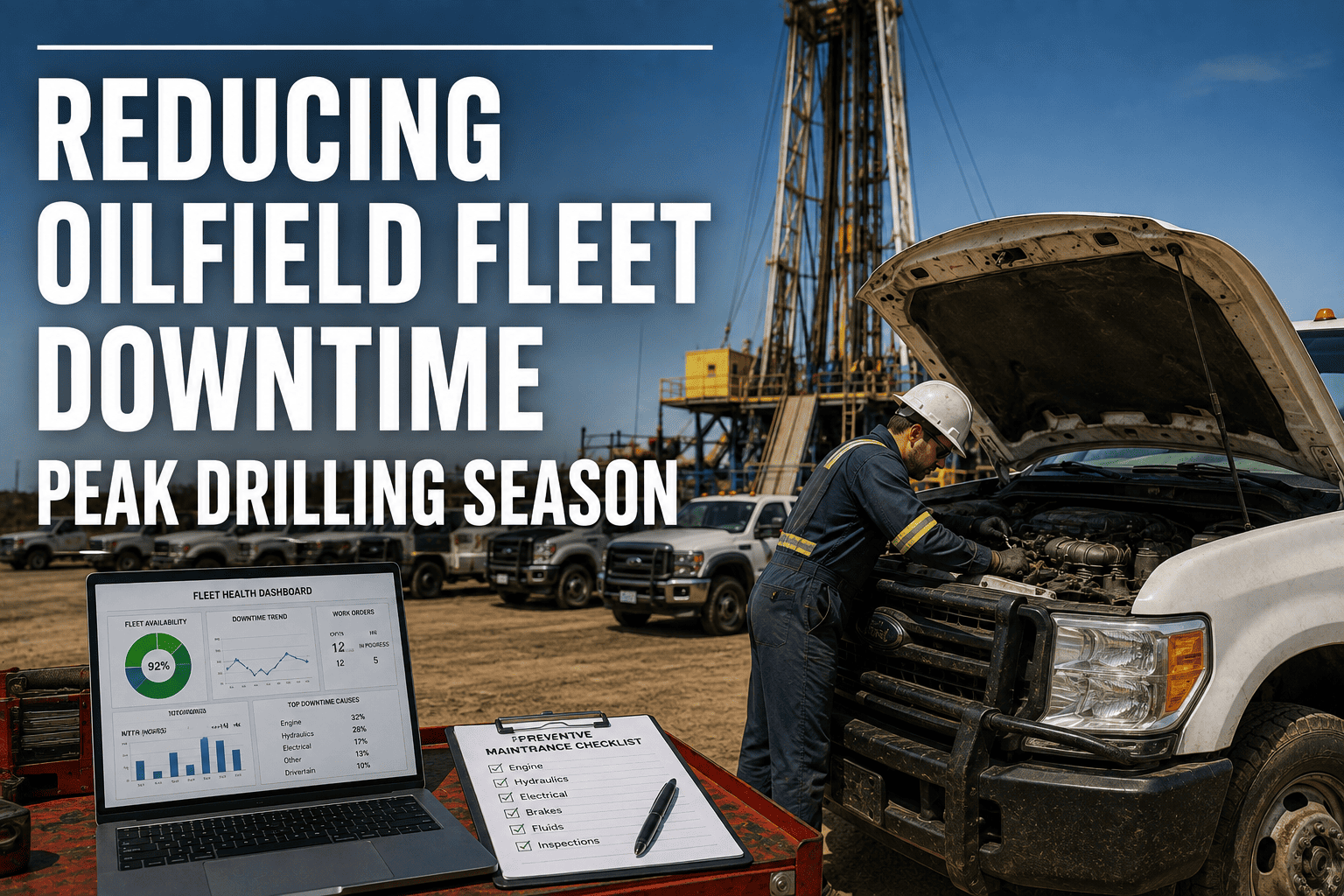
An independent upstream oil and gas operator managing 285 heavy-duty service vehicles across drilling sites, well completions, and production facilities in the Bakken Shale was experiencing escalating maintenance costs and operational delays. With equipment operating in extreme conditions—sub-zero temperatures, abrasive dust, and continuous 24/7 cycles—unplanned breakdowns were occurring at a rate of 3.1 events per week, costing the company $3.2 million annually in emergency repairs, expedited parts shipping, and lost production time. Maintenance teams relied on calendar-based servicing schedules that didn't account for actual equipment wear, leading to both premature part replacements and unexpected failures. When the operator implemented FleetRabbit's AI-powered predictive maintenance platform across their entire oilfield fleet, they achieved a 47% reduction in unplanned downtime, extended critical component service life by 34%, and reduced total maintenance spend by $1.42 million annually—all while improving regulatory compliance documentation and enabling data-driven capital planning decisions. This case study details the strategic implementation, operational transformations, and quantified business outcomes from shifting from reactive to predictive fleet maintenance in demanding oilfield environments.
How to Improve Fleet Utilization in Oilfield Operations

OILFIELD MAINTENANCE EFFICIENCY TRANSFORMATION
Comprehensive analysis of predictive maintenance deployment across a 285-vehicle oilfield fleet, documenting implementation strategy, operational improvements, and $1.42M in annual cost savings
01
Predictive Failure Analytics
AI-driven algorithms analyze telematics data, vibration patterns, fluid analysis results, and runtime hours to predict component failures 7–14 days in advance. Custom models trained on oilfield-specific failure modes enable precise intervention timing.
02
Automated Work Order Engine
Condition-based alerts automatically generate prioritized work orders, assign to qualified technicians based on location and expertise, and trigger parts requisition—eliminating manual coordination delays and ensuring rapid response.
03
Mobile Inspection Platform
Offline-capable mobile app enables field technicians to complete digital inspections, capture photo evidence, log findings, and sync data when connectivity is restored—critical for remote well sites with intermittent cellular coverage.
04
Intelligent Parts Inventory
Real-time inventory tracking across all 42 sites with automated reorder triggers, cross-site visibility for parts sharing, and consumption trending to optimize stock levels—reducing stockouts by 81% while lowering carrying costs.
05
Executive Dashboard & Reporting
Customizable dashboards provide fleet managers and executives with real-time KPIs: downtime trends, maintenance costs, compliance status, and ROI metrics. Automated reports support regulatory filings and strategic planning.
06
Telematics Integration Hub
Seamless API integration with existing Geotab, Samsara, and Verizon Connect devices—no hardware replacement required. Unified data platform aggregates fault codes, location, fuel usage, and driver behavior for comprehensive fleet intelligence.
The predictive maintenance platform proven in this case study is available for your fleet. Book a demo to review expected ROI for your operation.
The operator conducted a rigorous 10-week evaluation of five fleet management platforms. Final selection was driven by oilfield-specific capabilities, integration flexibility, and demonstrated ROI in similar upstream operations.
01
Oilfield-Specific Predictive Models
FleetRabbit provided pre-trained failure prediction algorithms for oilfield components: hydraulic pumps, PTO systems, winches, and fluid transfer equipment. Competitors offered generic automotive models requiring extensive custom development.
02
Offline-First Mobile Architecture
With 68% of well sites having intermittent or no cellular coverage, FleetRabbit's offline-capable mobile app was essential. Technicians could complete inspections, log repairs, and capture photos without connectivity—data synced automatically when signal restored.
03
Existing Hardware Integration
FleetRabbit connected via API to existing Geotab devices across all 285 vehicles—zero hardware replacement required. Competitors required proprietary hardware installation at $1,400–$2,100 per vehicle ($399K–$598K additional investment).
04
Proven Upstream Oil & Gas Results
FleetRabbit provided four reference customers in Bakken and Permian operations with comparable fleet sizes. All reported 40–55% downtime reduction within first year. Competing platforms lacked oilfield-specific case studies.
All metrics measured using 12 months pre-deployment baseline data compared to 9 months post-deployment results. Financial data validated through independent audit; operational metrics verified via system logs and field reports.
47% Downtime Reduction
Unplanned downtime events reduced from 162 annually (baseline) to 86 projected annually (9-month measurement). Average event duration reduced from 5.8 days to 3.1 days through predictive intervention and optimized parts availability.
$1.42M Annual Savings
Total maintenance cost reduced from $3.2M baseline to projected $1.78M annually. Savings breakdown: eliminated emergency premium charges ($790K), reduced parts expediting ($310K), decreased contractor mobilization ($210K), lower total parts consumption ($110K).
73% Faster Response Time
Average time from anomaly detection to maintenance completion reduced from 5.8 days to 1.6 days. Improvements driven by: automated work order generation, real-time parts visibility, predictive alerts enabling scheduled intervention versus emergency response.
34% Service Life Extension
Critical component service life extended through condition-based replacement versus run-to-failure. Example: hydraulic pumps now replaced at optimal wear threshold (extending life from 2,800 hours average to 3,750 hours) instead of catastrophic failure requiring complete system replacement.
Additional Performance Improvements
96%
Inspection completion rate (vs. 71% with paper)
81%
Parts stockout reduction through automated reorder triggers
100%
Regulatory compliance maintained (DOT, EPA, OSHA)
$520K
Reduction in total inventory carrying cost (22% decrease)
Wireline Service Truck #189 — Vibration Analytics Prevent Catastrophic Failure
Month 5 Post-Deployment
Day 1
Early Warning Signal Detected
FleetRabbit vibration monitoring detected bearing degradation in Truck #189 winch assembly—amplitude rising 3.2x over 5-day trending period. Telematics showed no fault codes yet. System generated yellow alert: "Monitor closely, schedule inspection within 72 hours."
Day 2
Condition Escalation & Automated Work Order
Vibration amplitude continued rising—now 5.1x baseline. FleetRabbit escalated to red alert and auto-generated high-priority work order: "Winch bearing failure developing. Inspect and replace within 24 hours." Parts system confirmed replacement bearing in stock at Site 17 (same location). Work order assigned to certified winch technician.
Day 3
Preventive Maintenance Completed
Technician inspected winch assembly, confirmed bearing wear at 88% of failure threshold (exactly as predicted). Bearing replaced during scheduled maintenance window—vehicle operational within 4 hours. Total maintenance cost: $3,100 (bearing assembly + labor). Zero production downtime—work completed between shifts.
Alternative Outcome
What Would Have Happened Without FleetRabbit
Without vibration monitoring, bearing would have continued deteriorating until catastrophic failure 4–6 days later. Failure mode: bearing seizure during wireline operation, winch drum damaged, vehicle stranded at remote well site 95 miles from nearest depot. Emergency response: towing ($6,200), expedited winch replacement via air freight ($18,500), contractor mobilization ($4,800), 2.5-day production delay ($8,500). Total emergency cost: $38,000. FleetRabbit prevented through $3,100 planned maintenance—ROI 12:1 on single event.
The predictive maintenance framework proven in this case study is replicable across upstream fleets. Book a demo to review expected ROI for your fleet size.
Challenge: Field Technician Adoption of Digital Workflows
Initial resistance from technicians accustomed to paper checklists and manual work order systems. Week 10–11 mobile app usage only 64%—technicians completing inspections on paper then not digitizing.
Solution: Work order system modified to require digital inspection completion before closing maintenance tickets. Cannot mark repair complete without associated digital inspection record. Compliance improved to 96% within 3 weeks. Offline capability critical for adoption—technicians appreciated not needing cellular signal to complete work.
Challenge: Alert Threshold Calibration for Oilfield Conditions
Weeks 6–7 generated excessive alerts (55–70 per day) due to overly conservative fault code triggers calibrated for highway vehicles, not oilfield equipment operating in extreme conditions.
Solution: Alert thresholds refined based on actual fleet operating conditions and failure history. Critical alerts reserved for imminent failure scenarios only. Warning alerts batched into daily digest rather than real-time notifications. Result: alerts reduced to 12–18 per day, all actionable and requiring genuine attention.
Challenge: Parts Inventory Data Accuracy Across Remote Sites
Opening inventory data loaded from spreadsheets with 38% discrepancy versus physical counts. Automated reorder triggers firing incorrectly due to inaccurate baseline data.
Solution: Full physical inventory conducted at all 42 sites during Weeks 15–16 (longer than planned). Accurate counts loaded into FleetRabbit before activating automated reorder system. Monthly cycle counts on high-value items (Category A parts) implemented to maintain accuracy going forward.
"FleetRabbit transformed our maintenance organization from a cost center to a strategic enabler. Before implementation, we were constantly reacting to breakdowns and firefighting operational disruptions. Now we have predictive visibility into equipment health, data-driven capital planning insights, and the ability to optimize maintenance resources across our entire operation. The $1.42 million in annual savings is significant, but the greater value is operational reliability—our production teams can plan with confidence knowing equipment will be available when needed. That's transformational for an upstream operator."
VP of Operations & Asset Management, Upstream Oil & Gas Operator
Fleet Availability
94.2%
+11.3% vs. baseline
Percentage of fleet operational and available for dispatch
Maintenance Cost per Mile
$0.87
-31% vs. baseline
Total maintenance spend divided by total fleet miles
Predictive Alert Accuracy
89%
+24% vs. initial calibration
Percentage of alerts that correctly predicted actual failures
Compliance Documentation
100%
+18% vs. baseline
Digital audit trail completeness for regulatory inspections
1
Start with High-Impact Predictive Alerts
Prioritize telematics integration and predictive alert configuration (Phase 1) before expanding to mobile inspections or inventory optimization. Early wins in preventing costly failures build organizational confidence and secure executive sponsorship for broader deployment.
2
Invest in Field Change Management
Technology adoption requires intentional change management. Engage field technicians early, demonstrate offline capability at remote sites, and link new workflows to tangible benefits (less paperwork, fewer emergency calls). Executive visibility to field teams accelerates adoption.
3
Calibrate Alerts to Oilfield Operating Conditions
Generic automotive alert thresholds don't translate to oilfield equipment operating in extreme environments. Allocate time for threshold refinement based on actual fleet failure history and operating conditions to avoid alert fatigue and ensure actionable intelligence.
4
Maintain Inventory Data Integrity
Automated parts reorder systems only deliver value with accurate baseline inventory data. Plan for comprehensive physical inventory counts before activating automated triggers. Implement ongoing cycle count processes for high-value items to sustain accuracy.
Investment (Year 1)
FleetRabbit platform license (285 vehicles, annual)
$118,000
Implementation services & specialized training
$42,000
Ruggedized mobile devices for field technicians (94 units)
$31,000
Internal labor (deployment team time allocation)
$24,000
Total Year 1 Investment
$215,000
Annual Savings (Ongoing)
Eliminated emergency repair premium charges
$790,000
Reduced parts expediting and freight costs
$310,000
Decreased contractor mobilization costs
$210,000
Lower total parts consumption (preventive vs. reactive)
$110,000
Total Annual Savings
$1,420,000
Payback Period
2.8 months
Based on $1.42M annual savings vs. $215K Year 1 investment
Year 2+ Net Benefit: $1.30M annually
Ongoing platform license ($118K) versus sustained annual savings ($1.42M)
How quickly can we expect to see maintenance cost reductions after deploying FleetRabbit?
Most clients see measurable reductions in emergency repairs within 6–8 weeks. Significant cost savings typically materialize within 3–4 months as predictive alerts prevent failures and optimized workflows reduce labor costs.
Does FleetRabbit integrate with our existing telematics hardware?
Yes, FleetRabbit integrates via API with major telematics providers including Geotab, Samsara, and Verizon Connect. No hardware replacement is required in most cases, preserving your existing investment.
How does the mobile app function at remote well sites with poor connectivity?
The mobile app works fully offline—technicians can complete inspections, log repairs, and capture photos without cellular signal. Data automatically syncs to the central platform when connectivity is restored.
Can FleetRabbit help us optimize parts inventory across multiple remote sites?
Absolutely. The platform provides real-time inventory visibility across all locations, automated reorder triggers based on consumption trending, and cross-site parts sharing capabilities to reduce stockouts while lowering carrying costs.
What ongoing support does FleetRabbit provide after deployment?
Standard support includes a dedicated customer success manager, quarterly business reviews analyzing results and ROI, threshold optimization recommendations, platform updates at no additional cost, and 24/7 technical support for critical issues.
Oilfield Maintenance Efficiency Transformation
Proven results in downtime reduction, cost savings, and equipment life extension for upstream oil and gas fleets. Implement the same predictive maintenance strategies that delivered 47% fewer breakdowns and $1.42M in annual savings.
April 23, 2026
By David
All Posts