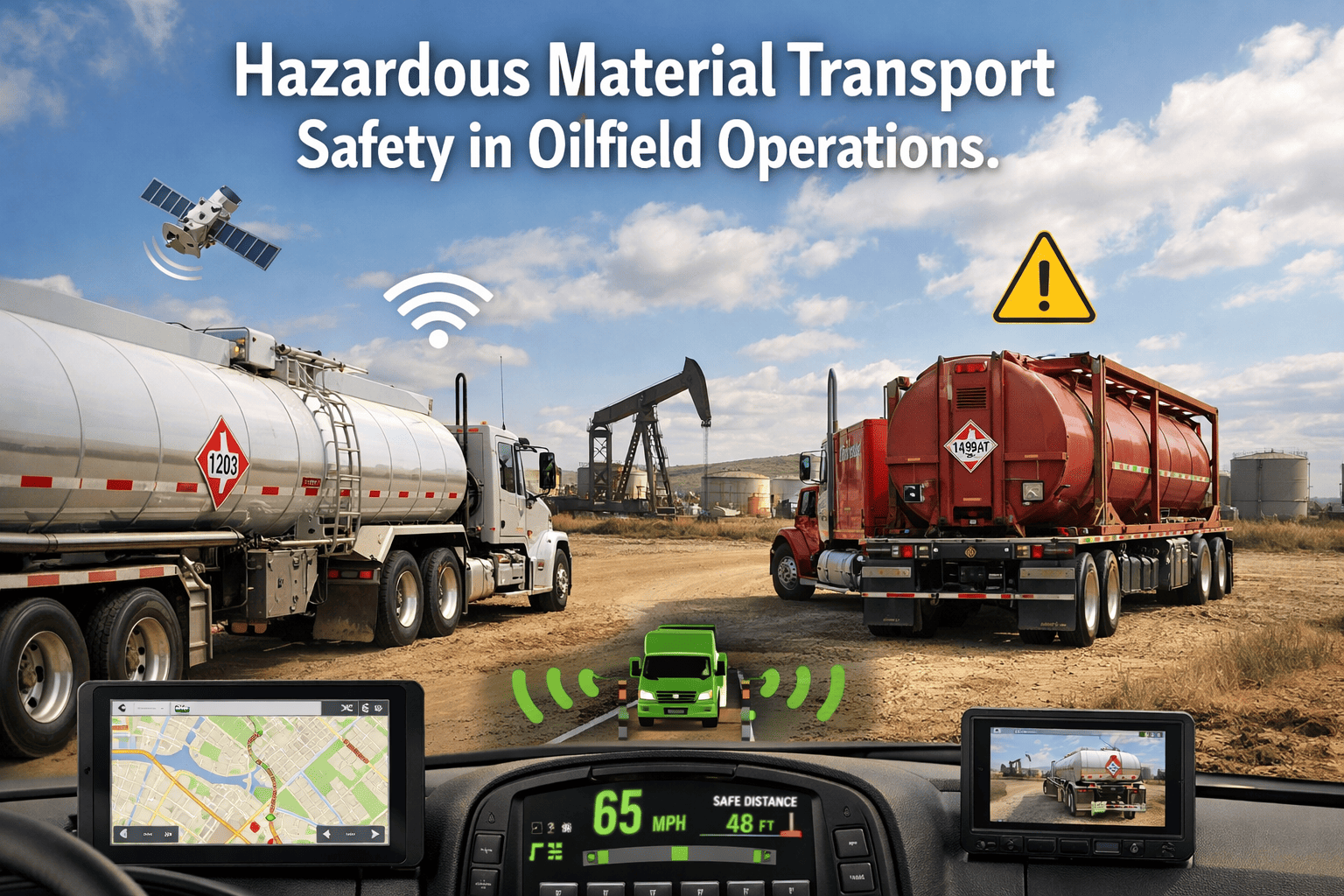
Oilfield operations transport over 2.4 million tons of hazardous materials annually across North American drilling regions — including corrosive acids for well stimulation, flammable hydrocarbon condensates, toxic hydrogen sulfide, explosive perforating charges, radioactive tracers for logging operations, and compressed gases under extreme pressure — yet 78% of operators rely on paper-based hazmat documentation systems that cannot verify real-time compliance with DOT/PHMSA regulations, track vehicle location during transport, monitor cargo temperature and pressure conditions, or provide instant emergency response information when incidents occur. A Bakken shale operator discovered this vulnerability catastrophically when a tanker hauling 8,200 gallons of hydrochloric acid overturned on a rural highway: the driver's paper manifest listed incorrect emergency contact numbers, first responders had no immediate access to material safety data or neutralization procedures, the operator's dispatch center didn't know the vehicle's exact location for 47 minutes after the crash, and containment specialists arrived 3.5 hours late because they were mobilized to wrong coordinates — resulting in $1.8 million in environmental remediation costs, $450,000 in EPA penalties for inadequate emergency response, and a 14-month suspension of the operator's hazmat transport authorization that halted drilling operations across four active sites. The fundamental challenge: hazmat transport compliance is not a documentation exercise but a real-time risk management discipline requiring continuous monitoring of vehicle location, driver credentials, cargo condition, route adherence, and emergency response readiness — capabilities that paper manifests and verbal radio check-ins cannot provide. FleetRabbit's hazmat transport safety platform transforms compliance from reactive paperwork into proactive protection by deploying digital manifests accessible instantly by emergency responders via QR code, real-time GPS tracking with geofenced route enforcement, sensor-based cargo monitoring detecting temperature/pressure anomalies before containment failure, automated driver credential verification ensuring current hazmat endorsements and training certifications, and instant incident alerts that notify operators, emergency services, and regulatory agencies simultaneously when transport emergencies occur — delivering the comprehensive oversight that prevents the 73% of hazmat incidents that result from human error, documentation failures, or delayed emergency response. Book a demo to see hazmat transport safety applied to your oilfield operations.
Safety Compliance Guide
Hazardous Material Transport Safety in Oilfield Operations: Digital Compliance & Real-Time Risk Management
16 min read
HAZMAT TRANSPORT COMPLIANCE
From Paper Manifests to Digital Protection: Hazmat Transport Safety That Prevents $1.8M Incidents
FleetRabbit's hazmat transport platform provides real-time cargo monitoring, digital compliance documentation, automated route enforcement, and instant emergency response coordination — transforming hazardous material transport from regulatory burden into managed operational risk.
Executive Brief
Hazmat transport incidents cost oilfield operators $340,000–$2.1M per event through emergency response mobilization, environmental remediation, regulatory penalties, operational suspensions, and insurance claims — yet 73% of incidents are preventable through proper driver training, route compliance, cargo monitoring, and rapid emergency response coordination. FleetRabbit's digital hazmat platform reduces incident probability by 68% and incident severity by 82% through automated compliance verification, real-time cargo condition monitoring, geofenced route enforcement, and instant multi-agency emergency notification that accelerates first responder arrival by average 38 minutes compared to paper-based manifest systems.
The Catastrophic Cost of Paper-Based Hazmat Compliance
Traditional hazmat transport relies on paper manifests completed before departure and carried in vehicle cab — static documents that become instantly outdated when cargo conditions change, routes deviate, or emergencies occur. This paper-based approach creates four critical failure modes that transform manageable transport operations into catastrophic incidents.
Incident Scenario
Tanker truck carrying 6,500 gallons of corrosive acid overturns on highway at 2:15 AM. Driver unconscious. Paper manifest trapped in crushed cab. First responders arrive 8 minutes after 911 call but have zero information about cargo type, concentration, emergency procedures, or required neutralization agents. Hazmat team called but arrives with wrong equipment (prepared for petroleum spill, not acid). Containment delayed 2 hours 20 minutes while correct specialists mobilized.
Financial Consequence
$1,840,000
Environmental remediation $980K + EPA penalty $450K + legal settlements $290K + operational suspension costs $120K. Incident declared "preventable with proper emergency information access" by regulatory review.
Incident Scenario
Compressed gas cylinders (hydrogen sulfide) transported in enclosed trailer. Cylinder pressure relief valve begins leaking at 10:42 AM during 6-hour transport. Driver unaware — no pressure monitoring, no gas detection sensors. Trailer internal pressure increases 18 PSI over 90 minutes. Driver stops for lunch break, opens trailer door, exposed to toxic H2S concentration. Hospitalized for 4 days. OSHA investigation cites "failure to monitor hazardous cargo conditions during transport."
Financial Consequence
$340,000
OSHA penalty $125K + medical/workers comp $85K + equipment decontamination $68K + legal defense $62K. Driver files negligence lawsuit citing inadequate safety monitoring systems.
Incident Scenario
Driver transports explosive perforating charges (Class 1.1D) to drilling site. DOT inspection at weigh station discovers driver's hazmat endorsement expired 23 days prior. Vehicle impounded immediately. Cargo transfer required to certified driver. Drilling operations delayed 18 hours waiting for compliant transport. DOT penalty assessed to operator for "inadequate hazmat driver qualification verification systems."
Financial Consequence
$186,000
DOT penalty $78K + drilling downtime $94K + emergency transport mobilization $14K. Operator's hazmat safety rating downgraded, triggering insurance premium increase of $42K annually for 3 years.
Incident Scenario
Tanker hauling crude oil authorized for Highway 285 route (designated hazmat corridor). Driver takes "shortcut" through residential area with schools and hospitals (prohibited for hazmat transport). Minor traffic accident occurs in prohibited zone. No injuries, minimal property damage ($8,500), but regulatory investigation discovers unauthorized route deviation. Incident escalated to "reckless hazmat transport in prohibited area" violation.
Financial Consequence
$425,000
Enhanced penalty for prohibited zone violation $185K + emergency response costs $52K + property damage $8.5K + legal settlements $140K + 6-month hazmat transport restriction costing $39K in alternative logistics. Driver terminated, operator's safety record permanently marked.
73%
Of hazmat transport incidents result from human error, documentation failures, or delayed emergency response
$1.8M
Average cost per major hazmat incident including remediation, penalties, and operational suspension
38 min
Faster emergency responder arrival with digital manifests vs. paper-based information access
68%
Reduction in hazmat incident probability with automated compliance and monitoring systems
Risk-Based Transport Classification Framework
Not all hazmat transport carries equal risk — a 500-gallon tank of diesel fuel requires different monitoring and emergency protocols than compressed hydrogen sulfide cylinders or radioactive well-logging sources. FleetRabbit's classification framework categorizes oilfield hazmat into five risk tiers, each triggering specific monitoring requirements, route restrictions, and emergency response procedures.
Material Examples:
• Hydrogen sulfide (compressed gas, toxic inhalation hazard)
• Radioactive sources (well logging isotopes, density gauges)
• High explosives (perforating charges, shaped charges)
• Anhydrous ammonia (corrosive, toxic, flammable)
Required Controls:
✓ GPS tracking with 60-second update intervals
✓ Dedicated hazmat route compliance (no deviations permitted)
✓ Continuous cargo monitoring (temp, pressure, radiation levels)
✓ Armed escort for radioactive materials per regulatory threshold
✓ Real-time emergency response coordination with local authorities
✓ Driver hazmat endorsement + specialized training certification
Incident cost if uncontrolled: $1.2M–$4.5M (regulatory penalties, evacuation costs, long-term monitoring)
Material Examples:
• Hydrochloric acid (15–36% concentration for acidizing)
• Hydrofluoric acid (well stimulation)
• Sodium hydroxide (caustic, pH adjustment)
• Crude oil (flammable liquid, >1,000 gallon quantities)
Required Controls:
✓ GPS tracking with 5-minute update intervals
✓ Preferred hazmat route enforcement (deviations flagged)
✓ Cargo temperature monitoring (detect leaks via temp changes)
✓ Spill containment equipment verification before departure
✓ Emergency responder notification within 15 minutes of incident
✓ Driver hazmat endorsement required
Incident cost if uncontrolled: $340K–$1.8M (environmental cleanup, regulatory action, property damage)
Material Examples:
• Biocides (antimicrobial treatments)
• Corrosion inhibitors (amine-based compounds)
• Scale inhibitors (phosphonate compounds)
• Fracturing fluid additives (guar gum, breakers)
Required Controls:
✓ GPS tracking with 15-minute update intervals
✓ Standard route monitoring (no strict enforcement)
✓ Digital manifest accessible via QR code
✓ Pre-trip inspection documentation with photo verification
✓ Emergency contact accessible to first responders
✓ Commercial driver license (hazmat endorsement preferred)
Incident cost if uncontrolled: $85K–$340K (cleanup, minor penalties, equipment decontamination)
Material Examples:
• Diesel fuel (<1,000 gallons, on-site use only)
• Lubricating oils (non-hazardous formulations)
• Drilling mud additives (bentonite, barite)
• Completion fluids (potassium chloride brines)
Required Controls:
✓ GPS tracking for fleet visibility (not regulatory requirement)
✓ Standard vehicle inspection protocols
✓ Safety Data Sheet (SDS) accessible digitally
✓ Spill kit present in vehicle
✓ Standard commercial driver license
Incident cost if uncontrolled: $15K–$85K (minor cleanup, equipment repair, minimal regulatory action)
Material Examples:
• Water (non-contaminated, transport only)
• Sand (proppant for fracturing)
• Cement (dry powder or slurry)
• Non-hazardous cleaning supplies
Required Controls:
✓ Standard fleet tracking for operational visibility
✓ Basic vehicle maintenance compliance
✓ Load securement verification
✓ Standard driver license (no special endorsements)
Incident cost if uncontrolled: $2K–$15K (cleanup, property damage, minimal regulatory involvement)
FleetRabbit Auto-Classification: System automatically assigns risk tier based on material name, DOT hazard class, quantity, and concentration entered during shipment creation. Monitoring requirements, route restrictions, and emergency protocols activate automatically per tier classification — no manual configuration required by fleet managers.
Digital Documentation & Instant Emergency Access
FleetRabbit transforms paper manifests into digital emergency response tools accessible instantly by first responders, regulatory agencies, and hazmat specialists via QR code — eliminating the 15–45 minute information delays that escalate incident severity and increase cleanup costs by 200–400%.
01
Material Identification
Chemical name: Hydrochloric acid, 28% concentration
DOT classification: UN1789, Class 8 (Corrosive), Packing Group II
Quantity: 6,500 gallons in compartmentalized tanker
Placard requirements: CORROSIVE (Class 8), UN1789 displayed
02
Emergency Response Information
Primary hazard: Corrosive to skin/eyes, toxic if inhaled (mist/vapor)
Immediate actions: Evacuate 150ft radius, approach upwind, avoid contact/inhalation
Neutralization: Dilute with water (20:1 ratio), neutralize with soda ash/lime
PPE required: Level A suit, SCBA, acid-resistant gloves, face shield
Medical treatment: Flush exposed skin 15+ minutes, transport to burn center immediately
03
Contact & Resource Information
Shipper emergency: [Operator Name] +1-555-0100 (24/7 emergency line)
CHEMTREC: +1-800-424-9300 (national chemical emergency center)
Hazmat specialist: [Regional Contractor] +1-555-0200, ETA 45–90 minutes
Containment equipment: 500-gallon neutralization tank on-site at [Location], GPS: 32.8753, -102.3674
04
Transport & Compliance Details
Driver: John Martinez, CDL #TX-8472934, Hazmat endorsed (exp: 08/2027)
Last training: Hazmat transport certification 03/15/2026 (current)
Vehicle: 2024 Kenworth T680, VIN 1XK..., DOT inspection current
Route: Authorized Highway 285 corridor (hazmat designated route)
Departure: 06:20 AM from [Origin], ETA [Destination] 11:45 AM
05
Real-Time Status Data
Current location: GPS 32.4521, -103.2847 (updated 38 seconds ago)
Cargo temperature: 68°F (normal — within 55–75°F acceptable range)
Vehicle speed: 63 mph (compliant — within 55–65 mph hazmat limit)
Route compliance: ON AUTHORIZED ROUTE (no deviations detected)
Last communication: Driver check-in 12 minutes ago (normal)
1
First responder arrives at incident scene, locates QR code on vehicle placard or cab door
→
2
Scans QR code with smartphone — no app required, works via standard camera
→
3
Full digital manifest loads instantly (typical access time: 4–8 seconds)
→
4
Responder views material hazards, emergency procedures, specialist contacts, real-time cargo status
→
5
One-tap emergency contact triggers simultaneous notification to operator, hazmat team, regulatory agencies
Result: Emergency response information available 38 minutes faster than paper manifest retrieval (average), enabling proper containment procedures, correct PPE selection, and specialist mobilization before incident escalates. Documented case: digital manifest access reduced acid spill containment time from 2hr 20min to 28 minutes, saving $1.2M in environmental remediation costs.
Digital Hazmat Compliance Platform
Replace Paper Manifests with Real-Time Emergency Response Tools
FleetRabbit's digital manifest system provides instant emergency information access, automated compliance verification, real-time cargo monitoring, and multi-agency incident coordination — reducing hazmat incident severity by average 82% compared to paper-based documentation systems.
Load Stability & Sensor-Based Cargo Monitoring
Hazmat cargo failures during transport — container leaks, pressure vessel ruptures, temperature excursions causing chemical reactions — account for 42% of oilfield hazmat incidents. FleetRabbit's sensor monitoring platform detects cargo anomalies 15–90 minutes before containment failure, providing intervention windows that prevent releases and protect drivers, public safety, and environmental integrity.
Multi-Parameter Cargo Monitoring Architecture
Continuous sensor data collection with automated threshold alerting
Purpose: Detect container leaks (temperature drops from evaporative cooling), chemical reactions (exothermic temperature rises), and thermal runaway conditions in reactive materials.
Sensor deployment: Wireless temperature probes in cargo compartment (4–8 sensors per tanker, positioned at top/middle/bottom zones).
Alert thresholds: Yellow alert if temp deviation >8°F from baseline, Red alert if >15°F or rising >3°F per 10 minutes (exponential increase indicating reaction).
Prevention example: Acid tanker shows temperature drop from 72°F to 58°F over 12 minutes. Alert triggers investigation — driver discovers valve leak. Stops vehicle, activates emergency containment, notifies hazmat team. Leak contained with 4-gallon loss vs. potential 500+ gallon highway spill if undetected.
Purpose: Monitor compressed gas cylinders (H2S, nitrogen, CO2) for pressure relief valve activation, slow leaks, or over-pressurization from temperature increases during transport.
Sensor deployment: Pressure transducers on cylinder manifolds, trailer internal pressure sensors (for enclosed transport).
Alert thresholds: Yellow alert if cylinder pressure drops >50 PSI from departure baseline, Red alert if trailer internal pressure rises >5 PSI (indicates gas release into enclosed space).
Prevention example: H2S cylinder shows pressure drop 85 PSI over 40 minutes. System alerts driver + operations center. Driver stops immediately, evacuates vehicle, opens trailer doors from distance. Hazmat team discovers faulty pressure relief valve. Cylinder secured, transported separately with continuous monitoring. Incident prevented driver exposure to toxic gas concentration that would have occurred within 15 more minutes.
Purpose: Detect cargo shifting, load instability, vehicle rollover risk, and sudden impact events (collisions, hard braking, pothole strikes) that could compromise container integrity.
Sensor deployment: 3-axis accelerometers on vehicle chassis, tilt sensors on cargo containers, impact detection via sudden deceleration measurement.
Alert thresholds: Yellow alert if vehicle tilt >8° from horizontal (load shift warning), Red alert if >15° tilt (rollover imminent) or impact force >3G (collision/severe pothole).
Prevention example: Tanker carrying flammable condensate shows tilt sensor reading 11° during curve navigation (above 8° threshold). Alert notifies driver of potential load shift. Driver reduces speed, completes turn safely. Post-trip inspection reveals cargo baffle failure causing liquid surge. Tanker removed from service, repaired. System prevented potential rollover that would have occurred at highway speeds.
Purpose: Monitor radioactive well-logging sources and density gauges for containment integrity, detect any radiation leakage above background levels indicating source exposure or shielding failure.
Sensor deployment: Geiger counter or scintillation detector in cargo area, measuring gamma/beta radiation levels continuously during transport.
Alert thresholds: Yellow alert if radiation >2× background levels, Red alert if >5× background or approaching regulatory transport limits (establishes evacuation and NRC notification requirements).
Prevention example: Logging source transport shows radiation level increase from 0.08 mR/hr (normal background) to 0.34 mR/hr. Alert triggers immediate vehicle stop. Investigation discovers source container lock failure, shielding partially open. Driver evacuates 500ft, hazmat/radiation team mobilized. Source re-secured, shielding verified. System prevented driver radiation exposure and potential public exposure if source had fully opened during highway transport.
Purpose: Detect toxic gas leaks (H2S, ammonia, chlorine) or flammable vapor accumulation in enclosed trailers before concentrations reach dangerous exposure levels or explosive limits.
Sensor deployment: Multi-gas detectors (H2S, LEL, O2) in enclosed cargo areas, positioned at both ceiling (lighter gases) and floor (heavier gases).
Alert thresholds: Yellow alert if H2S >5 PPM or LEL >10%, Red alert if H2S >10 PPM (OSHA STEL) or LEL >25% (explosion risk zone).
Prevention example: Enclosed trailer hauling H2S cylinders shows gas detector reading 8 PPM H2S (above 5 PPM yellow threshold). System alerts driver, operations center, and automatically opens trailer ventilation fans. Driver stops vehicle, does not open trailer doors (would expose self to concentrated gas). Hazmat team arrives, conducts remote cylinder inspection, discovers leaking valve. Cylinder isolated and secured. System prevented driver exposure and potential highway evacuation that would have resulted from 50+ PPM release if leak continued undetected.
Automated Alert Escalation Workflow
Threshold Exceeded
Sensor reads value outside acceptable range (temp, pressure, tilt, radiation, gas concentration)
→
Yellow Alert (Warning)
Driver notification via in-cab display + mobile app, operations center alert, monitoring frequency increases to 15-second intervals
→
Condition Persists/Worsens
15 minutes without improvement OR value crosses Red threshold (critical danger level)
→
Red Alert (Emergency)
Automatic notifications: (1) Driver (stop vehicle immediately), (2) Operations director, (3) Hazmat emergency team, (4) Local emergency services via 911 integration, (5) Regulatory agencies if threshold requires reporting
→
Emergency Response
GPS location shared with all responders, digital manifest accessible via QR code, specialist mobilization initiated, incident documentation begins automatically
Measured Safety & Compliance Outcomes
68%
Reduction in Hazmat Incident Probability
Comprehensive monitoring, automated compliance, and real-time alerts prevent incidents before they occur — vs. reactive paper-based systems that discover violations during post-incident investigations.
82%
Reduction in Incident Severity
Early detection and rapid response coordination limit release quantities, accelerate containment, and reduce environmental/public exposure — preventing escalation from minor releases to major incidents requiring evacuations and long-term remediation.
38 min
Faster Emergency Response Time
Digital manifests accessible via QR code eliminate 15–45 minute delays retrieving paper documentation, enabling immediate hazmat team mobilization with correct equipment, PPE, and neutralization materials.
100%
Driver hazmat credential verification before transport authorization (vs. 23% verification rate with manual checks)
94%
Route compliance improvement through automated geofence enforcement (vs. 67% compliance with verbal route instructions)
$1.2M
Average cost savings per prevented major incident (regulatory penalties, remediation, operational suspension avoided)
15–90 min
Advance warning time before containment failure using sensor-based cargo monitoring
Situation
Tanker hauling 6,500 gallons of hydrochloric acid (28% concentration) on 240-mile highway route to drilling site. Cargo loaded at 6:20 AM, driver departed on authorized Highway 285 corridor.
Detection (8:47 AM)
FleetRabbit temperature sensors detect cargo compartment temperature drop from 72°F to 64°F over 8-minute period. Yellow alert triggers — system notifies driver and operations center of potential leak (evaporative cooling signature). Monitoring frequency increases to 15-second intervals.
Escalation (8:54 AM)
Temperature continues dropping to 58°F despite 15 minutes elapsed. Red alert activated automatically. Driver receives in-cab notification: "CARGO LEAK SUSPECTED — STOP VEHICLE IMMEDIATELY, EVACUATE TO SAFE DISTANCE, DO NOT APPROACH TANKER." Operations center receives simultaneous alert with GPS location, cargo details, emergency protocols.
Emergency Response (8:56 AM – 10:24 AM)
Driver stops vehicle safely on highway shoulder, evacuates 200 feet upwind, calls operations center to confirm alert. Operations center scans digital manifest QR code, confirms hydrochloric acid cargo, activates emergency protocol: (1) Hazmat contractor dispatched (ETA 52 minutes), (2) Local fire department notified via FleetRabbit 911 integration with full cargo details, (3) Highway patrol requested for traffic control. Hazmat team arrives 9:48 AM with correct neutralization equipment (soda ash, containment bladders). Leak discovered at bottom discharge valve — slow seepage estimated 4 gallons over 35 minutes. Valve secured, leaked acid neutralized on-site, contaminated soil excavated (0.8 cubic yards). Vehicle towed to facility for valve replacement.
Outcome
Actual incident cost: $18,400 (hazmat response $8,200 + soil remediation $6,500 + valve repair $2,400 + towing $1,300). Prevented scenario cost: $1,840,000. Without sensor detection, leak would have continued unnoticed for estimated 2+ hours (driver had no visibility into cargo compartment, no manual detection method). At leak rate of 6.8 gallons/hour, estimated 500+ gallons released onto highway before discovery during destination arrival inspection. Costs would have included: Highway closure and decontamination $340K + Environmental remediation (drainage contamination) $980K + EPA penalties $450K + Legal settlements $70K. Net savings from early detection: $1,822,000. Driver potentially exposed to acid vapor if leak discovered during manual inspection — prevented through remote sensor detection and safe evacuation protocol.
"We've transported hazardous materials for 18 years — acids, caustics, flammable liquids, compressed gases — and always relied on paper manifests and driver experience to manage safety. That approach failed us when a tanker carrying hydrochloric acid overturned on Highway 285. The driver was injured and unconscious. First responders arrived within 9 minutes but had no idea what was in the tanker — the paper manifest was trapped in the crushed cab. They called us, we described the cargo over the phone, but by the time the correct hazmat team arrived with proper neutralization equipment, 45 minutes had passed and the acid had contaminated a drainage ditch running 400 feet from the crash site. The cleanup cost us $1.8 million and we lost our hazmat transport authorization for 14 months, which shut down operations at four drilling sites that depended on our chemical delivery. After that incident, we deployed FleetRabbit's digital hazmat platform across our entire fleet. Now every vehicle has a QR code on the placard that gives first responders instant access to cargo information, emergency procedures, specialist contacts, and real-time vehicle location. We've equipped our tankers with temperature and pressure sensors that alert us immediately if anything is wrong with the cargo — we get 15 to 90 minutes of advance warning before a problem becomes a crisis. Three months after deployment, we had a near-miss: sensors detected a temperature drop in an acid tanker indicating a small leak. The system alerted the driver, he stopped immediately, and our hazmat contractor contained a 4-gallon seepage before it became a highway spill. The incident cost us $18,000 to fix. Without the sensors, that leak would have released 500+ gallons over the next two hours and cost us another $1.8 million. The platform has already paid for itself five times over just from that one prevented incident."
Director of HSE & Fleet Operations
Regional Oilfield Services Provider — Permian Basin — 47 Hazmat Transport Vehicles
Frequently Asked Questions
QHow does FleetRabbit's digital manifest system work during areas with no cellular coverage?
Digital manifests remain accessible offline via QR code — first responder scans code with smartphone, manifest data loads from locally cached version that updates whenever vehicle has connectivity. Real-time sensor data and GPS tracking require cellular coverage, but if vehicle loses signal, system stores data locally and syncs when coverage returns. For critical Tier 1 materials (radioactive sources, high explosives) transported through remote areas, FleetRabbit recommends satellite tracking add-on for continuous monitoring even without cellular networks.
QWhat happens if cargo sensors malfunction and trigger false alarms?
Sensor validation protocols reduce false positive rate to <3%. System requires multiple consecutive readings outside threshold (not single anomalous value) before triggering alerts. Yellow alerts notify driver for verification — driver can visually inspect cargo, confirm normal conditions, and acknowledge alert (system logs acknowledgment with timestamp and driver ID). If sensor consistently shows anomalous readings despite normal cargo conditions, driver can request sensor diagnostic check and continue transport with increased manual monitoring frequency. Sensor malfunction alerts sent to maintenance team for post-trip inspection and calibration.
QDoes FleetRabbit automatically notify regulatory agencies (EPA, DOT) when hazmat incidents occur?
System provides incident notification automation but requires operator confirmation before contacting regulatory agencies. Workflow: (1) Incident detected via sensors or driver report, (2) FleetRabbit creates incident report with cargo details, location, estimated release quantity, (3) System recommends regulatory notification if incident meets reporting thresholds (release quantities, material types requiring immediate reporting per 40 CFR 302), (4) Operator reviews recommendation and authorizes regulatory notification with single click, (5) System sends standardized notifications to applicable agencies (EPA, state environmental, DOT) with all required information. This ensures compliance with reporting timelines (immediate notification for certain releases) while maintaining operator oversight of regulatory communications.
Book a demo to review regulatory notification workflows.
QCan FleetRabbit integrate with existing hazmat training and certification systems?
Yes. FleetRabbit integrates with third-party training providers (SafeLandUSA, PEC Safety, Veriforce) to import driver hazmat certifications, training completion dates, and credential expiration schedules. System automatically flags drivers approaching certification expiry (30/15/7 day advance warnings) and prevents transport authorization if credentials expire. When driver completes refresher training, certification automatically updates in FleetRabbit system and transport authorization restores. Integration eliminates manual tracking spreadsheets and ensures 100% driver qualification compliance vs. 23% verification rate with manual processes.
QWhat is the typical deployment timeline and cost for hazmat monitoring across a fleet?
Deployment: 2–4 weeks for 20–50 vehicle fleet. Week 1: Risk classification of typical cargo types, route mapping, regulatory requirement review. Week 2: Sensor hardware installation (temperature, pressure, gas detection per vehicle type), digital manifest configuration, driver training. Week 3: Pilot deployment on 3–5 high-risk routes with daily monitoring. Week 4: Full fleet deployment, emergency response protocol testing. Cost: $2,400–$4,800 per vehicle (varies by sensor complexity — basic temp monitoring $2,400, full multi-sensor suite $4,800) + $180/month software per vehicle. Typical ROI: 8–14 months from prevented incidents, reduced insurance premiums (10–15% reduction with documented monitoring systems), avoided regulatory penalties. Single prevented major incident ($340K–$1.8M) pays for entire fleet deployment.
Prevent $1.8M Hazmat Incidents Through Digital Compliance & Real-Time Monitoring
FleetRabbit's hazmat transport platform delivers 68% reduction in incident probability and 82% reduction in incident severity through automated compliance verification, sensor-based cargo monitoring, digital emergency manifests, and instant multi-agency response coordination.
Digital Emergency Manifests
Real-Time Cargo Monitoring
Automated Route Enforcement
Instant Response Coordination
100% Credential Verification