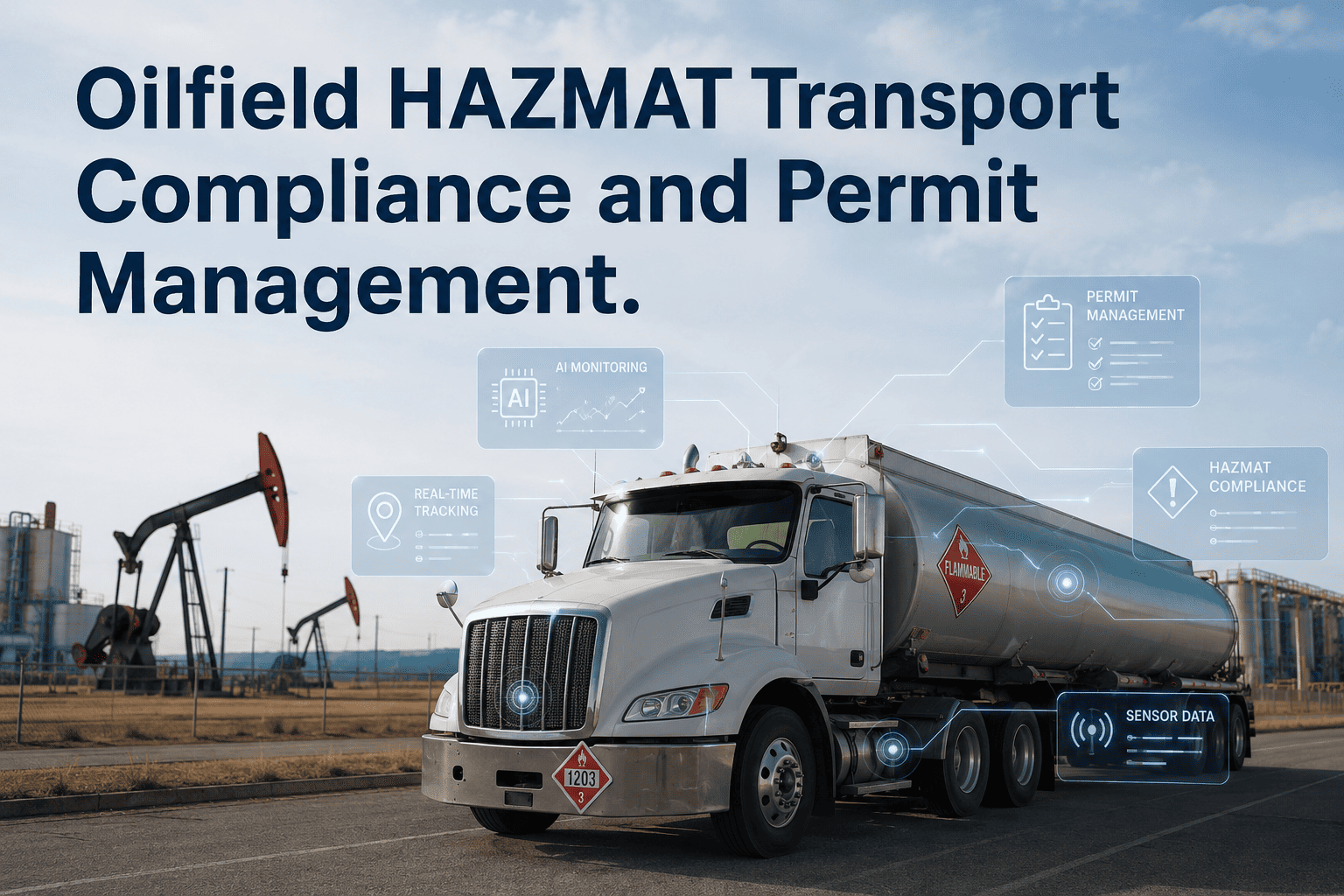
Oilfield HAZMAT Transport Compliance and Permit Management

kioilaos-best-oil-gas-fleet-management-software

Oilfield hazardous material transport operations sit at the intersection of PHMSA pipeline and hazardous materials regulations, DOT FMCSA commercial vehicle compliance, EPA environmental protection requirements, and state-level permit authorities — creating a compliance matrix that paper-based fleet management systems cannot reliably track across dispersed oilfield transport fleets. A single HAZMAT transport violation can result in civil penalties up to $84,425 per day per violation under 49 U.S.C. 5123, with willful violations reaching $196,992 per day. Beyond financial exposure, HAZMAT citation patterns trigger FMCSA compliance reviews that downgrade carrier safety ratings, restrict operational capacity, and disqualify oilfield service contractors from approved vendor lists maintained by major operators. Fleet managers overseeing fleets transporting crude oil, produced water, drilling fluids, completion chemicals, compressed gases, and other regulated materials across multiple jurisdictions require a centralized compliance platform that tracks driver hazmat certifications, shipping document currency, placard requirements, route permits, and vehicle condition simultaneously — capabilities that define FleetRabbit's oilfield hazmat transport management system. Book a live demo to see how FleetRabbit manages oilfield HAZMAT transport compliance across your entire fleet.


2026 HAZMAT COMPLIANCE EDITION DOT · PHMSA · EPA · FMCSA

Oilfield HAZMAT Transport Compliance and Permit Management

A complete compliance framework for fleet managers and operations executives overseeing hazardous material transport in oilfield and midstream operations — covering driver certification tracking, shipping document management, route permit compliance, placard verification, and real-time incident escalation through FleetRabbit's digital fleet management platform.

HAZMAT Compliance Risk Without Digital Management
$84K
Per-day per-violation civil penalty under 49 U.S.C. 5123
$197K
Willful violation daily penalty — PHMSA maximum
40–60 hrs
Manual audit preparation time eliminated by FleetRabbit
2 hrs
Compliance report generation with FleetRabbit digital records
Deploy Digital HAZMAT Compliance

The Multi-Agency HAZMAT Compliance Framework for Oilfield Transport Operations

Oilfield HAZMAT transport compliance spans four primary federal regulatory authorities with overlapping jurisdiction over different aspects of the same transport operation. PHMSA administers the Hazardous Materials Regulations under 49 CFR Parts 100–185, governing hazmat classification, packaging, marking, labeling, placarding, shipping documentation, and employee training requirements for all modes of transport. DOT FMCSA overlays commercial vehicle requirements under 49 CFR Parts 380–399 adding driver qualification, hours of service, vehicle inspection, and carrier registration requirements specifically for highway HAZMAT transport. EPA administers the Resource Conservation and Recovery Act requirements for hazardous waste transport under 40 CFR Parts 262–263, requiring EPA identification numbers, uniform hazardous waste manifests, and licensed transporter registration for regulated waste movements. State DOT and environmental agencies add route permits, access restrictions, and state-specific manifest requirements creating a compliance matrix that changes by commodity, quantity, route, and jurisdiction.

For oilfield transport fleets hauling crude oil under UN3494, produced water with NORM content, hydraulic fracturing chemicals, completion acid systems, compressed natural gas, hydrogen sulfide-containing streams, or Class 3 flammable liquid blends — every load triggers a specific intersection of these regulatory frameworks that must be verified before the vehicle departs the wellsite. Manual compliance verification relying on driver knowledge, paper checklists, and supervisor spot checks creates systematic gaps that surface as FMCSA roadside violations, PHMSA shipping paper deficiencies, and EPA manifest discrepancies — each carrying independent penalty exposure and safety rating consequences.

PHMSA
49 CFR Parts 100–185
Classification, packaging, marking, labeling, placarding, shipping documentation, and employee hazmat training requirements
FMCSA
49 CFR Parts 380–399
Driver qualification, CDL-H endorsement, hours of service, vehicle inspection, and motor carrier registration for highway hazmat
EPA RCRA
40 CFR Parts 262–263
Hazardous waste transporter registration, EPA ID numbers, uniform hazardous waste manifests, and release response requirements
State DOT / DEQ
Jurisdiction-Specific
Route permits, access restrictions, state manifest supplements, and enhanced reporting for radioactive or extremely hazardous substances
FleetRabbit centralizes HAZMAT driver certifications, shipping document tracking, route permits, and vehicle compliance records into one digital platform — giving fleet managers real-time visibility into compliance status before every dispatch. Schedule a demo to see HAZMAT compliance management configured for your commodity mix and fleet profile.
01

HAZMAT Driver Certification and Training Compliance

49 CFR Part 172 Subpart H and 49 CFR Part 383 require hazmat employees to receive function-specific training and testing before performing regulated HAZMAT transport functions, with recurrent training required every three years. CDL-H endorsement requires written knowledge testing and FBI background check completion under the USA PATRIOT Act security threat assessment program.

49 CFR 172.700 — Hazmat Employee Training 49 CFR 383.93 — CDL Hazmat Endorsement 49 CFR 1572 — TSA Background Check PHMSA HMR Function-Specific Training
CDL Hazmat Endorsement Requirements
HAZMAT Training Documentation — 49 CFR 172 Subpart H
How FleetRabbit Manages Driver HAZMAT Certification Compliance
CDL-H Expiration Tracking
Individual driver certification expiration dates tracked with automated alerts to fleet managers 60 and 30 days before CDL-H, medical certificate, and TSA STA renewal deadlines — preventing dispatch of non-current certified drivers
Training Record Repository
PHMSA-compliant training records stored per individual employee with function-specific training categories, completion dates, trainer identification, and 3-year recurrent training scheduling — satisfying 49 CFR 172.704 documentation requirements
Dispatch Authorization Control
Driver certification status verified against load hazmat class before dispatch authorization — drivers with expired CDL-H or overdue hazmat training cannot be assigned to regulated commodity loads without supervisor override documentation
Compliance Dashboard Visibility
Fleet-wide driver certification status visible on supervisor dashboard — operations executives can verify 100% driver certification compliance across entire fleet without individual record review
02

Shipping Document Compliance — 49 CFR Part 172 Subpart C

PHMSA shipping papers must accompany every regulated hazardous material shipment in highway transport, providing emergency responders and enforcement personnel with commodity identification, quantity, emergency contact, and shipper certification information. Deficient shipping papers are among the most frequently cited HAZMAT violations during DOT roadside inspections of oilfield transport vehicles.

49 CFR 172.200 — Shipping Paper Requirements 49 CFR 172.202 — Hazardous Material Description 49 CFR 172.604 — Emergency Response Information EPA 40 CFR 262 — Uniform Hazardous Waste Manifest
Shipping Paper Content Requirements
Shipper Certification and Placement Requirements
How FleetRabbit Manages Shipping Document Compliance
Digital Shipping Paper Templates
Commodity-specific shipping paper templates pre-populated with correct proper shipping names, hazard classes, and UN numbers from the 49 CFR 172.101 table — preventing description errors that generate PHMSA violations at roadside inspections
Manifest Retention Management
Shipping papers and manifests stored digitally with load-specific metadata enabling retrieval within minutes for PHMSA, EPA, or client audit requests spanning prior 375-day retention requirement periods
Pre-Departure Document Verification
Pre-trip checklist enforces shipping paper completeness verification before vehicle departure — mandatory confirmation that shipping papers are present, accessible, and load-specific before dispatch authorization granted
Emergency Contact Verification
Emergency response telephone number currency tracked per commodity type — expired or discontinued emergency contacts flagged before load documentation generated, preventing 24-hour unstaffed number violations

Complete HAZMAT Compliance Visibility Across Every Vehicle, Driver, and Route

Operations executives and fleet directors managing oilfield HAZMAT transport programs cannot rely on driver self-certification and paper records to maintain the compliance posture required by PHMSA, FMCSA, and major operator prequalification programs. FleetRabbit's digital compliance platform delivers real-time visibility into driver certification status, load document currency, vehicle inspection completion, and route permit validity across your entire fleet — from one dashboard, accessible from any device, without manual data aggregation from field personnel.

When a FMCSA compliance review is initiated, a DOT roadside inspection escalates, or a major operator requests HAZMAT transport compliance documentation before contract renewal — FleetRabbit generates complete compliance packages covering driver qualification records, training documentation, shipping paper history, vehicle inspection records, and incident reports within 2 hours, versus the 40–60 hours consumed by manual paper records assembly.

Book an Executive Platform Demo
95%
Reduction in compliance report preparation time
100%
Driver certification status visibility across fleet
2 hrs
PHMSA or FMCSA audit package generation
3–4 wks
Full fleet deployment for 50–200 vehicles
Real-time driver certification expiration alerts
GPS-verified pre-trip inspection records
Automated defect escalation to maintenance coordinators
Route permit validity monitoring by jurisdiction
One-click regulatory compliance audit packages
Offline mobile app for remote wellsite operations
03

HAZMAT Vehicle Equipment and Inspection Compliance

Vehicles transporting HAZMAT commodities must comply with specialized equipment requirements under 49 CFR Part 393 and 397 beyond standard CMV inspection requirements — including cargo tank inspection certifications, emergency shutoff systems, bonding and grounding equipment, fire extinguishers, and hazmat-specific placard mounting systems verified before each departure.

49 CFR 393 — Parts and Accessories 49 CFR 397 — HAZMAT Vehicle Operation 49 CFR 178 — Cargo Tank Standards DOT SP-MC 306/331/338/341 — Cargo Tank Design
Cargo Tank and Containment Equipment
HAZMAT Vehicle Safety Equipment
How FleetRabbit Manages HAZMAT Vehicle Compliance
Cargo Tank Certification Tracking
Annual and periodic cargo tank inspection certification dates tracked per tank serial number with automated alerts before expiration — prevents operation of non-current certified cargo tanks on public roads
HAZMAT Pre-Trip Checklists
Commodity-specific pre-trip inspection checklists include HAZMAT equipment verification items with mandatory photographic documentation of placards, cargo tank condition, and safety equipment presence
Defect Escalation for Critical HAZMAT Items
Emergency shutoff, cargo tank integrity, and placard deficiencies identified during inspection trigger immediate supervisor notification and automatic vehicle dispatch block — preventing departure with uncorrected HAZMAT equipment violations
PRV and Equipment Recertification Scheduling
Pressure relief valve and cargo tank inspection recertification intervals managed by FleetRabbit scheduling module with advance notification enabling planned maintenance rather than compliance deadline emergencies
Digital HAZMAT compliance management eliminates the documentation gaps that surface as PHMSA citations, FMCSA safety rating downgrades, and client vendor disqualifications. FleetRabbit tracks every certification, document, and inspection interval in one platform — giving fleet managers the real-time compliance visibility that paper systems cannot provide. Start your free trial and deploy HAZMAT compliance management across your oilfield fleet today.
04

HAZMAT Route Permits and Operational Restrictions — 49 CFR Part 397

Federal and state regulations restrict routing of certain HAZMAT commodities through tunnels, near densely populated areas, and over specific bridge and road types. Oilfield transport fleets moving crude oil, flammable gases, explosives, and radioactively contaminated materials must comply with routing regulations that change by jurisdiction — creating permit tracking requirements that manual processes cannot reliably manage across multi-state oilfield operations.

49 CFR 397.67 — Federal Highway Route Controls 49 CFR 397.101 — Preferred Routes 49 CFR 397.103 — State Routing Designations PHMSA HMIS Route Reporting
Federal and State Route Compliance
Oversize and Overweight HAZMAT Load Permits
How FleetRabbit Manages Route Permit Compliance
Permit Expiration Tracking
State and federal route permits tracked per vehicle and jurisdiction with expiration alerts ensuring permits are renewed before operational deadlines rather than discovered expired during a load movement
Commodity-Route Compliance Verification
Pre-dispatch verification workflow confirms route permit validity for load commodity and origin-destination pair before driver departure authorization — systematic check that driver knowledge alone cannot reliably provide
Multi-Jurisdiction Permit Repository
All state OS/OW, HAZMAT route, and special commodity permits stored in centralized digital repository accessible to dispatch and drivers — eliminates permit document management from individual driver responsibility
05

HAZMAT Incident Reporting and Emergency Response Compliance

PHMSA requires immediate telephonic notification and written follow-up reports for HAZMAT incidents meeting reporting thresholds under 49 CFR 171.15 and 171.16. Failure to report qualifying incidents within required timeframes carries independent penalty exposure separate from the underlying release event — making incident response workflow management a critical compliance function for oilfield HAZMAT transport operations.

PHMSA Incident Notification Requirements — 49 CFR 171.15
Written Incident Report — 49 CFR 171.16 DOT Form F 5800.1
How FleetRabbit Manages HAZMAT Incident Response Compliance
Mobile Incident Report Initiation
Driver can initiate HAZMAT incident report from mobile app at scene capturing incident details, photographic evidence, GPS coordinates, and timeline documentation while response actions are still in progress
Regulatory Notification Deadline Tracking
Incident report workflow automatically tracks 30-day written report deadline with escalating alerts to compliance manager and fleet director when submission deadline approaches
Corrective Action Workflow
Post-incident corrective action items assigned, tracked, and closed through FleetRabbit workflow with documentation satisfying PHMSA enforcement expectation for systemic root cause correction beyond individual driver disciplinary action
06

FMCSA Carrier Safety Rating and HAZMAT Program Compliance

FMCSA Compliance, Safety, and Accountability scores in the Hazardous Materials BASIC category aggregate roadside inspection HAZMAT violations into a carrier safety profile that affects insurance rates, contract eligibility with major oil and gas operators, and triggers compliance review interventions when percentile scores exceed alert thresholds.

CSA Hazardous Materials BASIC Management
Carrier Registration and Operating Authority
How FleetRabbit Protects Carrier Safety Ratings
Violation Pattern Analysis
Roadside inspection violations entered into FleetRabbit with automatic categorization by BASIC category — recurring HAZMAT violation patterns trigger corrective action assignments before CSA score impacts reach alert thresholds
Operating Authority Currency Tracking
USDOT registration, operating authority, and insurance filing expiration dates tracked with advance alerts — preventing unintentional authority lapse from insurance renewal timing gaps
Compliance Documentation for CSA Defense
Complete DVIR, driver certification, and shipping paper records in FleetRabbit provide evidence base for DataQs challenges when roadside inspection citations are disputed — reducing erroneous violation scoring impact on HAZMAT BASIC

How FleetRabbit Transforms Oilfield HAZMAT Transport Compliance Management


Mobile-First Compliance Execution

Drivers and fleet supervisors access all compliance functions through the FleetRabbit mobile app on smartphones or tablets. Pre-trip HAZMAT checklists, shipping paper verification, placard confirmation, and incident reporting are all completed at the vehicle — not after the fact in an office. Offline operation ensures full functionality at remote wellsites beyond cellular coverage with automatic sync when connectivity is restored.


Centralized Certification and Permit Repository

All driver CDL-H certifications, hazmat training records, TSA STA documentation, cargo tank inspection certificates, route permits, and carrier registration documents are stored in one platform with expiration tracking, advance alerts, and instant retrieval for audit or enforcement requests. Fleet managers see the complete compliance posture of their entire driver population and vehicle fleet from one dashboard.


Automated Compliance Escalation

Critical compliance gaps — expired CDL-H endorsements, overdue cargo tank inspections, invalid route permits — trigger automated notifications to fleet managers and operations supervisors with sufficient advance notice for corrective action before operational impact. Vehicle dispatch blocking prevents assignment of non-compliant drivers or vehicles to HAZMAT loads without documented supervisor authorization override.


Regulatory Audit Package Generation

One-click export generates complete HAZMAT compliance packages for PHMSA, FMCSA, EPA, or major operator audit requests — compiling driver qualification files, training records, shipping paper history, vehicle inspection records, corrective action documentation, and incident reports into organized packages in under 2 hours. Versus 40–60 hours of manual paper records assembly from dispersed field locations.


GPS-Verified Tamper-Evident Records

Every inspection, shipping paper verification, and compliance check includes GPS coordinates and timestamps proving execution occurred at the vehicle location — not backdated from a remote office. This evidence quality is critical for DataQs challenges of disputed roadside inspection violations and PHMSA enforcement defense when the completeness of compliance program execution is questioned.


Customizable for Any Commodity Mix

FleetRabbit's checklist configuration supports commodity-specific compliance requirements for crude oil, produced water, completion chemicals, compressed gases, TENORM waste, and Class 3 flammable blends. Custom items for client-specific HAZMAT transport requirements from major operators are integrated alongside standard regulatory requirements — one platform managing all compliance obligations simultaneously.

FleetRabbit HAZMAT Compliance Platform Deployment Across Your Oilfield Fleet

Week 1

Compliance Configuration and Data Migration

FleetRabbit implementation team configures commodity-specific HAZMAT checklists, loads current driver certification and training records, enters cargo tank certification dates, uploads existing route permits, and establishes expiration alert thresholds based on your fleet profile and regulatory obligations. Standard PHMSA, FMCSA, EPA, and state HAZMAT compliance templates are active immediately. Custom items for specific client HAZMAT transport requirements are added during configuration review.

Deliverable: Platform configured, existing compliance records loaded, alert thresholds set, dispatch integration active
Week 2

Driver and Dispatcher Training

All CDL-H drivers receive mobile app training covering HAZMAT pre-trip inspection execution, shipping paper verification, placard confirmation, incident report initiation, and offline operation procedures. Dispatch staff and fleet supervisors are trained on the compliance dashboard, certification expiration monitoring, route permit verification workflows, and regulatory audit package generation. Pilot validation with representative load types confirms checklist completeness before full fleet activation.

Deliverable: All drivers and dispatch staff trained, pilot validation completed with actual commodity loads
Week 3–4

Full Fleet Activation and Compliance Monitoring

Digital HAZMAT compliance system activated across all vehicles and drivers. Real-time compliance dashboard provides fleet management and operations executives immediate visibility into certification status, inspection completion rates, open violations, and approaching permit expirations. First complete HAZMAT compliance audit packages generated and validated against PHMSA and FMCSA documentation requirements before a live regulatory interaction demands them.

Deliverable: Full fleet active, compliance monitoring operational, first audit packages validated, baseline metrics established

Common Questions from Oilfield Fleet Managers and HAZMAT Compliance Coordinators

How does FleetRabbit track HAZMAT driver certifications across a fleet where drivers may carry multiple endorsements with different expiration dates?
FleetRabbit tracks each certification category independently per driver — CDL-H endorsement, medical certificate, TSA STA, hazmat general awareness training, function-specific training, and any client-required certifications all have individual expiration dates with separate alert timelines. The fleet dashboard displays each driver's current certification status across all required categories, with color-coded status indicators identifying drivers approaching or past any certification deadline. Dispatch authorization can be restricted for drivers with expired certifications in categories required for their assigned load type.
Can FleetRabbit shipping paper templates be configured for oilfield-specific commodities like crude oil UN 3494, produced water with NORM, and completion acids?
Yes. FleetRabbit shipping paper templates are configurable per commodity with pre-populated proper shipping names, hazard classes, UN numbers, packing groups, and emergency response numbers from the current 49 CFR 172.101 Hazardous Materials Table. Commodity-specific templates for crude oil PG I, II, and III based on vapor pressure classification, completion acid systems, and other oilfield-specific materials are built during implementation configuration. Templates are updated when regulatory description requirements change to prevent drivers from using outdated commodity descriptions.
How does the platform handle multi-state route permit management for oilfield transport operations that cross multiple state jurisdictions on the same load?
Route permits are stored in FleetRabbit's permit repository with commodity class, origin-destination corridors, issuing jurisdiction, and expiration date metadata. Pre-dispatch verification checklists prompt confirmation that permits for each state on the planned route are current for the load commodity. When a permit expires or a new commodity type requires a permit not currently held, the system flags the compliance gap before dispatch authorization rather than after a roadside enforcement encounter.
Does FleetRabbit work offline for drivers operating at remote wellsites without cellular connectivity?
Yes. The FleetRabbit mobile app operates fully offline, storing inspection checklists, shipping paper templates, photographic evidence, GPS coordinates, and timestamps in local device memory when cellular connectivity is unavailable. All data syncs automatically to the platform cloud when connectivity is restored — preserving the original collection timestamps that establish when each compliance action was completed. For operations in areas with persistent connectivity challenges, satellite connectivity integration options are available.
What compliance documentation can FleetRabbit generate for a PHMSA or FMCSA compliance review?
FleetRabbit generates complete compliance packages including driver qualification files with CDL-H and medical certificate status, hazmat training records per 49 CFR 172.704 documentation requirements, vehicle inspection history with mechanic repair certifications, cargo tank inspection certification records, shipping paper history with load-specific documentation, incident reports with corrective action closure records, and route permit documentation — organized into regulator-ready packages within 2 hours of any audit request, compared to 40–60 hours for manual paper records assembly.
What is the typical deployment timeline for oilfield HAZMAT transport compliance management across a fleet of 50–200 vehicles?
Standard deployment for a 50–200 vehicle oilfield HAZMAT transport fleet completes in 3–4 weeks including compliance data configuration, driver and dispatcher training, pilot validation with actual commodity loads, and full fleet activation. Fleets with complex multi-state permit portfolios or multiple major operator client HSE requirements may extend to 5–6 weeks. FleetRabbit's PHMSA, FMCSA, and EPA HAZMAT compliance template library provides the regulatory baseline, with commodity-specific and client-specific customization completed during the implementation configuration session.

Protect Your Carrier Safety Rating and Eliminate HAZMAT Compliance Exposure With FleetRabbit

Oilfield HAZMAT transport operations face civil penalty exposure up to $84,425 per day per violation under PHMSA regulations, FMCSA safety rating downgrades from accumulated roadside violations, EPA enforcement from incomplete manifest and SPCC documentation, and major operator vendor disqualification when compliance program documentation cannot be produced on demand. FleetRabbit's digital HAZMAT compliance platform eliminates these exposures through centralized driver certification tracking, commodity-specific shipping paper management, cargo tank inspection scheduling, route permit monitoring, GPS-verified tamper-evident compliance records, and one-click regulatory audit package generation — covering driver qualifications, training documentation, vehicle inspections, and incident reports for PHMSA, FMCSA, EPA, and client HSE audit requirements in under 2 hours.

CDL-H expiration tracking 49 CFR 172 shipping paper templates Cargo tank certification management Route permit monitoring GPS-verified compliance records 2-hour regulatory audit packages Automated driver dispatch control Offline mobile app