A single missed signature on a heavy-haul permit can strand a rig-up load on the shoulder of a county road for hours, blow a delivery window on a drilling location, and trigger fines that dwarf the cost of the move itself. Oilfield heavy-haul freight, drilling rig components, compressors, tanks, and modular equipment, almost always exceeds standard legal dimensions, which means every move depends on permits, escorts, and inspections lining up perfectly before the truck ever leaves the yard. Fleets that treat pre-move inspection as a formality end up absorbing the cost in roadside delays, permit violations, and damaged loads. Fleets that treat it as a discipline get equipment to location on time, every time.
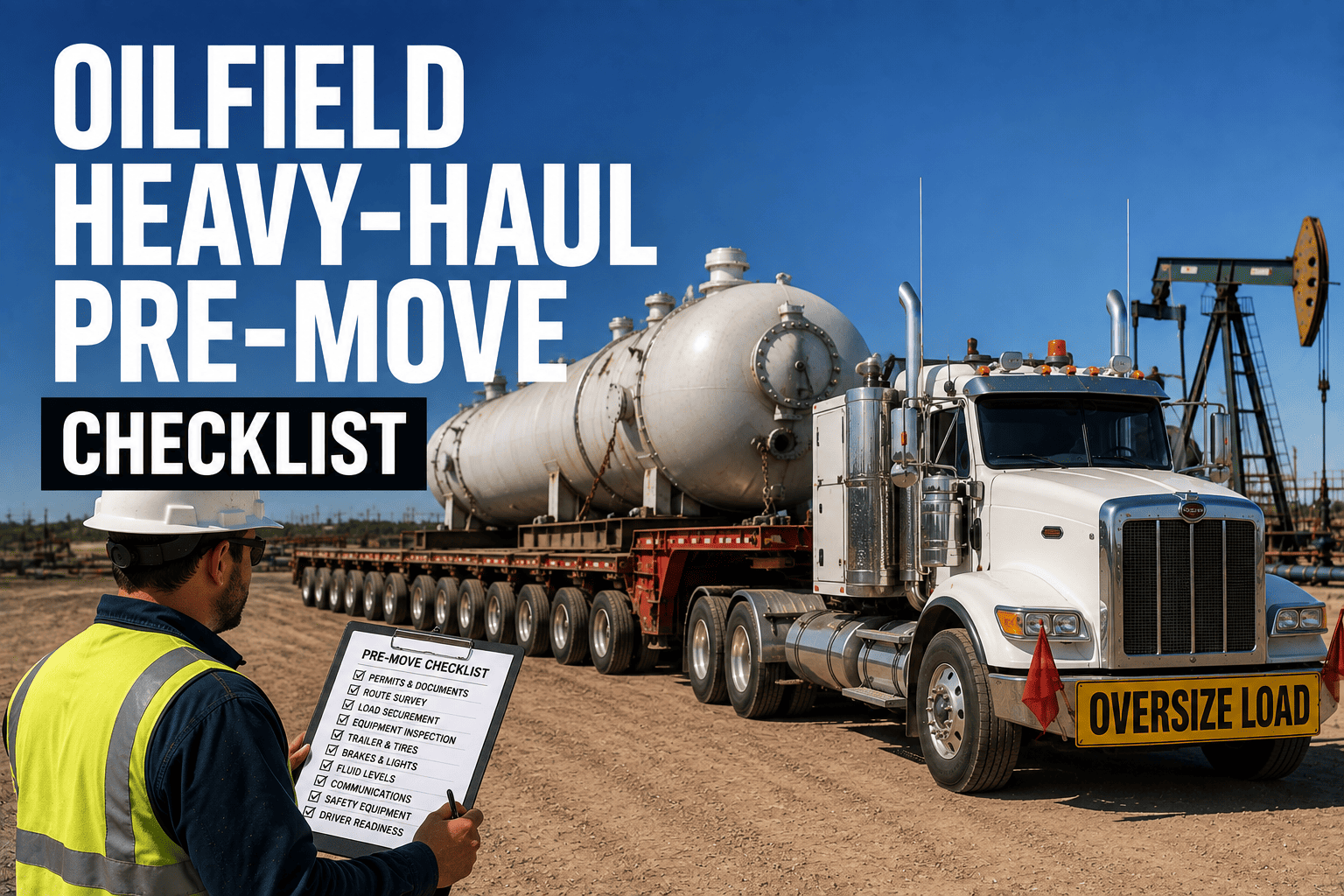
A complete oilfield heavy-haul pre-move inspection covers five areas: dimension and weight verification, state and county permit validation, escort and pilot car coordination, route survey for bridges and clearances, and load securement documentation. Missing any one of these is the leading cause of roadside holds, permit fines, and delivery delays on oversize oilfield moves. Sign up free to run this checklist digitally on every move.
Why Heavy-Haul Pre-Move Checks Matter More In The Oilfield
Oilfield heavy-haul is a different animal than standard freight. Loads like drilling rig substructures, mud tanks, compressors, and modular housing units are usually non-divisible, meaning they cannot be broken down to fit legal dimensions. That pushes width, height, length, or weight past federal thresholds almost by default, which means most oilfield moves require a permit before they can legally touch a public road. Add in the reality that many locations sit at the end of unpaved lease roads, low bridges, or county routes never designed for superload traffic, and the margin for error shrinks fast.
A pre-move inspection is not paperwork for its own sake. It is the difference between a load that clears its route in one pass and one that gets flagged at a weigh station, held by law enforcement for a missing escort, or turned back at a bridge it was never cleared to cross. Book a demo to see how digital pre-move checklists catch these gaps before the truck rolls.
Federal and State Dimension Thresholds To Know
Standard legal limits across most states sit at 8.5 feet wide, 13.5 feet tall, and 80,000 pounds gross vehicle weight. Any oilfield component that crosses those numbers becomes an oversize or overweight load requiring a permit, and every state sets its own rules on top of the federal baseline, so a multi-state rig move needs a separate permit for each state it crosses.
The Five-Stage Pre-Move Inspection Checklist
Run these five stages in order before any oilfield heavy-haul unit leaves the yard. Skipping the sequence, especially jumping straight to permits without confirming exact dimensions, is where most compliance gaps start.
Measure width, height, length, and gross weight with the load fully rigged for transport, including chains, dunnage, and any escort equipment mounted to the trailer. Permits are issued against these exact figures, and a discrepancy discovered mid-route voids the permit on the spot.
State permits do not cover city or county roads automatically. Lease roads and county crossings near the well site often need a separate local permit, and travel time windows, many states restrict oversize moves to daylight hours only, must match the planned departure.
Loads wider than roughly 12 feet or longer than 75 feet typically require at least one certified pilot car, with two cars or a law enforcement escort common for superloads. Confirm escort certification, radio communication, and amber warning lights before departure.
Walk or map the route for low bridges, narrow lease road turns, weight-restricted crossings, and overhead utility lines. Oilfield routes frequently change with well pad development, so a route surveyed last quarter needs a fresh check, not an assumption it still holds.
Chains, binders, and tie-downs must meet DOT securement ratios for the cargo weight, and required signage, oversize load banners, flags, and amber lighting, needs to be mounted and functional before the truck leaves the yard, not added at the first weigh station.
FleetRabbit turns this five-stage checklist into a mobile inspection every driver completes before departure, with permit expiration alerts and route hazard flags built in. Sign up free and run your first digital pre-move inspection today.
Permit And Escort Requirements By Load Category
Oilfield equipment spans a wide range of dimensions, and the permit and escort burden scales with it. Use this as a planning reference, then confirm exact figures against the specific states and counties on your route since requirements are never uniform nationwide.
| Load Type | Typical Width / Weight | Escort Requirement | Key Risk If Skipped |
|---|---|---|---|
| Compressor Package | 10 to 12 feet wide | One pilot car, front or rear depending on state | Weigh station hold, permit voided if weight mismatches filing |
| Drilling Rig Substructure | 14+ feet wide, superload weight | Two pilot cars plus possible law enforcement escort | Route denial at bridges rated below the axle load |
| Frac Tank | 10 to 13 feet wide | One to two pilot cars based on route | Securement failure on rough lease road transitions |
| Modular Housing Unit | Up to 16 feet wide | Two pilot cars, height pole required | Overhead utility strike or bridge clearance violation |
| Wellhead / Christmas Tree Skid | Under 10 feet, high weight concentration | Escort optional in most states, permit still required | Overweight fine if axle distribution is not documented |
County And Lease Road Permits Are Easy To Miss
State-level oversize permits get most of the attention, but many oilfield locations sit past county or municipal roads that carry their own weight and width restrictions, particularly on older bridges never rated for superload traffic. Confirming these secondary permits before departure is one of the most commonly skipped steps in the entire process, and it is exactly where a quick demo of automated route and permit checking pays for itself on the first move.
Common Mistakes That Stall Heavy-Haul Moves
Most roadside holds and missed delivery windows trace back to a small set of repeat mistakes. Building these checks into a standard pre-move routine eliminates the majority of avoidable delays.
Building Pre-Move Inspection Into Daily Fleet Operations
The fleets that avoid heavy-haul delays are not the ones with the most paperwork, they are the ones with the most consistent process. That means every driver, dispatcher, and permit coordinator working from the same checklist, updated the moment a permit renews or a route changes, instead of relying on memory or a printed form that goes stale.
Standardize The Checklist Across Every Driver
A pre-move checklist only works if it is identical every time, regardless of which driver or dispatcher is running the move. Standardizing the five-stage sequence, dimensions, permits, escorts, route, securement, into a single format removes the guesswork that leads to skipped steps during busy dispatch periods.
Digital Checklists Catch What Paper Misses
Paper checklists cannot flag an expiring permit or a changed bridge rating on their own. A digital pre-move inspection tied to permit expiration dates and live route data catches these issues automatically, before the truck is loaded, not after it is stopped on the road. Sign up for free to see how this works on your own fleet's routes.
Keep A Searchable Record For Every Move
When a load does get flagged at a weigh station or by law enforcement, a documented inspection record with timestamps, permit copies, and escort confirmation is what resolves the stop quickly instead of turning into a multi-hour delay or a disputed fine.
A single missed permit or uncertified escort can cost hours on the road and put a well site delivery behind schedule. FleetRabbit builds the five-stage pre-move inspection into a mobile checklist your drivers actually use, with permit expiration alerts and route hazard tracking included. Sign up free or book a demo to see it running on your fleet.