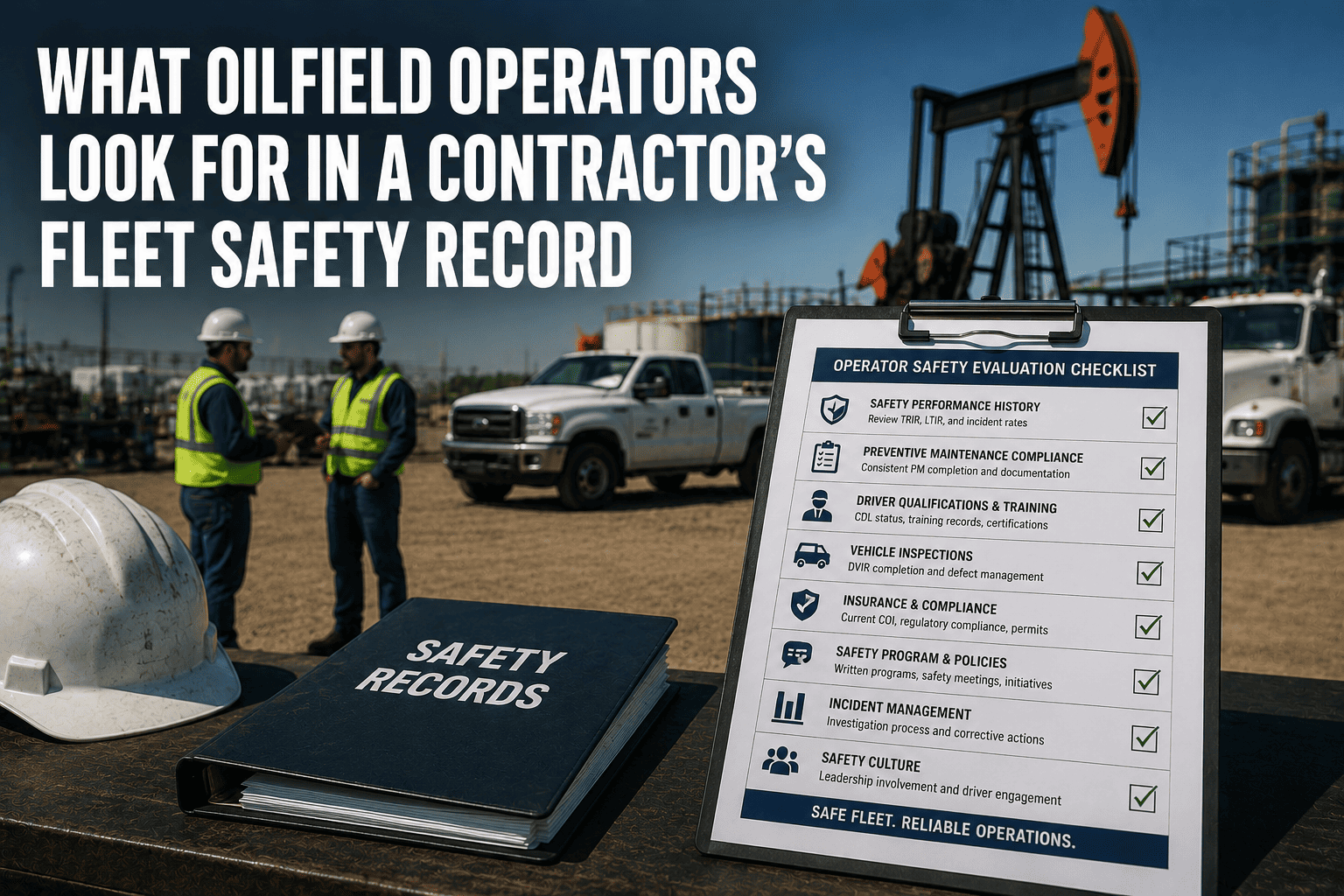
Regulatory compliance in oilfield fleet management has become structurally more demanding since 2024 — with simultaneous obligations under FMCSA 49 CFR Parts 391–396 for commercial vehicle operations, DOT PHMSA for hazardous materials transport, OSHA 29 CFR 1910 and 1926 for worker safety across classified and general industry environments, EPA programs including SPCC and NSPS OOOOa for environmental protection, and client operator HSE prequalification frameworks that add another layer of documentation requirements from ADNOC, Saudi Aramco, Shell, ExxonMobil, and independent operators whose contractor approval panels evaluate not just policy documentation but demonstrated inspection execution with evidence. Fleet managers operating across multiple basin locations face a compliance landscape where a single documentation gap in a DVIR programme can produce a DOT safety rating downgrade affecting the entire operational fleet, where an expired driver H2S certification discovered at a classified hazard zone gate generates a recordable OSHA event before any injury has occurred, and where an FMCSA audit requesting 90-day inspection records from a paper-based programme requires 40–60 hours of manual retrieval across multiple file storage locations. The purpose of this 2026 compliance checklist is not to replace professional regulatory counsel or formal compliance audit programmes — it is to provide oilfield fleet managers and HSE directors with a structured self-assessment framework covering the six regulatory domains most consistently cited in oilfield fleet enforcement actions, and to demonstrate how FleetRabbit's digital compliance platform converts each manual checklist item into an automated compliance control that operates continuously without requiring manual verification. The checklist covers 120+ compliance verification points across driver qualification, vehicle inspections, HAZMAT documentation, hours of service, incident reporting, and audit record management — the domains that collectively account for over 85% of oilfield fleet regulatory enforcement actions. Book a demo to see FleetRabbit's oilfield HSE compliance platform deployed for your specific regulatory obligations.
WHY OILFIELD FLEET COMPLIANCE FAILURES ARE COSTLY IN 2026
The Enforcement Landscape Every Oilfield Fleet Manager Needs to Understand
The six regulatory domains in this checklist account for over 85% of oilfield fleet enforcement citations recorded in FMCSA, OSHA, and EPA enforcement databases in the preceding 24 months. Each domain carries enforcement consequences that extend well beyond the immediate citation — because a DOT safety rating downgrade triggered by DVIR documentation gaps affects the entire fleet's operational status, and a client operator HSE prequalification failure resulting from incomplete audit records removes a service company from approved vendor panels worth millions in annual contract value.
Paper-based compliance systems are the common factor in the majority of oilfield fleet enforcement actions — not because operators are negligent, but because paper systems create structural data lags that prevent management intervention within the window that matters. FleetRabbit's digital compliance platform converts each checklist item into an automated control running continuously — without the 24–72 hour data lag that prevents paper systems from preventing what they are designed to prevent.
FMCSA Safety Rating Downgrade
Entire fleet operations affected
OSHA Serious Violation
$7K–$70K per citation
PHMSA HAZMAT Violation
$2K–$25K per occurrence
DOT HOS Violation
$1K–$16K per driver per violation
EPA Daily Fine (SPCC)
$25K–$50K per day
Client HSE Disqualification
Approved vendor panel removal
Manual Audit Preparation
40–60 hours per audit request
01
Driver Qualification and Certification Compliance — 49 CFR Part 391
Driver qualification failures are the most frequently cited category in FMCSA compliance reviews — because the consequences of operating a CMV with an uncertified or improperly qualified driver are immediate: out-of-service orders, safety rating downgrade, and potential civil liability in any subsequent incident. Verification must be continuous, not periodic.
FMCSA 49 CFR Part 391DOT Medical Standards 49 CFR 391.41HAZMAT Endorsement RequirementsADNOC Contractor Driver Standards
FLEETRABBIT AUTOMATES THIS DOMAIN
FleetRabbit tracks unlimited certificate types per driver — CDL, medical, H2S, HAZMAT endorsement, site access credentials, defensive driving, drug programme status — each with independent expiry dates and automated 60/30/7-day renewal alerts. Dispatch blocking activates automatically for expired Critical certifications without requiring dispatcher awareness. Complete DQ file audit packs generated in under 2 hours per driver for any FMCSA review.
02
Vehicle Inspection Programme — FMCSA 49 CFR Part 396
DVIR programme gaps are the primary cause of DOT safety rating downgrades during FMCSA compliance reviews — and the primary reason why fleet operators with no actual safety deficiencies receive enforcement action. The inspection occurred. The documentation does not exist. For regulators, the outcome is identical to the inspection not occurring.
49 CFR 396.11 — Driver Vehicle Inspection Report49 CFR 396.3 — Systematic Inspection49 CFR 396.17 — Periodic InspectionCVSA Out-of-Service Criteria
FLEETRABBIT AUTOMATES THIS DOMAIN
FleetRabbit enforces 100% DVIR completion before dispatch — vehicles cannot be assigned without a completed pre-trip record. The mobile app works fully offline at remote wellsites, with GPS timestamp at point of collection. Defects auto-generate maintenance work orders. Brake and tyre inspection completion tracked per vehicle. Engine-hour PM scheduling replaces mileage intervals for wellsite-intensive assets. Complete inspection history exportable in FMCSA 396 format within 2 hours.
FLEETRABBIT COMPLIANCE AUTOMATION
Every Checklist Item in This Guide Runs as an Automated Digital Control in FleetRabbit — Continuously, Without Manual Verification
The 120+ compliance verification points in this checklist represent the full scope of what FleetRabbit automates across oilfield fleet operations — driver certification tracking with dispatch blocking, offline DVIR with defect escalation, HAZMAT document generation, ELD HOS monitoring, incident evidence capture, and multi-jurisdiction audit pack generation. Deployed in 5–7 working days at $3/vehicle/month.
5–7Working days to full deployment
$3Per vehicle per month — all compliance domains
<2 hrsAudit pack generation for any period
03
HAZMAT and PHMSA Documentation — 49 CFR Parts 171–180
Oilfield HAZMAT compliance is more demanding than highway commercial transport — because the cargo classifications include crude oil, produced water with NORM concentrations, drilling chemicals, and well stimulation acids that trigger additional documentation, routing restriction, and disposal facility authorisation obligations beyond the standard shipping paper requirements. Every gap in the documentation chain is an enforcement finding.
49 CFR Parts 171–180 — PHMSA HMRADR (European Operations)TxRRC Environmental Transport PermitsNORM Classification Requirements
FLEETRABBIT AUTOMATES THIS DOMAIN
FleetRabbit generates complete HAZMAT shipping papers and ADR consignment notes automatically at dispatch from the cargo classification database — UN number, hazard class, proper shipping name, emergency contact populated without manual completion. Driver ADR certificate cross-referenced against cargo class at assignment. SDS library accessible offline on driver mobile device. NORM documentation generated for applicable waste streams. GPS track retained for PHMSA route restriction evidence.
04
Hours of Service Compliance — FMCSA ELD Mandate and 49 CFR Part 395
HOS violations are the most operationally damaging compliance gap in oilfield fleet management — because they are discovered at the point of violation rather than at the intervention window that prevents them. Discovering a HOS conflict when a driver is already 90 miles from the nearest yard during an active frac stage is a different problem than discovering it 3 hours earlier when dispatch can prevent it.
49 CFR Part 395 — Hours of ServiceFMCSA ELD Mandate — 49 CFR Part 395.811-Hour Driving Rule70-Hour/8-Day Rule
FLEETRABBIT AUTOMATES THIS DOMAIN
FleetRabbit's ELD-integrated HOS module displays remaining drive time per driver in the dispatch dashboard — generating proactive alerts at the configurable 90-minute threshold that gives dispatchers the intervention window to reschedule before violation occurs. HOS records retained and exportable for FMCSA review. Violation rate tracked automatically with trending for monthly compliance reporting.
05
Incident Reporting and Documentation — OSHA 300 Log and FMCSA Accident Register
Incident documentation quality determines whether a regulatory event becomes a manageable compliance matter or an enforcement escalation. Incomplete, late, or improperly formatted incident records transform an isolated safety event into evidence of systematic compliance programme failure during OSHA 300 log audits and FMCSA accident register reviews.
OSHA Recordkeeping 29 CFR 1904FMCSA Accident Register 49 CFR 390.15PHMSA Release ReportingState Workers' Compensation Requirements
FLEETRABBIT AUTOMATES THIS DOMAIN
FleetRabbit's mobile incident module captures GPS coordinates, timestamps, driver identity, vehicle status, and certification status at point of occurrence — automatically assembling the evidence package required for OSHA 300 log entry and FMCSA accident register compliance. Corrective action workflow assigns responsible party and deadline automatically. Incident records stored with tamper-evident audit trail for litigation hold capability. Near-miss reporting rate increases 4–5x when paper forms are replaced by 4-minute mobile submissions.
06
Audit Record Management and Regulatory Response Readiness
Audit readiness is not a project — it is the cumulative outcome of continuous digital record generation. Fleet operations that physically conducted every inspection, maintained every certification, and followed every procedure can still face enforcement action if the documentation demonstrating compliance cannot be produced within the regulatory response window in the format the auditor requires.
FMCSA 49 CFR Part 390 — General ComplianceOSHA 29 CFR 1904 — RecordkeepingEPA 40 CFR Part 112 — SPCC RecordsADNOC Contractor Audit Requirements
FLEETRABBIT AUTOMATES THIS DOMAIN
FleetRabbit generates tamper-evident, GPS-timestamped compliance records continuously — storing all DVIR records, DQ file data, maintenance work orders, HAZMAT shipping records, and incident documentation in a central database with cross-reference linkage between drivers, vehicles, and events. Complete audit packs in FMCSA, DVSA, ADNOC, or DGMS format generated in under 2 hours for any period and vehicle range. Access controls, audit trails, and litigation hold capabilities standard. Data backup and disaster recovery included in platform.
DEPLOY DIGITAL COMPLIANCE — 5–7 WORKING DAYS — $3/VEHICLE/MONTH
Every Item in This 2026 Compliance Checklist Runs as an Automated Digital Control in FleetRabbit
FleetRabbit automates all 120+ compliance verification points across driver qualification, vehicle inspections, HAZMAT documentation, HOS compliance, incident reporting, and audit record management — deployed on your oilfield fleet in 5–7 working days at $3/vehicle/month. The platform that converts compliance from a manual documentation burden into a continuous automated control system satisfying FMCSA, OSHA, EPA, ADNOC, and client operator audit requirements simultaneously.
Driver Certification Tracking
Offline Digital DVIR
HAZMAT Document Generation
ELD HOS Integration
Incident Evidence Capture
Multi-Jurisdiction Audit Packs
120+ Compliance Points
Under 2-Hour Audit Response
$3/vehicle/month
Does this checklist apply to both US domestic oilfield operations and international GCC operations under ADNOC requirements?
The six domains covered apply to both — with jurisdiction-specific regulatory citations differing between FMCSA/OSHA (USA) and ADNOC/DVSA/DGMS (GCC/UK/India). FleetRabbit generates audit packs in jurisdiction-specific formats from the same underlying compliance database, enabling operators in multiple regulatory environments to satisfy all applicable frameworks without separate systems.
How does FleetRabbit handle DVIR compliance at remote wellsites with no cellular coverage?
FleetRabbit's mobile DVIR app works fully offline — forms, photo capture, GPS coordinates, and electronic signatures all function without network connectivity. Data is timestamped at point of collection, not at point of sync. All records sync automatically when connectivity is restored with the original collection timestamp preserved for FMCSA 396.11 evidentiary purposes.
How quickly can FleetRabbit generate an audit pack for an unannounced FMCSA compliance review?
FleetRabbit generates complete audit packs — DVIR records, DQ file data, maintenance histories, HOS records, incident logs — for any specified period and vehicle range in under 2 hours from the central compliance database. The same documentation that takes 40–60 hours to assemble from paper records across multiple storage locations is produced automatically in the correct FMCSA format.
Does FleetRabbit's HOS integration prevent violations or only record them after occurrence?
Preventive — not reactive. FleetRabbit displays remaining drive time per driver in the dispatch dashboard in real time, generating proactive alerts at the configurable warning threshold (standard: 90 minutes remaining). Dispatchers receive the alert with sufficient lead time to reschedule before the violation occurs — not after the driver has already breached the limit and been placed out-of-service mid-delivery.
Can FleetRabbit track ADNOC site access credentials and offshore-specific certifications like BOSIET and OPITO alongside standard FMCSA driver qualification requirements?
Yes. FleetRabbit supports unlimited certificate types per driver profile — including all North Sea offshore qualifications (BOSIET, HUET, GWO, OPITO), GCC-specific credentials (ADNOC, Aramco access), and standard FMCSA requirements (CDL, medical, endorsements) — each with independent expiry dates and jurisdiction-specific dispatch blocking rules.
How long does FleetRabbit deployment take to cover all six compliance domains in this checklist?
5–7 working days for fleets up to 200 vehicles — including telematics API integration, driver certification record import, DVIR workflow configuration, HAZMAT document template setup, HOS alert threshold configuration, and executive compliance dashboard activation. All six compliance domains go live simultaneously, not sequentially.
This 2026 compliance checklist documents 120+ verification points that FleetRabbit automates as continuous digital controls. The difference between this checklist on paper and FleetRabbit deployed is the difference between knowing what compliance requires and having a system that delivers it automatically. Book a demo and see every compliance domain running on a live oilfield fleet
May 8, 2026
By David
All Posts