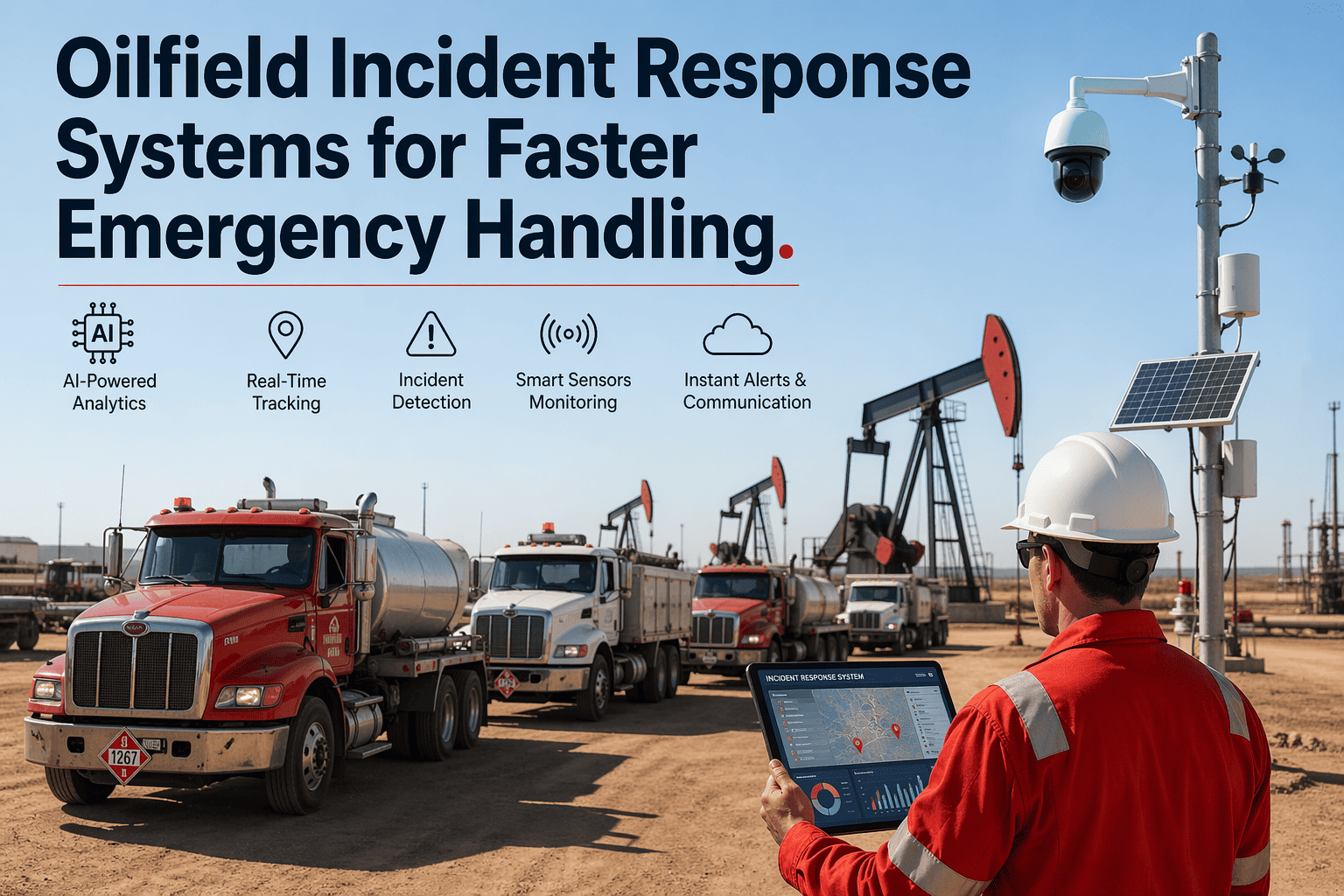
Every second counts when an incident occurs on an oilfield site. Equipment failures, safety events, environmental releases, and personnel emergencies demand immediate coordinated response — yet traditional incident management relies on phone calls, radio traffic, and manual documentation that delays critical action. FleetRabbit's digital incident response platform delivers instant alerting, real-time location tracking, automated escalation protocols, and full audit trails — ensuring your emergency response team has the intelligence and coordination tools to act decisively when it matters most. Schedule a demo to see incident response automation in action.
Digital Incident Response Systems for Oilfield Emergency Management
FleetRabbit transforms incident response from reactive phone-tree chaos into coordinated digital action — delivering real-time alerts, automated escalation, GPS-tracked responder dispatch, and complete incident documentation that saves lives, minimizes damage, and ensures regulatory compliance.
Executive Brief
Incident response speed determines outcome severity. A gas leak detected and isolated in 6 minutes results in controlled venting and equipment shutdown. The same leak undetected for 18 minutes risks ignition, personnel injury, and catastrophic asset loss. FleetRabbit's incident response platform integrates real-time sensor monitoring, automated emergency protocols, GPS-tracked fleet coordination, and regulatory documentation — eliminating response delays, communication gaps, and documentation failures that turn manageable events into major incidents.
Why Fast Incident Response is Critical in Oilfield Operations
Oilfield incidents escalate exponentially with time. What begins as a small hydraulic leak becomes equipment failure. Equipment failure becomes fire risk. Fire risk becomes evacuation. Evacuation becomes production shutdown, regulatory investigation, and liability exposure. The window between detection and containment — typically 8 to 15 minutes — determines whether an incident remains a maintenance event or escalates into a safety crisis.
Traditional response protocols depend on human communication chains: field operator notices anomaly, radios supervisor, supervisor calls safety manager, safety manager dispatches emergency crew, crew navigates to location without precise coordinates. Each handoff adds 2-5 minutes. Each decision point introduces hesitation. Each manual step creates documentation gaps that complicate regulatory reporting and liability defense.
Time-to-Response Determines Severity
Research across upstream operators shows direct correlation between response time and incident cost. Equipment fires contained within 8 minutes average $180K in damage. Beyond 12 minutes, average damage exceeds $1.8M due to secondary equipment involvement, production loss, and environmental release. Every minute saved during emergency response translates directly to reduced financial and safety impact.
Location Precision Prevents Delays
Manual location reporting — "Compressor station near the north pad" — wastes critical minutes as responders search sprawling sites. GPS-precise incident tagging delivers exact coordinates to emergency personnel, enabling direct navigation to incident location. For remote wellsites across multi-county operations, location precision reduces arrival time by 40-60%.
Simultaneous Multi-Team Notification
Phone-tree escalation is sequential: operator calls supervisor, who calls manager, who calls emergency coordinator. Digital systems alert all stakeholders simultaneously — field responders, supervisors, safety managers, and executives receive incident notification within seconds, with role-appropriate information and action requirements. Parallel notification cuts coordination delays by 70%.
Real-Time Documentation Prevents Gaps
Post-incident documentation reconstructed from memory and scattered notes creates regulatory compliance risk and liability exposure. Automated documentation captures incident timeline, response actions, personnel involved, and equipment status in real-time — creating contemporaneous records required by OSHA, EPA, and state regulators while events are still unfolding.
How FleetRabbit's Digital Incident Response System Works
Automatic Incident Detection & Manual Reporting
Incidents trigger through multiple pathways: automated sensor alerts (pressure excursions, temperature spikes, gas detection, equipment shutdown), manual operator reports via mobile app (button press triggers incident category selection), or third-party system integration (SCADA alarms, fire suppression activation). All pathways route to unified incident management dashboard with standardized severity classification and GPS location tagging.
Real-Time Alerting System
Incident triggers immediate multi-channel notification: push alerts to mobile devices, SMS to on-call personnel, email to management chain, and dashboard pop-ups for control room operators. Alerts include incident type, severity level, exact GPS coordinates, nearest responder location, and recommended initial actions. Notifications escalate automatically if unacknowledged within defined timeframes — 2 minutes for critical events, 5 minutes for urgent, 15 minutes for precautionary.
GPS-Tracked Responder Dispatch
System identifies nearest qualified responders based on real-time GPS fleet tracking, certification status, and current availability. Dispatch notifications include turn-by-turn navigation to incident site, estimated arrival time, and pre-loaded incident details. Response team members acknowledge assignment through mobile app, updating incident dashboard with responder count, ETA, and resource availability. Control room maintains live map view of all responding personnel and equipment converging on incident location.
Dynamic Incident Command Structure
FleetRabbit automatically establishes incident command hierarchy based on severity level and response protocols. Minor incidents assign field supervisor as incident commander. Major incidents escalate to operations manager with automated notification to HSE director and executive team. Command authority, communication channels, and decision-making protocols activate per company-defined emergency response plans — eliminating confusion about who's in charge during crisis response.
Real-Time Status Updates & Communication
Incident timeline updates automatically as responders take action: arrival at scene, hazard assessment complete, containment measures initiated, equipment isolated, area secured, all-clear issued. Updates populate incident dashboard visible to all stakeholders with role-appropriate detail levels. Two-way communication channel enables responders to request additional resources, report changing conditions, or escalate severity classification without breaking away from response activities.
Automated Documentation & Regulatory Reporting
Complete incident record generates automatically: detection timestamp, alert delivery confirmation, responder dispatch times, arrival times, actions taken with timestamps, resource deployment, equipment status changes, personnel involved, and incident resolution. System pre-populates regulatory reporting forms (OSHA 300 logs, state environmental reports, DOT incident notifications) and flags incidents requiring mandatory reporting based on severity thresholds and release volumes.
Real-Time Alerting System: Multi-Channel Emergency Notification
Effective incident alerting delivers the right information to the right people through the right channels at the right time. FleetRabbit's alert engine routes notifications based on incident severity, recipient role, time of day, and communication preferences — ensuring critical information reaches decision-makers without overwhelming teams with alert fatigue.
Severity-Based Routing
Critical Incidents (Red): Immediate push notification + SMS + phone call to on-call emergency coordinator, site manager, and HSE director. Desktop alerts to control room with audible alarm. Incident commander assignment within 90 seconds.
Urgent Incidents (Orange): Push notification + SMS to field supervisor and safety manager. Email to operations director. 5-minute acknowledgment requirement before escalation.
Precautionary (Yellow): Push notification to field supervisor. Email summary to shift manager. 15-minute acknowledgment window.
Informational (Green): Dashboard notification and daily email digest. No immediate action required but logged for trending analysis.
Role-Appropriate Information
Field Responders: Incident location (GPS coordinates + map), incident type, recommended PPE, nearest equipment/resources, safety hazards identified, initial action checklist.
Supervisors: All field responder info plus personnel availability, equipment status, estimated containment time, escalation triggers, regulatory reporting requirements.
Executives: High-level incident summary, potential business impact, media/community exposure risk, response team status, projected resolution timeline.
Regulatory Affairs: Incident classification for reporting threshold determination, release volumes, affected environmental areas, preliminary reporting deadline calculation.
Escalation Automation
Unacknowledged alerts auto-escalate through defined chains: Field supervisor (2 min) → Operations manager (5 min) → Site director (8 min) → Regional VP (12 min). Escalation triggers additional notification channels — unacknowledged critical alert at 5 minutes generates phone calls to backup on-call personnel. System prevents single-point-of-failure in emergency communication.
Severity auto-escalation also occurs based on duration: incident unresolved after 30 minutes upgrades from Yellow to Orange, triggering expanded notification and resource deployment. Prevents minor incidents from becoming major emergencies through inattention.
Geo-Fenced Notifications
Location-based alerting notifies personnel within defined proximity: gas leak triggers alerts to all workers within 500-meter radius, enabling immediate evacuation. Hazardous material release alerts downwind facilities based on real-time weather data integration. Ensures personnel safety through location-aware emergency communication.
Real-Time Fleet Tracking for Emergency Response Coordination
Emergency response effectiveness depends on knowing where your people and equipment are at all times. FleetRabbit's GPS tracking platform provides live visibility into responder locations, estimated arrival times, and resource availability — enabling incident commanders to coordinate complex multi-team responses with precision.
Live Responder Location Map
Dashboard displays real-time positions of all field personnel, response vehicles, and mobile equipment. Incident location marked with severity-coded icon. System calculates nearest responders and displays ETAs based on current position and road network routing. Incident commander sees convergence pattern in real-time — confirming adequate response or identifying need for additional resources before responders arrive on scene.
Automatic Responder Identification
System cross-references responder location against certification records, training status, and equipment assignments. Gas leak incident automatically identifies personnel certified for H2S response within 10-minute drive time. Confined space rescue triggers notification only to rescue-team-certified responders with required equipment. Prevents dispatch of unqualified personnel to specialized emergency scenarios.
Turn-by-Turn Navigation Integration
Dispatched responders receive navigation link in alert notification — one tap launches turn-by-turn routing to exact incident coordinates. Routes optimize for road conditions, avoid restricted areas, and account for site-specific access protocols. Reduces wrong-turn delays and ensures fastest possible arrival even for personnel unfamiliar with remote wellsite locations.
Resource Proximity Analysis
System identifies nearest response resources beyond personnel: fire suppression equipment, spill containment materials, backup generators, medical supplies, heavy equipment. Map overlay shows resource locations relative to incident site, enabling rapid deployment decisions. Prevents "we didn't know the spill kit was 200 yards away" scenarios that delay containment.
Historical Movement Playback
Post-incident review mode replays responder movement timeline — visualizing who arrived when, how response pattern unfolded, and whether protocols were followed. Supports after-action analysis, training scenario development, and investigation documentation. GPS timestamp evidence proves response compliance for regulatory audits and liability defense.
Evacuation Zone Management
For incidents requiring personnel evacuation, system creates geo-fenced evacuation perimeter and tracks all personnel exiting the zone. Dashboard confirms "all clear" when no GPS-tracked personnel remain in hazard area — preventing incomplete evacuations that endanger workers. Muster point check-in confirms headcount matches known personnel in affected area at incident time.
Incident Types Managed Through FleetRabbit's Response Platform
Equipment Fire / Explosion
Detection: Temperature sensors, smoke detectors, manual operator report, fire suppression system activation
Alert Routing: Critical-level instant notification to all site personnel, emergency response team, fire brigade, operations management, HSE director
Response Protocol: Immediate equipment shutdown sequence, evacuation zone establishment, fire suppression deployment, mutual aid coordination with local fire department
Documentation: Auto-populated OSHA incident report, insurance claim packet, regulatory notification forms for state fire marshal
Gas Leak / H2S Release
Detection: Fixed gas detectors, portable monitor alarms, operator smell/observation, pipeline pressure drop
Alert Routing: Geo-fenced notification to all personnel within 500m radius, certified H2S responders, incident command structure activation, state environmental agency pre-notification
Response Protocol: Upwind evacuation, breathing apparatus deployment, source isolation, ventilation/dispersion monitoring, area re-entry clearance procedures
Documentation: Release volume calculation, weather conditions, exposure duration, personnel affected, medical evaluations, regulatory reporting threshold determination
Personnel Injury / Medical Emergency
Detection: Manual emergency button, man-down alarm from wearable device, coworker report, routine check-in missed
Alert Routing: Site medic/EMT, nearest coworkers for immediate assistance, supervisor, safety manager, EMS coordination if hospital transport required
Response Protocol: Scene safety assessment, first aid/CPR if needed, victim stabilization, helicopter landing zone establishment for severe injuries, hospital notification with patient info
Documentation: OSHA recordkeeping determination, injury classification (first aid/medical treatment/lost time), witness statements, scene photos, equipment involved, PPE use verification
Spill / Environmental Release
Detection: Tank level deviation, pipeline leak detection, visual observation, surface water contamination sensor
Alert Routing: Spill response team, environmental compliance manager, operations director, state/federal environmental agencies if reportable quantity exceeded
Response Protocol: Source control and isolation, secondary containment deployment, soil/water sampling, affected area mapping with GPS, cleanup contractor mobilization
Documentation: Release volume estimation (initial and final), affected media (soil/water/air), cleanup actions and timeline, disposal documentation, corrective action plan, regulatory filing package
Critical Equipment Failure
Detection: Vibration monitoring alert, SCADA alarm, operator observation of abnormal operation, automatic shutdown trigger
Alert Routing: Maintenance supervisor, operations manager, on-call technician, parts/vendor contact if specialty repair needed
Response Protocol: Immediate isolation and lockout/tagout, damage assessment, temporary workaround evaluation, repair vs. replace decision, production impact analysis
Documentation: Failure mode analysis, maintenance history review, root cause investigation, corrective action to prevent recurrence, warranty claim if applicable
Security / Unauthorized Access
Detection: Perimeter intrusion sensor, camera motion alert, gate/door access log anomaly, personnel report
Alert Routing: Security personnel, site supervisor, local law enforcement if trespassing/theft suspected
Response Protocol: Visual/camera verification, personnel dispatch to investigate, facility lockdown if threat confirmed, law enforcement coordination, equipment/material inventory check
Documentation: Incident timeline with camera footage, personnel on-site during event, items missing/damaged, law enforcement case number, insurance claim preparation
Case Study: Compressor Station Gas Leak Response
6-Minute Response Prevents $4.2M Catastrophic Failure
Major upstream operator — West Texas production facility — October 2024
Fixed LEL sensor at compressor station detects 18% Lower Explosive Limit — exceeds 10% action threshold. FleetRabbit receives alarm from SCADA integration and classifies as Critical Incident due to LEL percentage and equipment proximity.
Push notifications + SMS to 14 personnel within geo-fenced 600m radius. Phone calls to on-call incident commander and H2S-certified response team (4 personnel). Control room receives audible alarm with map display showing leak location and all personnel positions relative to incident.
Incident commander acknowledges and assumes command authority through mobile app. System identifies nearest H2S-certified responder 0.8 miles from compressor station with ETA 3.2 minutes. Second responder 1.4 miles away, ETA 4.8 minutes. Both receive turn-by-turn navigation + incident brief with gas type, concentration, wind direction.
Responder arrives at compressor station, confirms gas leak from valve packing gland. GPS check-in auto-updates incident dashboard. Requests remote compressor shutdown via app communication channel. Control room operator initiates shutdown sequence — compressor stops within 90 seconds, reducing gas pressure and leak rate by 85%.
Second responder arrives with specialty tools. Team isolates valve using upstream/downstream block valves. LEL reading drops to 3%, then 0% within 8 minutes as residual gas dissipates. Incident commander updates status: "Source isolated, area ventilating, no ignition, monitoring for 30-minute all-clear."
All-clear issued after sustained zero LEL readings. Total response time: 6 minutes from detection to source isolation. FleetRabbit incident report auto-populated with complete timeline, responder actions, equipment status, gas concentrations, weather conditions, and personnel exposed. Regulatory review determined no reportable release threshold exceeded — documentation proves compliance with response protocol.
Outcome Analysis
FleetRabbit Incident Response Platform Features
Mobile-First Incident Reporting
Field personnel report incidents through dedicated mobile app with one-touch emergency button, photo/video capture, voice notes, and GPS auto-tagging. Pre-configured incident categories ensure consistent classification. Offline mode queues reports for transmission when connectivity restored — no lost documentation from remote locations.
Live Incident Command Dashboard
Real-time map view shows active incidents, responding personnel, equipment status, and resource locations. Incident timeline displays all actions with timestamps. Communication panel aggregates updates from all responders. Configurable widgets for role-specific information needs — field supervisor sees different data than executive team.
Automated Escalation Protocols
Pre-configured escalation rules trigger based on incident severity, duration, or specific conditions. Unacknowledged critical alerts auto-escalate every 2 minutes. Incidents unresolved after 30 minutes upgrade severity tier and expand notification list. Prevents incidents from "falling through the cracks" during shift changes or busy periods.
Qualification-Based Dispatch
System cross-references incident type against personnel certification database — confined space rescue only dispatches rope-rescue-certified teams, electrical incidents route to licensed electricians. Prevents deployment of unqualified responders to specialized emergency scenarios, reducing liability and improving response effectiveness.
Real-Time Analytics & KPIs
Dashboard tracks response performance metrics: average time-to-acknowledge, time-to-scene, incident duration by type, responder availability rates, false alarm percentage. Management visibility into response effectiveness enables continuous protocol improvement and identifies training gaps.
Third-Party System Integration
Bi-directional integration with SCADA, fire alarm panels, gas detection systems, access control, and emergency notification systems. Incidents auto-create work orders in CMMS. Injury incidents populate OSHA recordkeeping database. Spills trigger environmental compliance tracking. Eliminates duplicate data entry across safety/operations platforms.
Regulatory Documentation Engine
Auto-populated templates for OSHA 300 logs, EPA spill reports, DOT incident notifications, state agency filings. System flags incidents approaching regulatory reporting thresholds (spill volume, injury severity, downtime duration) and pre-fills required data fields from incident timeline. Regulatory compliance manager receives alert packet with draft forms ready for review and submission.
Audit Trail & Legal Defense
Immutable incident record with cryptographic timestamps proves contemporaneous documentation. GPS logs confirm responder locations and arrival times. Communication logs show who was notified when. Post-incident modifications tracked with user ID and reason for change. Documentation package supports liability defense, insurance claims, and regulatory audit responses.
Traditional vs. Digital Incident Response: Performance Comparison
Deploy Faster Emergency Response Across Your Operations
FleetRabbit's incident response platform delivers the coordination tools, real-time visibility, and automated documentation your emergency response team needs to contain incidents before they escalate into safety crises and financial catastrophes.
Integration with Existing Safety Systems
SCADA & Process Control Systems
FleetRabbit connects to major SCADA platforms (Wonderware, Ignition, OSIsoft PI, Schneider Electric) via OPC-UA, Modbus, or REST API. Process alarms — high/low pressure, temperature excursions, flow deviations, shutdown events — automatically trigger incidents with severity mapped from alarm priority. Bidirectional integration enables incident commanders to remotely operate equipment through SCADA interface without leaving incident dashboard.
Gas Detection & Fire Alarm Systems
Integration with fixed gas detection systems (Honeywell, MSA, Dräger) and fire alarm panels creates zero-latency incident triggering. LEL/H2S/CO readings exceeding action thresholds generate immediate Critical incidents with geo-located alert zones. Fire alarm activation triggers building evacuation protocols and external emergency service notification. System prevents human delay between alarm and response mobilization.
Access Control & Security Systems
Badge reader integration tracks personnel location at facility entry/exit points — system knows who's on-site when incident occurs, enabling accurate headcount during evacuations. Intrusion detection and camera motion alerts generate security incidents with video clip attached. After-hours access logging creates audit trail for incident investigation (who had facility access when equipment was damaged).
Weather & Environmental Monitoring
Real-time weather data integration (NOAA, Weather Underground, site-specific sensors) enhances incident response decisions. Wind speed/direction data determines evacuation zones for gas releases. Lightning detection triggers outdoor work suspensions and electrical safety protocols. Severe weather warnings auto-generate preparatory incidents — securing loose equipment, sheltering personnel, shutting vulnerable systems.
CMMS & Maintenance Systems
Equipment failure incidents auto-create work orders in maintenance systems (IBM Maximo, SAP PM, Fiix) with incident details, photos, and recommended repairs. Maintenance history imported to incident dashboard — recurring failures flagged for root cause investigation. Post-repair validation links back to originating incident, closing loop between emergency response and corrective action.
Emergency Notification Systems (ENS)
Integration with mass notification platforms (Everbridge, AlertMedia, Rave Mobile Safety) enables one-touch emergency broadcasts. Critical incidents trigger pre-configured ENS templates — shelter-in-place, evacuation, hazmat release — reaching hundreds of personnel via voice calls, SMS, and email simultaneously. Community notification capability alerts neighbors for off-site impact events.
Training & Adoption for Successful Implementation
Technology doesn't save lives — trained people using effective technology save lives. FleetRabbit's incident response platform includes comprehensive training programs designed for rapid adoption across field personnel, supervisors, and management teams.
Role-Based Training Modules (Week 1-2)
Field Responders: 2-hour mobile app training — emergency button usage, incident reporting, status updates, photo documentation, navigation to incidents. Hands-on simulation exercises with test incidents.
Supervisors/Incident Commanders: 4-hour dashboard training — incident monitoring, responder coordination, escalation triggers, communication management, decision support tools. Tabletop exercise running simulated multi-team response.
Management/HSE: 3-hour executive briefing — platform capabilities, KPI interpretation, regulatory compliance features, audit trail access, reporting functions. Strategic-level incident scenario walk-through.
Live Drills & System Testing (Week 3-4)
Coordinated emergency response drills using FleetRabbit platform in test mode. Realistic incident scenarios (gas leak, equipment fire, injury) with actual personnel dispatch and response actions. System performance validated under simulated emergency conditions. Feedback incorporated to refine alert routing, escalation timing, and communication protocols before go-live.
Phased Go-Live & Continuous Improvement (Ongoing)
Platform activated for single facility or incident category first — validating workflows before fleet-wide deployment. Monthly performance reviews analyze response metrics and identify improvement opportunities. Quarterly tabletop exercises maintain proficiency. Annual full-scale drills test organization-wide coordination. After-action reviews from actual incidents feed protocol refinements.
Frequently Asked Questions
How does FleetRabbit's incident response platform handle communications in areas with poor cellular coverage?
The mobile app operates in offline mode — incident reports, photos, status updates, and GPS locations queue locally on the device and transmit automatically when connectivity is restored. No data is lost from remote wellsites. For critical incidents requiring immediate coordination, FleetRabbit integrates with satellite communication systems (Iridium, Globalstar) to ensure alert delivery even in zero-cellular environments. Control rooms with hardwired internet maintain continuous platform access regardless of field connectivity.
Can the system integrate with our existing emergency response procedures and chain-of-command structure?
Yes — FleetRabbit is fully configurable to match your organization's emergency response plan. Alert routing, escalation chains, incident command hierarchy, and approval authorities are customized during implementation to reflect your documented procedures. The platform enforces your protocols digitally rather than replacing them. You can also maintain multiple response plans (facility-specific, incident-type-specific) and the system applies the correct protocol automatically based on incident classification.
What happens if someone accidentally triggers a false alarm?
Incident reporters can immediately cancel false alarms through the mobile app within the first 60 seconds — preventing unnecessary mobilization. After 60 seconds, cancellation requires supervisor approval to prevent premature all-clears. All false alarms are logged and analyzed for patterns (specific equipment generating repeated false positives, training gaps causing misidentification). System tracks false alarm rates per facility and responder to identify issues requiring sensor calibration or additional personnel training.
How does FleetRabbit determine which responders are qualified for specialized incidents like confined space rescue or H2S response?
FleetRabbit's personnel database stores certifications, training records, medical clearances, and equipment qualifications for each employee. Incident types are tagged with required qualifications (e.g., H2S incident requires current H2S Alive certification + respirator fit test + gas monitor training). When an incident triggers, the dispatch algorithm filters available personnel against qualification requirements and only notifies those meeting all criteria. Expired certifications automatically disqualify personnel from specialized response until retraining is completed and documented.
Can FleetRabbit's incident platform support multi-company coordinated response for shared facilities or pipeline corridors?
Yes — platform supports multi-tenant configurations where multiple operators share response resources or have mutual aid agreements. Incidents can trigger notifications across organizational boundaries to contracted emergency response providers, neighboring facility operators, or third-party specialized teams. Each organization maintains separate data access controls but participates in shared incident command structures when appropriate. Useful for pipeline joint ventures, shared tank batteries, and regional emergency response cooperatives.
What is the typical deployment timeline for a 28-rig fleet spread across multiple states?
Full deployment: 8-12 weeks. Week 1-2: System configuration, alert routing setup, integration with existing SCADA/safety systems. Week 3-4: Personnel data import, certification records upload, mobile app rollout to field teams. Week 5-6: Training delivery (role-based modules), emergency drill simulations. Week 7-8: Phased go-live starting with highest-priority facilities. Week 9-12: Fleet-wide activation, performance monitoring, protocol refinement based on initial incidents. Critical facilities can go live within 3-4 weeks if prioritized for accelerated deployment.
Every Second Counts During Emergencies
FleetRabbit's digital incident response platform eliminates the communication delays, coordination failures, and documentation gaps that turn manageable incidents into catastrophic events. Give your emergency response team the real-time visibility and coordination tools they need to protect your people, assets, and environment.