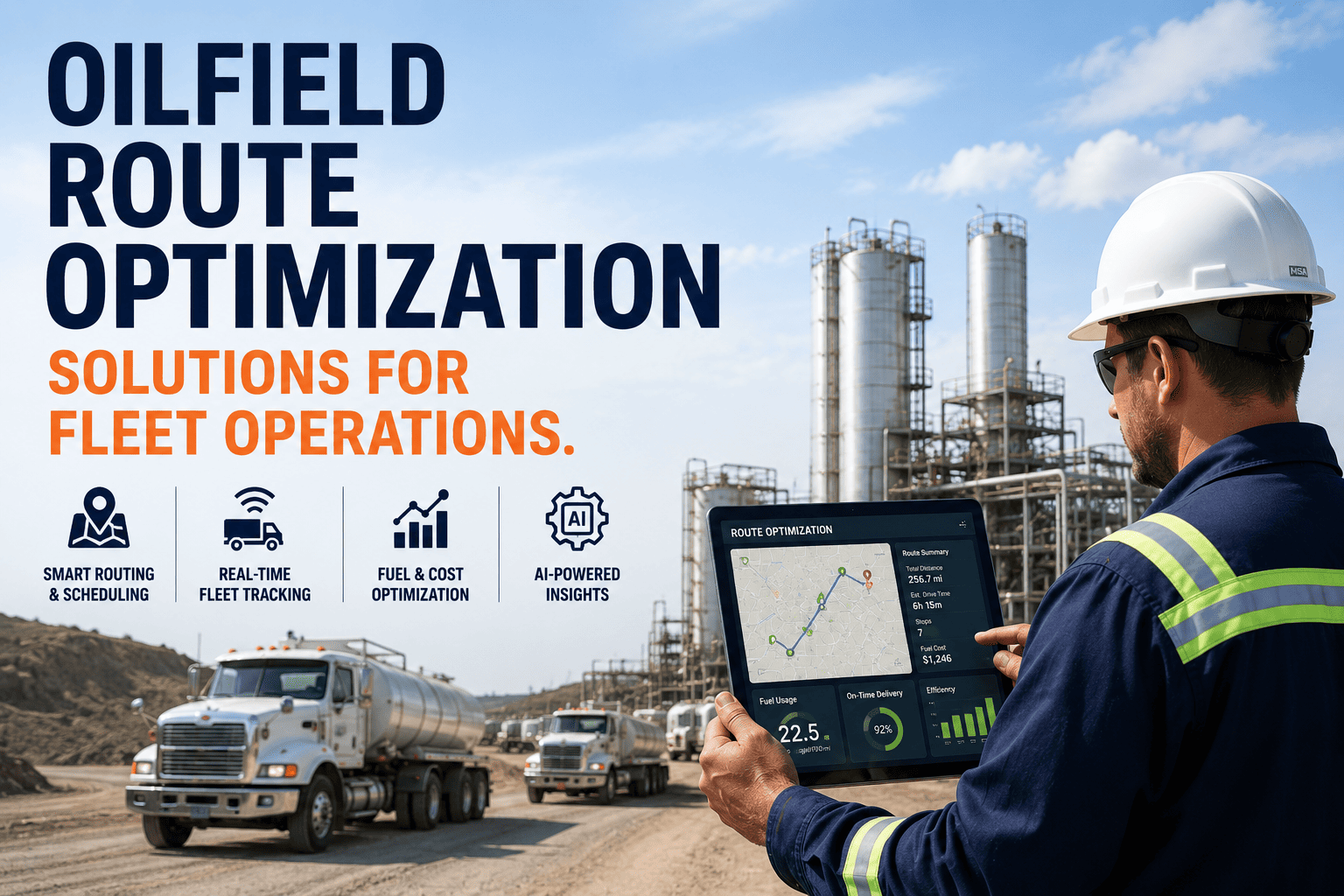
Oilfield fleet route optimization represents the operational discipline separating efficient logistics operations achieving 18-24 percent fuel cost reduction and 15-20 percent productivity improvement from inefficient competitors burning excessive diesel traveling redundant miles between wellsites, tank batteries, and disposal facilities scattered across remote basin territories spanning hundreds of square kilometers. The fundamental challenge stems from routing complexity exceeding capabilities of manual dispatch planning where fleet managers assign vehicle routes based on intuition, historical patterns, and basic geographic proximity without systematic analysis of optimal sequencing, real-time traffic conditions, or dynamic operational constraints — resulting in suboptimal route assignments where trucks travel 30-40 percent more miles than mathematically optimal pathways, encounter unexpected road closures or construction requiring mid-route rerouting decisions made under time pressure without comprehensive alternative analysis, arrive at facilities during peak congestion periods waiting 45-90 minutes for service access that could be avoided through intelligent scheduling, and burn excessive fuel climbing elevation changes or fighting headwinds that alternative routes circumvent through gentler terrain and favorable wind patterns. Traditional static routing approaches cannot accommodate dynamic operational realities including real-time service requests from field operations requiring immediate dispatch response, equipment breakdowns necessitating emergency rerouting to alternative service providers, weather events closing rural lease roads and forcing lengthy detours, and disposal facility capacity constraints requiring dynamic load balancing across multiple authorized locations. Progressive oilfield operators deploy AI-powered route optimization platforms transforming manual dispatch guesswork into systematic mathematical optimization — FleetRabbit's routing engine analyzes thousands of potential route combinations across entire fleet simultaneously identifying optimal vehicle-to-job assignments minimizing total travel distance while satisfying operational constraints including driver hours-of-service limits, vehicle capacity restrictions, facility operating hours, and customer time window requirements, integrates real-time traffic data detecting congestion, accidents, and road closures enabling dynamic rerouting before drivers encounter delays, incorporates elevation profiles and weather forecasts optimizing routes to avoid steep grades during icing conditions or selecting paths with tailwind assistance reducing fuel consumption, and provides turn-by-turn navigation with automatic mobile alerts when route deviations detected ensuring drivers follow optimized pathways rather than reverting to familiar but inefficient routes. Book a demo to see FleetRabbit's route optimization demonstrated with actual oilfield logistics scenarios.
Oilfield Route Optimization Solutions for Fleet Operations: Reduce Fuel Costs 18-24%
Manual dispatch planning creates systematic inefficiencies where vehicles travel 30-40 percent excess miles from suboptimal route sequencing, encounter unexpected delays from unmonitored traffic conditions, and burn excessive fuel fighting adverse terrain and weather. FleetRabbit's AI-powered route optimization analyzes thousands of route combinations simultaneously — minimizing total travel distance while satisfying operational constraints, integrating real-time traffic data for dynamic rerouting, and incorporating elevation and weather forecasts for fuel-efficient path selection.
Why Intuition-Based Route Planning Fails Oilfield Fleet Operations
The Combinatorial Optimization Problem
Route planning complexity escalates exponentially with fleet size and service location count creating mathematical optimization challenges exceeding human cognitive capacity for manual analysis. A fleet of 10 vehicles serving 30 service locations daily faces over 265 billion potential route combinations when accounting for visit sequencing, vehicle assignments, and time window constraints — making exhaustive manual evaluation impossible and forcing dispatchers to rely on heuristic approximations based on geographic clustering and historical patterns that capture only small fraction of potential efficiency gains.
The operational consequence manifests as systematic suboptimization where manual route assignments achieve 60-70 percent of mathematically optimal efficiency leaving 30-40 percent improvement opportunity unrealized through better vehicle-to-job matching, superior visit sequencing reducing backtracking and crossover patterns, and intelligent time window coordination minimizing waiting periods at congested facilities. A 50-vehicle water hauling fleet traveling 15,000 miles daily under manual dispatch planning could reduce total daily mileage to 9,000-10,500 miles through mathematical optimization — eliminating 4,500-6,000 redundant miles daily translating to $2,700-$3,600 daily fuel savings at $0.60 per mile operating cost or $985,000-$1,314,000 annual cost reduction opportunity from route optimization alone.
Real-Time Dynamic Disruption Response
Static route plans optimized during morning dispatch lose validity within 2-4 hours as operational reality diverges from planning assumptions through unexpected service requests from field operations requiring immediate response, equipment breakdowns necessitating route modifications to visit maintenance facilities or equipment rental yards, traffic accidents and road construction closing planned routes forcing detours, disposal facility capacity constraints rejecting loads requiring rerouting to alternative authorized locations, and weather events including flash flooding or ice storms making rural lease roads temporarily impassable. Manual dispatch operations respond to these disruptions reactively through individual driver calls requesting guidance creating communication bottlenecks where fleet managers handle sequential emergency requests one-by-one rather than holistic fleet-wide reoptimization accounting for cascading impacts across all active routes.
The result manifests as fragmented suboptimal responses where individual route adjustments made in isolation create inefficiencies across broader fleet operations — driver assigned emergency service request could have been handled more efficiently by nearby vehicle currently traveling toward that location, rerouted vehicle encounters congestion that alternative pathway avoided, and sequential reactive decisions compound creating progressively degraded fleet-wide efficiency throughout operational day. Systematic real-time reoptimization analyzing entire fleet status simultaneously and recalculating optimal assignments accounting for all active constraints and objectives captures efficiency gains impossible through reactive sequential decision-making.
Multi-Objective Optimization Trade-offs
Oilfield fleet routing requires balancing competing objectives that cannot be simultaneously maximized including minimizing total travel distance reducing fuel costs and vehicle wear, minimizing total travel time improving driver productivity and customer service, balancing workload across drivers preventing overtime costs and fatigue-related safety risks, maximizing on-time arrival performance meeting customer time windows and facility operating schedules, and minimizing empty miles between service locations improving asset utilization. Manual route planning cannot systematically evaluate trade-offs between these competing objectives resulting in inconsistent prioritization where some routes optimize for distance while others prioritize time windows without coherent fleet-wide optimization strategy.
Six Integrated Capabilities Delivering 18-24% Fuel Cost Reduction
FleetRabbit's route optimization platform combines mathematical vehicle routing algorithms, real-time traffic integration, elevation and weather analysis, facility constraint management, mobile driver navigation, and continuous learning optimization — achieving documented fuel savings of $985,000-$1,314,000 annually for typical 50-vehicle water hauling operations.
Mathematical Vehicle Routing Optimization
FleetRabbit employs advanced vehicle routing algorithms solving multi-vehicle pickup and delivery problems with time windows, capacity constraints, and precedence relationships — mathematical frameworks proven to reduce total travel distance 25-35 percent versus manual heuristic planning. The optimization engine evaluates vehicle-to-job assignments, visit sequencing, and timing decisions across entire fleet simultaneously identifying globally optimal solutions rather than locally optimized individual routes that create inefficiencies when considered fleet-wide.
Real-Time Traffic Integration and Dynamic Rerouting
FleetRabbit integrates real-time traffic data from multiple sources including state DOT traffic management centers, crowdsourced mobile navigation platforms, and commercial traffic intelligence providers — detecting congestion, accidents, construction, and road closures along planned routes enabling proactive rerouting before drivers encounter delays. Dynamic rerouting algorithms recalculate optimal pathways when traffic conditions deteriorate suggesting alternative routes avoiding congestion while maintaining service schedule commitments.
Elevation Profile and Weather-Aware Routing
FleetRabbit incorporates terrain elevation data and weather forecasts into route optimization algorithms selecting pathways that minimize fuel consumption through intelligent elevation change management and favorable weather condition exploitation. The system analyzes multiple route alternatives comparing total elevation gain, grade steepness, and wind direction patterns — preferring routes with gradual elevation changes over steep climbs, selecting pathways with tailwind assistance over headwind resistance, and avoiding routes with ice or snow accumulation during winter weather events.
Facility Constraint and Capacity Management
Oilfield logistics operations face facility constraints including disposal well daily injection volume limits, tank battery storage capacity restrictions, and loading rack throughput bottlenecks — creating dynamic routing requirements where vehicle assignments must balance load distribution across multiple authorized facilities preventing capacity exceedance and excessive congestion. FleetRabbit tracks real-time facility utilization coordinating vehicle dispatches to distribute demand preventing arrival clustering during peak periods and ensuring no facility receives volume exceeding permitted capacity.
Mobile Navigation and Compliance Monitoring
FleetRabbit provides turn-by-turn navigation guidance on driver mobile devices ensuring optimized routes actually followed in field operations rather than drivers reverting to familiar but inefficient pathways. GPS tracking monitors actual routes traveled detecting deviations from assigned pathways and sending automated alerts to dispatchers when significant off-route travel detected — enabling immediate intervention addressing navigation errors, unauthorized stops, or intentional route modifications.
Continuous Learning and Adaptive Optimization
FleetRabbit's machine learning algorithms continuously analyze actual route performance outcomes comparing planned travel times against actual durations, predicted fuel consumption versus measured usage, and forecasted service times against realized completion times — identifying systematic deviations indicating model calibration requirements. The system adapts optimization parameters based on operational experience improving prediction accuracy and route quality over time as historical performance data accumulates.
Route Optimization Delivers $985K-$1.31M Annual Savings
FleetRabbit Route Optimization Implementation
Service Territory Mapping and Constraint Configuration
FleetRabbit implementation team maps complete service territory including all customer locations, disposal facilities, tank batteries, and loading racks with GPS coordinates and operational details. Road network imported covering highways, county roads, and lease road access routes. Operational constraints configured including vehicle capacity limits, driver hours-of-service restrictions, facility operating hours, customer time windows, and disposal volume limitations. Historical route data analyzed establishing baseline performance metrics for optimization comparison.
Optimization Algorithm Calibration and Testing
Route optimization algorithms calibrated using historical operational data including actual travel times, fuel consumption patterns, and service duration distributions. Machine learning models trained on past performance establishing realistic prediction parameters for travel speed, service time, and fuel usage. Test optimization scenarios executed comparing FleetRabbit recommendations against historical manual routes demonstrating improvement potential. Dispatcher training conducted covering optimization interface, manual override procedures, and exception handling protocols.
Driver Mobile Navigation Deployment and Pilot Operations
Mobile navigation application deployed to driver smartphones and tablets with turn-by-turn guidance, traffic integration, and route compliance monitoring active. Driver training demonstrates mobile app usage, navigation features, and deviation reporting procedures. Pilot operations commence with 25-30 percent of fleet operating under FleetRabbit optimization while remainder continues manual dispatch — enabling side-by-side performance comparison validating optimization benefits before full deployment. Initial results reviewed with management confirming fuel savings and productivity improvements.
Full Fleet Optimization and Continuous Improvement
Route optimization activated across entire fleet with all vehicles receiving AI-generated daily route assignments. Continuous learning algorithms monitor actual performance outcomes refining travel time predictions, fuel consumption models, and service duration estimates. Weekly performance reviews track fuel consumption trends, productivity metrics, on-time arrival rates, and optimization quality improvements. Monthly business reviews with executive management document ROI achievement and identify additional optimization opportunities from operational pattern analysis.
Common Questions About Route Optimization
Deploy AI Route Optimization Achieving 18-24% Fuel Savings
FleetRabbit's route optimization platform transforms manual dispatch guesswork into systematic mathematical optimization through advanced vehicle routing algorithms solving multi-vehicle pickup and delivery problems evaluating thousands of route combinations identifying globally optimal vehicle assignments and visit sequencing reducing total travel distance 25-35 percent, real-time traffic integration detecting congestion, accidents, and road closures enabling dynamic rerouting before drivers encounter delays improving on-time arrival from 75-80 percent to 92-96 percent, elevation profile and weather-aware routing selecting pathways minimizing fuel consumption through intelligent terrain management and favorable wind exploitation reducing consumption 8-12 percent beyond mileage reduction alone, facility constraint and capacity management coordinating vehicle arrivals preventing congestion and capacity exceedance eliminating wait times averaging 45-90 minutes under manual dispatch, mobile navigation with compliance monitoring ensuring drivers follow optimized routes rather than familiar inefficient pathways, and continuous learning algorithms adapting optimization parameters based on actual performance outcomes improving route quality 12-18 percent over initial 90-day learning period — delivering documented results for typical 50-vehicle water hauling fleet including 32 percent fuel cost reduction saving $832,000 annually, 19 percent productivity improvement enabling 1.2 additional deliveries per vehicle daily generating 15,600 additional annual service capacity, and ROI exceeding 46,000 percent from fuel savings alone before considering revenue gains from productivity improvement.
Transform Fleet Logistics Through AI-Powered Route Optimization
Manual dispatch planning creates systematic inefficiencies where vehicles travel 30-40 percent excess miles from suboptimal route sequencing, encounter unexpected delays from unmonitored traffic conditions burning time waiting in congestion, and consume excessive fuel fighting adverse terrain and weather conditions that alternative routes circumvent — with routing complexity escalating exponentially with fleet size creating over 265 billion potential route combinations for 10-vehicle 30-location operations exceeding human cognitive capacity for exhaustive analysis and forcing reliance on heuristic approximations achieving only 60-70 percent of mathematically optimal efficiency. FleetRabbit's AI-powered route optimization eliminates these inefficiencies through mathematical vehicle routing algorithms evaluating thousands of combinations across entire fleet identifying globally optimal vehicle assignments and visit sequencing, real-time traffic integration detecting congestion and closures enabling dynamic rerouting maintaining schedule commitments, elevation and weather analysis selecting fuel-efficient pathways avoiding steep grades and exploiting favorable wind patterns, facility constraint management coordinating arrivals preventing capacity exceedance and congestion, mobile navigation ensuring driver compliance with optimized routes, and continuous learning adapting to operator-specific conditions improving performance over time — delivering documented performance for typical 50-vehicle water hauling operations including 32 percent fuel cost reduction saving $832,000 annually, 19 percent productivity improvement enabling 1.2 additional deliveries per vehicle daily generating 15,600 additional annual capacity, 94 percent on-time arrival versus 76 percent baseline through intelligent scheduling, and ROI exceeding 46,000 percent from fuel savings alone with additional revenue potential from productivity-enabled capacity growth.