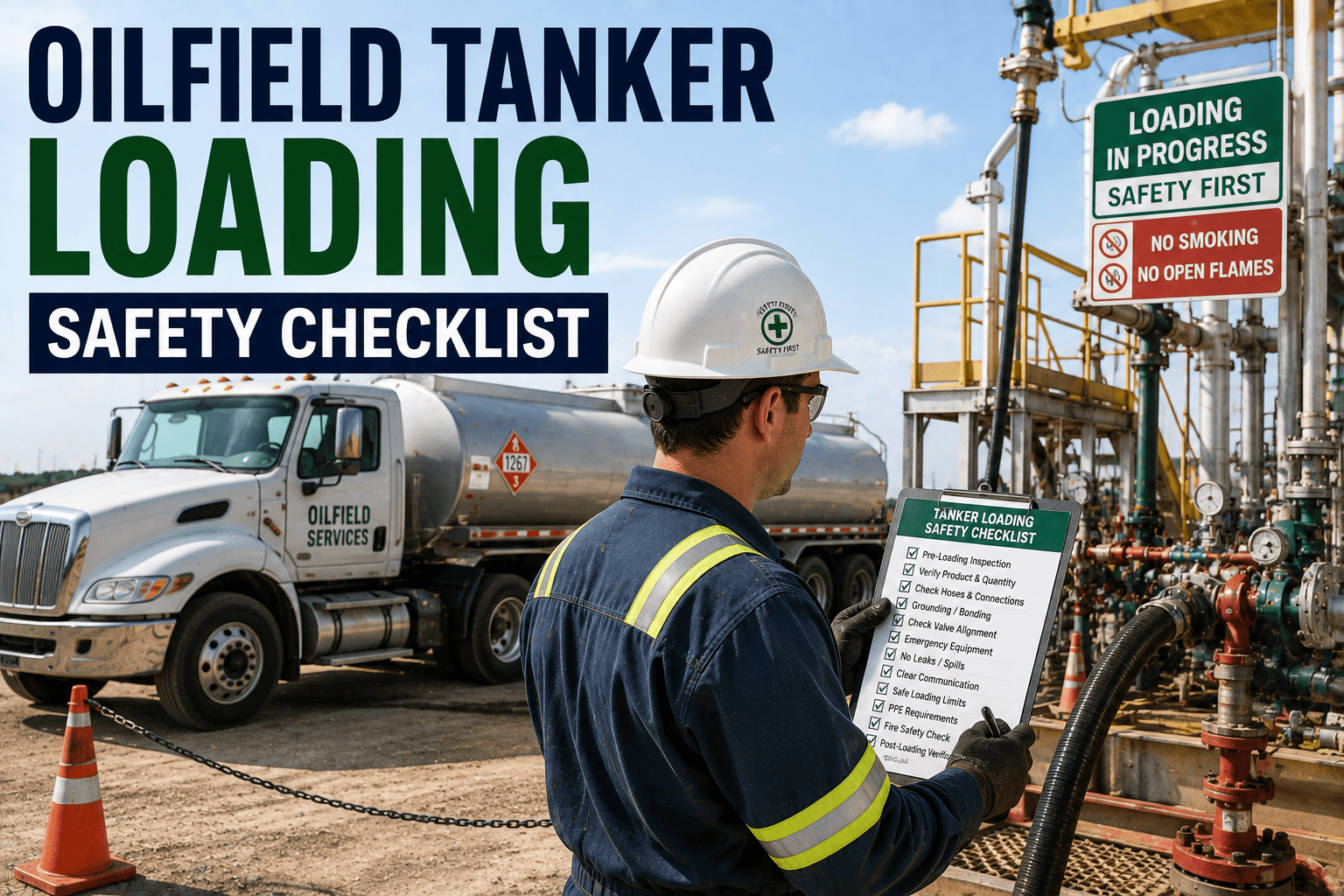
Loading a tanker in an oilfield yard looks routine right up until it isn't. A meter that keeps running a few seconds too long, a grounding clamp that never made contact, or a compartment valve left open on the wrong side of the tank, and a normal shift turns into a spill report or worse. Crude oil and produced water hauling carry different chemistry but the same core risks: static ignition and overfill. A tanker loading safety checklist built around those two failure points is what keeps drivers, equipment, and the site itself out of trouble on every single load.
A tanker loading safety checklist for crude oil and produced water hauling should confirm grounding and bonding before any valve opens, verify compartment valve status, set overfill protection with room for thermal expansion, start flow slowly to limit static buildup, and monitor gauges continuously until the load is complete. Skipping any one of these steps is how spills, overfills, and vapor ignition incidents happen.
The Four-Step Loading Sequence Every Crew Should Follow
Why Overfill and Static Charge Cause the Most Incidents
Every tanker loading checklist ultimately protects against the same two failure modes. The first is static discharge: crude oil and produced water both generate charge as they move through hoses and fill a tank, and without a verified ground path that charge has nowhere to go except a spark. The second is overfill: fuel and produced water both expand as temperature rises, so a tank filled to its physical limit at loading time can rupture or vent product hours later once it warms up.
Static Grounding Is Not Optional
Grounding systems create an electrical bond between the tanker and the loading rack, and that connection should be tight, direct, and never wound or twisted onto itself. Advanced rack systems continuously monitor this bond and can shut down the transfer automatically if the connection fails mid-load, which is exactly the kind of safeguard a checklist should confirm is active before loading begins rather than assume is working.
Overfill Protection Needs a Real Margin
A meter stop or automatic shutoff should always be set with room left over for thermal expansion, not filled to the tank's absolute physical capacity. Crews that treat the meter stop as the only safeguard, without a visual gauge check to confirm it, are one sensor fault away from a spill. Fleets that want this verification built into every load rather than left to memory can sign up for FleetRabbit and run digital loading checklists with mandatory photo confirmation on grounding and gauge readings.
FleetRabbit walks every driver through grounding, compartment verification, and overfill checks before the meter starts, with instant alerts if any step is skipped or fails.
The Complete Checklist By Loading Phase
Rather than one long list, the safest crews break the checklist into three phases: before the hose connects, during active transfer, and after the load is sealed. Each phase catches a different category of risk.
| Phase | Key Checks | What It Prevents |
|---|---|---|
| Before Loading | Engine and electrical systems off, site and storage tank compatibility confirmed, chock blocks set, grounding cable connected and verified | Ignition sources active during connection, wrong product routed to the wrong tank |
| During Loading | Only the correct compartment open, flow started slow, meter stop set with thermal margin, gauges and connections watched continuously | Cross-contamination between compartments, static buildup, silent overfill |
| After Loading | All valves closed and secured, hoses drained and disconnected in the correct order, grounding cable removed last, final volume and paperwork confirmed | Residual product spills during transport, incomplete or inaccurate load documentation |
Crude Oil vs Produced Water: Where the Checklist Differs
Crude oil and produced water hauling share the same grounding and overfill fundamentals, but the details underneath the checklist shift depending on what's in the tank.
Crude Oil Loading Considerations
Crude carries higher flammability risk and often arrives with associated vapor, so vapor control and slow initial flow rate matter even more than they do for water. H2S monitoring is standard practice at many wellhead and tank battery locations, and a checklist should confirm an active gas monitor is running before the crew approaches the loading point, not just carried in the truck.
Compartment Discipline Matters More With Crude
Cross-contamination between crude grades affects both product value and downstream processing, so confirming every non-active compartment valve is closed is worth a second look before flow starts, not just a glance during pre-trip.
Produced Water Loading Considerations
Produced water loads still require grounding and overfill discipline, since static and thermal expansion risks don't disappear just because the product isn't crude. The bigger difference is on the documentation side: manifest accuracy and disposal facility compatibility checks carry more weight here, since produced water often moves to specific permitted disposal sites rather than a processing terminal.
Spill Consequences Differ Too
A produced water spill still triggers environmental reporting obligations even though the ignition risk is lower than crude, so gauge monitoring and secure connections stay just as important through the entire loading process.
FleetRabbit lets you build separate loading checklist templates for crude and produced water, so every driver follows the right sequence for the product actually in the tank.
Making the Checklist Stick Across Every Shift
A checklist only works if it gets completed the same way regardless of who is driving, what time the load starts, or how many stops are left on the route. Paper forms tend to drift over time, filled out from memory after the fact rather than step by step during the job. A digital version fixes that by requiring each step in order, capturing a timestamp and photo where it matters, and flagging a supervisor immediately if grounding, compartment status, or gauge readings don't check out.
That kind of consistency also builds a record over time. If one loading rack keeps showing grounding faults, or one crew consistently starts flow too fast, that pattern becomes visible in the data long before it becomes an incident report. Teams ready to see how this fits their crude or produced water hauling operation can book a demo and walk through the setup with FleetRabbit directly.
Grounding, overfill margin, and compartment checks only work if they happen the same way on every load. FleetRabbit makes that routine automatic, with proof captured at each step. Start your free trial today with no credit card required.