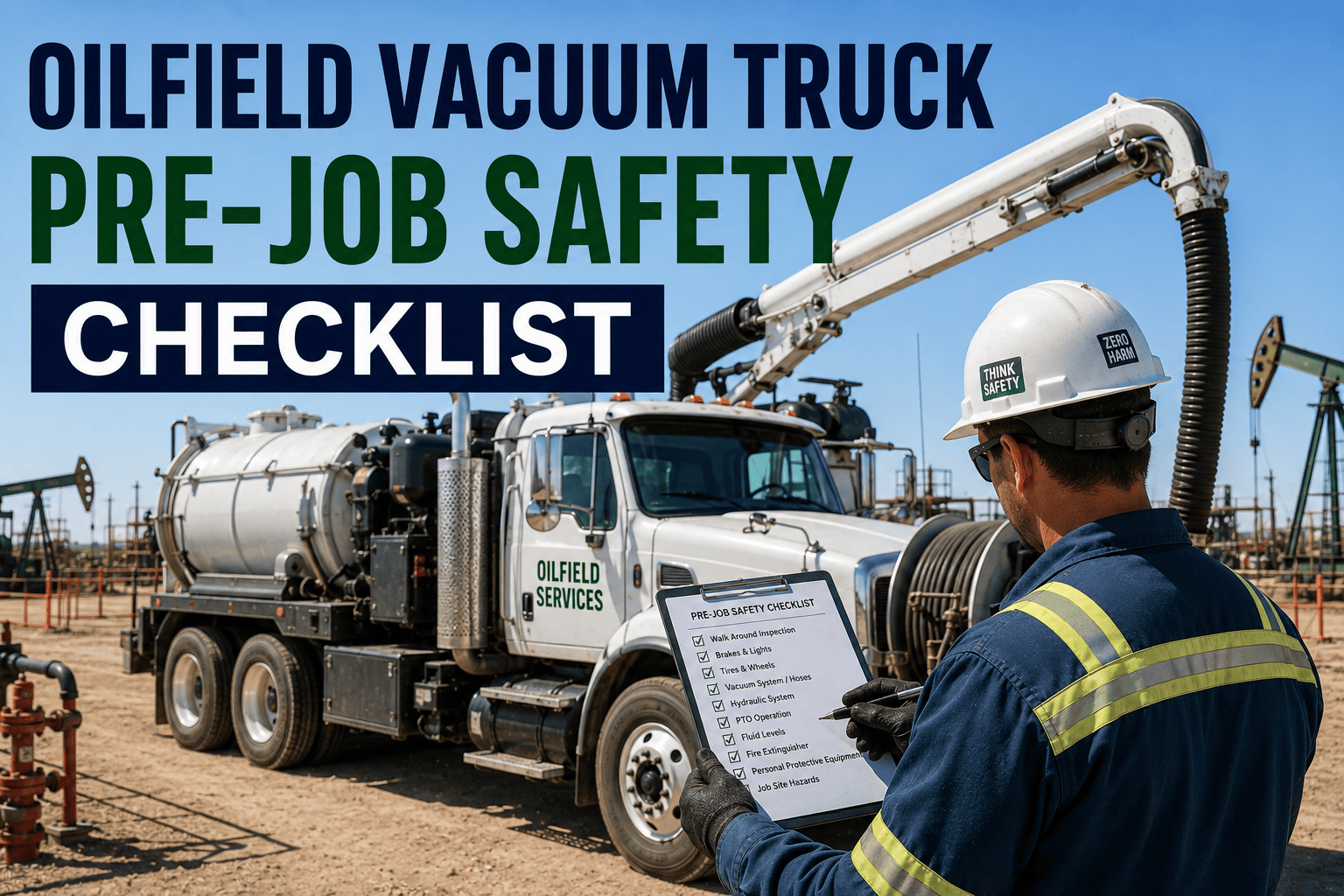
A vacuum truck rolling onto an oilfield location carries more risk in the first ten minutes on site than most vehicles carry in an entire shift. Flammable vapors, pressurized hoses, static charge, and heavy liquid loads all come together the moment a crew starts hooking up equipment. A rushed setup or a skipped grounding check has been the difference between a routine waste pickup and a documented incident. A structured pre-job safety checklist is what keeps every crew, every truck, and every location consistent, no matter who is behind the wheel that day.
A vacuum truck pre-job safety checklist for oilfield waste pickup should confirm bonding and grounding, tank and hose integrity, PPE and gas monitoring, safe distance from ignition sources, and site-specific waste compatibility before a single valve is opened. Crews that run this check before every job cut preventable incidents dramatically and keep loads compliant with DOT, OSHA, and EPA waste-handling rules.
Why a Pre-Job Checklist Matters Before Every Waste Pickup
Oilfield vacuum truck crews rarely work the same site twice in a row. One location has a tight lease road, the next has an open collection pit, and the one after that has a confined space nearby. That variability is exactly why relying on memory or habit is not enough. A written, repeatable pre-job checklist forces the same verification steps every time, regardless of how familiar the crew is with the site or how much time pressure they are under.
Regulators expect this discipline too. Vacuum truck operations handling oil and gas waste fall under DOT, OSHA, and EPA oversight depending on the material and the state. Roadside inspections commonly flag insecure loads, leaking hydraulic lines, and missing hazmat placards, while confined space and hazard communication violations are frequent findings during facility audits. A documented pre-job check is the paper trail that shows your crew verified conditions before work began, which matters as much for liability protection as it does for preventing the incident itself.
What Changes When Checklists Become Routine
Fleets that standardize this step stop treating safety as a judgment call left to each driver. Supervisors get visibility into which trucks and crews are consistently compliant, and gaps show up before they turn into incidents rather than after. Teams that want to move this process off paper and onto a phone or tablet can sign up for FleetRabbit to run digital pre-job checks with photo evidence and instant supervisor alerts.
FleetRabbit puts your bonding, grounding, hose, and PPE checks on every driver's device, with timestamped records and instant flags for anything that fails inspection. No more paper logs left in a glove box.
The Core Pre-Job Checklist, Section by Section
A complete pre-job safety checklist for oilfield vacuum truck waste pickup covers five areas: the vehicle and vacuum system, hoses and fittings, bonding and grounding, personal protective equipment, and the job site itself. Each section below outlines what a driver or operator should verify before a single hose is connected.
| Checklist Area | What To Verify | Why It Matters |
|---|---|---|
| Tank and Vacuum System | Relief valve function, hatch seals, oil level in sight glass, no external pump damage or leaks | A blocked relief valve with a closed hatch can cause the tank to implode under continued vacuum |
| Hoses and Fittings | Visual inspection in good lighting for cracks, abrasions, or wear, plus secure tie-offs | A hose failure under pressure can whip violently and strike nearby crew members |
| Bonding and Grounding | Grounding cable connected to truck and receiving vessel before any valve opens | Prevents static discharge from igniting flammable vapor released during offloading |
| PPE and Gas Monitoring | Chemical-resistant gloves, face shield, steel-toe boots, high-vis vest, gas monitor for hazardous loads | Reduces exposure risk from splash, vapor inhalation, and low-oxygen atmospheres |
| Site and Waste Compatibility | Manifest review, material safety data confirmation, safe distance from ignition sources | Confirms the load matches documentation and the site meets separation and permit requirements |
Tank, Pump, and Vacuum System Checks
Start at the pump. Check the oil level through the sight glass, confirm the oil color is clear rather than milky or dark, and listen for grinding or whining once the PTO is engaged. Then move to the tank itself: confirm the safety relief valve moves freely and the door gasket shows no cracking, since a compromised seal reduces vacuum efficiency long before it causes a bigger failure.
Listening for Early Warning Signs
Experienced operators treat sound as a diagnostic tool. Grinding, knocking, or an unusual whine from the vacuum pump during the operational check often signals a developing mechanical issue well before it becomes a breakdown on site.
Hose, Fitting, and Grounding Verification
Inspect every hose in daylight or under strong artificial light rather than relying on a quick glance in a shaded truck bay. Hairline cracks and abrasion patterns are easy to miss in dim conditions but are exactly what leads to a mid-job failure. Confirm the bonding cable is attached and making solid contact before any valve is touched, since this single step is what actually interrupts the static discharge path that has caused real oilfield fires during offloading.
PPE, Site Setup, and Waste Documentation
Minimum protective gear includes chemical-resistant gloves, safety goggles or a face shield, steel-toe boots, and a high-visibility vest. Hazardous waste loads call for an added layer: a NIOSH-approved respirator, a Tyvek suit, and an active gas monitor. Before the first valve opens, confirm the waste manifest matches what is actually being loaded, and keep the truck at a safe distance from open flame, running engines, or other ignition sources nearby.
Documenting the Load
Manifests exist for a reason beyond paperwork. RCRA and related state rules require accurate tracking of hazardous waste from pickup to disposal, and a mismatch between the manifest and the actual load is one of the more common findings during facility audits.
FleetRabbit preloads FMCSA, OSHA, and EPA-aligned checklist templates so drivers complete the same verified steps at every location, with photo capture and automatic flags on any failed item.
Building This Into a Digital Workflow
Paper checklists get left in truck cabs, filled out after the fact, or skipped entirely under time pressure. Moving the pre-job checklist onto a phone or tablet fixes the timing problem, since a driver has to complete each step on site before the app allows the job to start. Photo capture on hose condition or grounding connection adds a layer of proof that a written signature never could, and any failed item routes straight to a supervisor instead of waiting for someone to notice later.
Fleets running multiple vacuum trucks across different sites also gain something paper never provided: a pattern. If one truck keeps failing the same relief valve check, or one crew consistently skips gas monitoring on hazardous loads, that shows up in the data instead of staying invisible until an inspection or incident forces the issue. Teams ready to move in this direction can book a demo to see how a digital checklist fits into an existing oilfield waste pickup operation.
A missed grounding check or an overlooked hose crack is never worth the risk. FleetRabbit turns this checklist into a digital pre-job process your crews complete before every pickup, with proof captured automatically. Start your free trial today with no credit card required.