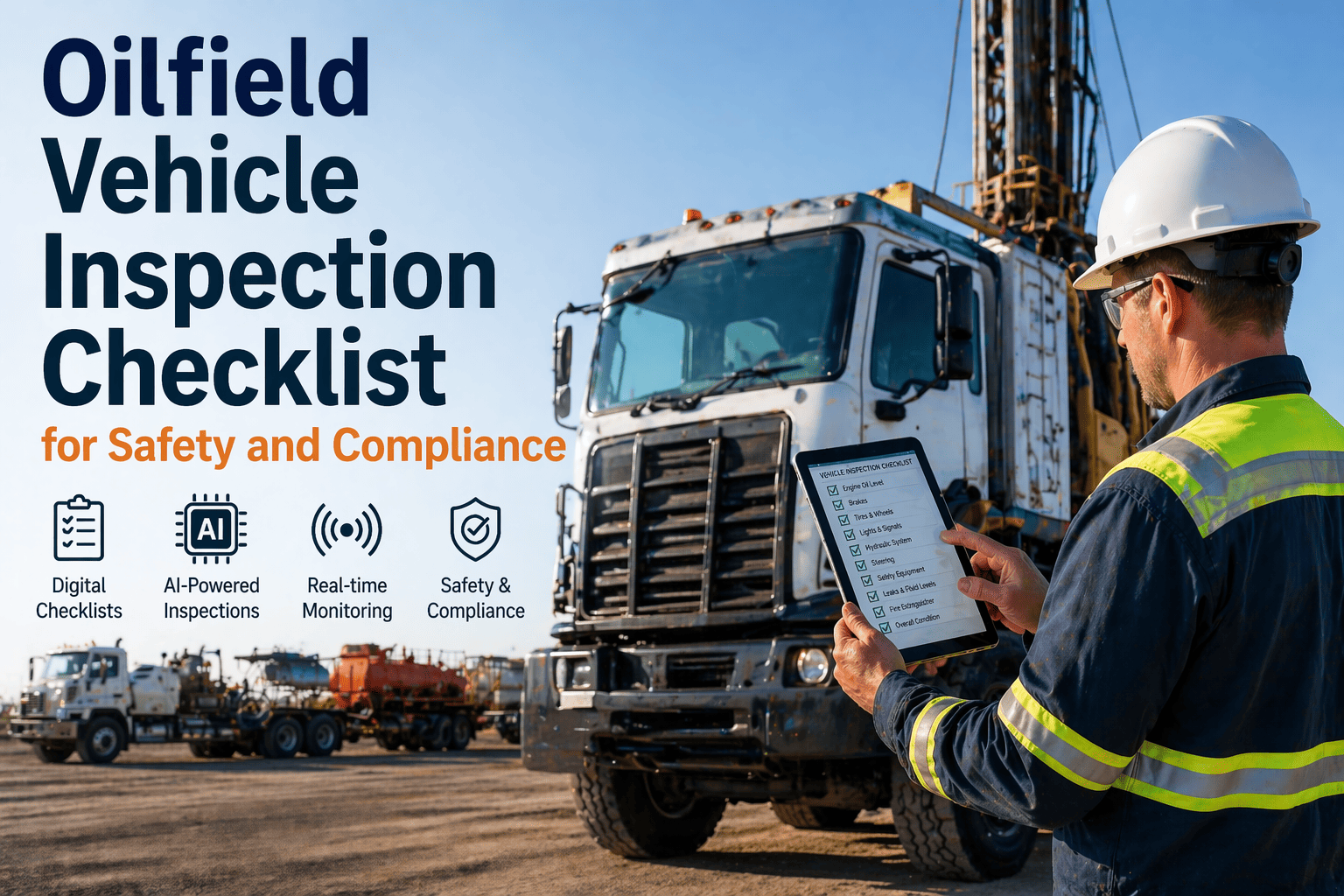
Oilfield Vehicle Inspection Checklist for Safety and Compliance
Selecting fleet management software for oil and gas operations is a strategic operational decision that directly impacts margin, safety, and regulatory standing. In upstream, midstream, and downstream environments, mobile assets face extreme mechanical stress, remote-location risk, and stringent HSE compliance regimes that standard commercial fleet platforms were never engineered to address. A mismatched software selection creates fragmented data, manual workarounds, and blind spots that only become visible after a preventable incident or failed audit. This executive guide provides a structured framework for evaluating oil and gas fleet software — moving beyond feature lists to focus on business outcomes: reducing unplanned downtime, enforcing HSE compliance automatically, and delivering real-time visibility into equipment utilisation across dispersed well sites, pipeline corridors, and production facilities. Use this guide to align procurement, operations leadership, and HSE teams around criteria that matter — and discover why FleetRabbit has become the preferred digital inspection and compliance platform for oilfield contractors globally. Book a demo to evaluate FleetRabbit against your specific operational requirements.
Executive Scope & Strategic Intent
This guide covers six critical evaluation dimensions for oil and gas fleet software: operational alignment with business goals, real-time equipment utilisation analytics, HSE and compliance automation, offline-capable field deployment, integration with existing telematics and ERP systems, and total cost of ownership including implementation timeline. Each dimension includes specific questions to ask vendors, red flags to watch for, and the FleetRabbit approach that addresses each requirement without custom development or multi-year professional services engagements.
FleetRabbit Solutions for Fleet Managers & Executives
FleetRabbit is not a generic fleet tracking tool. It is a purpose-built operational platform for oil and gas leaders who need real-time control, compliance certainty, and capital efficiency across dispersed, high-value mobile assets. Here is how the platform addresses the specific challenges faced by different stakeholder groups.
For Fleet Managers
Real-time dashboard showing every vehicle's inspection status, open defects, and certification health. Automatic work order routing eliminates manual coordination. Offline mobile app ensures 97%+ inspection completion even in zero-connectivity zones.
For HSE Officers
Automated compliance tracking for all vehicle and driver credentials. Multi-stage expiry alerts prevent lapses. One-click audit packs satisfy DVSA, FMCSA, ADNOC, and DGMS requirements. Safety equipment inspections tracked on independent schedules.
For Operations Directors
Portfolio-level visibility across all sites and assets. Equipment utilisation analytics identify under-performing vehicles for redeployment or disposal. Real-time exception alerts highlight compliance gaps before they become incidents or audit findings.
For Maintenance Teams
Work orders arrive automatically with geo-tagged photos, defect descriptions, and priority levels. No more chasing paper forms or deciphering handwritten notes. Historical repair data informs predictive maintenance strategies.
For CFOs
Reduced unplanned breakdowns lower repair costs by 73%. Equipment utilisation data supports right-sizing decisions, unlocking 15–25% capital efficiency. Compliance automation prevents costly contract penalties and litigation exposure.
For IT Leaders
Cloud-native platform with RESTful API, SSO support, and role-based access control. Native integrations with major telematics providers eliminate custom development. Data residency options available for regional compliance requirements.
02
HSE Compliance Automation
HSE compliance in oil and gas is not optional — it is the legal and contractual foundation of every operation. Missing fire extinguisher inspections, expired driver medicals, lapsed vehicle roadworthiness certificates, and undocumented pre-trip checks have each resulted in prosecution, contract termination, and reputational damage. Manual compliance management cannot scale across dispersed fleets operating under multiple regulatory regimes. Automation is the only viable path to sustained compliance.
Compliance Layers Fleet Software Must Address
FleetRabbit Compliance Automation Framework
03
Equipment Utilisation Analytics
Oil and gas fleets carry significant capital value — a single workover rig support vehicle, coiled tubing unit, or chemical injection tanker can represent a six-figure investment. Yet most operators lack accurate data on how intensively each asset is used, where it is deployed, and whether it is generating sufficient return. Equipment utilisation analytics transform raw telematics and inspection data into actionable intelligence for fleet right-sizing, capital planning, and operational optimisation.
Key Utilisation Metrics to Track
How FleetRabbit Delivers Utilisation Intelligence
FleetRabbit Utilisation Analytics
Turn Telematics Data Into Capital Efficiency Decisions
Identify under-utilised assets, reduce idle time, and optimise fleet size with data-driven insights — all within the same platform that manages your inspections, compliance, and maintenance workflows.
Oilfield operations routinely occur in areas with zero or intermittent mobile data coverage — remote wellpads, pipeline corridors in rural regions, and offshore supply bases. Any fleet management platform that requires constant connectivity will fail in these environments, producing incomplete records, missed inspections, and compliance gaps. Offline capability is not a nice-to-have feature; it is a fundamental operational requirement.
Offline Capability Requirements
FleetRabbit Offline Architecture
05
Integration & Total Cost of Ownership
Evaluating fleet software on licence price alone is a false economy. The true cost includes implementation time, integration complexity, training burden, ongoing support, and the operational impact of delays or failures. A low-cost platform that takes six months to deploy, requires custom API development to connect to your telematics provider, and produces data that cannot be exported for audit purposes will cost far more than a premium platform deployed in days with native integrations and compliance-ready outputs.
Integration Requirements
Total Cost of Ownership Comparison
06
Why Choosing the Right Software is Critical
Oil and gas fleet operations differ fundamentally from standard commercial transport. Assets operate on unpaved wellpad surfaces, carry hazardous materials, require site-specific safety certifications, and function in areas with zero mobile connectivity. Generic fleet management platforms assume paved roads, consistent data coverage, and uniform regulatory requirements — assumptions that collapse in the oilfield environment. The wrong software choice creates three systemic risks:
Operational Blind Spots
The FleetRabbit Difference
Measured Outcomes
FleetRabbit Oilfield Fleet Performance Results
73%
Fewer Unplanned Breakdowns
Average reduction at 12 months post-deployment across FleetRabbit oilfield fleet sites using structured zone inspection and automated work orders
97%
Inspection Completion Rate
Zone checklist completion rate on critical items across digitally deployed oilfield fleets — versus 61% industry average on paper-based systems
5–7 Days
Time to Live Deployment
Average time to full digital inspection deployment on a 50-vehicle oilfield fleet, including asset hierarchy, checklists, and crew onboarding
100%
Work Order Linkage
Every FLAG and STOP finding automatically routed to corrective work orders with photo evidence — zero manual transcription required
Frequently Asked Questions
QHow does FleetRabbit compare to generic fleet management platforms like Geotab or Samsara?
Geotab and Samsara are telematics providers — they excel at GPS tracking and engine diagnostics but do not provide structured DVIR/HSE inspection workflows, certification tracking, or automated work order routing. FleetRabbit complements these platforms by ingesting their telematics data and layering on oilfield-specific inspection, compliance, and maintenance automation. Many customers use FleetRabbit alongside Geotab or Samsara, not instead of them.
QCan FleetRabbit handle multi-client operations where different sites have different HSE requirements?
Yes. FleetRabbit supports site-specific inspection checklists and compliance rules. A driver dispatched to an ADNOC site sees the ADNOC-standard checklist, while the same vehicle dispatched to a different client sees that client's specific requirements. Site access permits and credentials are tracked per site, preventing dispatch to locations where the vehicle lacks valid authorisation.
QWhat happens if a driver completes an inspection offline and then loses the device before syncing?
FleetRabbit's mobile app stores all inspection data locally on the device with encryption. If the device is lost or damaged before sync, the data remains secure and unrecoverable without authentication. For operational continuity, we recommend enabling device-level backup (iCloud for iOS, Google Drive for Android) as an additional safeguard. In practice, device loss before sync is extremely rare given typical field usage patterns.
QHow does FleetRabbit support migration from paper-based systems without creating a compliance gap?
Historical paper inspection records should be imported as structured data against each vehicle asset in FleetRabbit before digital inspections go live. Auditors reviewing a vehicle's history will examine the full audit period, which may extend back 12–24 months. FleetRabbit's implementation team handles structured data import as part of standard onboarding, completing the full migration for most oilfield fleets in 5–7 working days. Discuss your migration timeline in a scoping call.
QIs FleetRabbit suitable for small fleets (under 20 vehicles) or only large operations?
FleetRabbit scales from single-digit fleets to thousand-vehicle operations. Small fleets benefit disproportionately because the platform eliminates the administrative burden that falls on a single fleet manager or owner-operator. There is no minimum fleet size, and the 5–7 day deployment timeline applies regardless of scale.
QWhat regions and regulatory frameworks does FleetRabbit support?
FleetRabbit structures inspection records and compliance outputs to satisfy audit requirements across the UK (DVSA), EU (TÜV/ITV), USA (FMCSA), Canada (NSC), GCC (ADNOC, Aramco standards), and India (DGMS). The platform is cloud-hosted with data residency options available for organisations subject to local data sovereignty laws.
Deploy in 5–7 Working Days
Evaluate FleetRabbit Against Your Oilfield Fleet Requirements
Use this buyer's checklist to structure your vendor evaluations. Then see how FleetRabbit addresses each criterion with purpose-built oilfield functionality — deployed in days, not months. Book a personalised demo or start a free trial to experience the platform firsthand.