Produced water hauling represents the fastest-growing segment of oilfield logistics operations — with hydraulic fracturing completion techniques generating 3-7 barrels of produced water for every barrel of oil extracted creating massive transportation demand across major basin operations in Permian, Eagle Ford, Bakken, and Marcellus regions where millions of barrels move daily from wellhead collection points to disposal facilities via truck transport fleets. The regulatory framework governing produced water hauling operations creates systematic compliance complexity that differentiates this transportation category from conventional commercial trucking — DOT hazardous materials regulations classify produced water as non-hazardous waste requiring specific placarding, driver certification, and manifest documentation despite absence of HAZMAT endorsement requirements, EPA Underground Injection Control regulations mandate disposal well permitting and monitoring with strict tracking of water volumes, sources, and injection pressures, state environmental agencies impose additional manifest requirements and route restrictions preventing water haulers from using certain roadways or disposing at unauthorized facilities, and local municipal codes frequently establish operational hours, noise restrictions, and traffic pattern limitations for water truck movements through residential corridors. Fleet managers operating produced water hauling operations face systematic administrative burden where manual compliance workflows consume 15-25 hours weekly per 50-truck fleet maintaining paper manifest systems, verifying disposal facility permits before each load delivery, documenting route compliance avoiding restricted roadways, tracking driver certification currency for non-HAZMAT waste transport, and assembling audit packages when regulators request compliance verification demonstrating proper handling, transportation, and disposal of produced water volumes. FleetRabbit's produced water compliance module automates these manual workflows through integrated digital manifest generation linking wellhead collection GPS coordinates to disposal facility permit numbers with automatic validation preventing deliveries to unauthorized locations, real-time route monitoring ensuring drivers follow approved corridors and flagging deviations from compliant pathways, automated driver certification tracking confirming all operators maintain current produced water hauling qualifications, and one-click audit report generation compiling manifest records, route compliance documentation, and disposal facility permit verification into export-ready packages satisfying DOT, EPA, and state regulatory submission requirements. Book a demo to see FleetRabbit's produced water compliance automation demonstrated with actual manifest and route scenarios.
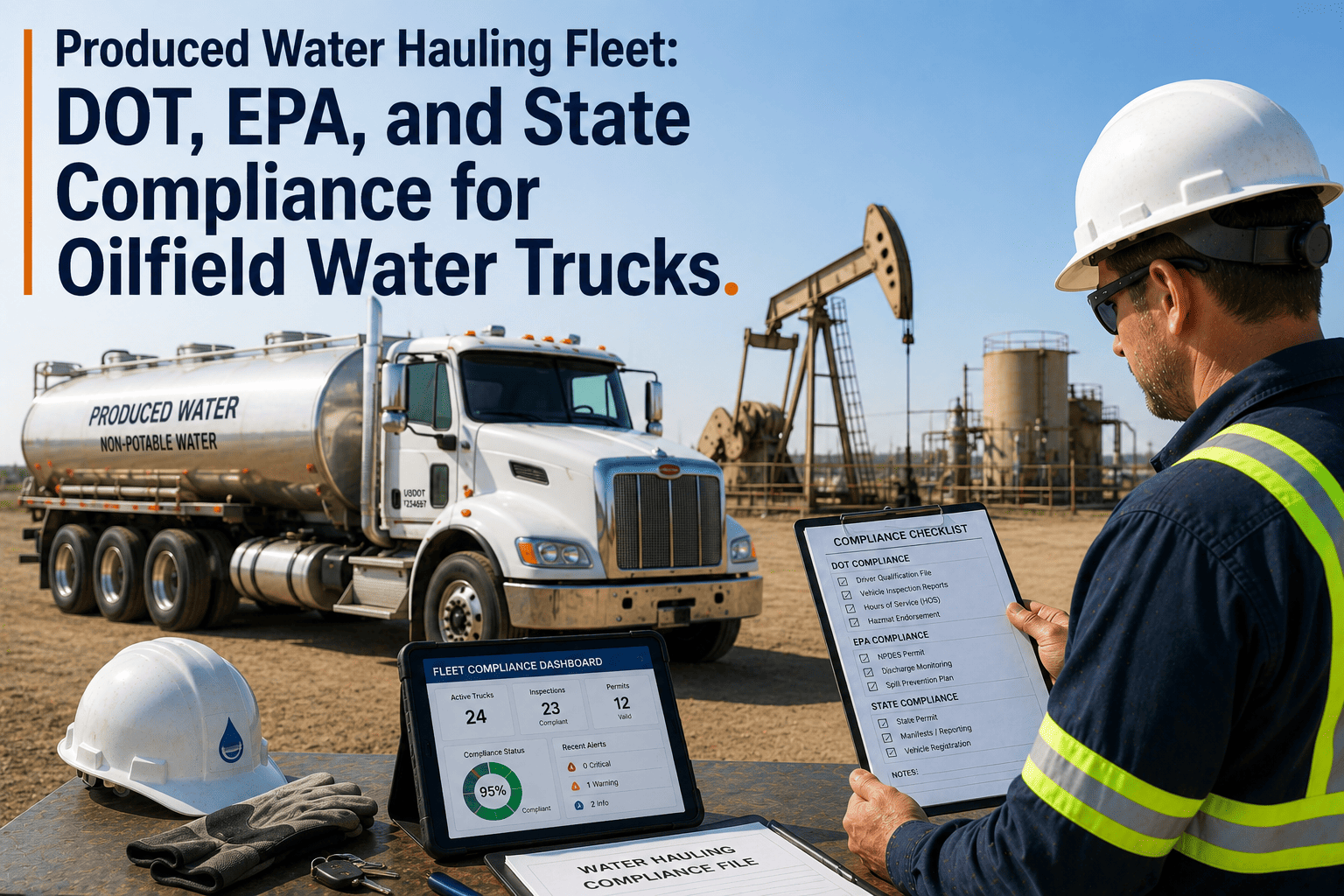
Produced Water Hauling Fleet: DOT, EPA, and State Compliance for Oilfield Water Trucks
Produced water hauling is the fastest-growing oilfield logistics segment and the most regulated. FleetRabbit's automated manifest tracking, route compliance monitoring, and spill documentation keep water haulers audit-ready across DOT, EPA, and state requirements.
Why Produced Water Hauling Compliance Overwhelms Manual Workflows
Produced water hauling operations exist at the intersection of multiple overlapping regulatory frameworks creating compliance complexity that exceeds conventional commercial trucking requirements. DOT hazardous materials regulations establish baseline transportation safety requirements including vehicle placarding with "Non-Hazardous Oilfield Waste" identifiers, manifest documentation for every load transported showing origin wellhead location and destination disposal facility, driver certification confirming operators understand produced water handling protocols despite absence of formal HAZMAT endorsement requirements, and route recordkeeping demonstrating compliance with local traffic restrictions and bridge weight limitations applicable to heavy water truck operations.
EPA Underground Injection Control regulations layer additional requirements focused on disposal well integrity and groundwater protection including disposal facility permit verification before accepting produced water deliveries, volume tracking ensuring injection rates remain within permitted limits preventing reservoir overpressure, water chemistry documentation demonstrating compatibility between produced water composition and receiving formation geology, and disposal monitoring proving injected volumes match transported volumes preventing unauthorized surface discharge or illegal dumping. State environmental agencies impose supplemental manifest requirements exceeding federal minimums — Texas Railroad Commission mandates Form H-10 completion for all saltwater disposal deliveries, New Mexico Oil Conservation Division requires additional chain-of-custody documentation, and Pennsylvania DEP imposes strict routing restrictions preventing water trucks from using certain county roads and municipal streets.
The operational consequence for fleet managers manifests as overwhelming administrative burden where manual compliance workflows consume 15-25 hours weekly per 50-truck fleet maintaining paper manifest systems that require driver completion at wellhead pickup, dispatcher verification before authorizing disposal delivery, facility operator signature confirmation, and office staff filing for audit retention, verifying disposal facility permits remain current before each load delivery preventing deliveries to facilities with expired or suspended UIC permits, documenting route compliance through driver logbooks and post-trip verification that approved corridors were followed avoiding restricted roadways, tracking driver certification currency ensuring all operators maintain current produced water hauling qualifications before dispatch assignment, and assembling audit packages when DOT, EPA, or state regulators request compliance verification requiring manual retrieval and photocopying of manifest records, route documentation, and permit verification spanning months or years of operational history.
Four Integrated Capabilities Automating Produced Water Fleet Compliance
FleetRabbit automates produced water hauling compliance across manifest generation, route monitoring, permit verification, and audit documentation — eliminating manual workflows consuming 15-25 hours weekly per 50-truck fleet.
FleetRabbit's digital manifest system automatically generates DOT and state-required manifest documentation when drivers log produced water pickups at wellhead locations using mobile devices. The system captures all mandatory data elements including pickup location GPS coordinates, estimated water volume, wellhead operator name, driver identification, and vehicle inspection status. When drivers arrive at disposal facilities, the mobile app automatically populates destination facility name, permit number, actual delivered volume, facility operator signature via touchscreen, and delivery timestamp — creating complete manifest record without manual paperwork.
Produced water haulers face route restrictions imposed by state DOT weight limits, municipal traffic ordinances, and local operational hours. FleetRabbit's route compliance module loads restricted corridor maps into GPS tracking system automatically alerting dispatchers and drivers when vehicles deviate from approved routes or enter prohibited areas. The system maintains audit trail of all route compliance events including approved pathway adherence, deviation incidents with GPS coordinates, and corrective action documentation.
EPA UIC permits authorizing produced water disposal require periodic renewal. Facilities with expired, suspended, or revoked permits cannot legally accept deliveries. FleetRabbit maintains disposal facility database tracking permit numbers, expiration dates, and current status updated weekly from state regulatory databases. The system automatically flags facilities with permits expiring within 60 days and blocks manifest generation for facilities with expired permits preventing inadvertent deliveries to non-compliant locations.
Regulatory audits request comprehensive documentation spanning 6-12 month periods including complete manifest records, route compliance documentation, disposal facility permit verification, driver certification records, and incident reports. FleetRabbit compiles this documentation automatically generating export-ready audit packages in PDF format organized by regulatory requirement eliminating manual records retrieval consuming 20-40 hours of staff time per audit request.
FleetRabbit Produced Water Compliance Module Deployment
FleetRabbit implementation team loads disposal facility database with UIC permit numbers, expiration dates, facility GPS coordinates, permit conditions, and current regulatory status for all locations receiving produced water from fleet operations. Route restriction maps imported defining prohibited corridors, weight-limited bridges, municipal no-truck zones, and operational hour limitations. Driver roster uploaded with produced water hauling certification status and expiration tracking.
Load disposal facility database, import route restrictions, and upload driver rosters. Timeline: 3-5 business days.
Train teams on digital manifest workflows, permit verification, and route compliance monitoring. Timeline: 2-3 days.
Activate digital manifests alongside paper documentation for side-by-side validation. Timeline: 1-2 weeks.
Eliminate paper manifests and activate continuous compliance monitoring and process refinement. Timeline: Ongoing.
Common Questions About Produced Water Fleet Compliance
Deploy Compliance Automation for Produced Water Hauling Operations
Produced water hauling represents the fastest-growing oilfield logistics segment with hydraulic fracturing completion techniques generating 3-7 barrels of produced water for every barrel of oil extracted creating massive transportation demand where millions of barrels move daily from wellhead collection points to disposal facilities via truck transport fleets — subject to overlapping regulatory frameworks from DOT, EPA, state environmental agencies, and local municipal codes. FleetRabbit's produced water compliance module automates these workflows through integrated digital manifest generation, real-time route monitoring, automated permit tracking, and one-click audit report generation — eliminating manual workflows consuming 15-25 hours weekly while preventing EPA violations carrying $37,500-$75,000 civil penalties per incident.