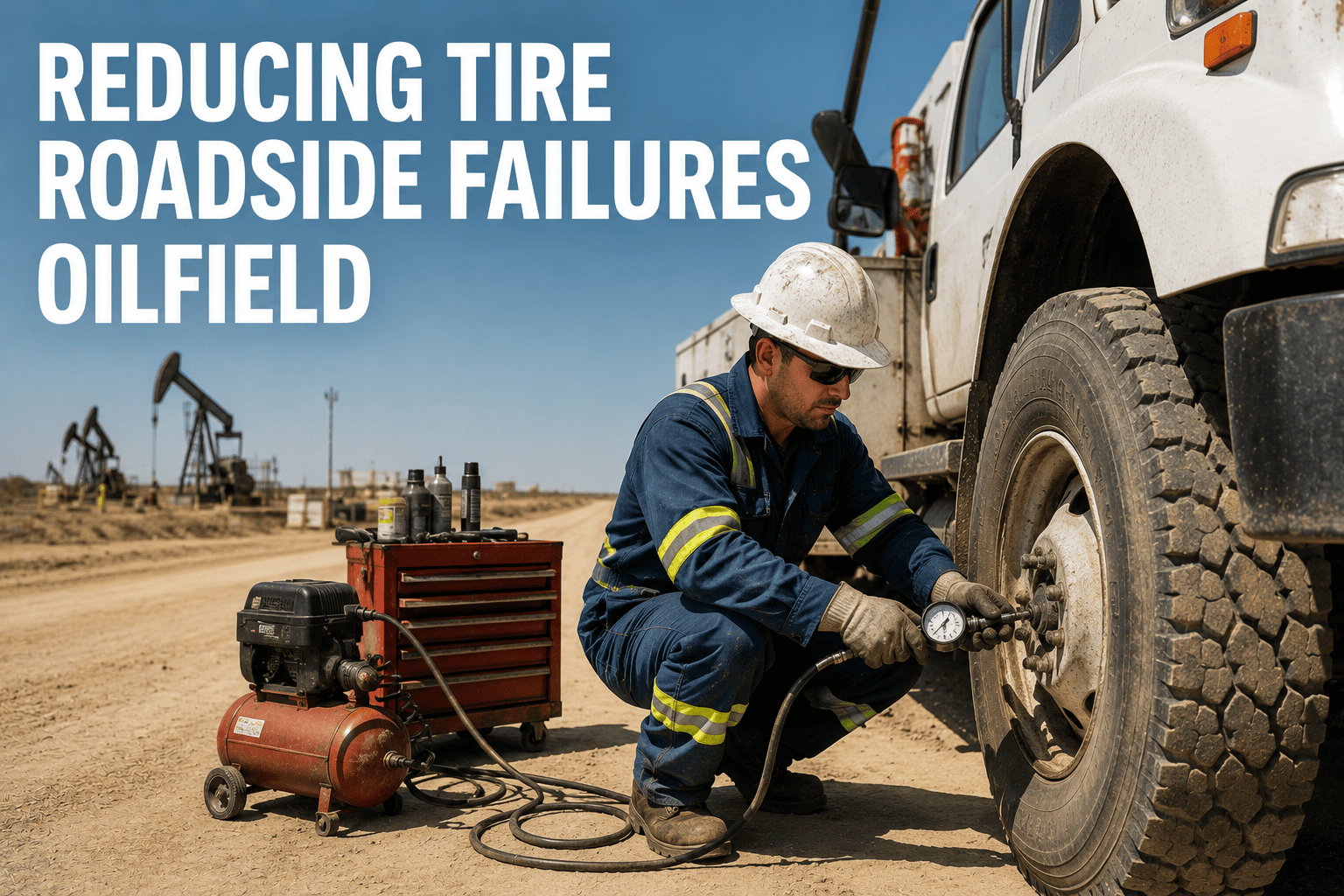
A tire doesn't blow out on the highway without warning. It leaks air for days, sometimes weeks, building heat with every mile until the structure finally gives. The failure feels sudden to the driver stranded on the shoulder of a remote access road, but the data almost always shows a slow, visible pattern that led up to it. For oilfield fleets running heavy loads over rough terrain far from the nearest service bay, that gap between when a tire starts failing and when someone notices is exactly where roadside breakdowns come from.
Roughly 80 percent of roadside tire failures trace back to gradual air loss rather than a sudden impact, and creeping underinflation builds heat that weakens the tire structure over days before it fails. Fleets that pair pressure monitoring with wear-pattern tracking routinely cut blowout rates by 70 percent or more, turning a $2,500 to $10,000 roadside event into a $15 to $400 planned repair caught during a routine check.
Why Tire Failures Hit Oilfield Fleets Harder
Oilfield vehicles carry heavier loads over rougher terrain than most commercial fleets, and they do it on routes where the nearest tire service can be an hour or more away. A failure that would be a minor inconvenience on a paved highway route becomes a real operational and safety problem when it happens on an unpaved access road to a remote wellpad.
Heavy Loads Accelerate Every Existing Weakness
A tire already running low on pressure or carrying early sidewall damage fails faster under the load profile common to oilfield service trucks and tankers, since the extra weight increases flex and heat buildup on every mile.
Distance Turns A Repair Into An Emergency
The same slow leak that could be caught and plugged for a few dollars during a routine stop becomes a roadside blowout costing thousands once it happens miles from the nearest service point, with a loaded vehicle now stranded and a delivery window slipping.
FleetRabbit monitors pressure trends per tire and flags gradual drift before it crosses into failure territory. You can start a free trial and see your fleet's current tire risk profile.
The Root Causes Behind Most Tire Failures
A small set of root causes accounts for the majority of roadside tire failures across commercial and oilfield fleets. Knowing which one is driving a specific truck's risk determines what fix actually works.
| Root Cause | How It Develops | Prevention Focus |
|---|---|---|
| Underinflation And Heat | Slow pressure loss increases flex, building internal heat over days | Frequent pressure checks against load-specific inflation charts |
| Embedded Debris | Nails or screws work loose from tread gradually, causing a slow leak | Close tread inspection at every stop, not just visible damage checks |
| Sidewall Damage | Cracks or bulges from impact or age weaken the structure over time | Regular sidewall inspection, since damage here is non-repairable |
| Rubber Aging | UV exposure and temperature cycling degrade rubber compounds by year five or six | Track tire age independently of tread depth or mileage |
| Overloading | Load exceeding a tire's rated capacity accelerates every other failure mode | Match inflation and tire rating to actual carried load, not sidewall max |
Reading Wear Patterns Like A Diagnostic Report
A tire's wear pattern tells you what's actually wrong with the vehicle, not just the tire. Learning to read that pattern turns every inspection into a chance to catch a mechanical issue before it destroys the next tire too.
Center wear signals overinflation
When only the center of the tread is wearing faster than the edges, the tire is carrying too much pressure for its load, reducing contact and grip.
Shoulder wear signals underinflation
Faster wear on the outer edges of the tread points to low pressure, the leading contributor to the heat buildup that causes blowouts.
Cupping points to suspension issues
A scalloped, uneven wear pattern usually means worn shocks or suspension components are letting the tire bounce rather than maintain steady contact.
Diagonal wear points to misalignment
Wear that runs at an angle across the tread indicates the truck is out of alignment, which also accelerates wear on every other tire in the same position across the fleet.
FleetRabbit logs tread photos and wear patterns per tire, per wheel position, so a developing alignment or suspension issue gets caught before it takes out the next tire too. You can book a demo to see it applied to your fleet.
Building A Pressure Monitoring Discipline That Actually Works
Most fleets already own the tools to prevent the majority of blowouts. The gap is usually a missed alert or a check that isn't happening consistently, not a lack of technology.
Route pressure alerts to someone who acts on them
A pressure drop alert sitting unread in a dispatcher inbox does nothing. Alerts need to route directly to the shop or maintenance team with a clear expectation of same-day follow-up.
Check against load-specific charts, not sidewall max
The correct inflation pressure depends on what the truck is actually carrying that day, not the maximum number printed on the tire's sidewall.
Combine physical checks with sensor data
A gauge check catches drift that happens below a sensor's alert threshold but is still enough to accelerate wear, so physical spot checks and continuous monitoring work best together.
Log tire age independently of mileage
A low-mileage tire can still be years old and structurally weakened, so age needs its own tracking field rather than being inferred from tread depth alone.
What To Track Per Tire, Per Wheel Position
The fleets seeing the biggest reduction in blowouts track pressure trend history, tread photos, and wear pattern notes at the individual tire level, tied to its specific wheel position on a specific truck, rather than logging tire condition as a single fleet-wide checkbox.
Almost every roadside blowout gives warning days in advance through pressure trends and wear patterns. FleetRabbit tracks both per tire, per truck, so your team catches the failure risk during a planned stop, not stranded on a remote access road.