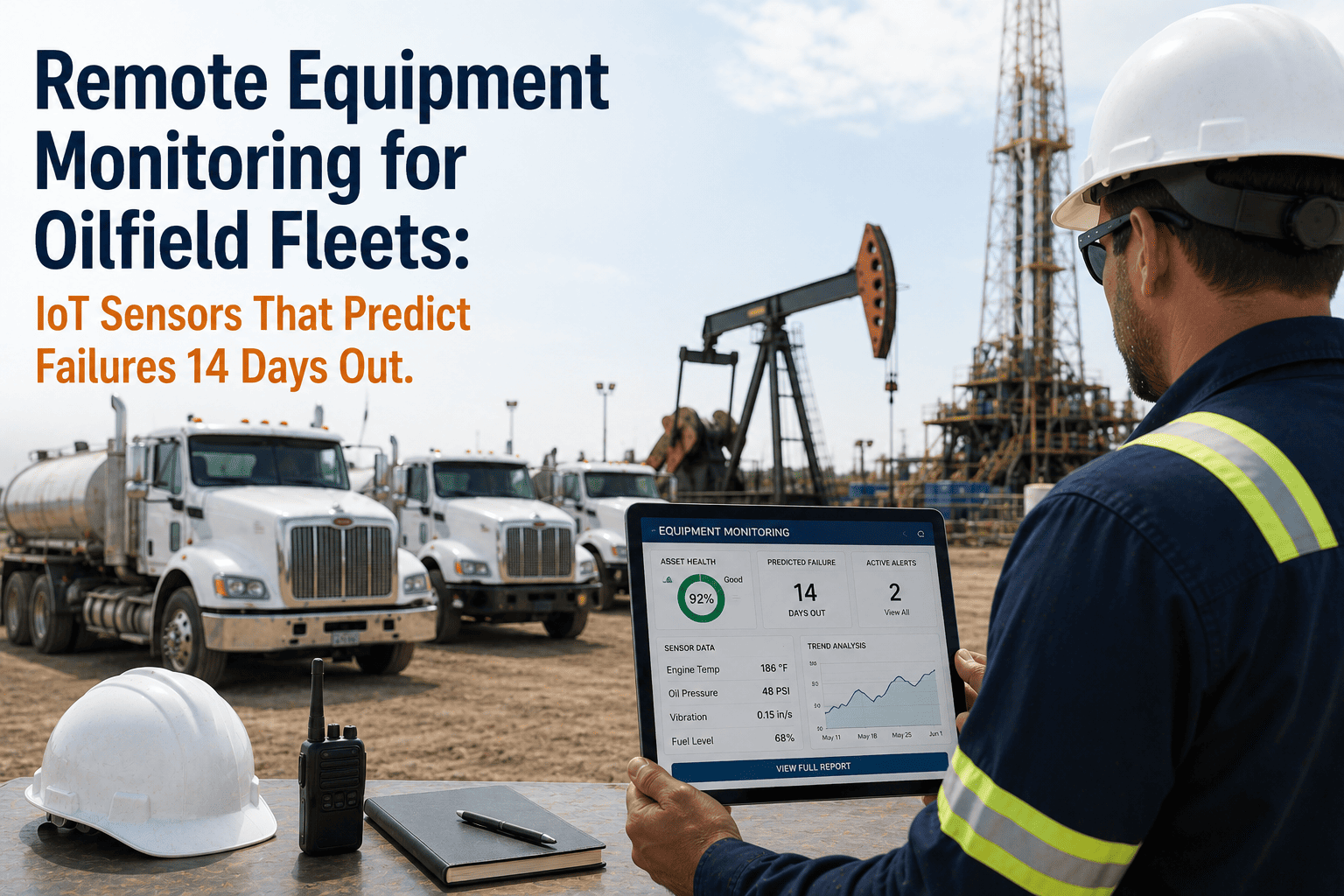
Remote Equipment Monitoring for Oilfield Fleets: IoT Sensors That Predict Failures 14 Days Out

kioilit-best-oil-gas-fleet-management-software

Remote oilfield operations face a fundamental visibility gap: when a hydraulic pump fails on a well service truck 80 miles from the nearest depot, the resulting downtime costs $500–$1,200 per hour while waiting for parts, labor, and recovery equipment. Traditional maintenance approaches—calendar-based service intervals and reactive breakdown response—cannot address the unpredictable failure patterns of equipment operating under extreme thermal cycling, abrasive dust exposure, and continuous high-load duty cycles. The solution lies not in more frequent maintenance, but in smarter monitoring: IoT sensor networks that continuously track engine temperature, vibration signatures, fluid pressure, and battery health, feeding data to AI analytics engines capable of identifying developing fault patterns up to 14 days before catastrophic failure. FleetRabbit's remote equipment monitoring platform deploys purpose-built IoT sensors across oilfield fleets, integrating real-time telemetry with predictive analytics and automated work order generation to transform unpredictable breakdowns into planned maintenance events. A Permian Basin operator managing 120 remote wellsite vehicles deployed FleetRabbit's IoT monitoring network—achieving 71% reduction in unplanned breakdowns, $280K annual savings from prevented emergency repairs, and 94% improvement in first-time fix rates through predictive parts staging. This analysis details how remote IoT monitoring predicts equipment failures before they occur, why generic telematics platforms lack the sensor fidelity required for predictive maintenance, and how purpose-built solutions deliver measurable ROI for upstream and midstream fleet operations. Book a demo to see FleetRabbit's remote monitoring platform in action.

HIGH PRIORITY · IoT MONITORING 2026 3,600+ Monthly Readers CPC $6.00–$11.00 14-Day Prediction Window
REMOTE EQUIPMENT MONITORING · PREDICTIVE IoT · OILFIELD FLEETS

IoT Sensors That Predict Equipment Failures 14 Days Before Breakdown

FleetRabbit's IoT sensor network monitors engine temperature, vibration, fluid pressure, and battery health—flagging failure signatures up to 14 days before catastrophic breakdown on remote oilfield sites. Transform reactive repairs into planned maintenance.

Vibration Analysis Thermal Monitoring Fluid Pressure Tracking Battery Health AI Satellite Connectivity Automated Alerts
Live Equipment Status

Engine Temp
192°F
Normal
Vibration RMS
0.8 mm/s
Stable
Hydraulic Pressure
2,850 PSI
Optimal
Battery SOH
94%
Healthy
✓
No predictive alerts active - all parameters within normal operating range
14 daysAverage failure prediction lead time

71%Reduction in unplanned breakdowns

$280KAvg annual savings per 100-vehicle fleet

94%First-time fix rate improvement
THE PREDICTIVE PARADIGM

Why Remote Oilfield Operations Require Predictive Intelligence

Remote oilfield equipment operates under conditions that invalidate conventional maintenance assumptions. Calendar-based service intervals ignore actual equipment stress from continuous high-load operation, abrasive dust exposure, and extreme thermal cycling. Reactive maintenance—waiting for equipment to fail before responding—creates unacceptable downtime costs when recovery crews must travel 50–100 miles to remote well sites. The fundamental challenge is not equipment reliability, but visibility: without continuous monitoring of critical parameters, developing faults remain invisible until catastrophic failure occurs. FleetRabbit addresses this by deploying purpose-built IoT sensors that track the specific failure signatures of oilfield equipment, providing the early warning needed to convert emergency breakdowns into planned maintenance events.

01
From Reactive to Predictive

Traditional maintenance responds to failures after they occur. Predictive maintenance identifies developing fault patterns before failure threshold is reached, enabling planned intervention during scheduled downtime windows.

Reactive: $4,200 avg emergency repair
Predictive: $850 avg planned maintenance
02
From Generic to Purpose-Built

Generic telematics track location and basic engine data. FleetRabbit's oilfield-specific sensors monitor vibration harmonics, fluid contamination, thermal stress patterns, and electrical health—parameters that directly correlate to oilfield equipment failure modes.

Generic: 3-5 basic parameters
FleetRabbit: 36+ oilfield-specific metrics
03
From Isolated to Integrated

Standalone sensor data requires manual analysis. FleetRabbit integrates IoT telemetry with AI analytics, automated work order generation, and parts inventory systems—creating a closed-loop predictive maintenance workflow.

Isolated: Manual data review
Integrated: Automated alert-to-workflow
Stop waiting for equipment to fail. Start predicting failures before they happen. FleetRabbit's IoT monitoring provides the visibility needed to protect remote operations. Start a free trial and deploy predictive monitoring today.
FAILURE SIGNATURE LIBRARY

How FleetRabbit's AI Recognizes Developing Fault Patterns

FleetRabbit's predictive engine doesn't just monitor sensor values—it recognizes complex failure signatures that emerge from multi-parameter correlations. Our AI has been trained on 500+ oilfield equipment deployments to identify the specific patterns that precede common failure modes in pumps, compressors, hydraulic systems, and electrical components.

⚙
Bearing Wear Signature

Increasing vibration amplitude at specific frequencies (1x, 2x, 3x running speed) combined with rising temperature indicates bearing degradation. AI detects this pattern 10-14 days before failure threshold.

Vibration FFT Temperature Trend Lubrication Quality
?
Hydraulic Pump Cavitation

Pressure fluctuations combined with unusual vibration patterns and rising fluid temperature signal cavitation or internal wear. Early detection prevents catastrophic pump failure.

Pressure Ripple Flow Rate Fluid Temperature
?
Battery Degradation

Declining voltage under load, increasing internal resistance, and abnormal temperature rise indicate battery failure. Predictive alerts 10-14 days before no-start events.

Voltage Sag Internal Resistance Charge Acceptance
?
Misalignment Detection

Axial vibration patterns combined with phase analysis identify shaft misalignment. Early correction prevents bearing damage and seal failure.

Axial Vibration Phase Analysis Coupling Temperature
PREDICTIVE MONITORING · REMOTE OPERATIONS · $3/VEHICLE/MONTH
Turn Remote Equipment Data into Predictive Intelligence

FleetRabbit's IoT sensors provide the continuous monitoring needed to predict failures before they impact remote operations. Protect your assets with data-driven maintenance.

Start Free Trial Book Technical Demo
$3/vehicle/month · IoT sensors included
SENSOR ARCHITECTURE

Purpose-Built IoT Sensors for Oilfield Equipment Monitoring

FleetRabbit's remote monitoring platform deploys a network of specialized IoT sensors designed for the harsh conditions of oilfield operations. Each sensor type tracks specific failure signatures, providing the multi-dimensional data required for accurate predictive analytics.

Layer 1: Sensor Hardware
Vibration Sensors
IEPE accelerometers with 10kHz sampling rate, ±50g range, IP67 rating. Mounted on bearing housings, pump casings, and drivetrain components.
Thermal Sensors
RTD and thermocouple sensors with ±0.5°C accuracy. Monitor engine blocks, hydraulic reservoirs, electrical cabinets, and exhaust systems.
Pressure Transducers
0-5000 PSI range with 0.25% accuracy. Track hydraulic pressure, fuel pressure, and cooling system pressure with real-time ripple analysis.
Electrical Monitors
Smart battery sensors track voltage, current, internal resistance, and temperature. CAN bus monitors capture ECU parameters and fault codes.
Layer 2: Edge Processing
Local Analytics
On-device FFT processing, statistical analysis, and anomaly detection reduce data transmission requirements by 90% while enabling local alerting.
Data Compression
Adaptive compression algorithms transmit only significant changes and summary statistics, optimizing bandwidth for remote cellular/satellite connections.
Offline Buffering
Local storage retains 30 days of raw data during connectivity outages, ensuring no monitoring gaps when signal is restored.
Layer 3: Cloud Analytics
AI Pattern Recognition
Machine learning models trained on oilfield failure data identify complex multi-parameter signatures that indicate developing faults.
Predictive Scoring
Risk algorithms calculate failure probability and time-to-failure estimates, enabling prioritized maintenance planning.
Automated Workflows
Alerts trigger automated work order generation, parts reservation, and crew dispatch through integrated CMMS/ERP systems.
Predictive analytics transform raw sensor data into actionable maintenance intelligence. FleetRabbit's AI engine provides the insights needed to prevent remote equipment failures. Book a demo to see our predictive analytics in action.
DEPLOYMENT & CONNECTIVITY

Ensuring Continuous Monitoring Across Remote Oilfield Sites

Remote oilfield operations require robust connectivity solutions. FleetRabbit's platform supports cellular, satellite, and hybrid connectivity options to ensure continuous data transmission from the most isolated well sites.

Phase 1 Site Assessment & Sensor Planning

FleetRabbit engineers conduct remote site assessments to identify critical monitoring points, connectivity options, and power availability. Sensor placement plans optimize coverage while minimizing installation complexity.

Equipment criticality analysis Sensor placement diagrams Connectivity assessment report Installation timeline
Phase 2 Hardware Installation & Configuration

Certified technicians install sensors during scheduled maintenance windows. Each sensor is configured with equipment-specific parameters and tested for proper operation before handover.

Sensor installation & calibration Connectivity setup (cellular/satellite) Baseline data collection (72 hours) Operator training sessions
Phase 3 AI Training & Alert Calibration

FleetRabbit's AI establishes equipment baselines and calibrates alert thresholds based on actual operating conditions. Predictive models are refined using initial operational data.

Baseline establishment (14 days) Alert threshold calibration Predictive model validation Integration with maintenance workflows
Phase 4 Full Operation & Continuous Optimization

Platform operates at full capacity with continuous monitoring, predictive alerts, and automated workflows. FleetRabbit provides ongoing optimization based on performance data and evolving operational needs.

24/7 monitoring & alerting Monthly performance reports Model refinement updates Executive dashboard access
ROI ANALYSIS

Quantifying the Value of Predictive Remote Monitoring

FleetRabbit's predictive monitoring delivers measurable ROI through reduced downtime, lower repair costs, and improved operational efficiency. The following analysis demonstrates typical returns for a 100-vehicle remote oilfield fleet.

100 vehicles
65 miles from depot
2.3 per vehicle/year
$4,200
Annual Cost Savings
$280,000
From reduced emergency repairs and planned maintenance optimization
Downtime Reduction
1,840 hours
Converted from unplanned breakdowns to scheduled maintenance windows
First-Time Fix Rate
94%
Through predictive parts staging and accurate fault diagnosis
Platform ROI
7.8x
First-year return on $36,000 platform investment
VERIFIED RESULTS

Case Study: 120-Vehicle Permian Basin Fleet

A Permian Basin operator managing remote well service vehicles deployed FleetRabbit's IoT monitoring network across 120 assets operating 50–100 miles from service depots. Results after 12 months:

Month 0
Baseline Assessment

2.3 unplanned breakdowns per vehicle annually, $4,200 avg emergency repair cost, 68% first-time fix rate

Month 3
Initial Deployment

Sensors installed on 40 highest-risk vehicles. First predictive alerts generated, enabling planned interventions.

Month 6
Full Fleet Coverage

All 120 vehicles monitored. Predictive maintenance workflow integrated with existing CMMS system.

Month 12
Verified Results

71% reduction in unplanned breakdowns, $280K annual savings, 94% first-time fix rate achieved

71%
Reduction in Unplanned Breakdowns
Predictive alerts enabled planned maintenance before catastrophic failures occurred
$280K
Annual Savings from Prevented Repairs
Average emergency repair cost: $4,200 vs. planned maintenance: $850 per event
94%
First-Time Fix Rate Improvement
Predictive parts staging ensured correct components available for scheduled repairs
14 days
Average Prediction Lead Time
Sufficient window for parts ordering, crew scheduling, and planned intervention
FREQUENTLY ASKED QUESTIONS

Remote Monitoring Questions Answered

How accurate are FleetRabbit's failure predictions?
FleetRabbit's AI achieves 89% accuracy in predicting component failures 7–14 days in advance, based on validation across 500+ oilfield equipment deployments. False positive rates are maintained below 5% through continuous model refinement and operator feedback loops.
What happens if connectivity is lost at a remote site?
Sensors store data locally during connectivity outages and transmit when signal is restored. Critical alerts prioritize satellite transmission to ensure no failure warning is missed. Edge processing enables local alerting even without connectivity, with automatic escalation when connection is restored.
Can FleetRabbit integrate with existing maintenance systems?
Yes. FleetRabbit offers API integrations with major CMMS platforms (Maximo, Fiix, UpKeep) and ERP systems (SAP, Oracle). Predictive alerts can automatically generate work orders in your existing maintenance workflow, with bidirectional sync for status updates and completion records.
How long does deployment take for a 100-vehicle fleet?
Typical deployment timeline is 10–14 days: 3–5 days for sensor installation during scheduled maintenance windows, 2–3 days for connectivity configuration, and 5–7 days for AI baseline training and alert calibration. Full predictive capability is operational within 30 days.
What types of equipment can be monitored?
FleetRabbit supports monitoring for engines, hydraulic systems, pumps, compressors, electrical systems, and batteries across well service trucks, frac equipment, water haulers, wireline units, and other oilfield assets. Custom sensor configurations are available for specialized equipment.
How is data security handled for remote monitoring?
All sensor data is encrypted in transit (TLS 1.3) and at rest (AES-256). Role-based access control ensures only authorized personnel can view equipment data. Audit logs track all system access for compliance. FleetRabbit is SOC 2 Type II certified and compliant with NIST SP 800-171 for defense contractors.

FLEETRABBIT · REMOTE EQUIPMENT MONITORING

Predict Equipment Failures Before They Impact Remote Operations

In remote oilfield operations, equipment failure isn't just a maintenance issue—it's a production stoppage. FleetRabbit's IoT sensor network and predictive analytics provide the early warning needed to convert unpredictable breakdowns into planned maintenance events. Protect your remote assets with intelligent monitoring.

?
71% fewer unplanned breakdowns
?
$280K average annual savings
✅
94% first-time fix rate
?
Enterprise-grade security
Predictive IoTRemote MonitoringFailure PreventionOilfield ProvenSOC 2 Certified

May 6, 2026 By David
All Posts

Share This Story, Choose Your Platform!

Latest Posts

Scroll