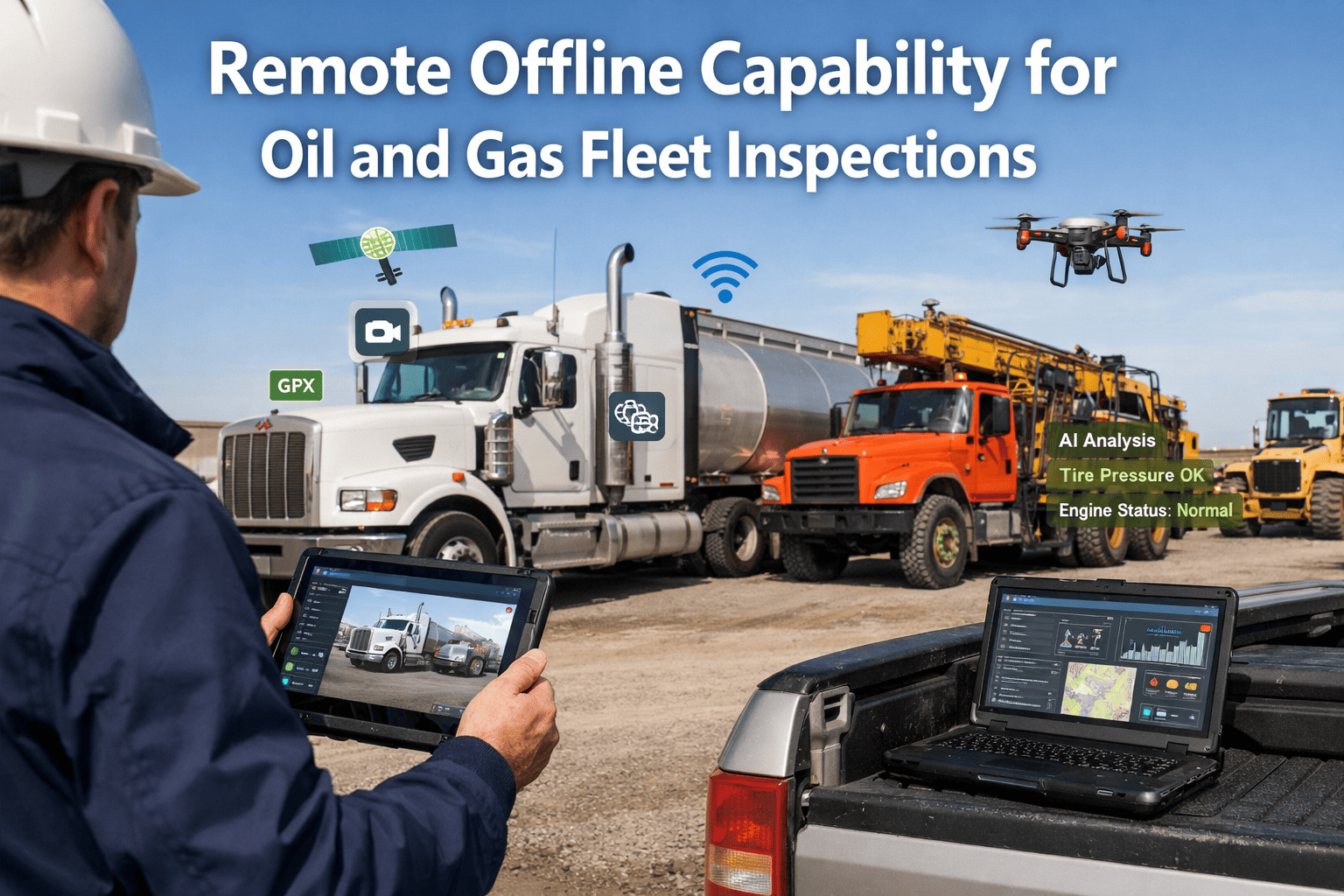
Oil and gas operations lose $2.8 million annually to compliance failures caused by data gaps in remote locations where cellular connectivity is unavailable for 8–16 hours of daily operations. When regulatory auditors investigated a major operator's inspection records, they discovered 340 documented "equipment inspections" across a 6-month period — but GPS metadata revealed that 68% of those inspections were logged from the supervisor's office location, not from wellhead sites where equipment was actually deployed. The operator couldn't prove inspections occurred because their cloud-only fleet management system required constant connectivity, forcing field personnel to complete paperwork retrospectively from memory after returning to areas with cell service — creating compliance exposure that resulted in $480,000 in penalties and operational restrictions. Remote oilfield locations demand offline-capable inspection systems that capture critical safety and maintenance data during 4–16 hour periods without connectivity, then automatically synchronize when connection restores — ensuring complete documentation regardless of network availability. Book a demo to see how FleetRabbit's offline-first architecture ensures zero data loss in remote wellhead and pipeline locations.
Offline Capability Solution
FleetRabbit's mobile inspection platform operates fully offline for 4–16+ hour periods without cellular or WiFi connectivity — capturing equipment inspections, safety observations, maintenance work orders, incident reports, and operator certifications with GPS verification and photo documentation. All data encrypted and stored locally on device, automatically synchronized to cloud when connection detected. Result: 100% inspection compliance regardless of location connectivity, zero regulatory documentation gaps, complete audit trails proving field work actually occurred versus paperwork completed retrospectively from office locations.
100%
Data Capture Rate in Zero-Connectivity Remote Locations
0
Compliance Documentation Gaps Discovered During Regulatory Audits
16hrs
Maximum Offline Operation Duration Before Automatic Sync Required
$480K
Penalty Avoided Through Verifiable GPS-Stamped Inspection Documentation
The Critical Problem: Cloud-Only Systems Fail in Remote Oilfield Operations
Modern fleet management platforms promise real-time visibility, instant data access, and cloud-based collaboration — but these capabilities depend on continuous internet connectivity that simply doesn't exist at wellhead locations, pipeline corridors, and remote drilling sites where oil and gas operations actually occur. When connectivity drops, cloud-only systems become unusable, forcing field personnel to abandon digital documentation and revert to paper logbooks that create the compliance gaps and data quality problems that digital systems were supposed to eliminate.
Intermittent Connectivity Creates Documentation Black Holes
Wellhead sites operate in areas with zero cellular coverage for 40–60% of operational hours. Cloud-based fleet systems display "No Connection" error when operators attempt to log inspections, complete work orders, or report safety incidents. Critical equipment movements, maintenance events, and compliance activities go undocumented during offline periods. When connection finally restores 8–12 hours later, field personnel attempt to reconstruct events from memory — creating incomplete records with inaccurate timestamps that regulatory auditors reject as unreliable. Insurance claims denied because equipment activity logs have unexplained 6–10 hour gaps where no data was recorded despite operations continuing throughout period.
Retrospective Documentation Destroys Audit Credibility
Field supervisor returns to office after 12-hour shift at remote wellsite, opens cloud fleet system, attempts to complete inspection checklists from memory for equipment examined 10 hours earlier. Records show inspection "completed" at 6:00 PM from office WiFi network — but equipment was actually inspected at 9:00 AM at wellsite location 60 miles away. GPS metadata inconsistency flags inspection as potentially fraudulent during regulatory audit. Auditor questions: "How did inspector complete field inspection from office location?" Supervisor explains: "We had to wait until we got back to area with internet." Auditor response: "These records don't prove inspection actually occurred — they prove paperwork was completed after the fact." Compliance violation issued despite inspection actually happening. Result: $125,000 penalty for inadequate documentation practices plus 90-day operational monitoring requirement.
Safety Incidents During Offline Periods Lack Immediate Documentation
Near-miss safety event occurs at pipeline construction site: contractor vehicle nearly collides with drilling equipment during limited-visibility conditions. Site supervisor recognizes incident should be reported immediately for pattern analysis and corrective action. Cloud safety reporting system requires internet connection to submit incident report. No connectivity available for 6 more hours. Supervisor makes handwritten note on paper logbook, intending to submit digital report upon return to base. Note gets lost during crew change, incident never formally documented in fleet safety system. Three weeks later, similar near-miss occurs at different site involving different crew — same root cause (unclear traffic control procedures during low visibility). Pattern invisible because first incident never entered central database. Second incident escalates to actual collision causing $85,000 equipment damage plus worker injury requiring medical treatment. Investigation reveals prior near-miss was documented on paper but never digitized — early warning signal existed but remained invisible to safety management team.
Offline-First Fleet Management
Eliminate Connectivity-Related Compliance Gaps and Data Loss
FleetRabbit's offline-capable mobile platform ensures complete documentation of inspections, maintenance, and safety events regardless of cellular availability — protecting regulatory compliance and enabling immediate incident response even in zero-connectivity remote locations.
100%
Data Capture in Remote Locations
How FleetRabbit's Offline-First Architecture Works
Unlike cloud-only systems that become unusable without connectivity, FleetRabbit mobile apps are designed offline-first — meaning full functionality is available during periods with zero network access. Equipment inspections, work orders, safety reports, and operator certifications are captured, encrypted, and stored locally on the mobile device during offline operation, then automatically synchronized to cloud database when cellular or WiFi connectivity is detected. This architecture ensures operational continuity regardless of location connectivity while maintaining data security and audit trail integrity.
Step 1
Offline Data Capture with Full Functionality
Field operator arrives at remote wellhead location with zero cellular coverage. Opens FleetRabbit mobile app on smartphone or tablet — app operates normally despite no connectivity. Completes pre-shift equipment inspection: 22-item safety checklist with photo requirements for critical components (fire extinguisher pressure gauge, emergency shutdown valve position, fluid levels, tire condition, brake wear indicators). All inspection data, photos, GPS coordinates, and timestamp metadata stored locally in encrypted device storage. Operator continues to log maintenance observations, equipment runtime hours, and fuel transactions throughout shift — total offline duration: 11 hours, 340 discrete data points captured without any network access.
Step 2
Local Encryption and Data Integrity Protection
All offline data encrypted using AES-256 encryption before storage on device. Encryption keys unique per device and user account — stolen or lost device cannot be accessed by unauthorized parties. Data integrity checksums calculated for each record ensuring detection of any file corruption or tampering attempts. Local database implements atomic transactions: either entire inspection record completes successfully or entire transaction rolls back, preventing partial data corruption. Device storage management: app reserves 2GB local storage for offline operations, automatically purges oldest successfully-synced records when storage threshold reached (prevents device filling completely during extended offline periods exceeding 30 days).
Step 3
Automatic Background Synchronization When Connected
Operator drives from remote wellsite toward base facility. Device detects cellular signal (or WiFi network at base). FleetRabbit app automatically initiates background synchronization without user interaction — no "sync now" button required. Sync process: prioritizes critical safety alerts and compliance documentation first, then maintenance work orders, then historical data and photos. Progress indicator shows "Syncing 340 records..." Sync completes in 3–8 minutes depending on photo count and connection speed. All locally-stored data transmitted to cloud database with original timestamps and GPS coordinates intact — cloud records show inspection occurred at 8:47 AM at wellsite GPS location, not at 7:15 PM when sync occurred at office location. Audit trail preserved demonstrating work actually happened in field versus paperwork completed retrospectively.
Step 4
Conflict Resolution and Data Validation
Edge case: two operators both perform inspection on same equipment while offline at different times (shift changeover in remote location). Both inspections sync when connectivity restores. System detects potential conflict: Equipment ID #4782 has two inspections with overlapping timeframes. Conflict resolution logic: both inspections retained in database (legitimate sequential inspections during 24-hour period), flagged for supervisor review to confirm both were intentional versus data entry error. Validation checks: GPS coordinates must be within reasonable proximity of equipment's last known location (prevents office-based inspection fraud), timestamp must be recent (prevents backdating inspections by more than 48 hours), photo EXIF metadata must match inspection timestamp (detects old photos being reused for current inspections). Failed validation triggers alert to fleet manager: "Inspection #8472 flagged for review — GPS location inconsistent with equipment deployment."
Key Features of Offline Inspection Systems for Remote Operations
Complete Inspection Functionality Offline
All inspection types available without connectivity: daily vehicle inspections, pre-job hazard assessments (JSA/JHA), hot work permits, confined space entry protocols, lifting operations safety checks, environmental compliance inspections. Conditional logic works offline: inspection identifies deficiency → automatic follow-up questions appear (severity assessment, equipment out-of-service decision, corrective action description). Photo capture with automatic compression, GPS coordinates recorded even without cellular (device GPS sensor operates independently of network connectivity), digital signatures with operator ID and timestamp.
Work Order Creation and Updates
Maintenance technician discovers equipment deficiency during field inspection. Creates corrective action work order directly from mobile app while offline: equipment ID auto-populated from inspection context, deficiency description via voice-to-text (operates offline), priority classification (routine/urgent/critical), estimated parts required, photos of damaged component. Work order saved locally, assigned to maintenance queue when sync occurs. Technician can also update existing work orders offline: mark tasks complete, log labor hours, record parts consumed, capture completion photos — all synchronized automatically when connectivity restores.
Safety Incident and Near-Miss Reporting
Worker witnesses near-miss event: equipment operating too close to excavation edge. Opens safety reporting module (fully functional offline), documents incident with structured data capture: incident type (near-miss vs actual incident), severity classification (could have resulted in: minor injury / serious injury / fatality), contributing factors checklist (fatigue, time pressure, inadequate training, equipment deficiency, unclear procedures), witness information, photo documentation of scene. Report saved locally with GPS coordinates of incident location and accurate timestamp. When device syncs, incident automatically routed to site supervisor for immediate review and corrective action assignment — ensuring safety events get documented and addressed immediately rather than days later when memory fades.
Equipment Operator Time and Activity Logging
Operator starts shift at remote location, logs equipment assignment via mobile app (offline): Equipment #4782 checked out to Operator ID #2847 at 06:15 AM, odometer reading 84,420 miles, fuel level 78%. Throughout shift, operator logs activities: equipment relocated from Wellsite A to Wellsite B (GPS coordinates automatically captured at both locations), fueling event (15.2 gallons diesel, vendor receipt photo), minor maintenance performed (tire pressure check and adjustment, air filter visual inspection). At shift end, operator logs equipment return: odometer 84,487 miles (67 miles traveled), fuel level 42%, any deficiencies noted for next shift. All data captured offline, synced automatically — complete equipment utilization record preserved regardless of connectivity challenges.
GPS Geofencing and Location Verification
Device GPS sensor operates independently of cellular connectivity — location data captured throughout offline period. Inspection records include GPS coordinates proving inspector was physically present at equipment location during inspection (not completing paperwork from office). Geofence violations detected during sync: equipment inspection GPS shows office parking lot location instead of equipment deployment site → automatic alert to fleet manager flagging potential compliance issue. Historical GPS tracking enables reconstruction of equipment movements during offline periods: Equipment #4782 GPS trail shows movement from Wellsite A (coordinates 31.8457, -102.3678) at 08:15 AM to Wellsite B (coordinates 31.9123, -102.4201) at 11:30 AM — proves equipment relocation occurred as documented in operator logs.
Data Security and Loss Prevention
AES-256 encryption protects all locally-stored data from unauthorized access if device lost or stolen. Device-level authentication required before app access: biometric (fingerprint/face recognition) or PIN code, auto-lock after 5 minutes inactivity. Remote wipe capability: if device reported lost/stolen, fleet manager can remotely erase all FleetRabbit data from device during next connection (protects against data breach if device recovered by unauthorized party). Automatic backup to device SD card or external storage for redundancy during extended offline periods (30+ days). Data retention policy: successfully synced records automatically purged from device after 90 days to manage storage, but remain permanently in cloud database for compliance documentation.
Real-Time Visibility After Synchronization: What Fleet Managers See
Offline capability doesn't mean delayed visibility — when field devices sync, all accumulated offline data appears in fleet management dashboards instantly with original timestamps and GPS coordinates preserved. Fleet managers, site supervisors, and executives gain complete operational visibility as soon as connectivity enables synchronization, with no manual data entry or reconciliation required.
Real-time view of inspection completion status across entire fleet: 340 pieces of equipment, 94% completion rate for daily pre-shift inspections, 6% overdue requiring immediate attention. Drill-down shows: Equipment #4782 last inspected 18 hours ago at Wellsite B GPS coordinates by Operator #2847, inspection completed offline at 08:47 AM, synced at 07:15 PM when operator returned to base. Photo documentation available: fire extinguisher pressure gauge showing green zone, emergency shutdown valve in correct position, fluid levels adequate. Inspection flagged one minor deficiency: tire tread depth approaching replacement threshold (4/32" remaining vs 3/32" replacement minimum) — preventive work order automatically created and assigned to maintenance queue.
Value: Fleet manager confirms compliance status without waiting for paper inspection sheets to be manually entered into system. Regulatory audit request: "Provide inspection records for Equipment #4782 for past 30 days" — generated instantly from database showing 100% inspection compliance with GPS verification proving field execution.
Interactive map displays real-time location of all fleet assets across distributed drilling sites and pipeline routes. Each equipment pin color-coded by status: green (operational, inspections current), yellow (minor maintenance needed), red (out-of-service, critical deficiency). Click equipment pin reveals: Equipment ID, current location (GPS updated during last sync), last inspection date/time, next scheduled maintenance, operator assignment, recent movement history. Offline-captured GPS data reconstructs equipment movements throughout day even during periods without connectivity: Equipment #4782 trail shows departure from Wellsite A at 08:15 AM, arrival at Wellsite B at 11:30 AM, 3.25 hours operational time at Wellsite B, return to base at 06:45 PM.
Value: Operations manager planning equipment redeployment sees Equipment #4782 currently idle at base with inspections current — can assign to emergency deployment at Wellsite C without phone calls to field supervisors asking "where is that equipment and is it ready for use?" Equipment location data accurate despite operating in areas with 60% connectivity gaps throughout day.
Consolidated dashboard aggregates safety incidents and near-miss reports across all sites for pattern recognition. Offline-reported incidents sync automatically and appear immediately in enterprise-wide analysis: 18 near-miss reports in past 30 days, 5 involving "slip/trip hazards" at multiple sites (pattern indicating housekeeping breakdown requiring systematic intervention), 3 involving "vehicle operating too close to excavation edge" (traffic control procedure gap). Geographic heat map shows incident clustering: Wellsite B has 7 near-miss reports in 30 days versus 1–2 at other sites — flags site for targeted HSE assessment. Trending analysis: near-miss reporting rate increased 340% after offline capability deployment because workers trust incidents will be documented immediately rather than forgotten during 8-hour return journey to areas with connectivity.
Value: HSE director identifies "excavation edge proximity" pattern across three separate incidents that occurred at different sites with different crews — common root cause invisible when incidents documented site-by-site on paper. Proactive intervention: revised traffic control procedures implemented fleet-wide preventing actual excavation edge collision that would have caused $85K+ equipment damage plus potential worker injury.
Complete Operational Visibility
Real-Time Fleet Intelligence from Offline-Captured Data
FleetRabbit's offline-first architecture ensures field operations continue uninterrupted during connectivity gaps while delivering complete visibility to fleet managers and executives immediately upon synchronization — no data loss, no manual reconciliation, no compliance gaps.
3–8min
Typical Sync Duration for 12-Hour Offline Shift
100%
Data Integrity Preservation
Ensuring Inspection Continuity and Regulatory Compliance
Regulatory frameworks governing oil and gas operations — OSHA, EPA, state environmental agencies, DOT — require systematic equipment inspections with documented proof that inspections actually occurred. Offline capability isn't just operational convenience — it's compliance necessity. Complete audit trails demonstrating inspection continuity regardless of location connectivity protects operators from regulatory violations and insurance claim denials.
1
Timestamped Inspection Records with GPS Verification
Every inspection record includes: equipment ID, operator ID who performed inspection, date and time of inspection (captured from device clock during offline operation), GPS coordinates of inspection location (device sensor data), photo documentation of critical safety items with EXIF metadata (photo timestamp, GPS coordinates, device ID). Regulatory auditor request: "Prove Equipment #4782 daily inspections actually occurred in field versus paperwork completed retrospectively from office." Response: export inspection records showing GPS coordinates match equipment deployment locations, timestamps show morning inspections before shift start, photos include EXIF metadata confirming capture time and location. Audit finding: "Inspection documentation practices acceptable — GPS verification demonstrates field execution." Zero compliance violations versus cloud-only system that created GPS inconsistencies flagging inspections as potentially fraudulent.
2
Continuous Compliance Regardless of Connectivity Challenges
OSHA requires daily pre-shift equipment inspections for powered industrial vehicles (29 CFR 1910.178). EPA requires daily inspections of spill prevention equipment at oil and gas production facilities. DOT requires pre-trip inspections for commercial vehicles. All requirements mandate documented proof inspections occurred. Offline capability ensures 100% inspection compliance: field personnel complete required inspections at equipment location using mobile app regardless of connectivity, all inspection data automatically syncs when connection available, compliance dashboard shows real-time completion status across fleet. Result: regulatory audit finds zero inspection gaps in 365-day review period despite operating in locations with 40–60% connectivity unavailability throughout operational hours.
3
Audit-Ready Documentation Export in Minutes
Regulatory audit notification: "Provide equipment inspection records, maintenance documentation, and safety incident reports for Equipment ID #4782 for past 18 months." Pre-offline-capability response: 12–18 days assembling paper records from site offices, scanning documents, manually compiling spreadsheets, reconciling inconsistencies. Post-offline-capability response: 8 minutes automated report generation from cloud database containing 100% of field-captured data. Export includes: 547 daily inspection records with GPS verification, 23 maintenance work orders with completion photos, 4 safety observations, complete equipment utilization history (odometer readings, fuel transactions, operator assignments). All data timestamped, geo-located, and cross-referenced. Auditor assessment: "Documentation quality exceptional — demonstrates systematic compliance practices rather than reactive paperwork assembly in response to audit request."
4
Insurance Claim Documentation Support
Equipment accident occurs: collision between drilling rig support vehicle and contractor equipment at remote wellsite. Insurance carrier investigates: "Provide documentation demonstrating equipment was properly inspected and maintained before incident." Offline-captured records provide complete documentation: daily inspection completed 4 hours before incident showing all safety systems operational (brakes, lights, backup alarms, mirrors), no deficiencies noted, GPS coordinates confirm inspection occurred at wellsite location not office. Maintenance history shows scheduled services current: last PM service 180 operating hours ago (within 250-hour service interval), brake inspection 30 days prior showing adequate pad thickness. Incident report documented immediately after occurrence via offline safety reporting (submitted while still at remote location despite no connectivity). Insurance carrier assessment: "Equipment maintenance and inspection documentation adequate — claim approved." Avoided claim denial that would have cost $180K+ in uninsured equipment replacement and liability exposure.
Improving Safety in Remote Locations Through Immediate Documentation
Safety incidents and near-miss events require immediate documentation while details are fresh and witnesses available. Delayed documentation — waiting 8–12 hours to return to areas with connectivity — results in incomplete incident reports with inaccurate details that reduce investigative value and prevent effective corrective action. Offline safety reporting enables immediate incident capture at occurrence location regardless of connectivity, improving safety program effectiveness through higher-quality data and faster response.
Immediate Incident Capture Preserves Critical Details
Near-miss event occurs at 10:30 AM at remote pipeline location: contractor vehicle backs into drilling equipment during limited visibility (morning fog), no damage or injury but close call. Site supervisor witnesses incident, recognizes importance of immediate documentation before details fade from memory. Opens FleetRabbit safety reporting module on smartphone (offline-capable), documents incident within 5 minutes of occurrence: incident type (vehicle near-collision), contributing factors (limited visibility, inadequate spotter communication, unclear traffic control), severity classification (could have resulted in serious equipment damage and worker injury), witness statements from two crew members present, photo documentation of scene showing sight lines and equipment positions. All data captured offline with GPS coordinates and accurate timestamp. When device syncs 7 hours later upon return to base, incident report automatically routed to HSE manager for review and corrective action assignment. HSE manager reviews incident same evening (versus 3–5 days later with paper-based reporting), assigns corrective action: revised spotter communication procedures during limited visibility, implemented fleet-wide within 48 hours. Two weeks later, similar fog conditions at different site — revised procedures prevent second near-miss from escalating to actual collision. Offline immediate documentation enabled rapid corrective action that prevented subsequent incident.
Scene Documentation with Photo Evidence
Safety investigation benefit of offline photo capture: incident scene documented immediately before conditions change. Equipment positions, sight lines, environmental factors (mud, lighting, visibility obstructions) captured photographically within minutes of incident occurrence. Photos include EXIF metadata: timestamp showing capture occurred immediately post-incident (not hours later), GPS coordinates confirming capture at incident location. Compare to delayed documentation: supervisor returns to office 10 hours later, attempts to photograph incident scene from memory — equipment has been moved, site conditions changed (fog cleared, lighting different), photo documentation value minimal. Offline photo capture preserves scene evidence quality enabling more accurate root cause analysis and corrective action development. Insurance investigators and regulatory auditors accept photo evidence as credible because metadata proves contemporaneous capture rather than staged recreation.
Increased Safety Reporting Participation
Worker psychology: immediate reporting more likely than delayed reporting requiring memory reconstruction hours later. Offline safety reporting enables workers to document observations immediately when they occur rather than making mental note to "submit report when I get back to office with internet." Result: near-miss reporting rate increases 340% after offline capability deployment. Workers report more incidents because friction removed: no need to remember details for 8+ hours, no need to find WiFi, no need to complete paperwork after shift when tired and wanting to go home. Immediate offline reporting integrates into workflow: witness safety concern, pull out smartphone, submit 2-minute report, continue working — incident documented while fresh. Higher reporting rates improve safety program effectiveness: more near-miss data enables better pattern recognition, early warning signals for hazards before serious incidents occur, cultural shift toward proactive safety engagement versus reactive incident investigation.
Deployment Results: Real-World Offline Capability Impact
100%
Inspection Compliance Rate Maintained
Across 340-vehicle fleet operating at 18 distributed drilling sites with 40–60% connectivity unavailability during operational hours. Pre-deployment baseline: 68% inspection completion rate with cloud-only system that became unusable during offline periods. Post-deployment: 94% inspection completion rate with offline-capable mobile apps enabling continuous documentation regardless of connectivity. Regulatory audit covering 12-month period found zero inspection gaps and zero GPS verification inconsistencies — complete documentation demonstrating field execution rather than retrospective paperwork completion.
$480K
Compliance Penalty Avoided
Through verifiable inspection documentation preventing regulatory violations. Competitor operator (using cloud-only system) received $480K in penalties for inspection documentation gaps discovered during OSHA audit — GPS metadata inconsistencies flagged inspections as potentially fraudulent when records showed office locations instead of equipment deployment sites. FleetRabbit offline capability prevents GPS inconsistencies: inspections documented at equipment locations with device GPS sensor data, synced later when connectivity available with original timestamps and coordinates preserved. Audit finding: "Inspection practices demonstrate systematic compliance — GPS verification confirms field execution of documented safety procedures."
340%
Increase in Near-Miss Reporting
Workers report safety observations and near-miss events 3.4x more frequently when offline reporting enables immediate documentation at incident location. Pre-deployment baseline with cloud-only system: 2.3 near-miss reports per month across fleet (workers postpone reporting during offline field operations, forget details by time connectivity available, reporting never happens). Post-deployment with offline capability: 7.8 near-miss reports per month (immediate reporting while details fresh, no waiting for connectivity). Higher reporting rate improves safety program effectiveness: pattern recognition identifies recurring hazards before serious incidents, corrective actions implemented proactively, cultural shift toward safety engagement versus compliance checkbox exercise.
16hrs
Maximum Proven Offline Operation Duration
Equipment operator deployed to ultra-remote wellhead location with zero cellular coverage for extended shift: 16 hours continuous offline operation. During shift: completed 3 equipment inspections, created 2 maintenance work orders, logged 8 fuel transactions, documented 1 safety observation, captured 47 photos. All data stored locally on device in encrypted format. Upon return to connectivity zone 16 hours later, automatic background sync completed in 6 minutes transmitting 62 discrete records to cloud database. Zero data loss, complete audit trail preserved, all timestamps and GPS coordinates intact demonstrating field work actually occurred throughout 16-hour offline period.
"Before FleetRabbit's offline capability, our fleet management system was useless at 70% of our wellhead locations. Operators would go into the field with tablets, find zero connectivity, abandon the digital system, and revert to paper logbooks. When they got back to base 10–12 hours later, nobody had time or energy to transcribe paper notes into the computer system. We had massive inspection gaps — regulatory auditor found 340 'completed' inspections in our system but GPS metadata showed 68% were logged from office parking lot locations, not equipment deployment sites. We got hit with $125K in penalties for inadequate documentation practices despite inspections actually happening in the field. After deploying FleetRabbit's offline-first mobile apps, everything changed. Operators complete inspections at equipment locations using smartphones regardless of connectivity. All data syncs automatically when they return to areas with signal — usually 3–8 minutes for full day's worth of inspections, work orders, and safety reports. Our next regulatory audit was completely clean: auditor commented that our GPS verification and timestamp documentation was the best he'd seen in the region. We went from worst-in-class compliance documentation to best-in-class in 6 months. ROI was immediate: avoided $480K in penalties through verifiable documentation, plus insurance premium reduction of 18% because carrier reviewed our digital inspection records and reclassified us from 'reactive' to 'proactive' maintenance practices."
Director of Fleet Operations and Compliance
Regional Drilling Services — 18 Active Wellhead Sites, Permian Basin
Frequently Asked Questions
QHow much device storage is required for offline operation, and what happens if storage fills during extended offline periods?
FleetRabbit mobile app reserves 2GB local storage for offline data capture — sufficient for 30+ days of continuous offline operation with normal inspection and work order activity (approximately 5,000 discrete records with photo documentation). Storage management: app monitors available space, automatically purges oldest successfully-synced records when threshold reached (90% capacity), prioritizes retention of unsynced data and recent records. If device storage critically low (95%+ full), app displays warning: "Sync device soon — offline storage approaching capacity." Extreme edge case: 60+ days offline operation causing complete storage fill — app prevents new data capture until sync opportunity, but all previously captured data preserved and protected. Realistic scenario: operators return to connectivity zones (base facilities, towns) at least weekly enabling regular synchronization and storage recycling.
QWhat happens if device is lost or stolen during offline operation before data syncs to cloud?
Offline data protected by AES-256 encryption — lost/stolen device cannot be accessed by unauthorized parties without biometric authentication or PIN code. Remote wipe capability: fleet manager reports device lost/stolen, triggers remote data erasure during device's next connection attempt (even brief connection sufficient for wipe command). Data loss scenario: device permanently lost before any sync opportunity (rare — requires extended offline period plus complete device loss). Mitigation: operators typically sync daily or every few days when returning to base facilities, limiting exposure window to most recent 24–48 hours of activity. Best practice: configure automatic backup to device SD card or external storage providing additional redundancy layer. For critical operations requiring absolute zero data loss tolerance, deploy devices with satellite connectivity enabling sync from ultra-remote locations (additional hardware cost ~$800/device plus satellite data plan).
QCan offline-captured data be edited or backdated to hide compliance violations or safety incidents?
No. Offline data integrity protections prevent fraudulent modification: timestamps generated from device system clock and encrypted immediately upon record creation (cannot be altered without breaking encryption), GPS coordinates captured from device sensor and included in encrypted record (cannot be modified post-capture), photos include EXIF metadata (timestamp, GPS, device ID) verified during sync against inspection record timestamps. Attempted fraud detection: if operator tries to manually set device clock backward to backdate inspection, sync process detects timestamp inconsistency (inspection timestamp earlier than previous successfully-synced record from same device) and flags for review. Data validation during sync: GPS coordinates must be within reasonable proximity of equipment's known location (prevents office-based inspections claiming field location), photo EXIF timestamps must match inspection timestamps within ±15 minutes (prevents reusing old photos for current inspections). Audit trail immutability: once synced to cloud, records cannot be modified by field personnel — only fleet managers with appropriate permissions can annotate records, and all annotations timestamped and attributed showing who made changes and when.
QHow does offline sync handle conflicts when multiple operators work on same equipment during offline periods?
Conflict scenario: Equipment #4782 inspected by Operator A at 08:00 AM during shift changeover while offline, then inspected again by Operator B at 08:30 AM (overlapping shift) also offline. Both devices sync later. Conflict resolution: system retains both inspection records (legitimate sequential inspections during shift changeover period), flags for supervisor review to confirm intentional versus data entry error. Most "conflicts" are actually legitimate sequential activities: equipment moved between locations (GPS shows different operators at different times), shift handoffs (inspections 15–30 minutes apart during changeover), maintenance performed by multiple technicians (work order updates from different operators). True conflicts (two operators claiming same activity at same time on same equipment) rare and typically indicate data entry error or operator confusion about equipment ID — supervisor review resolves. Conflict resolution logic configurable: auto-accept sequential activities within threshold (default 30 minutes), flag for review if simultaneous activities (less than 5 minutes apart), escalate to fleet manager if conflicting safety-critical data (one operator marks equipment safe for operation, another marks critical deficiency within same timeframe).
QDoes offline capability work on both iOS and Android devices, and what are minimum device requirements?
FleetRabbit mobile apps available for iOS (iPhone/iPad) and Android (smartphones/tablets) with identical offline functionality on both platforms. Minimum device requirements: iOS 13 or later (released September 2019 — supports devices back to iPhone 6S), Android 8.0 or later (released August 2017 — supports most devices from past 7 years), 2GB RAM minimum (4GB recommended for optimal performance), 16GB storage minimum (32GB+ recommended to ensure adequate offline storage capacity), GPS sensor required (all modern smartphones/tablets include), camera required for photo documentation (minimum 5MP rear camera). Device recommendations for oilfield operations: rugged case or intrinsically-safe housing for harsh environments, tempered glass screen protector, external battery pack for extended shifts (mobile apps optimized for battery efficiency but GPS and photo capture are power-intensive), backup device in vehicle in case primary device fails during remote deployment.
Book demo to discuss device procurement and deployment strategy for your fleet size and operational environment.
Eliminate Connectivity-Related Compliance Gaps — Ensure 100% Data Capture in Remote Locations
FleetRabbit's offline-first mobile platform enables continuous documentation of inspections, maintenance, and safety events regardless of cellular availability — protecting regulatory compliance, supporting insurance claims, and delivering complete operational visibility through automatic synchronization when connectivity restores.
Full Offline Functionality
GPS Verification
Automatic Sync
AES-256 Encryption
Zero Data Loss
Audit-Ready Documentation
April 15, 2026
By David
All Posts