Safety in oil and gas fleet operations is not merely a regulatory checklist item or a box to be ticked at the end of a shift — it is the absolute operational foundation that protects human life, preserves high-value capital assets, maintains critical client contracts, and safeguards the organisational reputation against catastrophic failure. When a near-miss on a remote wellpad goes unreported due to cumbersome paperwork, when an H2S alarm fails to trigger the necessary escalation protocol because of communication silos, or when incident documentation is found to be incomplete or inconsistent during a rigorous regulatory review, the consequences extend far beyond the immediate event, potentially resulting in severe personnel injury, multi-million dollar liability claims, immediate contract termination by operator clients, and long-term reputational damage that can exclude a contractor from future bidding opportunities. FleetRabbit's comprehensive Safety Alerts and Incident Tracking module delivers real-time, intelligent hazard notifications, structured and auditable incident logging with rich media evidence, and automated compliance reporting workflows that actively support and enable zero-incident targets across dispersed, complex oilfield fleets operating in some of the most challenging environments on earth. By transforming safety management from a reactive, administrative burden into a proactive, data-driven strategic advantage, FleetRabbit empowers organisations to identify risks before they manifest as incidents, respond to emergencies with precision and speed, and demonstrate an unwavering commitment to HSE excellence that wins trust and drives sustainable business growth. Book a demo to see how FleetRabbit transforms safety management from reactive documentation to proactive prevention and operational excellence.
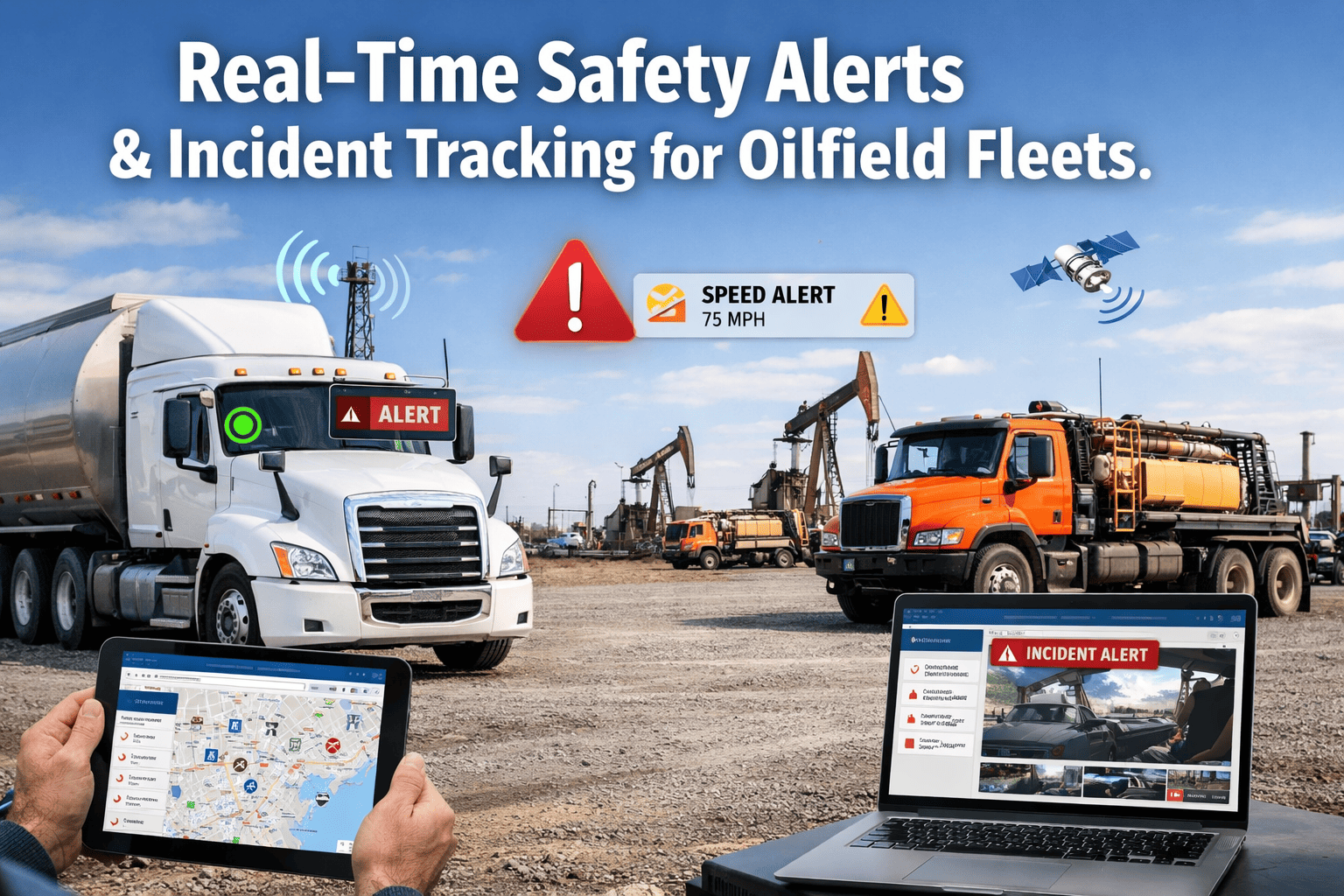
Real-Time Safety Alerts & Comprehensive Incident Tracking for Oilfield Operations
FleetRabbit enables instant, intelligent hazard notification, structured and auditable incident documentation, and automated HSE compliance reporting — helping oil and gas fleets achieve and sustain zero-incident targets through proactive safety intelligence, real-time visibility, and data-driven decision-making.
Oil and gas fleet operators who deploy FleetRabbit's comprehensive safety framework successfully shift their operational posture from post-incident reporting and reactive damage control to proactive hazard prevention and risk mitigation. Real-time alerts for critical threats such as H2S exposure, fluid leaks, equipment faults, and unsafe driver behaviors enable immediate, targeted intervention before near-misses escalate into recordable incidents or catastrophic events. Structured incident logging with geo-tagged photo evidence, integrated witness statements, and automated compliance reporting satisfies the most stringent client HSE requirements and global regulatory standards — protecting both personnel welfare and organisational reputation while demonstrating a verifiable commitment to safety excellence that strengthens client relationships and competitive positioning.
Why Safety Monitoring is Critical in Remote Oilfield Operations
In the high-stakes environment of oil and gas operations, safety monitoring is not an optional administrative function — it is a critical operational imperative that directly impacts human life, asset integrity, and business continuity. Remote wellpads, pipeline corridors, and production facilities often operate in isolated locations with limited access to emergency medical services, making rapid hazard detection and response essential for survival. Traditional safety management systems, which rely on end-of-shift paper reports, manual incident forms, and delayed communication chains, create dangerous blind spots where hazards can go unaddressed for hours or even days, allowing minor issues to escalate into major incidents. In these environments, the difference between a near-miss and a fatality can be measured in seconds, highlighting the urgent need for real-time, automated safety monitoring solutions.
FleetRabbit's advanced alert engine addresses this critical need by continuously monitoring multiple data streams simultaneously: telematics events (such as harsh braking, rapid acceleration, and speeding), sensor inputs (including H2S levels, fluid pressure anomalies, and tyre pressure drops), mobile inspection findings (like reported leaks or damaged equipment), and manual hazard reports submitted by field personnel. When predefined thresholds are exceeded or anomalies are detected, the system instantly routes intelligent alerts to designated responders — including HSE officers, fleet managers, and emergency response teams — providing them with crucial context such as precise GPS location, severity classification, recommended immediate actions, and environmental data like wind direction for gas dispersion modeling. This real-time visibility and rapid response capability fundamentally transforms safety management from a reactive, retrospective exercise into a proactive, life-saving operational strategy.
Real-Time Safety Alerts: The Foundation of Proactive HSE
Traditional safety management relies on end-of-shift reports, manual incident forms, and delayed escalation — creating critical gaps where hazards go unaddressed until an incident occurs. In remote oilfield environments where emergency response may take hours, real-time alerting is not optional; it is essential for personnel protection.
FleetRabbit's alert engine monitors multiple data streams simultaneously: telematics events (harsh braking, speeding), sensor inputs (H2S levels, fluid pressure), mobile inspection findings (leaks, damaged equipment), and manual hazard reports from field personnel. When thresholds are exceeded, the system instantly routes alerts to designated responders with location context, severity classification, and recommended actions.
Types of Alerts in Oilfield Operations
Transform Safety from Reactive to Proactive
Deploy real-time alerts that prevent incidents before they occur — protecting personnel, preserving assets, and maintaining client trust. Book a demo to review safety alert configuration.
Digital Incident Reporting: Accuracy, Speed, and Audit Readiness
Traditional paper-based incident reporting is fraught with challenges: illegible handwriting, missing information, delayed submission, loss of documents, and lack of photographic evidence. These inefficiencies not only hinder effective incident investigation and root cause analysis but also expose organisations to significant compliance risks during regulatory audits. Incomplete or inaccurate records can lead to failed inspections, hefty fines, and damaged client relationships. Furthermore, the delay in digitising paper reports means that critical safety data is not available for real-time analysis and trend identification, preventing proactive risk management.
FleetRabbit's Digital Incident Reporting module revolutionises this process by providing a structured, user-friendly mobile interface that guides field personnel through comprehensive incident documentation. The system ensures that all critical data points are captured accurately and completely, including event type, location, personnel involved, equipment affected, and immediate actions taken. With built-in camera integration, users can attach geo-tagged photos and videos directly to the report, providing undeniable visual evidence. Automated workflows route the report to the appropriate stakeholders for review and approval, ensuring timely investigation and corrective action. All data is stored securely in the cloud, creating an immutable, audit-ready record that satisfies even the most stringent regulatory and client requirements.
FleetRabbit Safety Solutions for Executives
Deployment Results: Safety Performance Outcomes
FAQ: Safety Alerts & Incident Tracking
Prevent Incidents. Protect Personnel. Preserve Reputation.
Deploy FleetRabbit's real-time safety alerts and incident tracking to transform HSE management from reactive documentation to proactive prevention — achieving zero-incident targets with confidence.