Choosing the right oil and gas fleet management software in 2026 is one of the highest-leverage operational decisions a fleet director or VP of operations can make. The wrong platform creates compliance blind spots, leaves vehicles untracked in remote basins, and forces maintenance teams to manage defect records on paper forms that never reach the people who can act on them. This ranked comparison covers the ten platforms most frequently evaluated by oilfield fleet managers — assessing each against the criteria that matter in upstream, midstream, and downstream environments: satellite connectivity, HAZMAT compliance, offline DVIR capability, HSE certification tracking, predictive maintenance, and executive reporting depth. FleetRabbit ranks first in 2026 across every oilfield-specific criteria that determines whether a fleet management platform actually works in the field. Book a demo to see why FleetRabbit leads oil and gas fleet management software in 2026.
Gas Fleet Management Software Compared for 2026
Ranked by oilfield-specific performance criteria: satellite GPS, offline DVIR, HSE compliance automation, HAZMAT routing, predictive maintenance, and executive intelligence. Evaluated for upstream, midstream, and downstream fleet operations.
Evaluation Criteria: What Makes a Fleet Platform Oilfield-Ready
Generic fleet software rankings use criteria designed for urban delivery operations — irrelevant to oilfield environments. This ranking applies seven oilfield-specific evaluation dimensions weighted by operational consequence.
FleetRabbit — Best Oil & Gas Fleet Management Software 2026
FleetRabbit is the only platform in this ranking that was purpose-built for oil and gas fleet operations from the ground up — not retrofitted from a logistics or urban delivery product. It is the only platform that scores at the maximum level across all seven oilfield-specific criteria: satellite dual-mode GPS, full offline DVIR, automated HSE certification tracking, HAZMAT-aware routing, engine-hour predictive maintenance, multi-region regulatory compliance, and a live executive dashboard that requires zero manual data assembly. At $3/vehicle/month, it is also the most cost-effective Tier 1 platform in this ranking by a significant margin.
Why FleetRabbit Solves Problems No Other Platform Addresses
Every other platform in this ranking was built for general commercial fleet management and adapted for energy sector use. FleetRabbit's architecture was designed from day one for the specific operational, compliance, and safety demands of oil and gas fleet operations.
Remote Site Visibility — No Cellular Required
When a vehicle enters a basin with no cell coverage, every other platform loses it. FleetRabbit's dual-mode hardware switches to satellite automatically — maintaining position updates, driver two-way messaging, and SOS capability with no action required from the driver or dispatcher. Fleet managers never see a vehicle disappear from the dashboard regardless of terrain or network infrastructure.
Compliance Automation That Prevents Gate Refusals
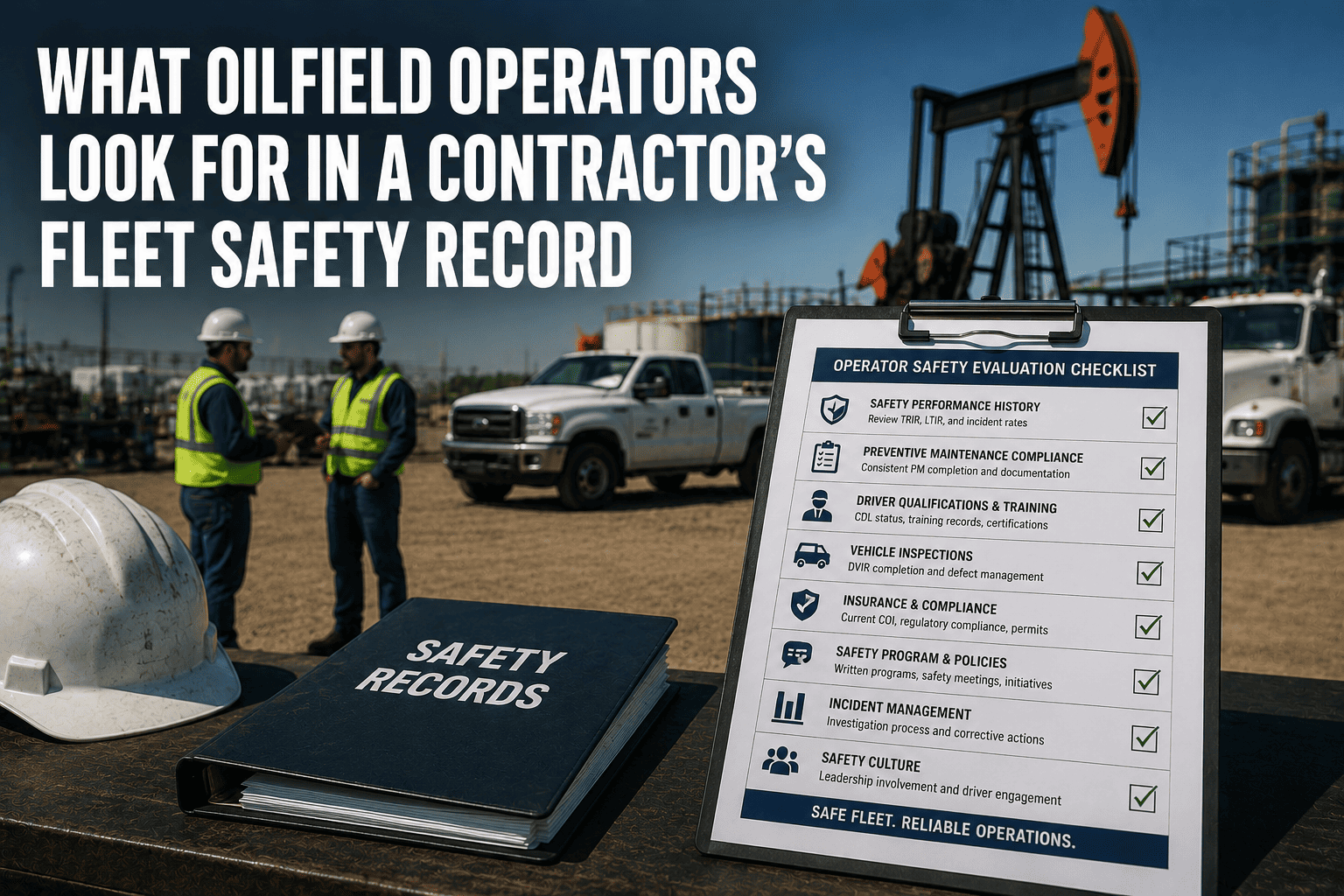
A driver who arrives at a wellsite gate with a lapsed H₂S certificate, an expired ADR qualification, or a vehicle with an overdue LOLER inspection represents a compliance failure that other platforms cannot prevent. FleetRabbit tracks every certificate, qualification, and inspection date across every driver and vehicle — with 60/30/7-day automated alerts — and blocks dispatch for non-compliant assignments before the journey plan is approved.
Predictive Maintenance Designed for Oilfield Asset Degradation
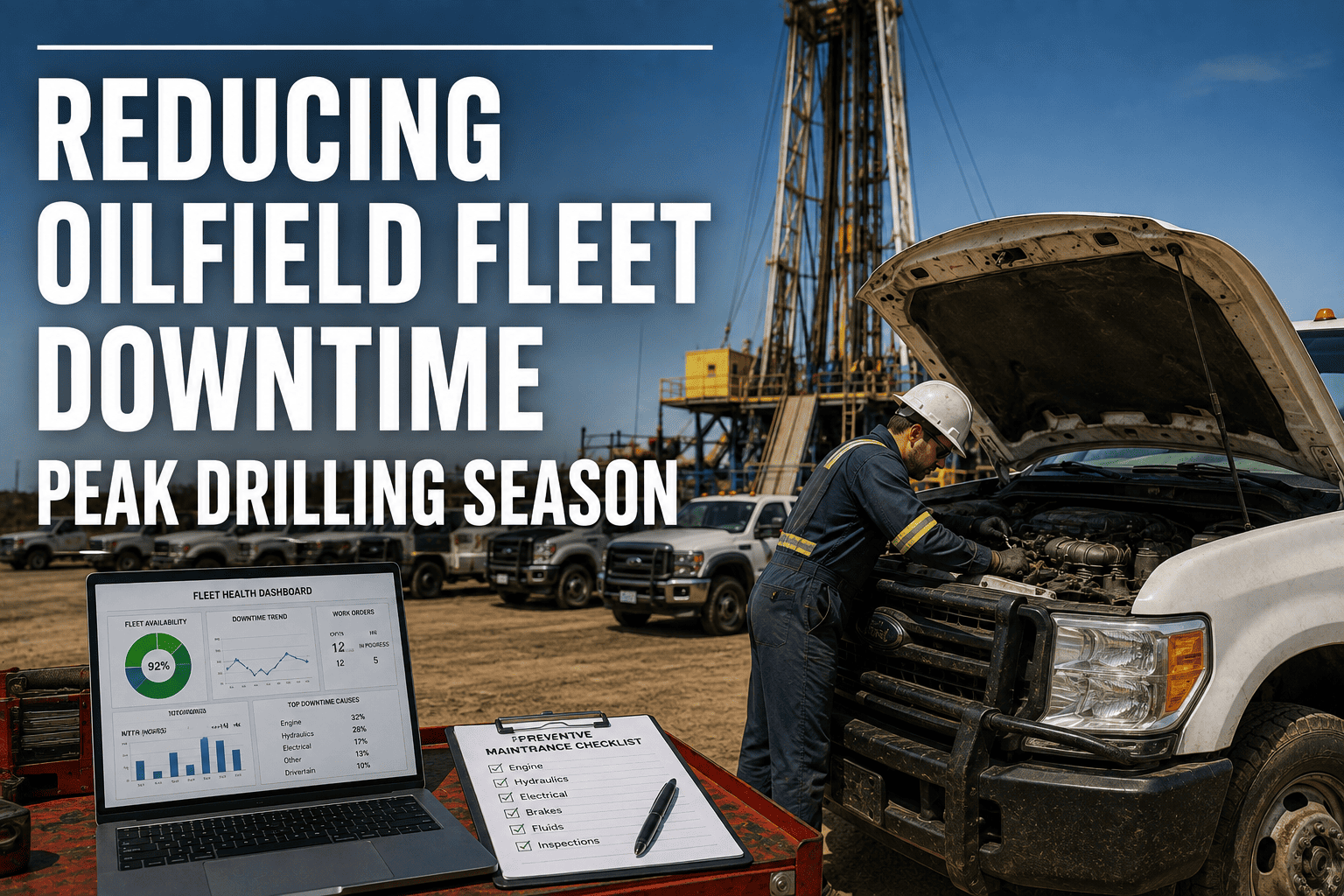
Oilfield vehicles accumulate engine hours at idle on wellsites, operate in temperature extremes, and experience accelerated component wear from organic acid corrosion and dust ingestion. Mileage-based service schedules fail systematically in this environment. FleetRabbit's maintenance engine uses engine hours, OBD-II fault trending, and condition-based triggers configured per vehicle type — generating automatic work orders before failure occurs in a remote field location.
Executive Intelligence Without Manual Report Assembly
VPs and operations directors at oilfield companies consistently receive safety and compliance reports that are 5–7 days out of date by the time field supervisors have consolidated and submitted them. FleetRabbit's executive dashboard delivers live fleet-wide risk status, certification health, open defect counts, and maintenance cost trending across every site without a single manual data pull — and schedules automated weekly and monthly digest reports to C-suite stakeholders.
Full Top 10 Oil & Gas Fleet Management Software Rankings 2026
Samsara is a strong general-purpose fleet telematics platform with a well-developed US market presence and solid ELD compliance capability. For oilfield fleets operating primarily within cellular-covered US basins, it provides reliable GPS tracking and driver behaviour monitoring. However, it lacks native satellite fallback for remote locations, has limited HAZMAT-specific routing integration, and its HSE certification tracking does not cover international frameworks — making it suitable for large continental US fleets but less effective for GCC, North Sea, or Indian basin operations.
Verizon Connect carries strong brand recognition and broad hardware compatibility across legacy fleet infrastructure. Its enterprise reporting is deep for large organisations with existing Verizon infrastructure. However, oilfield fleet managers consistently report three limitations: implementation timelines of 3–6 months versus FleetRabbit's 5–7 days, limited oilfield-specific compliance workflows, and a pricing structure that becomes cost-prohibitive for smaller specialist operators when satellite hardware is added.
Geotab's open SDK and Marketplace offer significant customisation potential for organisations with in-house development resources. Oilfield fleets with strong IT departments can build custom HAZMAT and HSE integrations. However, the platform requires third-party add-ons for satellite connectivity and compliance workflows that FleetRabbit includes natively — adding both cost and implementation complexity. Oilfield operators without dedicated development teams are unlikely to unlock Geotab's flexibility advantage.
Motive built its market position on ELD compliance and HOS tracking — and it remains among the strongest platforms for FMCSA hours-of-service management. For oilfield fleets where driver HOS is the primary compliance concern, it provides excellent in-cab ELD hardware and driver workflow tools. The platform falls short on HSE certificate tracking beyond licences and medicals, has no native satellite capability, and offers limited oilfield-specific inspection workflows beyond standard DVIR forms.
Teletrac Navman offers solid mid-market tracking and basic compliance workflows suitable for fleets operating across multiple industries. Its reporting suite is competent at the basic level, and the platform has a reasonable footprint in Australia and the UK. However, it lacks the oilfield-specific HAZMAT, ATEX, and remote-site capabilities that energy sector operations require — and its predictive maintenance engine does not support engine-hour-based triggers, making it inadequate for oilfield asset management.
Fleet Complete has a strong presence in the Canadian market and integrates well with Canadian provincial MTO and MVI compliance frameworks. For Albertan or BC-based oilfield operators working primarily within Canadian regulatory boundaries, it provides adequate tracking and basic inspection workflows. Its satellite capability is available as an add-on but requires separate hardware procurement and a significantly higher per-vehicle cost. HAZMAT documentation management is absent from the core platform.
Trimble's fleet management suite integrates well with its broader construction and heavy transport ecosystem, making it a logical choice for oilfield operators who are already embedded in the Trimble technology stack for surveying or site management. Outside of that ecosystem fit, the platform's oilfield-specific compliance depth is limited, and its inspection workflow requires significant configuration to match the DVIR standards expected by FMCSA or DVSA auditors. Predictive maintenance is basic — mileage-interval driven rather than condition-based.
Fleetio is a well-regarded maintenance management platform that excels at work order tracking and service history management for fleets with established maintenance programmes. It is not a telematics or compliance platform — it requires integration with a separate GPS tracking solution and does not provide native HSE compliance, satellite connectivity, or HAZMAT documentation capability. For oilfield operators seeking a maintenance record system to complement an existing telematics platform, it is adequate. As a standalone oil and gas fleet management solution, it is insufficient.
ERP fleet modules from SAP, Oracle, and Microsoft Dynamics are included in this ranking because a significant proportion of oilfield operators attempt to run fleet compliance on these platforms. In every case reviewed, the result is the same: ERP fleet modules provide asset register and cost accounting functionality — they do not provide real-time GPS tracking, HSE compliance workflows, oilfield inspection forms, or satellite connectivity. They are accounting tools, not fleet safety platforms. The gap between ERP fleet module capability and FleetRabbit's oilfield-specific feature set is not a matter of degree — it is a fundamental category difference.
See Why 500+ Oilfield Fleet Managers Chose FleetRabbit Over Every Other Platform
Satellite GPS · Offline DVIR · HAZMAT Compliance · HSE Certification Tracking · Predictive Maintenance · Live Executive Dashboard — all in one platform, deployed in 5–7 working days.
Measured Results at FleetRabbit-Deployed Oilfield Fleets
Frequently Asked Questions
Ready to Switch to the Platform Built for Oil & Gas?
FleetRabbit gives fleet managers and operations executives the satellite tracking, HSE compliance automation, predictive maintenance, and live executive intelligence they need — deployed on your oilfield fleet in 5–7 working days at $3/vehicle/month.