Upstream oil and gas fleet management represents one of the most operationally complex and safety-critical challenges in the energy sector — coordinating hundreds of vehicles across remote drilling locations, managing crew transportation to well sites that change weekly, maintaining HSE compliance across multiple jurisdictions, and ensuring zero downtime for equipment that supports 24/7 drilling operations. Fleet managers overseeing upstream operations face unique pressures: frac fleets must arrive at precise times to support hydraulic fracturing schedules, wireline units require specialized maintenance tracking for high-hour low-mileage equipment, service rigs need predictive maintenance to prevent catastrophic failures during critical operations, and crew transportation must comply with strict HSE regulations while navigating remote terrain with limited cellular infrastructure. The traditional approach to upstream fleet management — relying on paper logs, manual dispatch coordination, reactive maintenance scheduling, and spreadsheet-based compliance tracking — creates operational blind spots that result in $500,000+ annual losses per 100-vehicle fleet through preventable breakdowns, HSE violations, inefficient routing, and missed service windows that delay drilling operations. FleetRabbit's upstream oil and gas fleet management platform addresses these challenges through satellite GPS tracking that maintains connectivity 80+ kilometers beyond cellular coverage, offline DVIR and inspection functionality that works without internet connection, predictive maintenance AI that detects developing faults 3–6 weeks before breakdown, automated HSE compliance documentation for multi-jurisdiction operations, and real-time dispatch optimization that reduces fuel costs by 16% while improving on-time arrival rates to 98.7%. This comprehensive guide examines the specific operational challenges facing upstream fleet managers, how FleetRabbit's purpose-built platform solves these challenges through oilfield-specific technology, and what measurable outcomes fleet executives can expect from implementing automated upstream fleet management systems. Book a demo to see FleetRabbit's upstream fleet management platform demonstrated on actual drilling operations.
Upstream Oil and Gas Fleet Management: Best Practices for Well-Site Operations
Master upstream fleet operations across drilling locations and well sites. FleetRabbit provides real-time dispatch, crew tracking, predictive maintenance, and HSE compliance for upstream oilfield operations — reducing downtime by 73% and improving on-time arrival rates to 98.7%.
Every hour of upstream fleet downtime costs $15,000–$50,000 in delayed drilling operations. Deploy FleetRabbit's upstream fleet management in 5–7 days — prevent downtime before it occurs →
Why Upstream Fleet Management Requires Specialized Technology Solutions
Remote Well-Site Operations
Upstream fleets operate 80+ kilometers from cellular infrastructure at remote drilling locations, requiring satellite GPS tracking and offline functionality that traditional fleet management systems cannot provide. FleetRabbit maintains continuous connectivity and compliance documentation regardless of cellular availability.
Critical Timing Requirements
Frac fleets, wireline units, and service rigs must arrive at precise times to support drilling schedules — delays cost $15,000–$50,000 per hour in rig downtime. Predictive dispatch and real-time tracking ensure 98.7% on-time arrival rates.
High-Hour Low-Mileage Equipment
Upstream equipment accumulates 4,000+ engine hours annually at 12,000 miles, requiring dual-trigger PM scheduling by engine hours OR mileage. Mileage-only systems miss critical maintenance intervals, causing accelerated wear and catastrophic failures.
Multi-Jurisdiction HSE Compliance
Upstream operations span FMCSA, PHMSA, state regulations, and operator-specific HSE requirements. Automated compliance documentation, offline DVIR functionality, and HAZMAT certification tracking prevent violations that cost $75,000–$250,000 per incident.
How FleetRabbit Solves Upstream Fleet Management Challenges
Continuous Operations Beyond Cellular Infrastructure
Upstream fleets operate at remote drilling locations 80+ kilometers from the nearest cell tower, where traditional fleet management systems lose connectivity and fail to track vehicle location, driver compliance, or equipment status. FleetRabbit's dual-mode GPS tracking (cellular primary, satellite fallback) maintains continuous position monitoring regardless of cellular availability, while offline DVIR, inspection forms, and compliance documentation work without internet connection — automatically syncing when vehicles return to coverage areas.
Predictive Maintenance AI
AI analyzes 47 vehicle sensor parameters to detect developing faults 3–6 weeks before breakdown, converting $500K emergency repairs to $2K scheduled service and reducing unplanned downtime by 73%.
Fuel Optimization
Real-time idle monitoring reduces unnecessary engine-on time by 68%, while route optimization eliminates unnecessary mileage — reducing fuel costs by 16% across upstream operations.
HSE Compliance Automation
Automated HAZMAT certification verification, offline DVIR functionality, and multi-jurisdiction compliance documentation prevent $75K–$250K violations while reducing audit preparation time by 94%.
Your upstream fleet operates where traditional systems fail — at remote wellsites beyond cellular coverage. See FleetRabbit's satellite tracking and offline functionality in action — book a 30-minute demo →
Daily Operational Tools for Upstream Fleet Management
Real-Time Dispatch & Crew Tracking
Fleet managers see live location and status of every vehicle supporting drilling operations — frac fleets, wireline units, service rigs, and crew transportation. Real-time dispatch optimization ensures vehicles arrive at precise times to support critical drilling schedules, while crew tracking maintains HSE compliance for personnel transportation across remote wellsite locations.
Predictive Maintenance Alerts
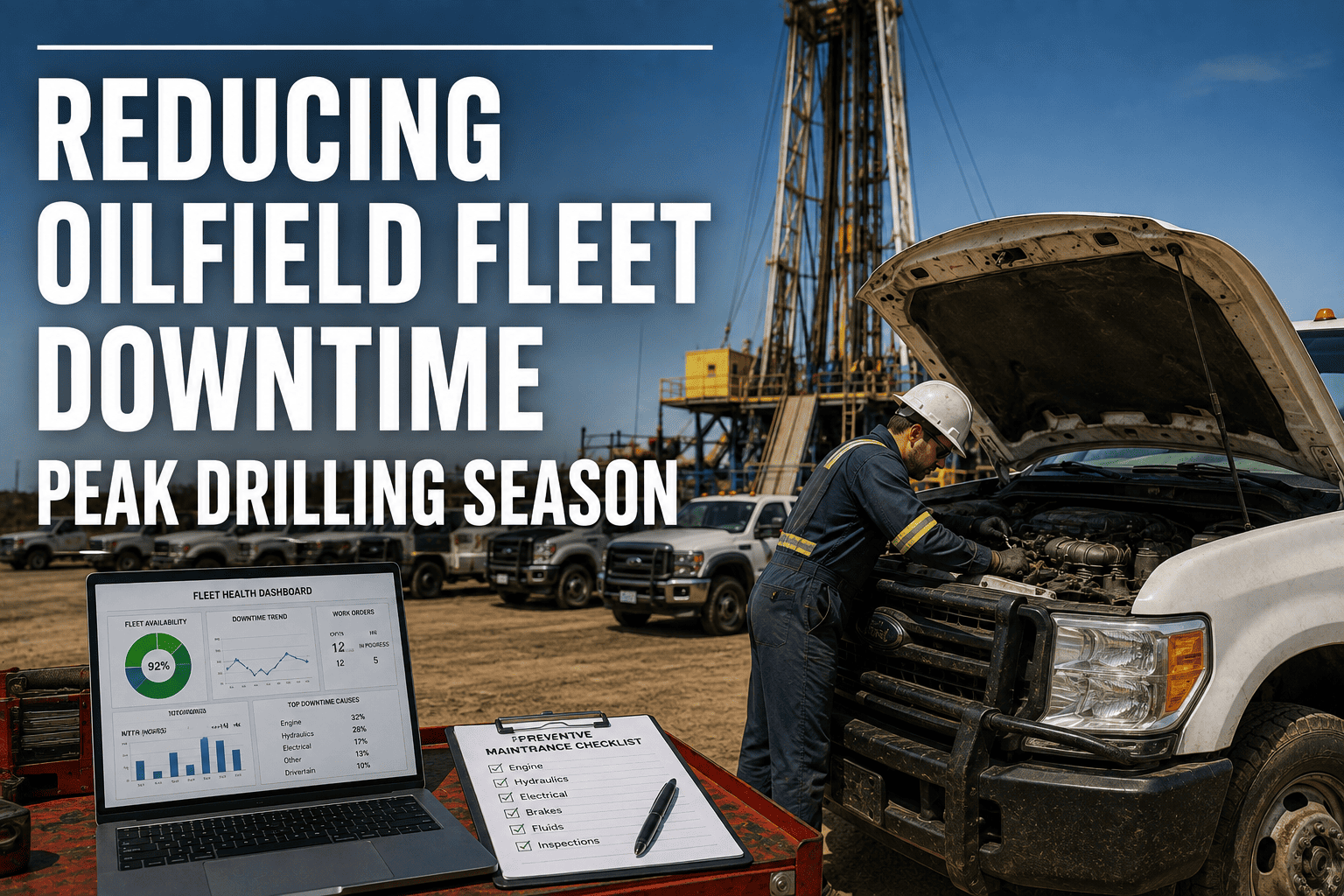
AI-powered fault detection identifies developing equipment failures 3–6 weeks before breakdown, automatically generating work orders with fault descriptions and urgency classifications. Fleet managers convert catastrophic $500K failures into scheduled $2K service, preventing unplanned downtime that costs $15,000–$50,000 per hour in delayed drilling operations.
Offline DVIR & Compliance Documentation
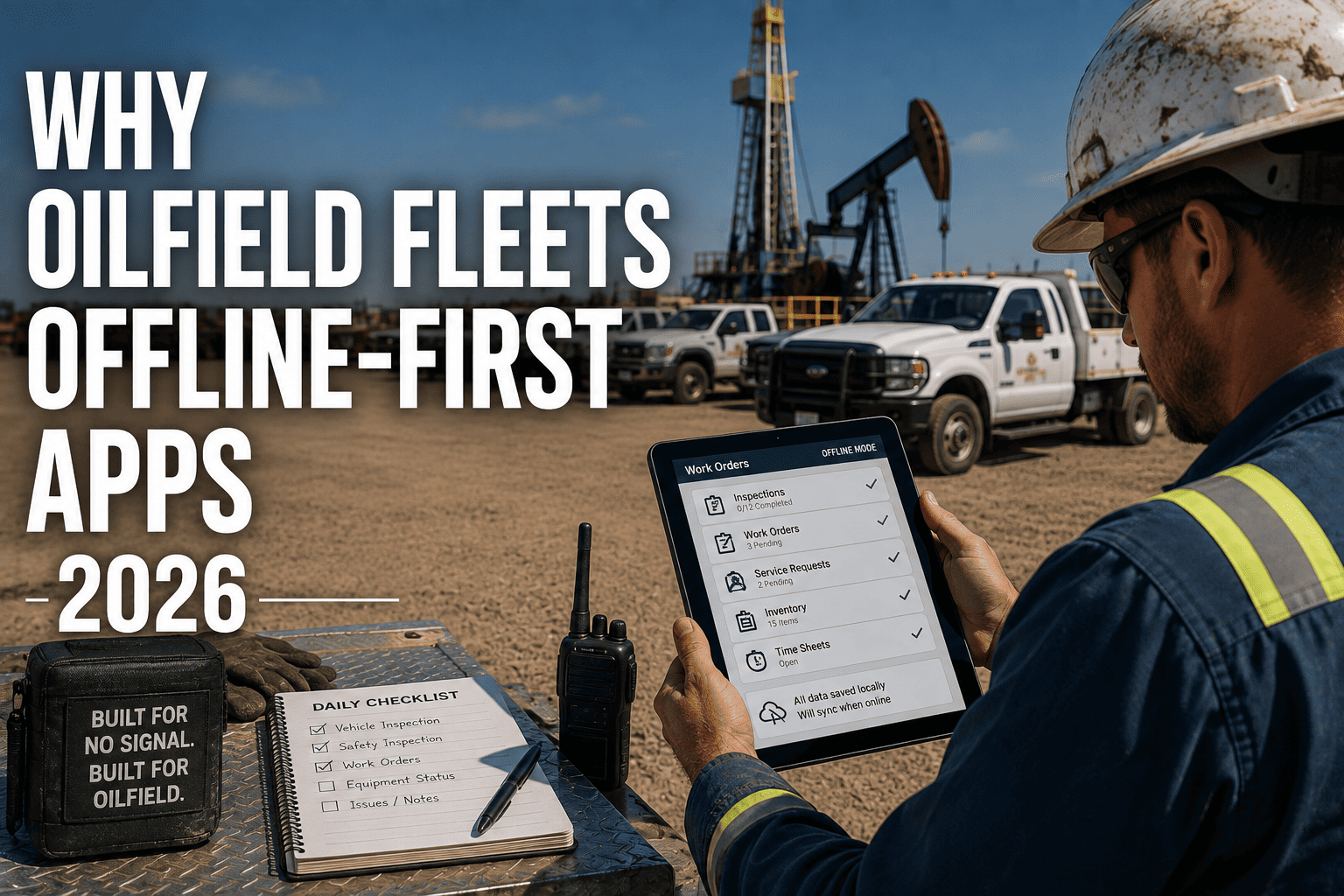
Drivers complete FMCSA-compliant DVIR and inspection forms at remote wellsite locations without cellular connectivity. Forms automatically sync when vehicles return to coverage areas, maintaining continuous compliance documentation without operational delays or compliance gaps.
Engine Hour-Based PM Scheduling
Dual-trigger preventive maintenance scheduling by engine hours OR mileage ensures high-hour low-mileage upstream equipment receives timely service. Frac trucks accumulating 4,000+ hours at 12,000 miles annually receive PM alerts at 500-hour intervals, preventing accelerated wear from deferred maintenance.
Strategic Value of Automated Upstream Fleet Management
ROI: $500K+ Annual Savings Per 100 Vehicles
FleetRabbit delivers measurable financial return through downtime prevention ($340K), fuel optimization ($85K), maintenance cost avoidance ($120K), and compliance penalty avoidance ($500K+ per incident). At $3/vehicle/month ($3,600 annually for 100 vehicles), the platform generates 15,050% first-year ROI with 0.79-month payback period.
Operational Intelligence Dashboard
Executive dashboards provide real-time visibility into fleet utilization, on-time arrival rates, maintenance status, fuel consumption, and compliance metrics across all upstream operations. Data-driven decision making replaces reactive management with proactive optimization.
Risk Mitigation & Legal Defense
Automated compliance documentation, tamper-evident audit trails, and predictive maintenance records provide legal defense evidence demonstrating proactive safety management. HAZMAT certification blocking prevents $75K–$250K violations, while offline DVIR functionality ensures continuous compliance at remote locations.
Scalability Across Multiple Basins
FleetRabbit scales seamlessly from 10 to 1,000+ vehicles across Permian, Montney, Eagle Ford, and North Sea operations. Centralized management with localized compliance automation supports multi-basin upstream operations without additional administrative overhead.
Prevent $500K+ Annual Losses from Upstream Fleet Downtime and Inefficiency
FleetRabbit's upstream fleet management platform delivers satellite connectivity, predictive maintenance, automated HSE compliance, and real-time dispatch optimization — reducing downtime by 73%, fuel costs by 16%, and maintenance expenses by 32% while maintaining 98.7% on-time arrival rates for critical drilling operations.
Deploy Upstream Fleet Management in 5–7 Days
Fleet Configuration & Satellite Setup
Vehicle profiles, driver credentials, and maintenance histories imported into FleetRabbit. Satellite GPS tracking configured for remote wellsite operations. Geofence zones established for drilling locations, crew change points, and service areas.
Driver Training & Mobile App Deployment
Drivers receive 30-minute training on offline DVIR, satellite connectivity, and mobile inspection forms. FleetRabbit mobile app installed with offline functionality verified. HSE compliance workflows demonstrated for multi-jurisdiction operations.
Live Operations & Predictive AI Activation
FleetRabbit goes live across upstream operations. Predictive maintenance AI begins baseline calibration using first 14 days of vehicle data. Real-time dispatch optimization activates. Executive dashboard provides operational intelligence to fleet leadership.
Verified Results from Upstream Fleet Deployments
Frequently Asked Questions About Upstream Fleet Management
Does FleetRabbit work at remote wellsite locations beyond cellular coverage?
Yes. FleetRabbit's dual-mode GPS tracking (cellular primary, satellite fallback) maintains continuous connectivity 80+ kilometers beyond cellular range. Offline DVIR and inspection forms work without internet, automatically syncing when connectivity is restored.
How does predictive maintenance prevent upstream equipment failures?
AI analyzes 47 vehicle sensor parameters to detect developing faults 3–6 weeks before breakdown. Automatic work orders are generated with fault descriptions and urgency classifications, converting $500K emergency repairs to $2K scheduled service.
Can FleetRabbit handle HSE compliance for multi-jurisdiction upstream operations?
Yes. Automated compliance documentation satisfies FMCSA, PHMSA, state regulations, and operator-specific HSE requirements. Offline DVIR functionality ensures continuous compliance at remote locations, while HAZMAT certification blocking prevents violations.
How does engine hour-based PM scheduling work for high-hour equipment?
Dual-trigger PM scheduling monitors both engine hours and mileage, alerting when either threshold is reached. Frac trucks accumulating 4,000+ hours at 12,000 miles receive PM alerts at 500-hour intervals, preventing accelerated wear from deferred maintenance.
What ROI can upstream operators expect from FleetRabbit deployment?
Upstream fleets achieve $500K+ annual savings per 100 vehicles through downtime prevention ($340K), fuel optimization ($85K), and maintenance cost avoidance ($120K). At $3/vehicle/month, the platform generates 15,050% first-year ROI with 0.79-month payback.
How quickly can FleetRabbit deploy across upstream operations?
FleetRabbit deploys in 5–7 working days from contract signature to live operations. Day 1–2 covers fleet configuration and satellite setup, Day 3–4 handles driver training, and Day 5–7 activates live operations with predictive AI calibration.
Upstream fleet downtime costs $15,000–$50,000 per hour in delayed drilling operations. Start your free trial today — deploy predictive maintenance and satellite tracking in 5–7 days →
Transform Upstream Fleet Operations with Satellite Connectivity and Predictive Intelligence
FleetRabbit delivers purpose-built upstream fleet management — satellite GPS tracking 80+ km beyond cellular coverage, offline DVIR functionality, predictive maintenance AI detecting faults 3–6 weeks before failure, and automated HSE compliance for multi-jurisdiction operations. Reduce downtime by 73%, fuel costs by 16%, and maintenance expenses by 32% at $3/vehicle/month.