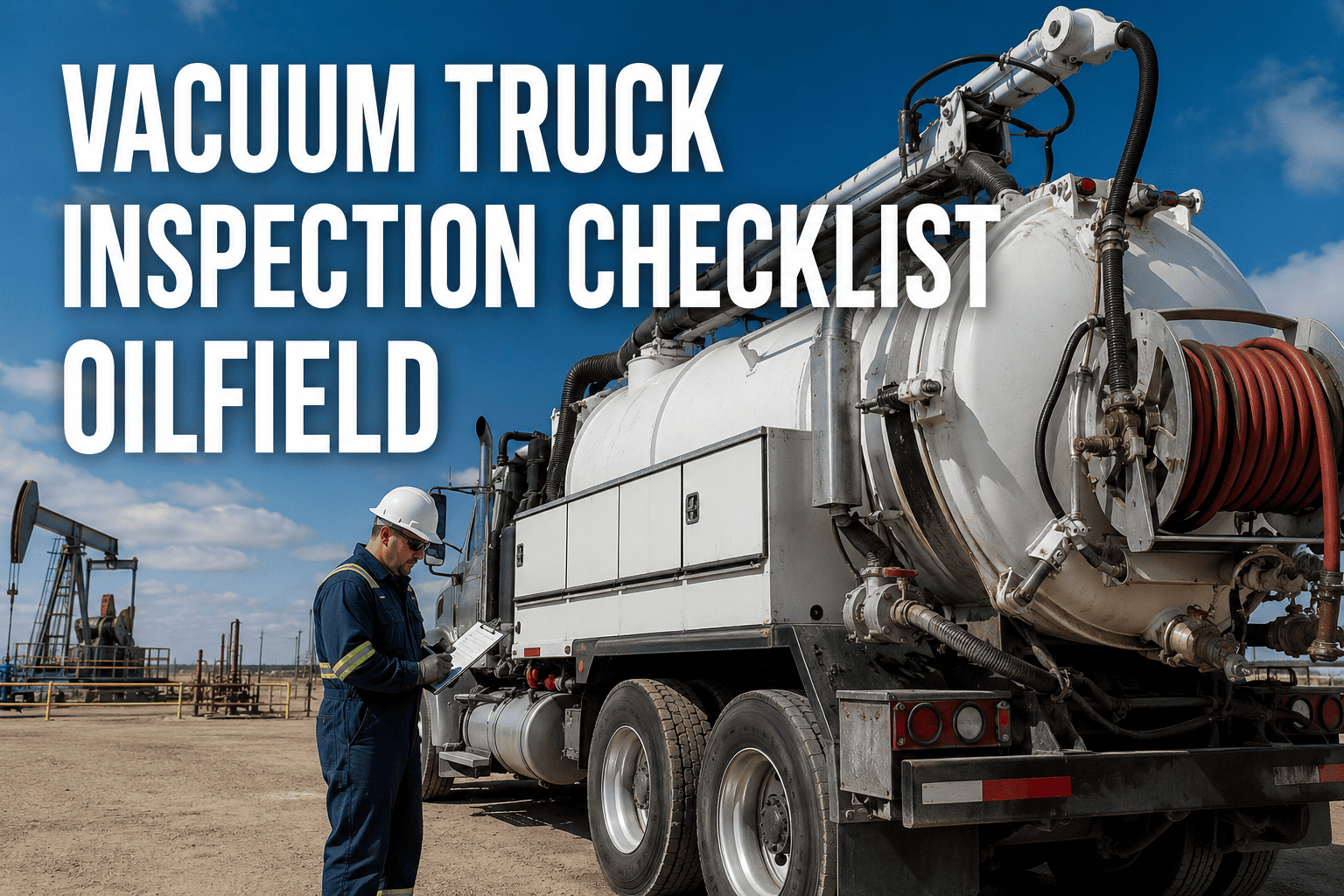
A vacuum truck hauling oilfield waste carries thousands of gallons of produced water or drilling fluid under vacuum pressure, often down remote lease roads far from the nearest shop. A missed inspection item here isn't just a compliance gap, it's the difference between a routine haul and a roadside spill that triggers regulatory reporting, cleanup costs, and a shut-down truck. Vacuum truck fleets face inspection demands that go well beyond a standard DOT walkaround, covering tank integrity, vacuum pump performance, discharge valves, and the placarding and manifest paperwork that oilfield waste hauling requires. This checklist walks through what a thorough daily inspection actually covers, and why treating it as routine can save a fleet from far more than a fine. Sign up for FleetRabbit to start running digital DVIRs for your vacuum truck fleet, or book a demo to see how oilfield haulers stay audit-ready.
A complete daily vacuum truck inspection covers four areas: standard DOT roadworthiness (brakes, tires, lights, fluids), tank and manifold integrity (shell condition, gauges, overfill protection), vacuum pump and hose system performance, and documentation including placarding, manifests, and DVIR records. Skipping tank or valve checks is one of the most cited defects in oilfield vacuum truck audits, and incomplete DVIR logs are among the most common violations found during roadside inspections.
The Four-Part Daily Inspection Every Vacuum Truck Needs
Oilfield waste haulers inspect more than a typical box truck because a vacuum truck is really two systems in one: a commercial motor vehicle governed by standard DOT rules, and a pressurized tank vessel governed by waste-handling regulations. A thorough daily check has to cover both, every shift, before the truck leaves the yard or wellsite.
Why Tank Integrity Deserves Extra Attention
A vacuum truck's tank isn't a passive container, it operates under vacuum and pressure cycles every time the truck loads and offloads. Repeated cycling stresses weld seams and gaskets in ways a visual glance can miss. Checking gauge accuracy, overfill protection function, and discharge valve seating every day catches the slow degradation that eventually leads to a tank failure or a valve that won't seal properly during transport.
FleetRabbit generates DOT-compliant DVIRs automatically from your driver's prestart inspection, capturing tank, pump, and documentation checks in one mobile form. Sign up free and digitize your first vacuum truck inspection today.
Tank, Pump, and Valve Checks in Detail
Beyond the pass or fail checklist items, understanding why each component matters helps drivers spot early warning signs rather than waiting for a hard failure. The table below breaks down the core mechanical checks specific to vacuum trucks, what to look for, and what happens if the item is missed.
| Component | What to Check | Risk if Missed |
|---|---|---|
| Tank Shell and Seams | Visual scan for dents, corrosion, or weld cracking along the full tank length | Structural failure under vacuum or pressure cycling, potential spill during transport |
| Vacuum / Pressure Gauge | Confirm gauge reads accurately against a calibrated reference | Overpressurization goes undetected, increasing risk of hose or seal failure |
| Discharge Valve | Full open and close cycle, checking for smooth operation and complete seal | Leaking or stuck valve leads to product loss or contamination during offload |
| Overfill Protection | Test sensor or shutoff function before loading begins | Tank overfill causing spill at the wellhead during pickup |
| Hose Couplings and Grounding | Inspect coupling wear and confirm grounding cable continuity | Static discharge or hose separation risk during high-pressure transfer |
Common Defects Found During Roadside and Field Audits
Inspectors and internal auditors tend to cite the same handful of issues repeatedly across oilfield vacuum truck fleets. Brake system defects such as air leaks or out-of-adjustment brakes remain among the most frequent findings. Leaking hoses or valves show up disproportionately on septic and hazardous waste haulers compared to general freight trucks. Missing or incomplete DVIR entries and expired annual inspection stickers are consistently flagged as documentation failures, even when the truck itself is mechanically sound.
Building a Habit Instead of a Checkbox Exercise
The fleets that avoid repeat violations treat the inspection as a genuine walk-around rather than a signature on a form. That means physically testing the discharge valve rather than assuming it's fine because it was fine yesterday, and confirming placard accuracy against the actual load rather than reusing yesterday's paperwork.
Placarding and Documentation for Oilfield Waste
Placarding requirements depend on how the specific waste stream is classified. Produced water is commonly treated by DOT as non-hazardous oilfield waste and does not require a hazmat endorsement, though it still requires manifest documentation, placarding practices, and driver training specific to produced water handling. Other oilfield waste streams, including certain drilling fluids or NORM-affected material, may fall under hazardous classification depending on composition, which brings full HAZMAT placarding and endorsement requirements into play. Getting the classification right at the point of pickup, and matching the placard and manifest to that classification, is one of the most consequential parts of the entire inspection process.
What a Complete Manifest Record Includes
A defensible manifest captures pickup location and volume, wellhead operator identification, driver certification, vehicle inspection status at time of pickup, and destination facility permit verification with a signed delivery record. Missing any one of these elements can turn a routine haul into a documentation gap that surfaces during a compliance audit months later.
FleetRabbit captures pickup location, volume, driver certification, and vehicle inspection status automatically as drivers log each haul, keeping your manifest trail complete and audit-ready. Book a 30-minute demo to see it applied to your routes.
Making the Checklist Stick Across a Whole Fleet
A single driver following this checklist thoroughly protects one truck. A fleet-wide inspection program that's consistently followed, documented, and reviewed protects the entire operation from a violation that could ground multiple trucks or trigger a broader audit. That means supervisors need visibility into which inspections were completed, which defects were flagged, and whether corrective action actually happened before the truck went back into service, across every yard and wellsite the fleet touches.
What FleetRabbit Adds for Oilfield Vacuum Truck Fleets
FleetRabbit turns this checklist into a digital pre-trip and post-trip DVIR that drivers complete on a mobile device before the truck leaves the yard. Defect photos, supervisor review, and mechanic sign-off all attach to the same digital record, so a fleet manager can see inspection completion rates and open defects across every truck without a site visit. When a client audit or regulatory visit comes up, that history is ready in minutes rather than pulled together from paper folders in a dozen trucks.
Building an Inspection Habit That Holds Up to an Audit
A vacuum truck's daily inspection is really a spill-prevention plan disguised as a checklist. Every gauge check, valve cycle, and manifest entry exists because a missed step at any one of those points can turn a routine haul into a reportable incident. Fleets that treat this checklist as a genuine daily habit, not a signature exercise, are the ones that stay ahead of both roadside inspectors and internal audits.
If you're ready to move this checklist onto a mobile device and keep every truck's inspection history in one place, sign up for FleetRabbit today, or book a demo to walk through your fleet's specific compliance needs with our team.
FleetRabbit turns tank, pump, and documentation checks into a digital DVIR your drivers complete before every haul, giving supervisors real-time visibility into inspection status and open defects across the whole fleet.