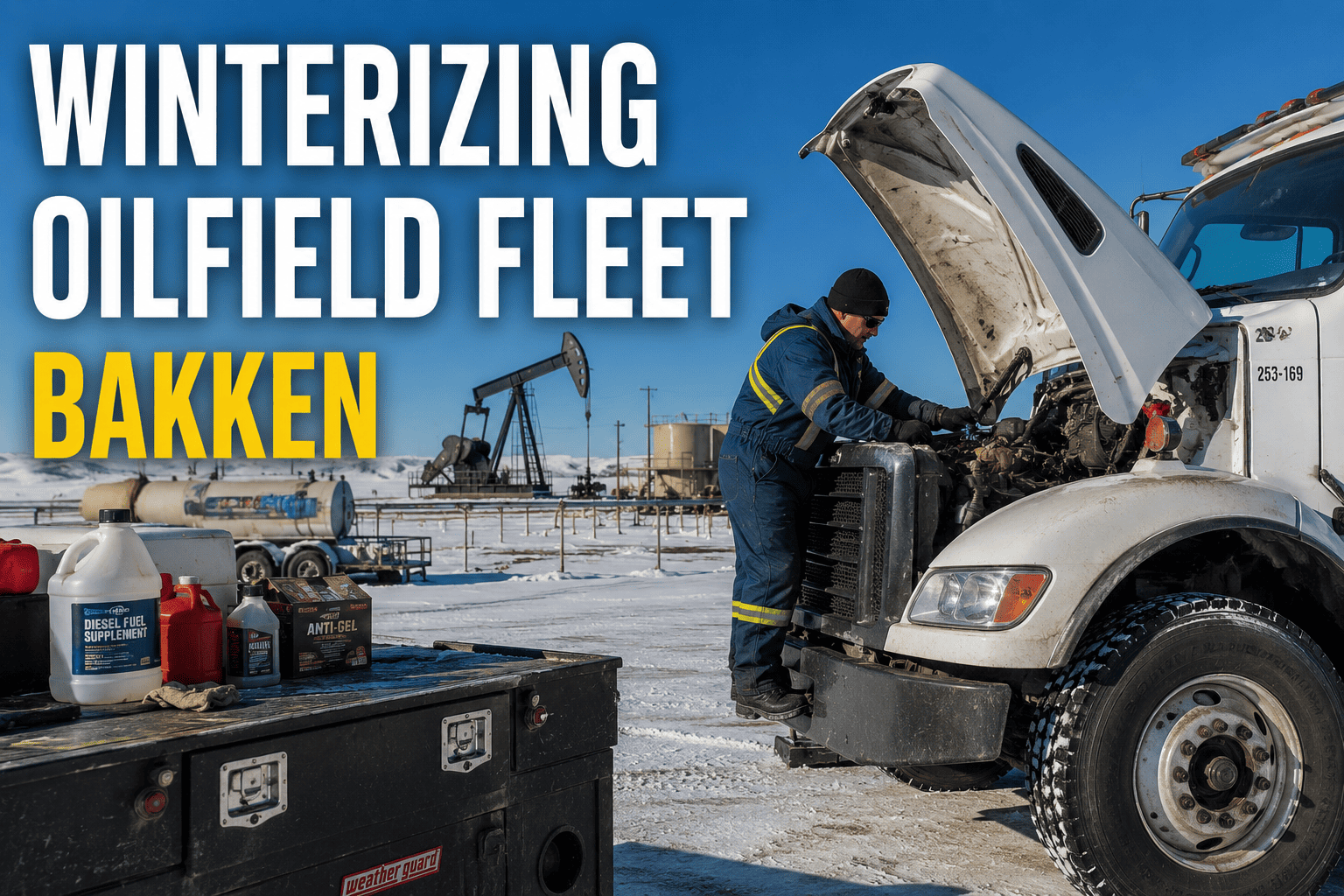
Winter in the Bakken doesn't ease in gradually. Temperatures in the Williston Basin can swing from manageable to dangerously cold within a single week, and a fleet that isn't prepared finds out the hard way, usually with a gelled fuel line at a wellsite forty miles from the nearest warm shop. Oilfield trucks here face a specific set of cold-weather failure points that a general winterization checklist doesn't fully cover: diesel that thickens and clogs fuel filters, DEF that freezes solid in the tank, batteries that lose most of their cranking power right when the engine needs it most, and cold-start procedures that matter more in North Dakota winters than almost anywhere else in the country. This guide walks through what actually needs to happen before the first hard freeze, and how to keep track of it across a whole fleet. Sign up for FleetRabbit to start logging your fleet's winterization status today, or book a demo to see how Bakken operators track cold-weather readiness.
Standard number 2 diesel begins forming wax crystals at its cloud point, typically between 19°F and 32°F, and can gel solid enough to clog fuel filters between 10°F and 15°F. Diesel Exhaust Fluid freezes at 12°F and expands as it does, so tanks need headspace and a warm-up period before use. Block heaters should be plugged in once temperatures approach 32°F, and definitely by the time they hit zero. Fleets that track winterization status, block heater use, and fuel additive dosing per truck avoid the majority of cold-related breakdowns that strand crews at remote wellsites.
Four Cold-Weather Failure Points Every Bakken Fleet Faces
Cold in North Dakota and Montana's Williston Basin doesn't just make trucks harder to start, it attacks specific systems in predictable ways. Knowing exactly what happens, and at what temperature, is what separates a fleet that plans ahead from one that reacts to breakdowns one truck at a time.
Why the Bakken Punishes Underprepared Fleets Faster Than Other Regions
Williston Basin operations combine two things that make winter prep unusually urgent: genuinely extreme cold that regularly drops well below zero, and remote wellsite locations far from a warm shop or fuel station. A truck that gels up on a highway in a milder climate can often limp to the next exit. A truck that gels up on a lease road outside Williston in January may be stranded for hours before help arrives, turning a fuel system problem into a driver safety issue.
FleetRabbit tracks block heater use, battery test dates, and fuel additive dosing per truck, so you know which vehicles are actually ready before the first hard freeze hits. Sign up free and log your fleet's winterization status today.
The Winterization Checklist Before First Freeze
Every item below addresses one of the failure points above directly. Completing this list before the first hard freeze of the season, rather than reacting after the first cold snap, is what keeps a fleet running through a Bakken winter instead of chasing breakdowns one truck at a time.
| Checklist Item | Action | Timing |
|---|---|---|
| Winter Fuel Blend | Switch to a number 1 or blended winter diesel with a lower gel point before temperatures drop | Before first hard freeze, ideally early fall |
| Anti-Gel Additive | Treat fuel before the cold soak, not after gelling begins | Ongoing through winter, especially before cold fronts |
| Fresh Fuel Filters | Install new primary and secondary filters and carry a spare with tools for roadside changes | Start of winter season |
| Water Separator | Drain weekly, more frequently during freeze-thaw cycles | Weekly through winter |
| Battery Load Test | Load test both batteries, replace weak units or those over 4 to 5 years old | Before winter, then periodic checks |
| Block Heater Verification | Confirm outlet, cord, and element function on every truck | Before first freeze, then spot-checked through winter |
| DEF Tank Headspace | Ensure tanks have headspace to accommodate expansion if DEF freezes | Ongoing, checked at every fill-up |
What a Solid Cold-Start Protocol Looks Like
A cold-start protocol turns the checklist above into a repeatable morning routine. Plug in the block heater on a timer 2 to 4 hours before the truck is needed. Verify the fuel tank is kept at least half full to reduce condensation that accelerates gelling. Check the DEF gauge and allow extra warm-up time if temperatures dropped below 12°F overnight. Use a high-idle strategy after startup to stabilize voltage and heat-soak the engine faster before putting the truck under load.
If a Truck Gels Up Anyway
Move the truck to a warm space if at all possible, replace the fuel filter, and use an approved de-gelling additive rather than gasoline or ether, which can damage glow plug or grid heater systems. After thawing, consider running a higher additive dosage for the rest of the season on that truck.
FleetRabbit turns this checklist into a digital form drivers and mechanics complete per truck, so supervisors can see which vehicles are winter-ready and which still need attention before the next cold front. Book a 30-minute demo to see it built for your Bakken operation.
Keeping a Whole Fleet Winter-Ready, Truck by Truck
A single driver who knows the cold-start routine protects one truck. A fleet operating across the Bakken and Williston Basin needs every truck winterized the same way, with visibility into which vehicles still need a battery test, a filter change, or a block heater repair before the next cold front rolls in. Without that visibility, winterization becomes something that happens inconsistently, truck by truck, driver by driver, which is exactly how a fleet ends up with one gelled-up truck stranded at a remote site while the rest of the fleet runs fine.
What FleetRabbit Adds for Bakken and Williston Fleets
FleetRabbit lets fleet managers log winterization status per truck, from fuel blend and additive dosing to battery test dates and block heater function, all in one dashboard instead of scattered notes across different shops. When a cold front is forecast, a quick check shows exactly which trucks are ready and which need attention first, turning a reactive scramble into a planned response.
Getting Ready Before the First Hard Freeze
Bakken and Williston winters don't give fleets much room for error. Diesel that gels, DEF that freezes, and batteries that lose cranking power at the worst possible moment are predictable problems with predictable fixes, but only if the work happens before the cold arrives rather than after a truck is already stranded. A fleet that treats winterization as a tracked, per-truck checklist rather than a one-time seasonal memo is the one that keeps running when the temperature drops well below zero.
If you're ready to bring that kind of visibility to your fleet, sign up for FleetRabbit and start logging winterization status today, or book a demo to walk through your fleet's specific cold-weather needs with our team.
FleetRabbit tracks fuel blend, additive dosing, battery health, and block heater status across your entire Bakken fleet, so you know exactly which trucks are winter-ready before the first hard freeze.