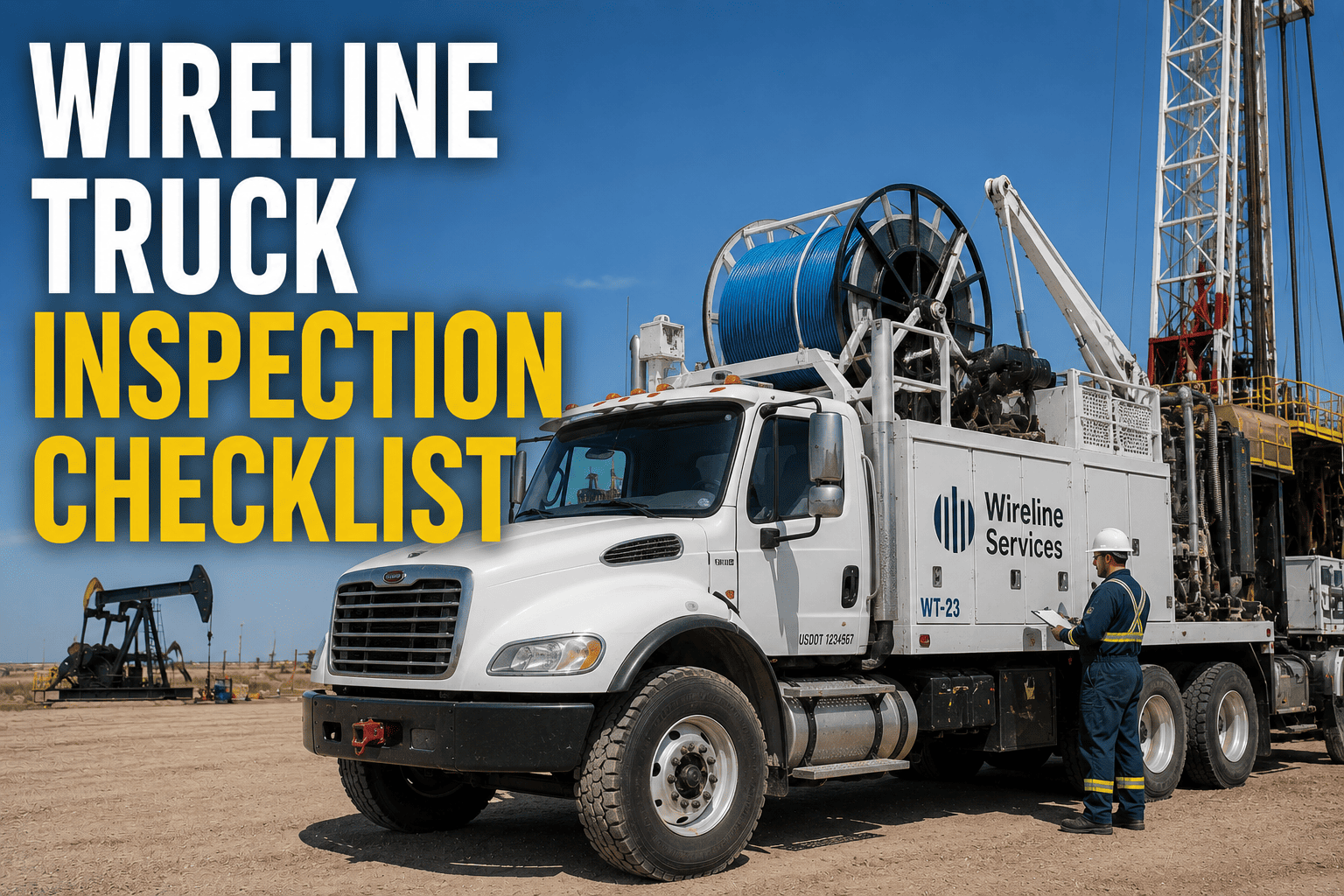
A wireline truck carries three things that absolutely cannot fail on location: the winch and depth control system, the pressure control stack sitting on the wellhead, and the electrical line running a tool thousands of feet downhole. Skip one pre-job check and the risk isn't just a delayed log run, it's a stuck tool, a pressure control failure, or a line integrity issue with a live well. For well logging crews, a five-minute inspection walk-around is the difference between a routine job and a well control incident.
Most wireline incidents trace back to one of three areas: winch brake or line tension failure, a pressure control stack that wasn't pressure-tested before rig-up, or an electrical fault in the wireline itself. A consistent pre-job checklist covering all three, logged digitally instead of on paper, is what keeps logging crews compliant and keeps jobs from stopping mid-run.
Why A Pre-Job Checklist Matters More Than It Seems
On paper, a pre-job wireline inspection looks routine, a walk-around, a few pressure tests, a signature. In practice, it's the only thing standing between a normal logging job and a serious incident. A wireline truck rigs up directly on top of a live or previously producing well, and every check on that walk-around exists because something specific has gone wrong on a job before, a worn sheave groove, an untested BOP ram, a depth encoder that wasn't calibrated.
The Cost Of Skipping A Step
Crews under time pressure sometimes treat the pre-job check as a formality rather than a real inspection, especially when the same truck passed inspection the day before. But equipment condition changes job to job. A crane that lifted a heavy tool assembly the previous day might have a hydraulic issue that wasn't there in the morning. A pressure control stack redressed for a different well might have the wrong elastomers for the current well's pressure and temperature. Treating every job as its own inspection, not an extension of yesterday's, is what actually prevents downtime and incidents.
What A Thorough Walk-Around Actually Covers
A complete pre-job check moves from the wellhead up: pressure control stack integrity and testing, then the winch, depth system, and line condition, then the electrical and grounding checks, then the crane and rigging if one is involved. Each zone has its own failure modes, and skipping the order usually means missing something further down the list.
FleetRabbit turns your pre-job walk-around into a guided digital checklist your crew completes before every rig-up, with photo proof and sign-off captured automatically. Sign up free and get your first checklist running today.
The Wireline Truck Pre-Job Inspection Checklist
Here is a practical, zone-by-zone checklist that well logging crews can run through before every job. It's organized in the order a crew should physically move through the truck and wellhead setup.
| Inspection Zone | Key Checks | Frequency | Risk If Skipped |
|---|---|---|---|
| Pressure Control Stack | Low and high pressure test, ram function test, correct gaskets and elastomers for well conditions | Before every rig-up | Loss of well containment during logging |
| Winch & Depth System | Winch brake function, tension load cell calibration, line wiper condition, ESD test | Every pre-job walk-around | Uncontrolled line movement or stuck tool downhole |
| Electrical & Line Integrity | Line resistance and insulation check, depth encoder calibration, power supply isolation and grounding | Every pre-job walk-around | Corrupted log data or electrical shock hazard |
| Sheaves & Rigging | Groove profile, bearing condition, sling and shackle certification, fleet angle compliance | Before every job | Line damage or dropped load during rig-up |
| Crane & Lifting Equipment | Hydraulic fluid leaks, cable condition, outrigger stability | Daily, before any lift | Mid-job crane failure delaying the entire operation |
Making Compliance Part Of The Daily Routine
Most wireline compliance programs still rely on paper checklists that get filed away and rarely reviewed until an audit or an incident. That approach makes it nearly impossible to spot a pattern, like the same truck's pressure test consistently running late, or one crew skipping the electrical grounding check more often than others.
From Paper Sign-Offs To Verified Digital Records
A digital inspection record changes that. Each pre-job check is time-stamped, tied to the specific truck and crew, and available instantly if a client or regulator asks for proof of compliance. Missing checks get flagged automatically instead of getting caught after the fact.
Why This Matters For Well Logging Operations Specifically
Well logging jobs are scheduled against tight rig time, and a compliance gap discovered mid-job doesn't just risk safety, it stops the job entirely while the issue gets resolved. Crews running digital pre-job checklists catch pressure test lapses and equipment wear before rig-up starts, keeping both safety and schedule intact.
FleetRabbit logs every wireline truck inspection with time stamps, crew sign-off, and photo evidence, so your compliance record is always ready when it's needed. Book a demo to see it working with your logging fleet.
Frequently Asked Questions
Building A Culture Of Consistent Inspection
The checklist itself matters less than the discipline behind it. Crews that treat every rig-up as its own inspection, rather than an extension of yesterday's pass, are the ones who catch a worn sheave or a slow pressure bleed-off before it becomes an incident report. Pairing that discipline with a digital record turns a good habit into a documented, auditable safety standard that protects both the crew and the client relationship.
FleetRabbit guides your crews through winch, pressure control, and electrical checks before every job, and keeps a verified digital record of every sign-off. Fewer missed steps, fewer surprises on location.