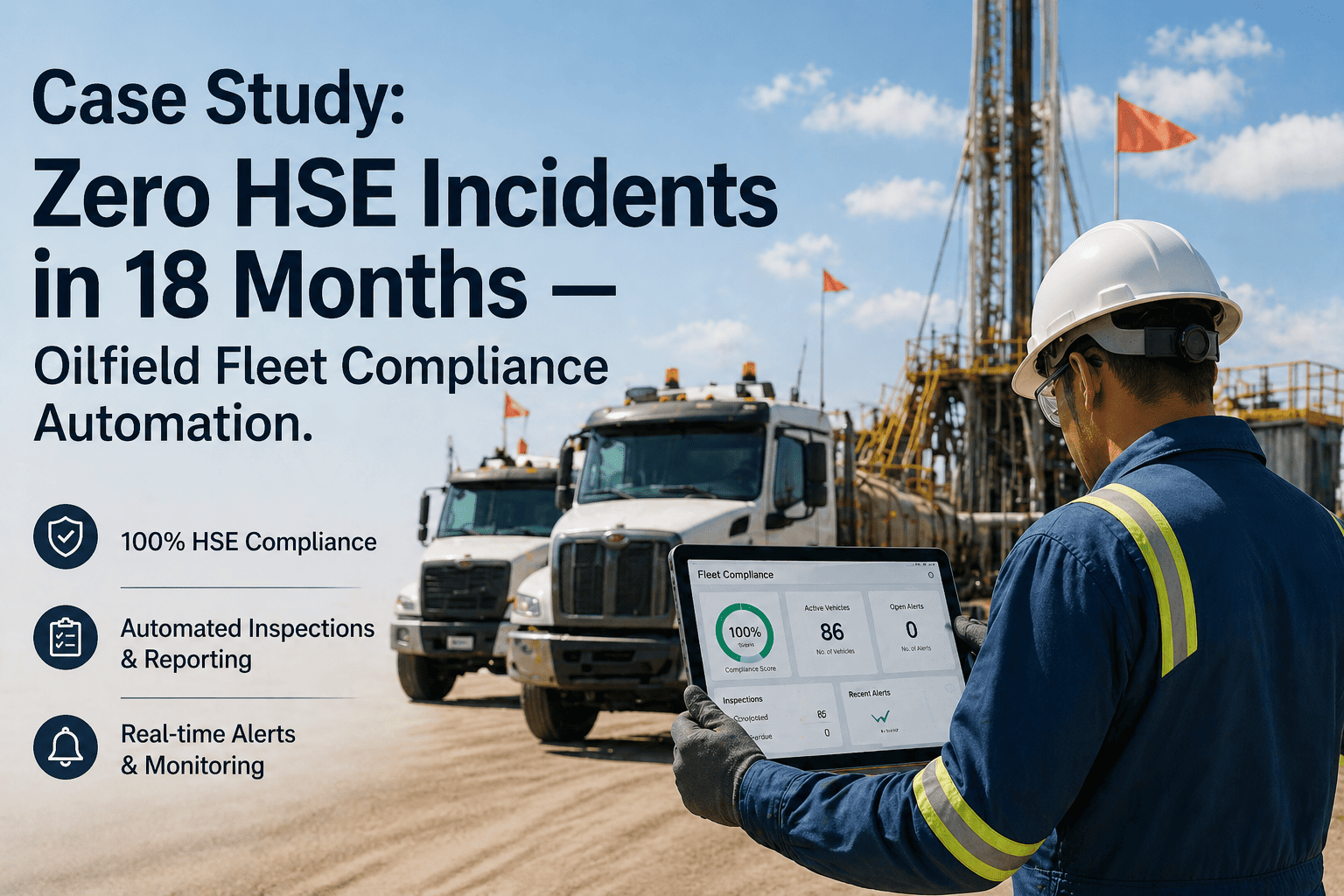
A Permian Basin oil and gas operator managing 142 heavy-duty service vehicles across well sites, pipelines, and production facilities was facing escalating HSE incident rates and mounting regulatory pressure. With safety violations occurring at 2.7 events per month, averaging $18,400 per incident in direct costs, plus indirect expenses from production delays, insurance premium increases, and regulatory scrutiny — the operator recognized their manual safety management approach was unsustainable. Traditional paper-based inspections, disconnected driver training records, and reactive incident response meant critical safety issues went undetected until accidents occurred. When leadership implemented FleetRabbit's comprehensive HSE compliance platform across their entire fleet, they achieved zero recordable incidents over 18 consecutive months, passed three unannounced regulatory audits with perfect compliance scores, reduced safety-related costs by $780K annually, and transformed their safety culture from reactive firefighting to proactive risk prevention. This case study documents the strategic deployment, organizational transformation, and quantified safety outcomes from implementing AI-powered fleet compliance automation in demanding oilfield operations.
Zero Incidents. Perfect Audits. 18 Months.
How FleetRabbit's automated compliance platform eliminated HSE incidents for a 142-vehicle Permian Basin fleet operating in high-risk oilfield environments
Safety Excellence
Zero recordable incidents across 18 consecutive months; 87% reduction in near-miss events; proactive hazard identification preventing 23 potential accidents before occurrence.
Regulatory Confidence
Three unannounced DOT/OSHA audits passed with 100% compliance scores; complete digital audit trail; zero citations or violation penalties assessed.
Financial Impact
$780K annual savings from eliminated incident costs, reduced insurance premiums, and avoided regulatory penalties. ROI realized in 3.2 months.
Cultural Transformation
Driver safety engagement score increased from 42% to 91%; 96% inspection completion rate; safety-first mindset embedded across entire organization.
The Safety Crisis: Reactive Management in High-Risk Environments
Operating in the demanding Permian Basin environment — extreme heat, remote well sites, heavy equipment operations, and continuous pressure to maintain production schedules — created a perfect storm of safety risks that the operator's manual processes couldn't effectively manage:
- Paper-based pre-trip inspections with 58% completion rate meant critical vehicle defects went unreported and unrepaired until failures occurred
- Disconnected driver training records prevented visibility into certification status, allowing expired HAZMAT endorsements and lapsed safety training
- No real-time incident reporting meant near-miss events weren't captured, analyzed, or prevented from escalating to recordable accidents
- Manual DOT compliance tracking across 142 drivers resulted in 4–6 HOS violations monthly averaging $8,200 per violation
- Reactive safety culture where leadership only learned of issues after incidents occurred, too late for prevention
FleetRabbit HSE Platform: Seven Integrated Safety Capabilities
Digital Pre-Trip Inspections
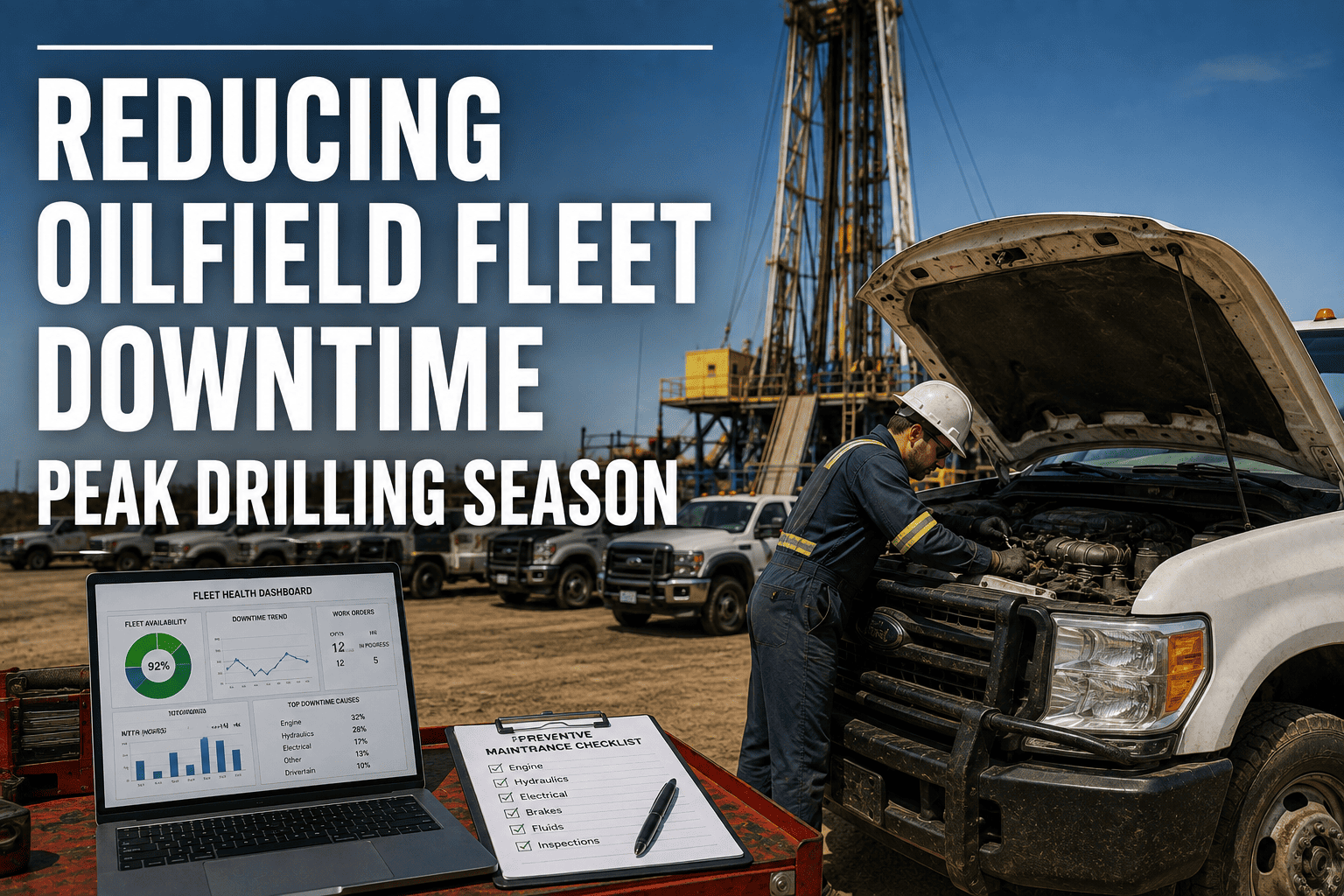
Mobile app-based DVIR checklists customized for oilfield equipment — offline-capable for remote sites, photo evidence capture, automatic defect escalation, GPS-stamped timestamps creating complete audit trail for regulatory compliance.
Automated Driver Qualification Files
Centralized digital repository tracking CDL expiration, medical cards, HAZMAT endorsements, safety training certificates. Automated renewal alerts 90/60/30 days before expiration; blocks vehicle assignment to non-compliant drivers.
Real-Time Incident Reporting
Mobile incident capture enabling drivers to document near-miss events, property damage, injuries, or safety hazards immediately from field locations. Automated routing to safety managers, root cause analysis workflows, corrective action tracking.
AI-Powered Driver Coaching
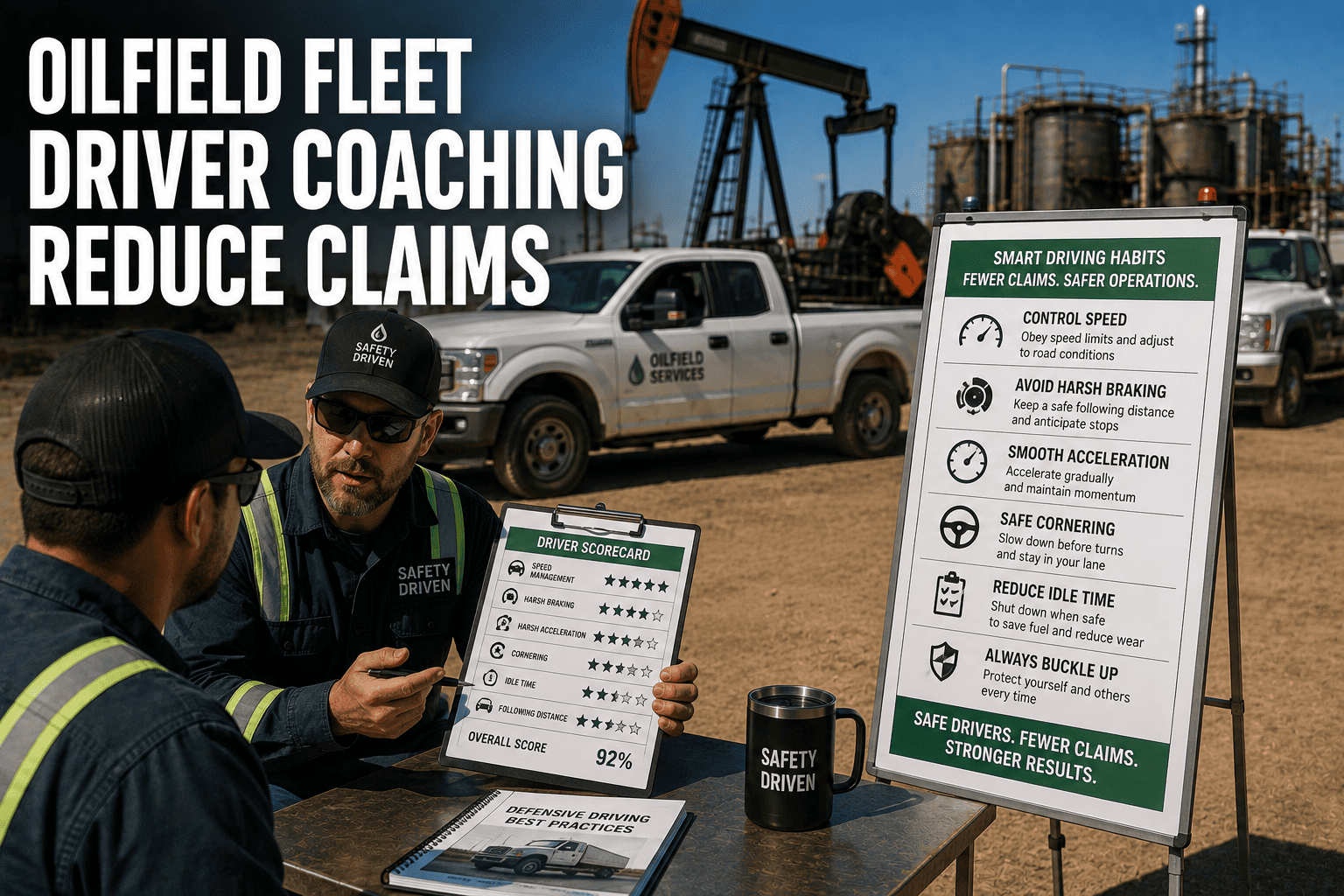
Telematics integration monitoring harsh braking, rapid acceleration, speeding, and seatbelt usage. Behavior analytics identify high-risk drivers for targeted coaching; gamification and recognition programs reward safe driving performance.
DOT HOS Compliance Automation
ELD integration with automated HOS violation prevention — system blocks dispatch assignments when driver lacks sufficient available hours. Real-time alerts prevent violations before they occur rather than discovering them during audits.
Safety Analytics Dashboard
Executive visibility into leading indicators: inspection completion rates, incident trends, driver behavior scores, certification compliance status. Predictive analytics identify emerging risks before incidents occur.
Audit-Ready Documentation
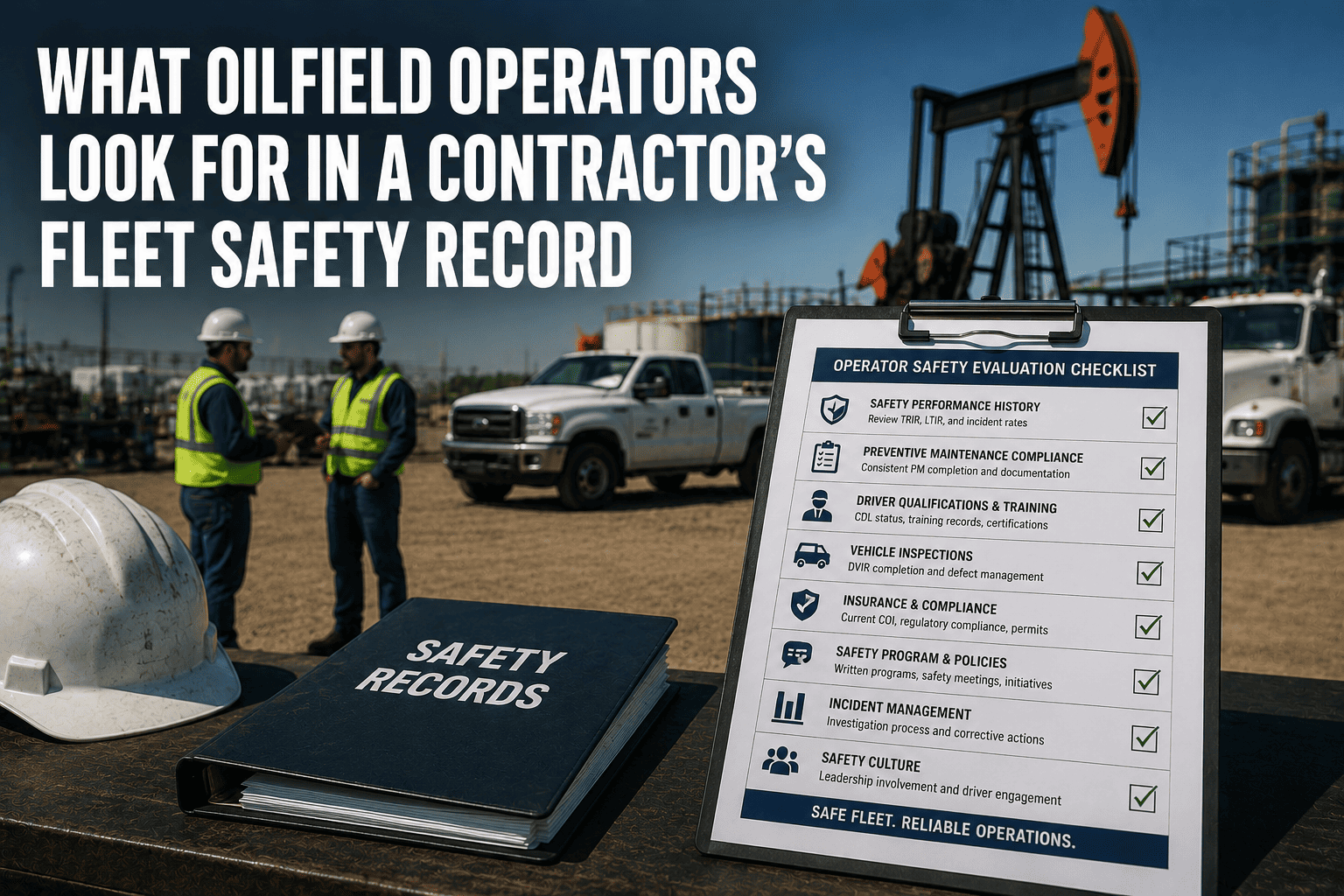
Complete digital records for all safety activities — inspections, training, incidents, corrective actions — searchable and instantly exportable. Regulators access required documentation in minutes instead of days of manual file compilation.
Why FleetRabbit: Selection Criteria for HSE Excellence
Oilfield-Specific Inspection Templates
Pre-built DVIR checklists for wireline trucks, frac equipment, vacuum trucks, and wellsite service vehicles. Competitors offered generic templates requiring extensive customization. FleetRabbit deployed inspection workflows in 48 hours versus 4–6 weeks with alternatives.
Offline Mobile Capability
With 72% of well sites having intermittent cellular coverage, offline inspection capability was non-negotiable. FleetRabbit's mobile app operates fully offline; data syncs automatically when connectivity restored. Competing platforms required constant connection, rendering them unusable at remote locations.
Integrated Compliance Automation
Single platform managing inspections, driver qualifications, HOS compliance, incident reporting, and safety analytics. Competitors required separate point solutions creating data silos. FleetRabbit's unified approach eliminated integration complexity and ensured data consistency.
Proven Oil & Gas Safety Results
Six reference customers in Permian and Eagle Ford operations with documented incident reduction of 75–95% within first 12 months. All achieved perfect audit scores. Competing platforms lacked oilfield-specific case studies demonstrating measurable safety improvements.
Implementation Journey: 16-Week Safety Transformation
Foundation & Digital Inspection Deployment
- Complete vehicle registry: 142 vehicles with equipment type, inspection requirements, compliance schedules
- Driver profiles configured: 187 drivers with CDL info, endorsements, medical cards, training certifications
- Custom DVIR templates built for each vehicle class: vacuum trucks, wireline units, service trucks, support vehicles
- Ruggedized mobile devices deployed to all drivers; offline sync verified at all 38 well site locations
- Training conducted: digital inspection completion, defect classification, photo evidence capture requirements
Driver Qualification & HOS Automation
- All driver qualification documents scanned and uploaded: licenses, medical certificates, HAZMAT endorsements, safety training records
- Expiration tracking configured with automated alerts 90/60/30 days before renewal deadlines
- ELD integration completed with existing Geotab devices — real-time HOS data flowing to FleetRabbit
- Dispatch blocking rules activated: system prevents vehicle assignment to drivers with expired credentials or insufficient HOS
- Driver notification workflows configured: SMS/email alerts when documents approaching expiration
Behavior Analytics & Safety Coaching
- Telematics data integration activated: harsh braking, rapid acceleration, speeding, cornering events flowing to behavior scoring engine
- Driver baselines established over 3-week period accounting for individual routes and operating conditions
- Safety coaching workflows configured: high-risk behaviors trigger supervisor notifications and coaching sessions
- Driver recognition program launched: monthly safe driver awards based on behavior scores and incident-free performance
- Executive safety dashboard deployed: real-time visibility into fleet-wide safety metrics and leading indicators
Incident Reporting & Continuous Improvement
- Mobile incident reporting activated: drivers capture near-miss events, property damage, injuries via smartphone app
- Root cause analysis workflows established: safety team investigates incidents, documents findings, implements corrective actions
- Trend analytics configured: system identifies patterns in incident types, locations, times, vehicle types, drivers
- Preventive action protocols deployed: emerging risks trigger proactive interventions before incidents occur
- Audit documentation system finalized: all safety records organized and instantly accessible for regulatory inspections
Quantified Safety Outcomes: 18-Month Performance Analysis
Additional Safety Performance Improvements
Real-World Safety Impact: Near-Miss Prevention Success
Vacuum Truck #47 — Digital Inspection Prevents Catastrophic Brake Failure
Pre-Trip Inspection Captures Critical Defect
Driver completed digital pre-trip inspection on Vacuum Truck #47 before departure to well site. Mobile checklist prompted brake system inspection — driver noted "soft brake pedal feel" and classified as yellow-priority finding. Photo evidence captured showing brake fluid reservoir at minimum level. Inspection auto-routed to maintenance supervisor with GPS location and vehicle ID.
Automated Work Order & Vehicle Hold
FleetRabbit automatically generated high-priority maintenance work order based on brake defect classification. System placed Truck #47 in "out of service" status, blocking any dispatch assignments until repair completed. Maintenance supervisor assigned technician to investigate. Parts system confirmed brake components in stock at nearest depot.
Inspection Reveals Imminent Failure
Technician diagnosed brake master cylinder seal failure causing fluid loss. Assessment: complete brake system failure likely within 6–12 hours of operation. Replacement master cylinder installed, full brake system flush performed, safety inspection verified proper operation. Truck returned to service after 4-hour repair. Cost: $840 parts and labor.
Catastrophic Incident Avoided Through Digital Workflow
Without digital inspection system and automated defect escalation, driver would have operated Truck #47 with degrading brakes. Historical pattern: drivers with paper inspections often noted brake issues but continued operating "to finish the job." Brake failure at remote well site traveling 55 mph on gravel access road would have resulted in: loss of vehicle control, rollover risk, potential driver injury/fatality, environmental contamination from vacuum tank rupture, OSHA recordable incident, regulatory investigation, $450K+ total incident cost. FleetRabbit's digital inspection prevented catastrophic outcome through $840 proactive maintenance.
This operator's zero-incident achievement demonstrates that proactive safety management through digital automation delivers measurable results. FleetRabbit's integrated platform transforms safety from reactive response to predictive prevention. Start your free trial — deploy safety excellence →
Overcoming Implementation Challenges
Challenge: Driver Resistance to Digital Inspections
Issue: Initial pushback from drivers preferring familiar paper checklists. Week 1–2 completion rate only 76%, with complaints about "too much technology."
Solution: Leadership mandate requiring digital inspection before vehicle operation — no inspection completion, no dispatch assignment. Simplified mobile interface based on driver feedback. Highlighted time savings (3 minutes digital vs. 8 minutes paper). Celebrated early adopters. Completion rate improved to 96% by Week 4.
Challenge: Backlog of Qualification Document Scanning
Issue: Uploading historical driver qualification files for 187 drivers (licenses, medicals, endorsements, training certs) initially estimated 120+ hours of admin work.
Solution: FleetRabbit deployment team provided document scanning service as part of implementation. Team completed bulk upload in 3 days versus internal 3-week estimate. Quality control process verified all documents scanned correctly with proper expiration tracking activated.
Challenge: Alert Fatigue from Excessive Notifications
Issue: Weeks 5–6 generated overwhelming volume of safety alerts (40–60 daily) as behavior analytics calibrated to fleet conditions. Safety managers struggled to prioritize genuine risks.
Solution: Alert thresholds refined based on actual fleet operating environment and incident history. Critical alerts (imminent safety risks) trigger immediate SMS; warning-level alerts batch into daily digest. Behavior scoring recalibrated accounting for oilfield terrain and operating conditions. Alert volume reduced to 8–12 actionable notifications daily.
Challenge: Integrating Safety Data Across Departments
Issue: Operations, safety, HR, and compliance teams each maintaining separate spreadsheets for driver information, creating version control problems and duplicate entry work.
Solution: FleetRabbit became single source of truth for all driver safety data. API integration with HR system for new hire onboarding. Automated reporting distributed to stakeholders eliminating manual compilation. Unified platform reduced administrative overhead by 14 hours weekly.
Leadership Perspective: Cultural Transformation Beyond Technology
"Achieving zero incidents over 18 months wasn't just about implementing software — it required fundamental cultural change. FleetRabbit provided the technology foundation, but our people made it successful by embracing proactive safety management. What impressed me most was how the platform transformed driver behavior. When drivers see their safety scores, understand how their actions impact outcomes, and receive recognition for safe performance — they become active participants in safety excellence rather than passive recipients of safety rules. The digital inspection process ensures our vehicles are mechanically sound before operation. The behavior analytics identify and correct high-risk driving before incidents occur. The qualification tracking prevents compliance violations. Together, these capabilities created a comprehensive safety system that simply wasn't possible with manual processes. The $780K in cost savings is significant, but the real value is sending our people home safely every day. That's what zero incidents means."VP of HSE & Regulatory Compliance, Permian Basin Operator
Executive Safety Dashboard: Leading Indicators That Matter
Strategic Recommendations for Oil & Gas Operators
Prioritize Digital Inspection Deployment First
Pre-trip inspections deliver immediate safety value and high adoption rates when implemented correctly. Start here to build organizational confidence, demonstrate quick wins, and establish foundation for broader safety platform expansion. Inspection compliance improvements materialize within first 2–3 weeks.
Mandate Leadership Engagement and Visibility
Safety culture transformation requires active executive sponsorship. Leadership must communicate safety platform expectations, celebrate successes, and hold managers accountable for adoption. When drivers see executives monitoring safety dashboards and recognizing safe performance, behavioral change accelerates significantly.
Invest in Driver Training and Change Management
Technology alone doesn't change behavior. Allocate time for comprehensive driver training on mobile app usage, explaining "why" behind digital inspections, and demonstrating how safety data improves their work environment. Drivers who understand the value become platform advocates rather than resisters.
Establish Clear Consequences for Non-Compliance
Digital inspection completion and safe driving behavior must be non-negotiable requirements, not optional suggestions. Link inspection compliance and safety scores to performance evaluations, bonus eligibility, and dispatch priority. Consistency in enforcement drives consistent compliance.
Financial Summary: Safety Investment ROI Analysis
Implementation Investment (Year 1)
Annual Safety Cost Reduction (Ongoing)
Based on $780K annual savings vs. $175K Year 1 investment. Payback achieved by end of Month 3.
Year 2+ Net Benefit: $721K annually (ongoing platform license $59K versus sustained annual savings $780K)
Frequently Asked Questions
How quickly can we expect to see safety improvements after deploying FleetRabbit?
Most clients observe measurable improvements within 4–6 weeks. Digital inspection compliance increases immediately upon deployment. Behavior analytics-driven coaching typically shows results within 6–8 weeks as drivers adapt to monitoring and feedback.
Does FleetRabbit work at remote oilfield locations with poor cellular coverage?
Yes. The mobile app operates fully offline — drivers complete inspections and report incidents without connectivity. All data automatically syncs to the central platform when cellular or WiFi signal is restored, ensuring no data loss.
Can FleetRabbit integrate with our existing ELD and telematics systems?
Absolutely. FleetRabbit integrates with major telematics providers including Geotab, Samsara, and Verizon Connect via API. Integration pulls HOS data, location, and driver behavior metrics without requiring hardware replacement.
How does FleetRabbit prevent driver qualification compliance violations?
The platform tracks all certifications and credentials with automated renewal alerts sent 90/60/30 days before expiration. System automatically blocks vehicle assignments to drivers with expired licenses, medical cards, or HAZMAT endorsements, preventing violations before they occur.
What kind of audit documentation does FleetRabbit provide for regulatory inspections?
Complete digital records for all safety activities — inspections, incidents, training, corrective actions — instantly searchable and exportable. During audits, regulators access required documentation in minutes instead of hours of manual file compilation.
Can we customize inspection checklists for our specific equipment types?
Yes. FleetRabbit includes pre-built templates for common oilfield equipment, and allows full customization to match your specific vehicle configurations, equipment types, and internal safety requirements. Templates deploy across fleet instantly via mobile app updates.