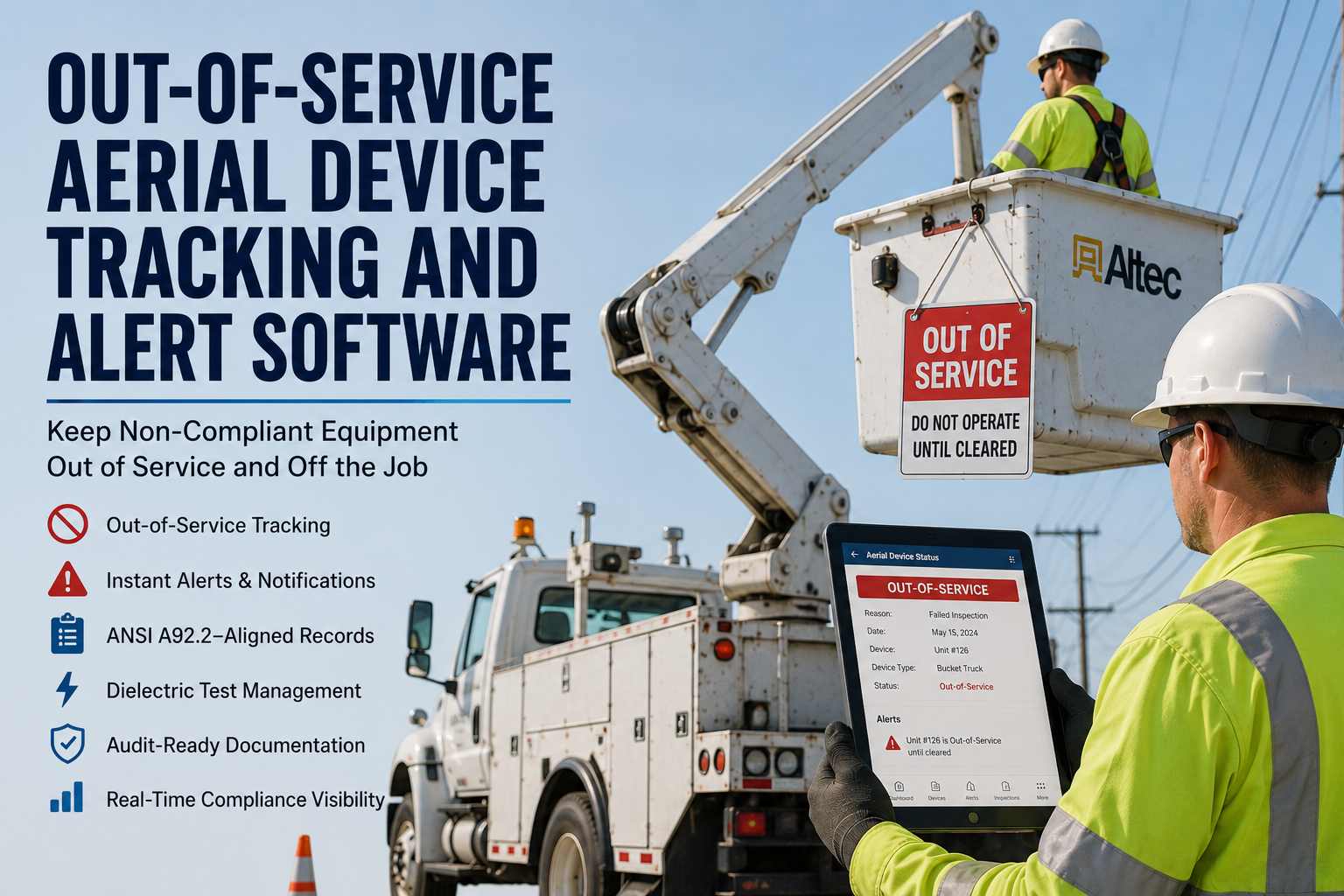
Electric utilities, high-voltage transmission contractors, and municipal power authorities face severe legal liability and life-safety hazards when defective aerial equipment remains in operation: deploying bucket trucks and digger derricks with cracked fiberglass booms, weeping hydraulic holding valves, or lapsed annual dielectric proof tests directly into high-voltage environments. When out-of-service (OOS) red tags, mechanic shop work orders, dielectric test expiration dates, and daily lineworker DVIR fail flags are tracked through physical paper tags or depot whiteboards, uncertified units slip through dispatch, exposing utility organizations to catastrophic flashovers, aerial drops, and immediate OSHA 1910.269 willful-violation penalties. Fleet Rabbit delivers specialized out-of-service aerial device tracking and alert software, combining automated dispatch lockouts, ANSI/SAIA A92.2 defect-triggered red-tagging, auxiliary PTO-hour PM scheduling, and offline-first mobile sync into one unified utility platform. Eliminate dangerous dispatch blindspots, enforce immutable OOS clearance workflows, and maintain audit-ready safety ledgers offline across remote transmission corridors with zero cellular coverage. Book a Demo to see Fleet Rabbit out-of-service aerial device tracking in action.
SECTION 1: RADIAL APEX COMMAND HEROOut-of-Service Aerial Device Tracking & Alert Software
Enforce digital red-tag lockouts on failed ANSI A92.2 inspections, automate instant alerts on overdue dielectric certifications, and block unauthorized dispatches across utility bucket truck fleets.
Why Physical Red Tags Fail Aerial Fleet Safety Governance
Manual cardboard tags and whiteboard markers fail in dynamic utility yards, allowing compromised bucket trucks with severe electrical or hydraulic faults to be driven out to live-line job sites.
Removed or Overlooked Physical Red Tags
Paper tags hanging from steering wheels or boom controls get torn off, weathered by rain, or ignored during emergency storm restoration dispatches, sending lineworkers aloft in compromised aerial devices.
Lapsed Annual Dielectric & Load Test Deadlines
When third-party 12-month dielectric high-pot tests or ANSI proof-load ratings expire, units remain in active yard pools unnoticed, exposing crews to uninsulated flashovers during distribution line repairs.
Unresolved Driver DVIR Defect Slippage
Critical failure flags logged on evening paper DVIRs—such as weeping outrigger holding valves or chattering boom rotation gears—often fail to reach dispatchers before morning shift assignments.
Remote Transmission Corridor Dead Zones
Emergency line repairs often dispatch from satellite staging yards with zero cellular reception. Cloud-only apps crash, leaving dispatchers blind to whether an assigned bucket truck has an open safety lock.
How Fleet Rabbit Enforces Out-of-Service Governance
Fleet Rabbit links digital inspection flags, credential-gated return-to-service protocols, automated dispatcher alerts, and offline mobile sync into one unified platform. Request a 1-on-1 walkthrough.
Automated Gated Dispatch Lockouts
Instantly locks compromised units on central dispatch boards upon failed inspection checks, open critical work orders, or lapsed statutory certifications.
Multi-Channel Out-of-Service Alerts
Instantly routes SMS, email, and dashboard notifications to safety directors, shop foremen, and operations leads the second an aerial device is flagged OOS.
Credential-Gated Return-to-Service
Only verified, qualified mechanics or safety supervisors with active credentials can sign off completed work orders and electronically release the OOS lockout.
Full Offline Mobile Mode
Lineworkers and mechanics flag safety defects, log out-of-service locks, and attach repair verification photos in remote easements with zero cellular signal.
Tamper-Evident Digital OOS Ledger
Maintains an immutable historical record detailing who placed the device out of service, the exact defect identified, parts replaced, and the qualified inspector sign-off.
Statutory Expiration Auto-Lockouts
Automatically red-tags aerial devices when annual dielectric test certificates or ANSI A92.2 structural proof-load ratings reach expiration without verified renewal.
Safety, OSHA & Utility Standards
Fleet Rabbit’s out-of-service tracking workflows are structured to meet statutory utility safety standards across major operating jurisdictions.
Full alignment with ANSI/SAIA A92.2 Section 6 (Inspection, Maintenance, and Testing), OSHA 1910.269(p) (Mechanical Equipment Out-of-Service Protocols), OSHA 1926.959, and DOT FMCSA Part 396.11.
Meets CSA C225 vehicle-mounted aerial device out-of-service criteria, provincial Occupational Health and Safety power utility mandates, and National Safety Code (NSC) Standard 13 rules.
Aligns elevated work platform defect quarantine procedures with LOLER 1998 Regulation 9, PUWER 1998 work equipment safety directives, and high-voltage network safety mandates.
Supports AS/NZS 1418.10 elevating work platform defect lockout rules, Safe Work Australia electrical safety codes, and National Heavy Vehicle Regulator (NHVR) compliance.
Aerial Device Out-of-Service Software Comparison
A capability comparison focused on high-voltage aerial device safety governance, automated dispatch lockouts, and offline utility compliance. Competitor data sourced from public records as of 2026. Request a technical comparison.
| Capability | Fleet Rabbit | Fleetio | Samsara | Generic Tools |
|---|---|---|---|---|
| Pricing (per asset) | $5/month | $4–10/month | $27–60/month | Variable ($$$) |
| Automated Dispatch Lockout on Defect | Native & automated | Manual review needed | Manual review needed | Not available |
| Credential-Gated Return-to-Service | Native & automated | Not available | Not available | Manual override |
| Dielectric Expiration Auto-Red-Tagging | Native & automated | Not available | Not available | Manual spreadsheets |
| Full Offline Mobile Sync | Full offline mode | Limited | Limited | Limited |
| Free Trial | 14 days, up to 3 assets | 14 days | Demo only | Demo only |
| Contract Terms | Monthly or annual | Annual billing discount | 3-year minimum | Annual / Multi-year |
5-Step Implementation Roadmap
Fleet Rabbit provides an accelerated deployment program engineered for electric utilities, establishing digital out-of-service controls and dispatch gating in under 2 weeks.
Fleet Roster & Certification Baseline Import
Import aerial device serials, insulated boom categories, active dielectric test expiration dates, and current maintenance status.
Defect Severity & Auto-Lockout Threshold Setup
Configure critical failure triggers that automatically red-tag units (holding valve leaks, fiberglass gouges, failed emergency lower controls).
Return-to-Service Clearance Hierarchy
Establish credential-gated clearance roles: only authorized Qualified Inspectors or safety supervisors can remove digital OOS flags.
Crew & Dispatch Mobile Rollout
Equip lineworkers, shop mechanics, and dispatchers with the intuitive offline-first mobile inspection and dispatch application.
Live Governance Board Go-Live
Activate real-time fleet out-of-service dashboards, automated SMS/email alert distribution, and 1-click OSHA audit ledgers.
2-Week Deployment Plan & Results
Modernize out-of-service tracking and dispatch safety governance with zero disruption to daily line construction schedules. Request an onboarding plan.
Week 1: Setup & Configuration
- Digitize paper red-tag forms, out-of-service ledgers, and mechanic release sign-off logs
- Configure automated dispatch lockout rules for failed daily DVIRs and expired dielectric dates
- Assign clearance permissions for lineworkers, shop mechanics, and fleet safety directors
Week 2: Field Pilot & Go-Live
- Conduct quick 15-minute crew training on completing offline defect tagging and work order logging
- Validate automated dispatch lockouts when drivers submit simulated critical hydraulic defects
- Activate central live readiness board and exportable OSHA compliance maintenance ledgers
Real-World Operational Results
Proven operational outcomes reported by electric power contractors and regional utility infrastructure groups. Request the full utility case study.
Dispatch Leakage Elimination — 58-Unit Bucket Truck Fleet
An electrical contractor experienced near-miss safety incidents when bucket trucks with known hydraulic holding valve leaks were mistakenly dispatched from remote yards during storm restoration calls. Fleet Rabbit implemented automated dispatch lockouts and digital red-tagging, eliminating 100% of unauthorized dispatches and ensuring zero uncertified units reached active job sites.
Faster Defect Triage — 34-Unit Utility Fleet
An electric cooperative suffered from delayed maintenance turnaround when paper out-of-service tags sat on truck dashboards for days without notifying shop mechanics. Fleet Rabbit converted failed pre-trip items into instant automated SMS alerts and prioritized work orders, cutting out-of-service turnaround time from 72 hours to under 12 hours.
In storm work, mistakes happen when people rely on paper tags hanging from a steering wheel. Someone takes the tag off, and a lineworker drives an aerial device with a compromised fiberglass boom out to energized lines. Fleet Rabbit took human error out of the equation: if a bucket truck fails an inspection or its dielectric test is expired, dispatch cannot assign it. It's that simple.
Frequently Asked Questions
Upgrade Your Out-of-Service Aerial Device Governance in Less Than 2 Weeks
Automate digital red-tag lockouts, prevent unauthorized dispatch of defective bucket trucks, and ensure audit-ready ANSI compliance at $5/asset/month with a 14-day free trial.