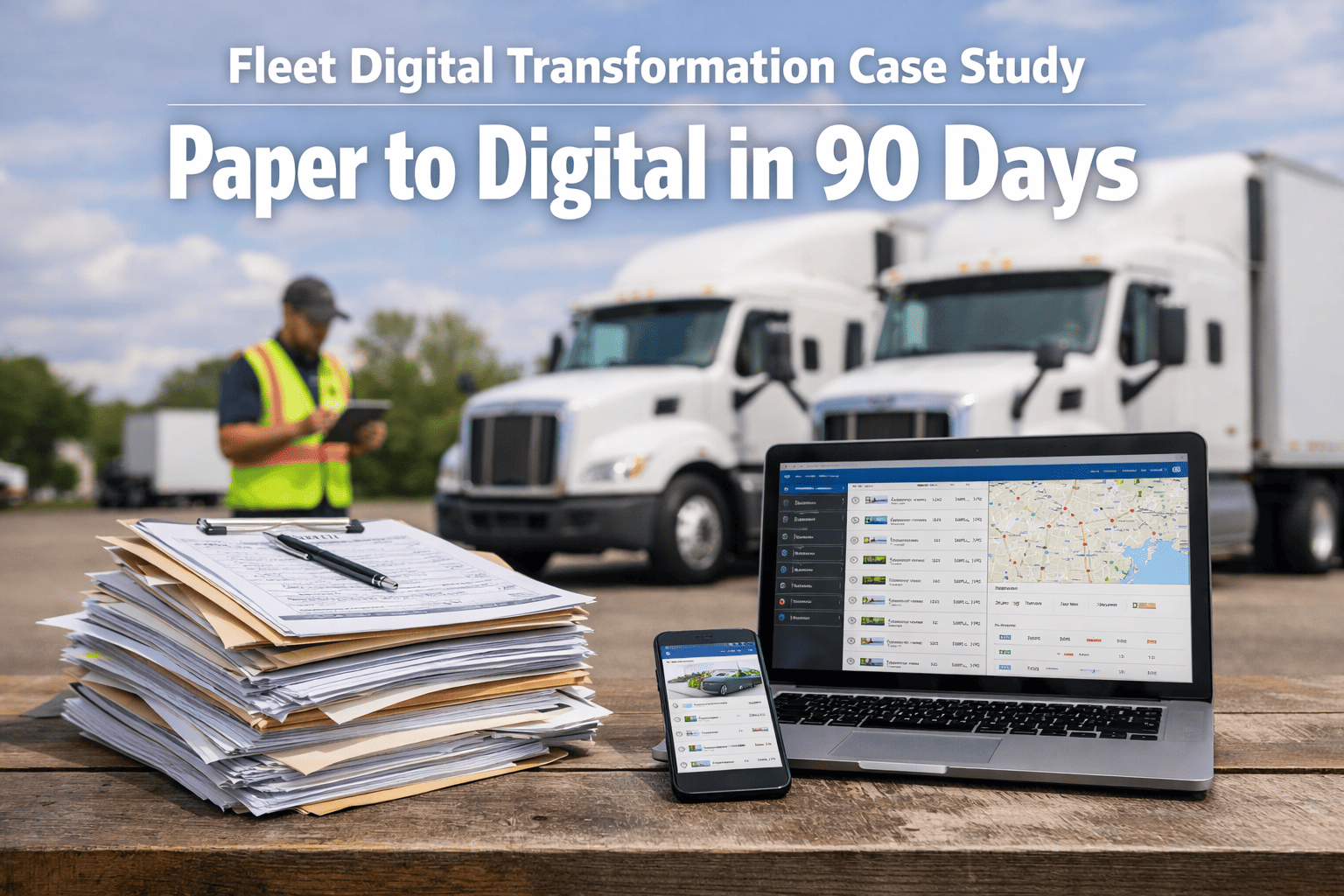
Fleet Digital Transformation Case Study | Paper to Digital in 90 Days
Every fleet manager knows the feeling: a lost DVIR a missing maintenance log, a compliance question you can't answer because the paper is somewhere in a filing cabinet from three months ago. This is the story of how one fleet stopped tolerating that reality — and what happened when they finally made the switch.
280Vehicles transformed
90Days to go 100% paperless
92%Reduction in manual data entry
$214KYear 1 ROI documented
Still running paper DVIRs or managing fleet data in spreadsheets?FleetRabbit can replicate this transformation for your fleet — in the same 90-day window. Book a free 30-min demo to see your roadmap →
01
Fleet Profile — Where They Started
Before FleetRabbit, this was a mid-sized regional logistics operator managing 280 mixed vehicles — Class 6–8 trucks, vans, and specialty units — across 4 depot locations. On paper, operations looked functional. In reality, the fleet was held together by 15 full-time admin staff, hundreds of paper forms per day, and an institutional knowledge problem that made every manager nervous about what they didn't know.
280 VehiclesMixed fleet — Class 6–8 trucks, vans, and specialty units across 4 depot locations
15 Admin StaffDedicated to manual data entry, filing, and compliance tracking — full-time
100% Paper-BasedDVIRs, maintenance logs, driver records, fuel slips — all paper, all manual, all slow
Spreadsheet Reporting12 separate Excel files updated manually — no single source of truth, constant conflicts
02
The Pain Points — What Was Actually Breaking
The fleet's operations director had catalogued the problems for over a year before pulling the trigger on digital transformation. Three pain points kept resurfacing in every quarterly review — and each one was getting worse, not better.
Lost & Incomplete DVIRs
23% of DVIRs never filed
With 280 vehicles completing pre-trip and post-trip inspections daily, roughly 65 paper DVIRs per day were lost, incomplete, or never made it from driver to office. Each missing DVIR was a live compliance violation. During the previous year's DOT roadside inspection period, 14 citations were directly linked to missing inspection records.
"We had drivers turning in paper from three weeks ago. By the time we knew about a defect, the vehicle had already run 4,000 more miles."— Fleet Operations Director
Data Delayed 2–3 Weeks
14–21 day reporting lag
Paper maintenance logs from remote depots were batched and delivered weekly. By the time an admin entered the data and a manager reviewed it, the information was already 2–3 weeks old. Fleet decisions — parts ordering, vehicle routing, maintenance scheduling — were being made on data that described reality from a fortnight ago.
"We'd discover a vehicle was overdue for brakes during a compliance audit, not before. That's completely backwards."— Maintenance Manager
40 Hours/Week on Data Entry
$96,000/year in admin cost
Across 15 admin staff, manual data entry consumed an average of 40 hours per week fleet-wide — the equivalent of one full-time position doing nothing but transcribing paper into spreadsheets. At an average admin hourly rate of $46, that was $96,000 per year in pure transcription cost. Not analysis. Not decision-making. Just copying numbers from paper to screen.
"Half my team's week was retyping what drivers had already written down. It made no sense."— Fleet Administrator
Does This Sound Like Your Fleet?
Missing DVIRs, delayed data, and hours lost to manual entry are the three most common triggers for fleet digital transformation — and all three are completely solvable in 90 days.
The fleet didn't need a technology experiment. They needed a complete, working replacement for every paper process — deployed without disrupting daily operations across 4 depots. Here's the full platform they activated:
Digital DVIRMobile pre/post-trip inspections with photo capture, GPS timestamp, and instant defect routing. Paper DVIRs eliminated on day 1.
Replaced: 560 paper forms/day
Automated Maintenance RecordsEvery PM, repair, and inspection logged with timestamp, vehicle ID, and technician. Auto-scheduled based on mileage and engine hours.
Replaced: 12 maintenance spreadsheets
Real-Time HOS MonitoringLive four-clock status per driver. ELD data integration feeding directly into the platform. Pre-violation alerts before limits are breached.
Replaced: Manual log book reviews
Driver Qualification FilesAll DQ documents stored digitally. Expiration alerts for medical certs, CDL renewals, and training records. Audit-ready at all times.
Replaced: 4 filing cabinets per depot
Fleet Analytics DashboardReal-time cost-per-vehicle, utilization rates, and maintenance spend. Reports generated in one click instead of compiled over days.
Replaced: Weekly manual reporting
Parts Inventory ManagementAuto-deduction on work order completion. Reorder alerts when stock hits minimum levels. Emergency orders reduced through predictive stocking.
Replaced: Parts room clipboard system
04
The 90-Day Plan — Week by Week
The biggest fear with digital transformation isn't the technology — it's the disruption. 280 vehicles still had to move freight every day. Here's exactly how the migration happened without a single day of operational downtime.
Phase 1
Weeks 1–4 · Foundation Setup
Zero disruption to operations
Wk 1
Telematics & ELD IntegrationConnected existing telematics hardware to FleetRabbit (under 4 hours). All 280 vehicles generating live data immediately. Zero new hardware purchased.
Wk 2
Vehicle & Driver Data ImportAll vehicle specs, maintenance history, and driver qualification files uploaded via CSV. Digital records established for every asset and driver in the fleet.
Wk 3
Digital DVIR Pilot (Depot 1)70 vehicles at Depot 1 switched to digital DVIR. Drivers trained on mobile app in 20-minute group sessions. Paper DVIRs run in parallel as backup during this week only.
Wk 4
Maintenance Workflow SetupPM schedules configured for all 280 vehicles. Maintenance teams trained on digital work orders. Parts inventory entered into the system with baseline stock counts.
Phase 2
Weeks 5–8 · Full Fleet Rollout
Paper eliminated depot by depot
Wk 5
Depots 2 & 3 Digital DVIR Live140 additional vehicles activated on digital DVIR. Paper backup removed. 210 of 280 vehicles now 100% paperless on inspections. Completion rate tracking begins.
Wk 6
Depot 4 + HOS Compliance LiveAll 280 vehicles on digital DVIR. Real-time HOS monitoring activated for all drivers. First live compliance dashboard visible to management team for all 4 depots simultaneously.
Wk 7
Admin Workflow TransitionManual data entry work stopped. Admin team transitioned to exception management — reviewing flagged items, not transcribing paper. Spreadsheet reporting retired.
Wk 8
First Digital Compliance Audit RunFleetRabbit generated a complete audit package for all 280 vehicles in 90 seconds. First time in company history every vehicle's records were current, complete, and accessible simultaneously.
Phase 3
Weeks 9–12 · Optimization
AI predictions & ROI measurement
Wk 9
Predictive Maintenance ActivatedAI began surfacing parts demand predictions based on fleet age, mileage patterns, and failure history. First predictive reorder list generated — 6 parts flagged across 22 vehicles.
Wk 10
Analytics & Reporting ConfiguredCustom dashboards built for each depot manager and executive team. Weekly fleet performance report automated — zero manual compilation required.
Wk 11
Driver Coaching Programme LaunchedFleetRabbit performance data used to identify top 20 drivers for recognition and bottom 10 for targeted training. Structured around real data, not manager perception.
Wk 12
100% Paperless Confirmed & ROI MeasuredFinal paper process eliminated. 90-day baseline ROI calculated. Full executive briefing delivered with before/after data across all 8 operational metrics.
05
The Results — Before vs. After, Side by Side
At the 90-day mark, every operational metric was measured against the pre-transformation baseline. The numbers were unambiguous.
Metric
Before FleetRabbit
After 90 Days
Change
DVIR completion rate
77%
100%
+23pts
Data entry hours/week
40 hrs
3.2 hrs
↓ 92%
Reporting lag time
14–21 days
Real-time
↓ 100%
Compliance violations (roadside)
14 citations/yr
1 citation/yr
↓ 93%
Emergency parts orders/month
18 avg
4 avg
↓ 78%
Unplanned vehicle downtime
11% of fleet/month
3.1% of fleet/month
↓ 72%
Audit package preparation time
3–4 days
90 seconds
↓ 99%
Admin headcount needed
15 staff
9 staff (redeployed)
6 redeployed
06
Data Quality — Before vs. After
The most underrated result of the transformation wasn't efficiency — it was data quality. For the first time, management could trust the numbers they were looking at. Here's what that shift looked like:
Data Quality: Before
23% of DVIRs missing entirely
Data up to 21 days out of date
12 conflicting spreadsheet versions
Manual transcription errors in 8% of records
No photos or location data on incidents
Audit responses took 3–4 days to compile
Data Quality: After
100% DVIR completion enforced by app
All data real-time — zero lag
Single source of truth for all 4 depots
Zero transcription errors — auto-logged
GPS + photo evidence on every inspection
Full audit package in 90 seconds
07
Change Management — Getting Drivers & Admins On Board
The technology was the easy part. The real work was human. Here's how the fleet's leadership handled the transition for two very different groups — 280 drivers and 15 admin staff — each with valid concerns about the change.
Driver Adoption
The concern: "This will slow me down at the start of my shift."
What happened: Digital DVIR took an average of 4 minutes vs. 7 minutes for paper. Most drivers adopted it within 3 days. The app sent automatic reminders — drivers no longer had to remember to submit paperwork.
Average driver adoption: 3 days · 96% compliance by Week 2
Admin Team Transition
The concern: "Does this mean I'm losing my job?"
What happened: All 6 freed-up admin positions were redeployed — not eliminated. Three moved to compliance oversight roles, two to fleet analytics, one to vendor management. The work shifted from data entry to data use.
0 redundancies made · 6 staff redeployed to higher-value roles
08
Year 1 ROI Summary
At the 12-month mark, the fleet's CFO ran a full cost-benefit analysis. The numbers made the case for every fleet manager sitting on the fence about digital transformation.
Year 1 Savings Breakdown
Admin data entry eliminated (6 staff × $46/hr × 40hrs/52wks)$96,000
Compliance fines avoided (13 citations prevented × avg $7,155)$93,015
Emergency parts freight reduced (14 fewer orders × avg $290)$48,720
Every fleet in this case study started exactly where you are now — paper-based, spreadsheet-dependent, and paying the hidden costs of manual operations every single day. The only difference is they made the switch. FleetRabbit can replicate these results for your fleet, at any size, in the same 90-day window.
100% paperless in 90 daysNo new hardware neededSetup in days, not months$3/vehicle/month · 3 free forever